Within Tuvalu
When Religious Freedom Challenged Island Unity
A ban on minority evangelism exposed a deep conflict between constitutional rights, customary authority and island unity.
On this page
- How the Tuvalu Brethren Church dispute began
- Harassment, court action and competing claims of harm
- Moral panic, minority rights and the limits of the cult label
Page outline Jump by section
Introduction
The Nanumaga church dispute is the clearest documented case in Tuvalu where fears about social division collided with constitutional guarantees of religious freedom. Beginning in the early 2000s, a conflict between the newly established Tuvalu Brethren Church and the traditional authorities of Nanumaga developed into a landmark legal battle over whether a small island community could restrict religious evangelism in order to preserve peace and customary life. Rather than representing a classic case of mass hysteria, the dispute illustrates how genuine concerns about community cohesion, identity and authority can generate intense social pressure against a religious minority. It remains one of the most significant constitutional cases in Tuvalu’s modern history because it tested the limits of customary power against individual rights.[Refworld]refworld.orgU.S. Department of State Annual Report on International Religious Freedom for 2004 - Tuvalu | RefworldSeptember 15, 2004…

How the Tuvalu Brethren Church dispute began
Nanumaga is one of Tuvalu’s outer islands, where community life has traditionally revolved around the established Church of Tuvalu and the authority of the Falekaupule, the assembly of elders. In such small communities, religious participation is closely connected with family relationships, local government and customary obligations. A new denomination therefore represented more than theological diversity: many island leaders viewed it as a potential challenge to social unity.[Refworld]refworld.orgU.S. Department of State Annual Report on International Religious Freedom for 2006 - Tuvalu | Refworld…
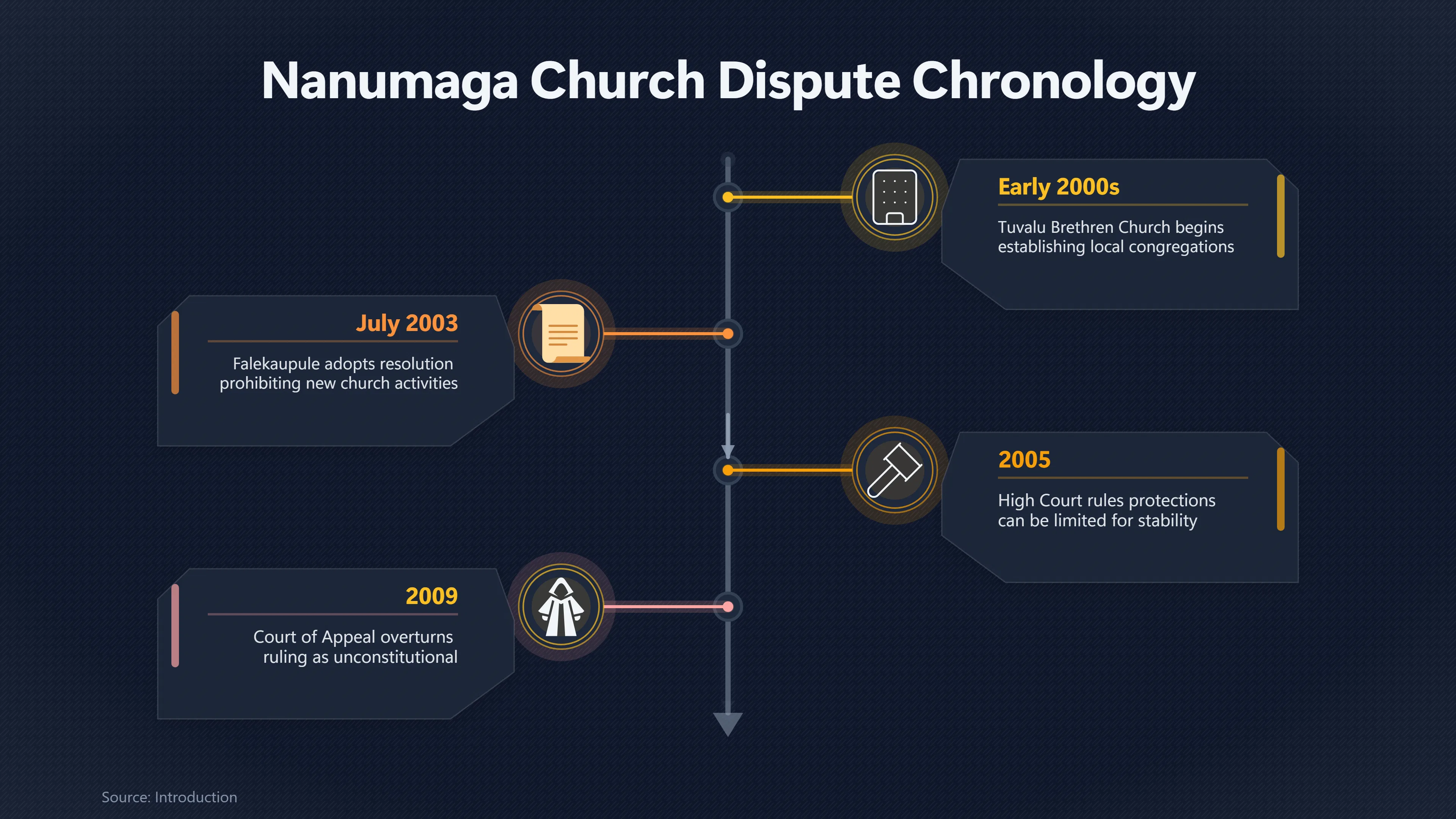
The immediate dispute began after members of the Tuvalu Brethren Church attempted to establish a congregation on Nanumaga. The church had already been legally registered in Tuvalu and sought to expand through Bible classes and evangelism. As interest grew, the Falekaupule concluded that the movement was creating conflict within the community. In July 2003 it adopted a resolution that effectively prohibited the Brethren Church from seeking converts or conducting its activities on the island.[Wikipedia]WikipediaCourt of Appeal of TuvaluCourt of Appeal of Tuvalu
For supporters of the ban, the issue was not simply religious doctrine. They argued that preserving harmony on a small island required limits on activities that divided families and neighbours. For Brethren members, however, the resolution denied fundamental constitutional rights to worship, express beliefs and associate freely. The disagreement therefore became a constitutional dispute rather than merely a disagreement between churches.[Wikipedia]WikipediaCourt of Appeal of TuvaluCourt of Appeal of Tuvalu
Harassment, court action and competing claims of harm
The legal dispute unfolded alongside reports of intimidation against Brethren members. Contemporary religious-freedom reports described allegations that converts experienced harassment, threats, stone-throwing and other forms of social pressure after leaving the dominant church. Some reportedly left Nanumaga altogether. Later disputes also involved dismissals of local government employees associated with the Brethren Church despite court intervention.[Refworld]refworld.orgU.S. Department of State Annual Report on International Religious Freedom for 2004 - Tuvalu | RefworldSeptember 15, 2004…
Traditional leaders presented a very different understanding of harm. They argued that unrestricted evangelism threatened the stability of a community whose institutions depended on broad religious consensus. In a settlement of only a few hundred people, even a small number of conversions could affect family loyalties, village decision-making and communal labour.
These competing claims reached the High Court in Teonea v. Kaupule. In 2005 the Chief Justice accepted evidence that the new church had generated serious tension on Nanumaga. He concluded that, in the circumstances then existing, the constitutional protections for religious freedom could be limited in order to protect Tuvaluan values and community stability.[Refworld]refworld.orgU.S. Department of State Annual Report on International Religious Freedom for 2006 - Tuvalu | Refworld…
The decision was controversial because it suggested that customary authorities could, in some circumstances, restrict constitutional freedoms where they believed island unity was genuinely at risk. Human-rights observers regarded the judgment as one of the most important tests of religious liberty in the Pacific.[Pacific Data Hub]pacificdata.orgphrld volume 32011 1Pacific Data HubPACIFIC HUMAN RIGHTSOctober 18, 2011…
Why the Court of Appeal changed the outcome
The dispute did not end with the High Court. The Brethren Church appealed, but Tuvalu had never convened its Court of Appeal since independence. The case therefore became historically significant for another reason: when the Court of Appeal finally sat in 2009, Teonea v. Pule o Kaupule of Nanumaga became one of its first major constitutional decisions.[Wikipedia]WikipediaCourt of Appeal of TuvaluCourt of Appeal of Tuvalu
By a majority of two judges to one, the Court of Appeal overturned the High Court ruling. The judges accepted that protecting social order and Tuvaluan culture was a legitimate constitutional objective, but they concluded that the blanket prohibition imposed by the Nanumaga resolution went further than was reasonably necessary. Less restrictive measures could have addressed local tensions without effectively preventing an entire religious group from practising and spreading its beliefs. The court therefore declared the 2003 resolution unconstitutional.[Wikipedia]WikipediaCourt of Appeal of TuvaluCourt of Appeal of Tuvalu
The judgment did not reject the importance of customary authority. Instead, it established that customary decisions of general application remain subject to constitutional protections. Traditional institutions retain significant authority, but they cannot exercise that authority in ways that impose disproportionate restrictions on protected rights.[Wikipedia]WikipediaCourt of Appeal of TuvaluCourt of Appeal of Tuvalu
Moral panic, minority rights and the limits of the cult label
The Nanumaga dispute is sometimes mentioned in discussions of religious conflict or alleged “cult” scares, but that description can be misleading.
There is no evidence that the Tuvalu Brethren Church was officially identified as a dangerous cult in the legal proceedings. Instead, opponents viewed it as a disruptive new denomination whose methods of evangelism threatened communal solidarity. The concern centred on social fragmentation rather than accusations of criminal conspiracy, supernatural danger or psychological manipulation that typically accompany genuine moral panics.[Wikipedia]WikipediaCourt of Appeal of TuvaluCourt of Appeal of Tuvalu
Equally, it would be inaccurate to dismiss local fears as irrational. On a very small island, where extended families, church membership and local government overlap, religious division can have consequences extending well beyond worship itself. The dispute therefore reflected a real tension between two legitimate public values:
- protecting individual freedom of religion;
- preserving community stability and customary governance.
The constitutional challenge lay in deciding how those values should be balanced without allowing either to eliminate the other. That balance—not the truth or falsity of religious beliefs—became the central legal issue.[Wikipedia]WikipediaCourt of Appeal of TuvaluCourt of Appeal of Tuvalu

Why the dispute remains important
The Nanumaga conflict remains one of Tuvalu’s defining constitutional cases because it clarified that freedom of religion cannot be overridden simply because a minority faith is unpopular or unsettling. At the same time, the judgments acknowledged that Tuvalu’s Constitution gives genuine weight to customary values and communal life, requiring courts to balance rights rather than treat them as absolute.[Wikipedia]WikipediaCourt of Appeal of TuvaluCourt of Appeal of Tuvalu
The case also demonstrated how disputes over religion can become amplified in very small societies. Conversion was interpreted not merely as a private spiritual decision but as a choice with implications for kinship, leadership and social cohesion. That explains why the conflict generated intense local reactions while remaining fundamentally different from classic episodes of mass hysteria or moral panic.
Within Tuvalu’s wider social history, the Nanumaga dispute stands as a carefully documented example of how constitutional rights, customary authority and fears about community fragmentation can collide. Its lasting significance lies less in theological disagreement than in establishing how a democratic society should protect both minority beliefs and the traditions of close-knit island communities.[wikipedia.org]WikipediaCourt of Appeal of TuvaluCourt of Appeal of Tuvalu


Endnotes
1.
Source: refworld.org
Link:https://www.refworld.org/reference/annualreport/usdos/2004/en/22521
Source snippet
U.S. Department of State Annual Report on International Religious Freedom for 2004 - Tuvalu | RefworldSeptember 15, 2004...
Published: September 15, 2004
2.
Source: refworld.org
Link:https://www.refworld.org/reference/annualreport/usdos/2006/en/37497
Source snippet
U.S. Department of State Annual Report on International Religious Freedom for 2006 - Tuvalu | Refworld...
3.
Source: Wikipedia
Title: Court of Appeal of Tuvalu
Link:https://en.wikipedia.org/wiki/Court_of_Appeal_of_Tuvalu
4.
Source: refworld.org
Link:https://www.refworld.org/reference/annualreport/usdos/2009/69919
Source snippet
2009 Report on International Religious Freedom - Tuvalu | Refworld...
5.
Source: Wikipedia
Title: High Court of Tuvalu
Link:https://en.wikipedia.org/wiki/High_Court_of_Tuvalu
6.
Source: refworld.org
Link:https://www.refworld.org/reference/annualreport/usdos/2012/en/87531
7.
Source: refworld.org
Link:https://www.refworld.org/reference/annualreport/usdos/2010/en/76731
8.
Source: refworld.org
Link:https://www.refworld.org/reference/annualreport/usdos/2010/en/71976
9.
Source: refworld.org
Link:https://www.refworld.org/reference/annualreport/usdos/2009/en/69919?prevPage=%2Fnode%2F69919
10.
Source: refworld.org
Link:https://www.refworld.org/reference/annualreport/usdos/2008/en/33934
11.
Source: refworld.org
Link:https://www.refworld.org/reference/annualreport/usdos/2007/en/40626
12.
Source: refworld.org
Link:https://www.refworld.org/reference/annualreport/usdos/2005/en/37612
13.
Source: youtube.com
Title: Church of Tuvalu
Link:https://www.youtube.com/watch?v=_vO_h6dAhWo
Source snippet
Climate change, faith and hope in Tuvalu...
14.
Source: pacificdata.org
Title: phrld volume 32011 1
Link:https://pacificdata.org/data/dataset/c80b1f96-2ec2-442f-9ff3-aa2d785300bd/resource/4f62b91a-6796-46b4-8abe-2d817747cb51/download/phrld_volume_32011_1.pdf
Source snippet
Pacific Data HubPACIFIC HUMAN RIGHTSOctober 18, 2011...
Published: October 18, 2011
15.
Source: cesnur.org
Link:https://www.cesnur.org/testi/irf2000/tuvalu.html
Additional References
16.
Source: researchgate.net
Title: (PDF) Is Legal Pluralism an Obstacle to Human Rights?
Link:https://www.researchgate.net/publication/242384804_Is_Legal_Pluralism_an_Obstacle_to_Human_Rights_Considerations_from_the_South_Pacific
Source snippet
Considerations from the South PacificDecember 1, 2013 — The second Tuvalu case is that of Teonea v Kaupule & Another [2005] TVHC 2 (Case...
Published: December 1, 2013
17.
Source: researchgate.net
Title: 303458905 BIBLIOGRAPHY OF TUVALU 2016
Link:https://www.researchgate.net/publication/303458905_BIBLIOGRAPHY_OF_TUVALU_2016
Source snippet
1991b Report of the Round Table Meeting for Tuvalu. [Suva:] UNDP. UNU-EHS 2016 Climate Change and Migration in the Pacific: Links, Attitu...
18.
Source: youtube.com
Title: Arrival at church, Tuvalu,
Link:https://www.youtube.com/watch?v=o5vD1tcNWfQ
Source snippet
Tuvalu's Bold Fight for Sovereignty: A [Sinking Nation]({{ 'sinking-nation/' | relative_url }})'s Revolutionary Strategy...
Published: June 4, 2023
19.
Source: researchgate.net
Link:https://www.researchgate.net/publication/356791416_JUDGES_AS_CULTURAL_OUTSIDERS_EXPLORING_THE_EXPATRIATE_MODEL_OF_JUDGING_IN_THE_PACIFIC
20.
Source: 9lib.co
Link:https://9lib.co/document/yngp599j-national-submitted-accordance-paragraph-council-resolution-general-assembly.html
21.
Source: vlex.co.uk
Link:https://vlex.co.uk/vid/sanatan-dharma-maha-sabha-807553509
22.
Source: courtsofnz.govt.nz
Title: tere moana purea v alan stanley perkins and adrienne rosemary perkins
Link:https://www.courtsofnz.govt.nz/cases/tere-moana-purea-v-alan-stanley-perkins-and-adrienne-rosemary-perkins
23.
Source: youtube.com
Title: Tuvalu’s Bold Fight for Sovereignty: A Sinking Nation’s Revolutionary Strategy
Link:https://www.youtube.com/watch?v=2Zfu5lyhmPI
24.
Source: nzlii.org
Link:https://www.nzlii.org/nz/journals/CanterLawRw/2013/4.pdf
25.
Source: youtube.com
Title: Climate change, faith and hope in Tuvalu
Link:https://www.youtube.com/watch?v=UXxX6FeBh2c
Source snippet
Prayercast Video: TUVALU...
Topic Tree