Within Dominica
What Made the Dread Act So Dangerous?
The 1974 Dread Act weakened ordinary safeguards by attaching severe police powers to suspected identity and association.
On this page
- Why the Government Passed the Act
- Powers of Arrest, Detention and Immunity
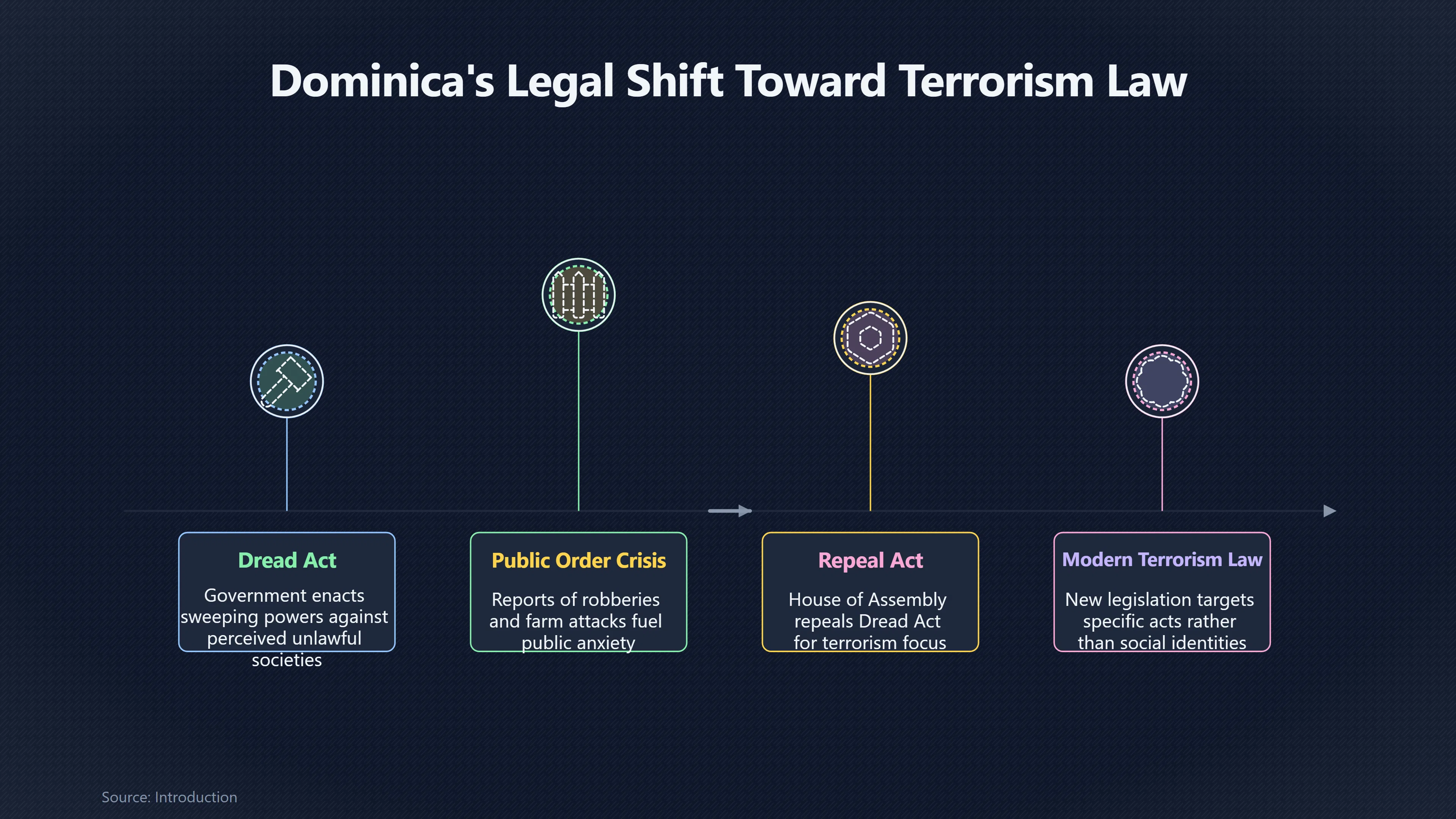
- Repeal and the Shift Toward Terrorism Law
Page outline Jump by section
Introduction
The 1974 Prohibited and Unlawful Societies and Associations Act, almost universally known as the Dread Act, was one of the most sweeping security laws ever enacted in Dominica. Introduced during a period of political tension and public anxiety about people labelled “Dreads”, it did far more than increase penalties for violent crime. Instead, it weakened ordinary legal safeguards by giving exceptional powers to police and, in some circumstances, private citizens, while making identity, appearance and alleged association central to law enforcement. Although ministers defended the Act as a necessary response to violence and intimidation, critics argued that it blurred the distinction between prosecuting criminal acts and persecuting a broad social movement. The law has since become one of the clearest examples in Caribbean history of how emergency-style justice can expand beyond genuine security threats and erode civil liberties.[DOM767]dom767.comprohibited and unlawful societies and associations act 1974 of dominicaProhibited and Unlawful Societies and Associations Act, 1974 – DOM767…
Why the Government Passed the Act
By late 1974, the government of Prime Minister Patrick John argued that Dominica faced a serious threat from groups associated with the emerging Dread movement. Reports of armed robberies, attacks on farms, intimidation in rural districts and confrontations with police convinced many citizens that stronger action was needed. The administration presented the legislation as a public-order measure aimed at organisations allegedly encouraging violence rather than at Rastafari as a religion.
In practice, however, the categories proved difficult to separate. The movement itself was highly diverse. Some participants embraced Rastafari, Black Power ideas or communal living without involvement in crime, while others were accused of serious offences. The Act allowed these distinctions to collapse into a single legal category of suspected “unlawful societies”. Critics at the time and later historians argue that visible markers such as dreadlocks became shorthand for presumed criminality, making appearance and association proxies for evidence of individual wrongdoing.[Wikipedia]WikipediaThe Prohibited and Unlawful Societies and Associations ActThe Prohibited and Unlawful Societies and Associations Act
This is why the Dread Act is often discussed as an example of a moral panic influencing legislation. A real security problem existed, but emergency powers extended well beyond prosecuting identifiable offences, allowing fear of a perceived social group to shape the legal response.
Powers of Arrest, Detention and Immunity
The most controversial feature of the Dread Act was not simply that it created new offences, but that it weakened ordinary protections normally available to suspects.
Among its reported powers were:
- Arrest without warrant for people identified as members of prohibited organisations.
- Restrictions on bail, making release significantly more difficult.
- Detention before normal judicial processes, reducing immediate court oversight.
- Criminal penalties based partly on membership or assistance, rather than solely on proven acts of violence.
- Authority to prohibit organisations considered unlawful by the state.[DOM767]dom767.comprohibited and unlawful societies and associations act 1974 of dominicaProhibited and Unlawful Societies and Associations Act, 1974 – DOM767…
Its most notorious provision granted immunity in specified circumstances to people who injured or killed a person classified as belonging to an unlawful organisation while that person was inside a private residence. Although defenders argued that this strengthened household self-defence against feared attackers, critics saw it as an extraordinary departure from ordinary criminal law because legal protection depended on the victim’s presumed identity rather than the full judicial examination normally required in homicide cases.[Wikipedia]WikipediaThe Prohibited and Unlawful Societies and Associations ActThe Prohibited and Unlawful Societies and Associations Act
This combination of preventive detention, reduced judicial safeguards and broad immunity provisions explains why historians often describe the Act as moving beyond conventional policing into a form of emergency justice.
How the Law Changed Everyday Policing
The Dread Act altered incentives throughout the criminal justice system. Instead of relying primarily on investigation followed by prosecution, police were given wider scope to intervene at an earlier stage based on suspicion of membership or association.
Contemporary accounts and later historical research describe consequences that extended beyond formal prosecutions. These included:
- arrests based largely on appearance or alleged affiliation;
- beatings and other forms of abuse during detention;
- forced cutting of dreadlocks;
- flight by some Dreads into Dominica’s interior forests to avoid arrest; and
- deaths whose precise circumstances remain disputed in some cases because surviving documentation is incomplete.[Wikipedia]WikipediaThe Prohibited and Unlawful Societies and Associations ActThe Prohibited and Unlawful Societies and Associations Act
Not every person wearing dreadlocks was arrested, nor was every police action unlawful. However, the Act created an atmosphere in which visible identity itself could attract suspicion. This illustrates an important feature of emergency legislation: even when intended to target a relatively small number of dangerous individuals, broad discretionary powers can affect many people outside the immediate security threat.
Why the Act Was So Controversial
The controversy surrounding the Dread Act centred on the relationship between public safety and the rule of law.
Dominica’s Constitution protects liberty, freedom of association and legal safeguards against arbitrary detention, while allowing certain restrictions that are reasonably justified for public safety and public order. The Dread Act’s critics argued that its practical operation exceeded what should be considered proportionate because identity and association became intertwined with criminal liability.[WIPO]wipo.intThe Constitution of the Commonwealth of Dominica, Dominica, WIPO LexThe Constitution of the Commonwealth of Dominica, Dominica, WIPO LexNovember 3, 1978…
Legal and historical debates have therefore focused on several recurring questions:
- Should extraordinary powers depend on demonstrated criminal conduct or on suspected group membership?
- How much discretion should police receive during periods of public fear?
- Can emergency powers remain temporary once they become politically useful?
- What safeguards are necessary to prevent collective suspicion replacing individual evidence?
These questions remain relevant well beyond Dominica because many democracies have faced similar tensions when responding to terrorism, insurgency or organised violence.
Repeal and the Shift Toward Terrorism Law
The Dread Act did not remain in force indefinitely. Following continued controversy and review, an official committee chaired by Reverend A. Didier reportedly concluded that most people labelled Dreads were peaceful and recommended replacing the legislation with a narrower law directed specifically at terrorism rather than a broad social category. Although the government initially rejected these recommendations, the approach eventually changed.[Wikipedia]WikipediaThe Prohibited and Unlawful Societies and Associations ActThe Prohibited and Unlawful Societies and Associations Act
In February 1981, the House of Assembly enacted the Prevention of Terrorism (Temporary Provisions) Act, which repealed the Dread Act. The new legislation sought to address politically motivated violence through offences tied more directly to terrorism instead of relying on the earlier framework centred on prohibited identities and associations.[Wikipedia]WikipediaThe Prohibited and Unlawful Societies and Associations ActThe Prohibited and Unlawful Societies and Associations Act
The replacement did not eliminate debate about security powers, but it marked an important shift in legal philosophy. Rather than treating a broad social movement as inherently suspect, the law increasingly focused on defined acts of terrorism and public violence.
Why the Dread Act Still Matters
The Dread Act occupies a distinctive place in Dominica’s history because it demonstrates how rapidly emergency measures can reshape ordinary justice during periods of collective fear.
For historians of moral panics and state responses, its significance lies in several lessons:
- visible identity can become confused with evidence of criminality;
- emergency powers introduced for exceptional situations may weaken long-standing legal protections;
- public fear can encourage unusually broad legislation that later generations regard as disproportionate; and
- repealing such laws does not erase their lasting effects on communities that experienced discrimination or violence.
Within the wider history of collective fears in Dominica, the Dread Act stands as a reminder that governments responding to genuine security concerns must also preserve the legal safeguards that distinguish prosecution based on evidence from punishment based on identity.
Amazon book picks
Further Reading
Books and field guides related to What Made the Dread Act So Dangerous?. Use these as the next step if you want deeper reading beyond the article.
The Serpent and the Rainbow
Provides accessible context for supernatural belief systems in the Caribbean and Central American region.


Endnotes
1.
Source: dom767.com
Title: prohibited and unlawful societies and associations act 1974 of dominica
Link:https://www.dom767.com/dompedia/prohibited-and-unlawful-societies-and-associations-act-1974-of-dominica/
Source snippet
Prohibited and Unlawful Societies and Associations Act, 1974 – DOM767...
2.
Source: Wikipedia
Title: The Prohibited and Unlawful Societies and Associations Act
Link:https://en.wikipedia.org/wiki/The_Prohibited_and_Unlawful_Societies_and_Associations_Act
3.
Source: wipo.int
Title: The Constitution of the Commonwealth of Dominica, Dominica, WIPO Lex
Link:https://www.wipo.int/wipolex/en/legislation/details/9009
Source snippet
The Constitution of the Commonwealth of Dominica, Dominica, WIPO LexNovember 3, 1978...
Published: November 3, 1978
4.
Source: wipolex-res.wipo.int
Title: Lex The Constitution of the Commonwealth of Dominica
Link:https://wipolex-res.wipo.int/edocs/lexdocs/laws/en/dm/dm032en.html
Source snippet
LexThe Constitution of the Commonwealth of Dominica...
5.
Source: dom767.com
Link:https://www.dom767.com/dompedia/rastafari-in-dominica/
6.
Source: youtube.com
Link:https://www.youtube.com/watch?v=LS-QQmwd2kA
Source snippet
The Dread Act | A Year-Long solemn Observation...
7.
Source: youtube.com
Title: The Dread Act | A Year-Long solemn Observation
Link:https://www.youtube.com/watch?v=1Ano8AJMx_0
Source snippet
Dominica Dread Act 1974 Patrick John ROSEAU DOMINICA | Dominica’s first Prime Minister, Col. Patrick Roland John is dead...
Additional References
8.
Source: GOV.UK
Title: crime and policing act 2026 counter terrorism and national security factsheet
Link:https://www.gov.uk/government/publications/crime-and-policing-act-2026-factsheets/crime-and-policing-act-2026-counter-terrorism-and-national-security-factsheet
Source snippet
and Policing Act 2026: counter terrorism and national security factsheet - GOV.UKMay 19, 2026 — APPLICATION OF CERTAIN TERRORISM OFFENCES...
Published: May 19, 2026
9.
Source: GOV.UK
Title: www.gov.uk Proscribed terrorist groups or organisations
Link:https://www.gov.uk/government/publications/proscribed-terror-groups-or-organisations–2/proscribed-terrorist-groups-or-organisations-accessible-version
Source snippet
Proscription criteria 2. Aliases 3. Proscription offences 4. Deproscription 5. Asset freezing 6. List of proscribed ter...
10.
Source: youtube.com
Link:https://www.youtube.com/watch?v=mA4J-6A0JWI
Source snippet
EP 471 Dominica's War On Ras Tafari: The Dread Act & Life In Prison As Ras Tafari...
11.
Source: youtube.com
Title: Undreading the Dread Act (2)
Link:https://www.youtube.com/watch?v=SrB5wdgu_CM
Source snippet
ROSEAU DOMINICA | Dominica’s first Prime Minister, Col. Patrick Roland John is dead...
12.
Source: youtube.com
Link:https://www.youtube.com/watch?v=lFKqv-Lrr40
Source snippet
Undreading the Dread Act (2)...
13.
Source: groups.google.com
Title: 8t0 VFt Pv OE
Link:https://groups.google.com/a/ciesin.columbia.edu/g/int-law/c/8t0-VFtPvOE
Source snippet
google.com[Request for Assistance] "Dread Act" & Amendment - DominicaNovember 1, 2023 — [REQUEST FOR ASSISTANCE] "DREAD ACT" & AMENDMENT...
Published: November 1, 2023
14.
Source: dlis.gov.dm
Title: Discoveries ‘La Kou’ featuring Peter Alleyne
Link:https://dlis.gov.dm/resources/48-national-documentation-centre/oral-history-biographies/194-discoveries-la-kou-featuring-peter-alleyne
15.
Source: dlis.gov.dm
Title: Dominica Library and Information Service
Link:https://dlis.gov.dm/index.php?catid=47&id=194&option=com_content&view=article
16.
Source: thedominican.net
Title: Dominica’s History Revisited
Link:https://www.thedominican.net/articles/domhist.htm
17.
Source: cain.ulst.ac.uk
Link:https://cain.ulst.ac.uk/hmso/pta1974.htm
Topic Tree