Within Malta
Why Malta Never Had a Mass Witch Hunt
Inquisition records reveal love spells, healing rites and protective charms, but no Maltese equivalent of a mass European witch hunt.
On this page
- Love magic, healing and protective rituals
- How the Inquisition defined forbidden belief
- Why prosecutions rarely became mass executions
Page outline Jump by section
Introduction
Malta has one of the richest surviving archives of witchcraft investigations in Europe, yet it never experienced the kind of mass witch hunts that devastated parts of Germany, Scotland or Switzerland. Instead of hundreds of executions driven by escalating panic, the records of the Roman Inquisition reveal something both more ordinary and more revealing: a society in which love spells, healing rituals, protective charms and divination formed part of everyday life, while Church authorities tried to define where acceptable religious practice ended and forbidden magic began. The result is an unusually detailed picture of popular belief, social anxiety and religious discipline rather than a story of collective persecution on the scale seen elsewhere in Europe.[L-Università ta' Malta]um.edu.mtOpen source on edu.mt.
Why Malta never experienced a mass witch hunt
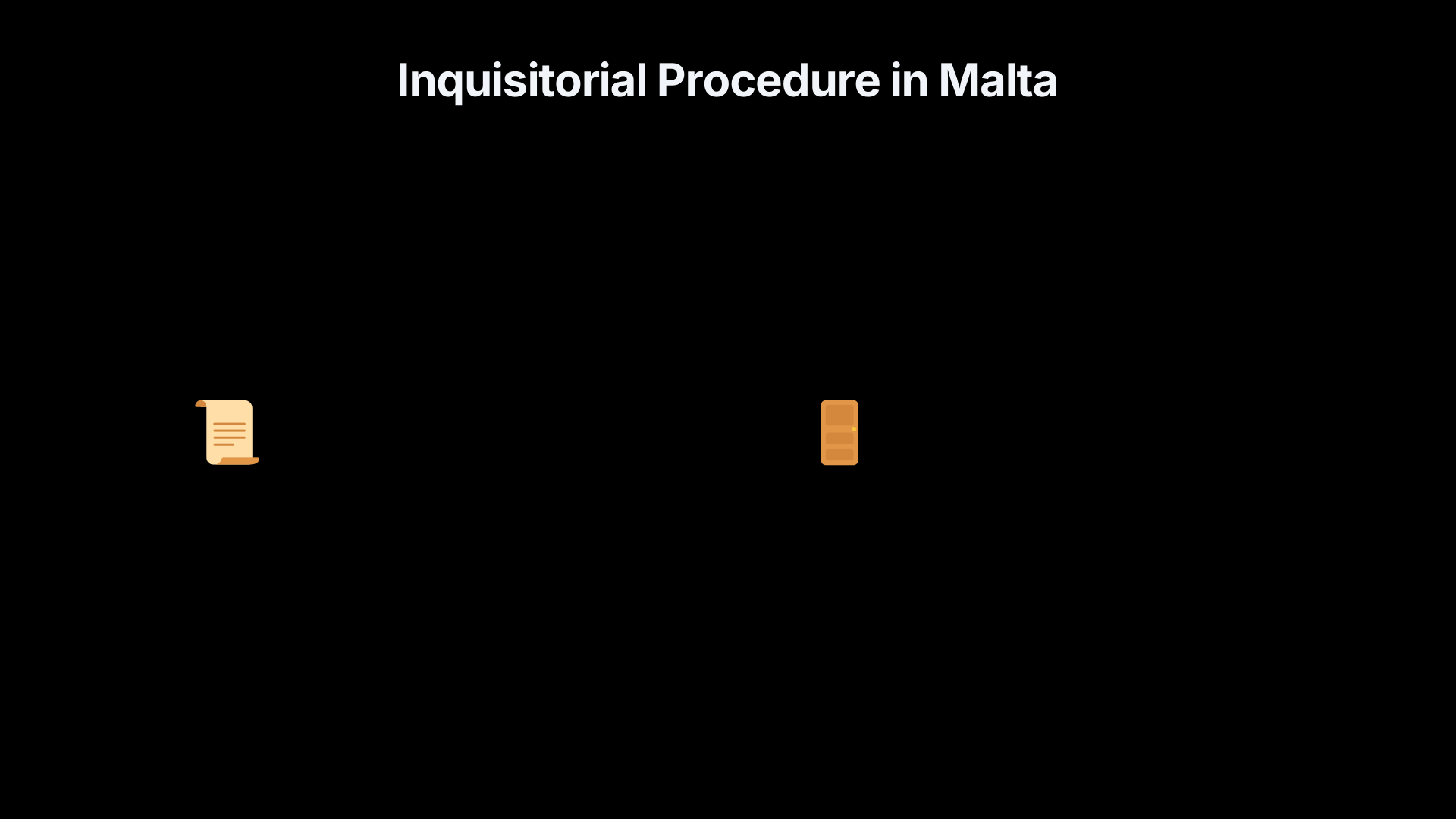
From 1561 until the end of the eighteenth century, witchcraft accusations in Malta fell primarily under the authority of the Roman Inquisition rather than local secular courts. This institutional difference mattered. Across much of northern Europe, witchcraft was often prosecuted as a criminal offence before local judges, where rumours could snowball into large-scale community panics. In Malta, inquisitors investigated allegations as matters of religious error, superstition or heresy, following procedures intended to obtain confessions, repentance and reconciliation with the Church.[L-Università ta' Malta]um.edu.mtL-Università ta' MaltaOAR@UM: The witches of Malta: the Catholic Church, the Inquisition, and the gendering of witchcraft in seventeenth…
This did not mean the system was lenient. Suspects could be imprisoned, interrogated and publicly humiliated, while repeat offenders faced severe penalties. Nevertheless, historians have found no evidence for the kind of self-reinforcing mass accusations that produced hundreds of executions elsewhere in Europe. Malta experienced witchcraft prosecutions, but not a sustained island-wide witch panic.[L-Università ta' Malta]um.edu.mtL-Università ta' MaltaOAR@UM: The witches of Malta: the Catholic Church, the Inquisition, and the gendering of witchcraft in seventeenth…
Several factors helped limit escalation:
- A single central inquisitorial tribunal reduced competition between local courts.
- Roman inquisitorial procedure generally demanded investigation rather than immediate conviction.
- Most cases concerned individual acts of magic rather than conspiracies of organised witches.
- The authorities aimed chiefly to restore religious conformity rather than eliminate imagined satanic networks.[L-Università ta' Malta]um.edu.mtOpen source on edu.mt.
Love magic, healing and protective rituals
The Inquisition records reveal that most alleged “witchcraft” was woven into everyday concerns rather than spectacular supernatural claims.
People sought magical help for familiar problems:
- attracting or keeping a lover;
- restoring a marriage;
- curing illness;
- protecting children or livestock;
- identifying thieves;
- recovering lost property;
- influencing absent sailors or soldiers.
Many rituals blended Catholic prayers with actions that inquisitors regarded as illicit. Holy water, blessed candles, relics, written prayers and saints’ names might be combined with herbs, symbolic objects, spoken formulas or ritual gestures. To participants, these practices often appeared as practical extensions of religious life rather than deliberate rejection of Christianity. To the Inquisition, however, attempts to compel supernatural forces or predict hidden events crossed the boundary into forbidden superstition.[L-Università ta' Malta]um.edu.mtOpen source on edu.mt.
The records therefore show less of a conflict between religion and magic than a struggle over who possessed legitimate spiritual authority.
What the trials reveal about everyday life
One reason Malta’s archives are so valuable is that they document ordinary people rather than only notorious criminals or elite theologians. Cases illuminate concerns that official records often ignore.
Love magic appears particularly frequently. The island’s social structure created distinctive pressures. Many men spent long periods at sea in the service of the Order of St John or in Mediterranean trade, leaving partners separated for months or years. Women sometimes turned to magical practitioners in hopes of preserving affection, securing marriage or preventing abandonment. Historians argue that these circumstances gave Maltese magical practice characteristics shaped by local social conditions rather than simply copying continental European traditions.[L-Università ta' Malta]um.edu.mtOpen source on edu.mt.
Healing rituals were equally common. Before modern medicine, household remedies and ritual healing overlapped naturally. A prayer spoken over herbs, a blessed object carried for protection or a charm against illness might all seem entirely reasonable to those seeking relief. The Inquisition often became involved only when practitioners claimed supernatural powers or used rituals judged incompatible with orthodox Catholic teaching.[L-Università ta' Malta]um.edu.mtOpen source on edu.mt.
These records therefore preserve a rare picture of how ordinary Maltese people tried to manage uncertainty in daily life through combinations of faith, custom and popular medicine.
How the Inquisition decided what counted as forbidden belief
The central issue for inquisitors was usually not whether supernatural forces existed. Both Church authorities and defendants generally accepted that they did. The dispute concerned their source.
Practices became suspect when they appeared to:
- invoke spirits or demons;
- promise supernatural control over another person’s will;
- use divination to reveal hidden knowledge;
- attribute miraculous power to rituals without Church approval;
- mix Christian prayers with ceremonies considered magical rather than devotional.[L-Università ta' Malta]um.edu.mtL-Università ta' MaltaOAR@UM: The witches of Malta: the Catholic Church, the Inquisition, and the gendering of witchcraft in seventeenth…
This distinction explains why outwardly similar practices could receive different treatment. A prayer asking God or a recognised saint for help might be entirely acceptable. The same prayer recited as part of a ritual claiming guaranteed supernatural results could be treated as superstition or heresy.
Rather than simply suppressing popular religion, the tribunal attempted to police the boundaries between acceptable devotion and unacceptable magical practice.
Women, gender and accusations
Women appear prominently in Maltese witchcraft records, especially in cases involving domestic relationships, childbirth, healing and love magic. That pattern reflects social roles more than exclusive female participation in magical practice.
Women often possessed practical knowledge about childbirth, herbal remedies and household care. Those same skills could attract suspicion if treatments failed or if neighbours believed supernatural methods had been used. Historians argue that accusations frequently reinforced wider expectations concerning sexuality, obedience and respectable female behaviour.[L-Università ta' Malta]um.edu.mtL-Università ta' MaltaOAR@UM: The witches of Malta: the Catholic Church, the Inquisition, and the gendering of witchcraft in seventeenth…
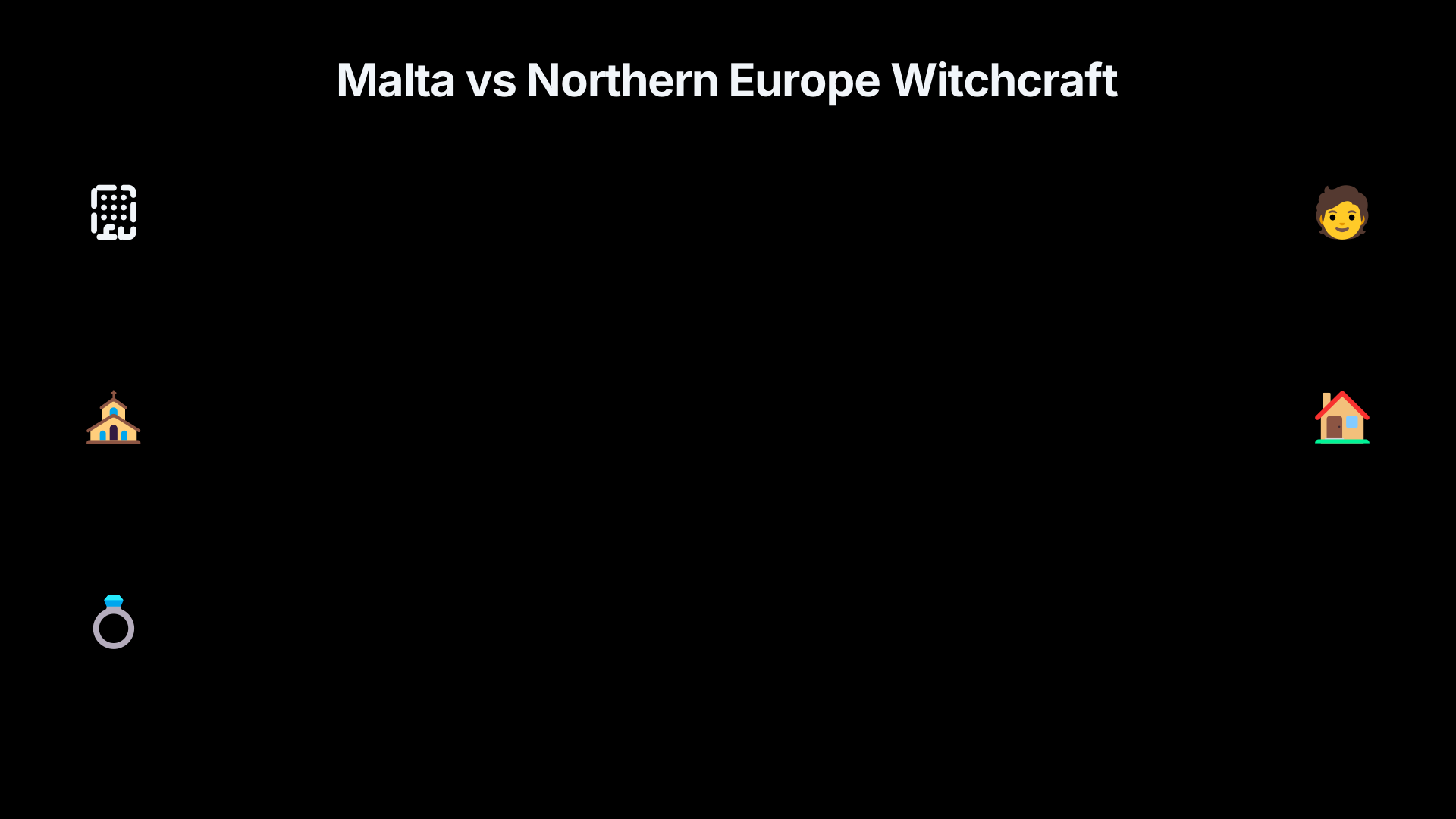
Yet the Maltese evidence differs from many northern European witch hunts. Defendants were not normally portrayed as members of organised satanic conspiracies. More commonly they were individuals accused of offering charms, remedies or rituals to solve specific personal problems.
A revealing case: love magic in 1617
One of the best-known Maltese Inquisition cases occurred in 1617, when Sulpitia de Lango, a former courtesan, was discovered preparing a magical mixture in the crypt of St John’s church in Valletta during the feast of Imnarja. The incident led to proceedings against several individuals accused of practising love magic.
The case illustrates many recurring features of Maltese prosecutions:
- magic centred on relationships rather than public harm;
- Catholic sacred spaces and objects were incorporated into rituals;
- investigators focused on religious transgression rather than spectacular claims of diabolical conspiracy;
- surviving records preserve unusually detailed testimony about beliefs and motivations.[L-Università ta' Malta]um.edu.mtL-Università ta' MaltaOAR@UM: Sex, magic, and the periwinkle: a trial at the Malta Inquisition Tribunal in 1617…
Rather than serving as evidence of widespread panic, the trial demonstrates how individual episodes allowed the Inquisition to reinforce religious boundaries while documenting everyday magical culture in remarkable detail.
What historians think the evidence means
Modern historians generally interpret Maltese witchcraft records less as evidence that people genuinely feared armies of witches than as evidence of how communities managed uncertainty.
Magic helped explain illness, failed relationships, financial hardship and unexpected misfortune. It also gave people a sense of agency when conventional solutions were unavailable. According to Carmel Cassar’s research, accusations could channel social tensions, regulate behaviour and provide culturally meaningful explanations for otherwise frightening events. Magic transformed random misfortune into something with an identifiable human cause.[L-Università ta' Malta]um.edu.mtOpen source on edu.mt.
The records also reveal the Church’s wider programme of religious discipline following the Counter-Reformation. The Inquisition was not merely punishing isolated offences; it was teaching people which forms of belief, healing and ritual belonged within orthodox Catholicism and which lay outside it.[L-Università ta' Malta]um.edu.mtL-Università ta' MaltaOAR@UM: The witches of Malta: the Catholic Church, the Inquisition, and the gendering of witchcraft in seventeenth…
Why Malta’s experience matters
Malta offers an important counterpoint to the familiar image of early modern Europe consumed by witch crazes. The islands certainly witnessed prosecutions, coercion and religious control, but they avoided the escalating cycles of accusation and execution that characterised the largest European witch hunts.
Because the Maltese Inquisition archive has survived so extensively, historians can reconstruct the everyday world of popular belief with unusual precision. The documents reveal not only what authorities condemned but also how ordinary people sought love, health, protection and certainty in an uncertain world.
For the wider history of collective fear, Malta demonstrates that belief in magic did not automatically produce mass hysteria. The same supernatural assumptions that elsewhere fuelled large-scale witch panics were, in Malta, more often channelled into individual prosecutions, negotiated religious discipline and the careful policing of the boundary between accepted devotion and forbidden magic.[L-Università ta' Malta]um.edu.mtOpen source on edu.mt.

Amazon book picks
Further Reading
Books and field guides related to Why Malta Never Had a Mass Witch Hunt. Use these as the next step if you want deeper reading beyond the article.



Endnotes
1.
Source: um.edu.mt
Link:https://www.um.edu.mt/library/oar/handle/123456789/29176
2.
Source: um.edu.mt
Link:https://www.um.edu.mt/library/oar/handle/123456789/42328
Source snippet
L-Università ta' MaltaOAR@UM: The witches of Malta: the Catholic Church, the Inquisition, and the gendering of witchcraft in seventeenth...
3.
Source: um.edu.mt
Link:https://www.um.edu.mt/library/oar/handle/123456789/22425
4.
Source: um.edu.mt
Link:https://www.um.edu.mt/library/oar/handle/123456789/106281
5.
Source: um.edu.mt
Link:https://www.um.edu.mt/library/oar/handle/123456789/106791
Source snippet
L-Università ta' MaltaOAR@UM: Sex, magic, and the periwinkle: a trial at the Malta Inquisition Tribunal in 1617...
6.
Source: um.edu.mt
Title: Study-Unit Description
Link:https://www.um.edu.mt/courses/studyunit/IMS5024
Source snippet
L-Università ta' MaltaSTUDY-UNIT DESCRIPTION CODE | IMS5024 TITLE | Religion and Society UM LEVEL | 05 - Postgraduate Modular Diploma or...
7.
Source: um.edu.mt
Link:https://www.um.edu.mt/profile/carmelcassar
Source snippet
Carmel Cassar - L-Università ta' MaltaPROF. CARMEL CASSAR PROF. CARMEL CASSAR B.A,M.Phil.(Cantab.),Ph.D.(Cantab.),F.R.Hist.S.,F.C.C.S. Pu...
8.
Source: malta.academia.edu
Title: Carmel Cassar
Link:https://malta.academia.edu/CarmelCassar
Source snippet
Cassar - University of MaltaCARMEL CASSAR University of Malta, Institute for Tourism, Travel & Culture, Faculty Member add Follow Followe...
Additional References
9.
Source: exeter.ac.uk
Link:https://www.exeter.ac.uk/research/projects/history/popularhealing/
Source snippet
Popular Healing | Research Projects | University of ExeterPOPULAR HEALING: CHRISTIAN AND ISLAMIC PRACTICES AND THE ROMAN INQUISITION IN E...
10.
Source: butterfliesandwheels.org
Link:https://www.butterfliesandwheels.org/2016/witchcraft-magical-spells-and-humanism-in-21st-century-malta/
Source snippet
May 26, 2016 — WITCHCRAFT, MAGICAL SPELLS AND HUMANISM IN 21ST CENTURY MALTA Written by Ophelia Benson in Articles May 26, 2016 After rea...
Published: May 26, 2016
11.
Source: sites.exeter.ac.uk
Title: exeter.ac.uk Malta’s Magic Hat > Exeter Medieval Studies Blog
Link:https://sites.exeter.ac.uk/medievalstudies/2015/02/10/maltas-magic-hat/
Source snippet
exeter.ac.ukMalta’s Magic Hat > Exeter Medieval Studies BlogFebruary 10, 2015 — MALTA’S MAGIC HAT Posted by Catherine Rider 10 February 2...
Published: February 10, 2015
12.
Source: timesofmalta.com
Title: Women, witchcraft and early modern Malta
Link:https://timesofmalta.com/article/women-witchcraft-early-modern-malta.1108694
Source snippet
April 27, 2025 — WOMEN, WITCHCRAFT AND EARLY MODERN MALTA A review of Carmel Cassar’s public lecture ‘Women, Witchcraft and the Maltese I...
Published: April 27, 2025
13.
Source: youtube.com
Title: Magic, Violence, Healing and the Knights of Malta, with Prof. Emanuel Buttigieg
Link:https://www.youtube.com/watch?v=ii51ErKGTKY
Source snippet
Inside the Inquisitor's Palace, Malta | Secrets of the Roman Inquisition...
14.
Source: youtube.com
Title: Inside the Inquisitor’s Palace, Malta | Secrets of the Roman Inquisition
Link:https://www.youtube.com/watch?v=ELVJSSV3BaQ
Source snippet
Inquisitor's Palace - Torture (English Version)...
15.
Source: youtube.com
Title: Inquisitor’s Palace
Link:https://www.youtube.com/watch?v=6EFBy9_NIUg
Source snippet
I FOUND THE REAL NOSTRADAMUS BOOK - AND A MAGIC MUSLIM HAT IN MALTA...
16.
Source: youtube.com
Title: I FOUND THE REAL NOSTRADAMUS BOOK
Link:https://www.youtube.com/watch?v=seNcgwOpxIs
Source snippet
Inquisitor's Palace Birgu Malta...
17.
Source: youtube.com
Title: Inquisitor’s Palace Birgu Malta
Link:https://www.youtube.com/watch?v=vi_OOhGiwNU
Topic Tree