When Fear Defined Reality in Serbia
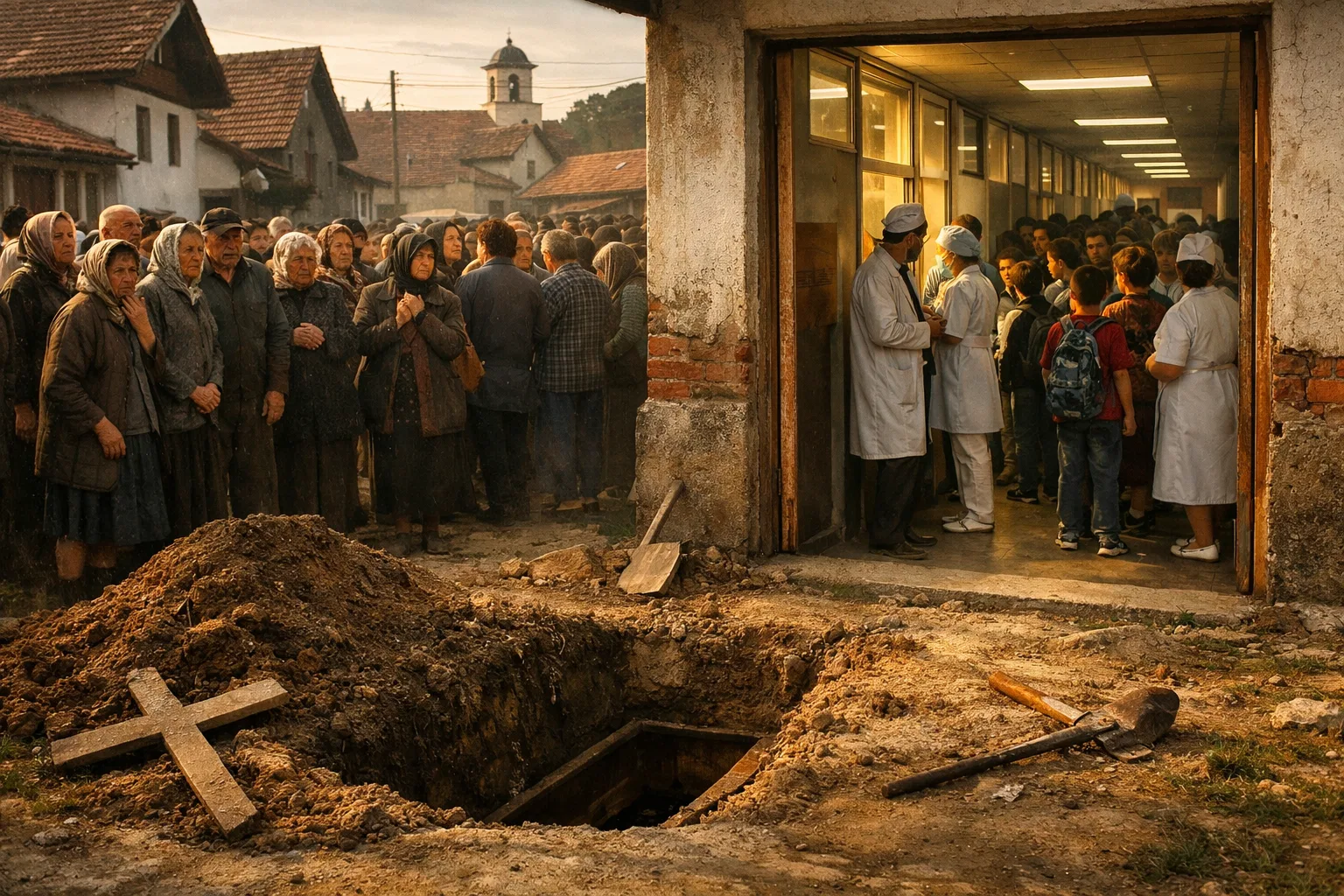
Serbia’s history of contagious belief is best understood not as one continuous tradition of “mass hysteria”, but as a series of very different episodes. Eighteenth-century villagers opened graves because they feared the dead were killing the living. Rural communities accused women of harmful magic.
Page outline Jump by section
Introduction
These cases matter because they show how fear changes when it passes between ordinary people, officials, doctors and the media. Some episodes involved sincere supernatural belief; others became political struggles over who could define reality. In several cases, the label applied to an event — vampire attack, witchcraft, mass illness or destructive cult — caused harm in its own right.
When Serbian vampire fears reached Europe
The vampire scares associated with Serbia in the 1720s and 1730s are among the best-documented episodes of supernatural panic in European history. They occurred in territories that had recently passed from Ottoman to Habsburg control, where Austrian administrators and military doctors encountered local practices surrounding suspicious deaths and disturbed corpses. The occupation turned village fears into official paperwork, allowing stories that might otherwise have remained local to circulate through Central and Western Europe.[Cambridge University Press & Assessment]resolve.cambridge.orgCambridge University Press & AssessmentVampire Country: Borders of Culture and Power in Central Europe (Chapter 1) - Metamorphoses of the…
In 1725, villagers in Kisiljevo blamed a recently deceased peasant, Petar Blagojević, for a sequence of deaths. According to the report sent by imperial official Ernst Frombald, the dying claimed that Blagojević had visited and attacked them. The villagers demanded that his body be exhumed. When the corpse appeared unusually well preserved and showed signs interpreted as fresh blood, it was staked and burned. Frombald did not endorse the supernatural explanation, but he feared that resisting the villagers could lead them to abandon the settlement. His report therefore records both the belief and the authorities’ uneasy accommodation of it.[Cambridge University Press & Assessment]resolve.cambridge.orgCambridge University Press & AssessmentVampire Country: Borders of Culture and Power in Central Europe (Chapter 1) - Metamorphoses of the…
A second and more influential outbreak was linked to Arnod Paole, a former soldier from the village of Medveđa. Paole had reportedly said that he had once been troubled by a vampire and had tried to protect himself through folk remedies. After his accidental death, villagers attributed further deaths to him, opened his grave and destroyed the body. Several years later, another cluster of deaths prompted a formal military-medical investigation. The resulting report, commonly known as Visum et Repertum, described exhumed bodies that appeared unexpectedly undecayed and contained liquid blood. The investigators recorded what they saw but had only limited knowledge of decomposition, disease transmission or the effects of local soil and winter burial conditions.[JSTOR]jstor.orgVampires, Burial, and Death: Folklore and Reality | JSTORVampires, Burial, and Death: Folklore and Reality | JSTOR…
These incidents were not simply cases of frightened people mistaking decomposition for supernatural activity. The vampire belief supplied a practical explanation for otherwise bewildering chains of illness and death. It identified an attacker, offered a test — opening the grave — and prescribed an intervention. Exhumation and staking could also restore a sense of control when ordinary remedies had failed.
The panic widened because imperial officials treated the claims as matters requiring investigation. Reports passed into newspapers, medical debates and theological arguments. Educated Europeans who might have dismissed village folklore were confronted with documents written and signed by military surgeons. Literary scholar Erik Butler argues that this encounter between Serbian borderland belief and Habsburg bureaucracy helped create the modern European vampire: not yet the elegant aristocrat of later fiction, but a contagious corpse threatening an entire community.[Cambridge University Press & Assessment]resolve.cambridge.orgCambridge University Press & AssessmentVampire Country: Borders of Culture and Power in Central Europe (Chapter 1) - Metamorphoses of the…
Modern medicine offers ordinary explanations for many reported signs. Bodies can swell, darken, leak fluid and appear to grow hair or nails after death. Cold weather can slow decay, while pressure within a corpse can force blood-coloured liquid from the mouth. Epidemics also produce apparent chains of victims without any returning dead person. Yet the reports remain historically important because the fear, exhumations and destruction of bodies were real even though the supernatural diagnosis was not.
Witchcraft fear without a Serbian Salem
Serbia did not experience a single centralised witch-trial crisis comparable with Salem or the largest early modern prosecutions in German-speaking Europe. The surviving picture is more fragmented: local accusations, ordeal-like tests, beatings and killings existed alongside traditions of healing, divination and protective magic. Folklorist Tatomir Vukanović’s studies of the central Balkans describe beliefs that witches could cause illness, death, storms, crop damage or the loss of milk from livestock. Such accusations often converted ordinary misfortune into evidence of a hidden human enemy.[Semantic Scholar]semanticscholar.orgSemantic ScholarWitchcraft in the Central Balkans II: Protection against…Witchcraft in the Central Balkans II: Protection against Witc…
The suspected witch was commonly imagined as a woman, particularly an older or socially vulnerable woman whose reputation made later events seem suspicious. A quarrel followed by illness could be reinterpreted as a curse. A healer’s knowledge might inspire respect in one setting and accusation in another. This ambiguity is important: folk practitioners were not members of a coherent anti-Christian underground, and the people described as witches did not necessarily understand themselves that way. The label was usually imposed by neighbours.
Research on rural Serbia also shows that magical healing survived because it was woven into ordinary social and religious life rather than organised as a separate “cult”. Practitioners might combine inherited remedies, prayer, charms and Orthodox Christian symbols. In contemporary Serbia, some occult or magical practitioners still identify as Orthodox Christians and say that their abilities operate through God. This makes a simple opposition between official religion and forbidden magic misleading.[Sage Journals]journals.sagepub.comSage JournalsMagical healing and revolutionary care in Rural Serbia…by C Novakov-Ritchey · 2023 · Cited by 1 — Vukanović TP (1989) Wit…
Accounts of nineteenth-century Serbia describe communities testing or punishing supposed witches outside a reliable judicial process. Claims that a particular woman was “the last witch killed in Serbia”, however, are often repeated without dependable documentation. The safer conclusion is that lethal violence connected with witchcraft accusations persisted into the period of the Serbian uprisings, but the chronology and details of famous individual cases are frequently clouded by folklore and later journalism.
The emerging Serbian state attempted to restrain such violence. Legal traditions associated with Karađorđe’s government are widely cited as forbidding people from persecuting or killing alleged witches. Whatever the exact dating of individual provisions, the larger shift is clear: the state increasingly treated attacks on suspected witches as criminal violence rather than accepting witchcraft as a supernatural offence.
That change did not abolish belief. It changed who was considered the offender. Under older communal logic, the supposed witch threatened the village. Under modern law, those who assaulted her became the perpetrators. Serbia’s witchcraft history is therefore less a story of great court trials than of the uneven replacement of village punishment by state authority.
Kosovo’s 1990 school illness: poisoning, psychogenic illness and distrust
The most serious modern case associated with mass psychogenic illness in the Serbian and Yugoslav setting occurred in Kosovo in 1990. Beginning in March, large numbers of ethnic Albanian pupils and students developed symptoms including fainting, dizziness, breathing difficulty, vomiting, spasms and irritation of the eyes or throat. Cases appeared across numerous schools and communities, eventually involving thousands of reported patients.[PubMed]pubmed.ncbi.nlm.nih.govOn the origin of mass casualty incidents in Kosovo, Yugoslavia, in 1990 - PubMed…
The episode took place during the dismantling of Kosovo’s autonomy and an escalating conflict between Serbian authorities and the Albanian majority. Schools, hospitals, public employment and the interpretation of almost every official action had become politically contested. In that atmosphere, an unexplained illness could not remain merely medical. Many Albanians believed that pupils had been deliberately poisoned. Serbian and federal officials generally rejected that claim, while some public statements accused pupils or Albanian doctors of staging the event. Human-rights reporting from the period documents the broader climate of repression and institutional distrust in which the controversy developed.[Human Rights Watch]hrw.orghuman rights abuses kosovohuman rights abuses kosovo
Epidemiologist Zoran Radovanović later reconstructed the outbreak as mass sociogenic illness, the term now often preferred to “mass hysteria”. This describes real symptoms spreading through a group without a shared toxic or infectious cause, commonly under conditions of fear, uncertainty and close social observation. His analysis argued that many sufferers had no identifiable exposure to a physical agent and suggested that respiratory illness in an intensely anxious population may have helped trigger the wave.[PubMed]pubmed.ncbi.nlm.nih.govOn the origin of mass casualty incidents in Kosovo, Yugoslavia, in 1990 - PubMed…
A psychogenic explanation does not mean that pupils were pretending. Stress can produce genuine dizziness, rapid breathing, numbness, muscle spasms, nausea and collapse. Once people believe that an invisible poison is present, ordinary sensations may be interpreted as signs of exposure. Seeing classmates fall ill can then intensify vigilance and symptoms in others. Schools are especially vulnerable to this pattern because pupils share rooms, rumours and authority figures.
Nevertheless, the case remains deeply disputed. Albanian doctors and witnesses reported smells, powders and symptoms they considered consistent with toxic exposure. Some foreign investigators also raised the possibility of an organophosphate or other chemical agent, although no proposed substance, delivery mechanism or laboratory evidence achieved broad scientific acceptance. The disappearance, disputed custody or uncertain provenance of samples further damaged confidence. Later official commemorations in Kosovo have continued to present the episode as deliberate poisoning, demonstrating that its political meaning remains alive even though the medical question was never resolved to everyone’s satisfaction.[president-ksgov.net]president-ksgov.netOpen source on president-ksgov.net.
Several cautions are essential. First, absence of a confirmed toxin is not proof that every reported case had the same psychogenic cause. A small initial exposure, infection or environmental irritation can coexist with socially transmitted symptoms. Secondly, calling the outbreak “hysteria” in 1990 was not politically neutral. Serbian officials sometimes used the diagnosis alongside language suggesting deception, turning a clinical hypothesis into a dismissal of Albanian testimony. Thirdly, allegations of poisoning were plausible to many families because they lived under real coercion. Collective fear did not arise in a social vacuum.
The episode therefore illustrates the limits of purely medical explanations. A psychogenic mechanism may account for how symptoms spread, while political history explains why poisoning became credible, why official denials were distrusted and why the event remains part of competing national memories.
How “sects” became modern folk devils
The collapse of Yugoslav socialism brought religious revival, war, economic breakdown and rapid media expansion. In this unsettled environment, Serbian public discussion increasingly focused on “sects”, satanism, occult practices and allegedly manipulative spiritual organisations. The word “sect” was often applied far beyond small coercive groups, covering Protestant minorities, Eastern religious movements, New Age practices, psychotherapies, popular magic and sometimes any religion regarded as foreign or non-traditional.
Scholarship on Serbia’s anti-cult movement traces its growth around the turn of the millennium, when clerics, police-linked commentators, campaigners and tabloid journalists presented new religious movements as dangers to young people, mental health, national identity and family authority.[dais.sanu.ac.rs]dais.sanu.ac.rsOpen source on sanu.ac.rs.
Some concerns were based on genuine risks. Religious or therapeutic groups can exploit members, demand money, isolate followers or justify abuse. A small number of crimes may involve ritual language or occult interests. The moral-panic problem begins when exceptional cases are treated as evidence of a large, secret and coordinated threat.
Serbian anti-sect discourse often relied on several recurring shortcuts:
- Unfamiliarity became evidence of danger. A minority faith’s unusual beliefs, imported literature or unconventional worship could be presented as signs of manipulation.
- Youth distress was attributed to recruitment. Suicide, drug use, family conflict or adolescent withdrawal were sometimes connected to “sects” without evidence that a group had caused them.
- Symbols were treated as confessions. Music, clothing, fantasy games, occult imagery and interest in alternative spirituality could be interpreted as stages of satanic involvement.
- Religious difference was securitised. Commentators blurred distinctions between lawful minority religions, occult practitioners, fraudulent healers and violent organisations.
- The label discouraged verification. Once a movement had been called a destructive sect, testimony from its members could be dismissed as proof of brainwashing.
The Serbian Orthodox Church has played a significant role in defining the boundary between acceptable religion and occult or heterodox practice. Yet its position has not been entirely consistent. Researchers note that Orthodox identity can coexist with astrology, energy healing, charms and other practices that church authorities formally reject. State institutions have likewise shifted between secular regulation, cooperation with the majority church and security-oriented interest in “cultic” activity.[EJournals]ejournals.euThe State, the Church, and the Demarcations of the Occult in SerbiaThe State, the Church, and the Demarcations of the Occult in Serbia…
This ambiguity helps explain the panic’s durability. “Sect” can mean a small religious community, a fraudulent organisation, a coercive group or simply a disliked belief. Because the term has no stable public meaning, alarming claims can move easily between those categories. An incident involving one abusive leader may be used to stigmatise unrelated minority churches; a sensational headline about satanism may be repeated without a victim, named organisation or verifiable crime.
For that reason, scholars of religion generally prefer more precise language such as “new religious movement”, “minority religion”, “high-control group” or “fraudulent spiritual enterprise”. These descriptions do not excuse abuse. They require accusations to identify the actual conduct: coercion, violence, confinement, financial exploitation, sexual abuse or threats. Precision protects both potential victims and peaceful minorities.
What Serbia’s cases reveal
Serbia’s episodes of collective fear differ in content, but they share a recognisable structure. A disturbing event — unexplained deaths, illness, social change or youthful rebellion — creates a demand for an intelligible cause. An established cultural figure supplies one: the vampire, the witch, the poisoner or the destructive sect. Authorities then amplify, suppress or redirect the belief according to their own priorities.
The vampire investigations show how official documentation can spread rather than end a supernatural scare. Witchcraft accusations show how private conflict and public misfortune can be converted into persecution of vulnerable neighbours. The Kosovo illness demonstrates that psychogenic processes and legitimate political fear can exist together. Serbia’s anti-sect campaigns show how a real concern about coercion can expand into suspicion of religious difference itself.
These cases also warn against using “mass hysteria” as a universal explanation. The phrase can hide important distinctions:
- A moral panic exaggerates the scale or unity of a social threat.
- Mass sociogenic illness involves genuine symptoms spreading without a common physical exposure.
- A rumour panic develops when uncertain information prompts protective or aggressive action.
- Persecution occurs when a labelled group or individual is punished regardless of reliable evidence.
- A collective religious experience may attract crowds without producing either illness or coercion.
- A documented abusive group requires evidence of specific harmful acts, not merely unfamiliar beliefs.
The most responsible way to read Serbia’s strange social history is therefore to ask two questions at once: what evidence supports the feared threat, and what made that threat persuasive at that particular moment? The answer is rarely that an entire population simply became irrational. More often, people used the explanations available to them while facing death, illness, political repression, institutional failure or rapid cultural change.

Amazon book picks
Further Reading
Books and field guides related to When Fear Defined Reality in Serbia. Use these as the next step if you want deeper reading beyond the article.
Vampires, burial, and death
Directly explains the historical vampire beliefs that made eighteenth-century Serbia famous across Europe.
Europe's inner demons
Helps explain the wider European patterns behind witchcraft accusations, panic, and supernatural fears discussed on the page.
Balkan Ghosts
Explores the historical tensions, identities, and conflicts that shaped modern perceptions of Serbia and the wider Balkans.

Imagining the Balkans
Provides essential historical and cultural context for understanding how Serbia and the Balkans have been represented and interpreted.
Endnotes
1.
Source: resolve.cambridge.org
Link:https://resolve.cambridge.org/core/services/aop-cambridge-core/content/view/448526EC12F36C6B627FD63205F4428C/9781571138170c1_p27-51_CBO.pdf/vampire-country-borders-of-culture-and-power-in-central-europe.pdf
Source snippet
Cambridge University Press & AssessmentVampire Country: Borders of Culture and Power in Central Europe (Chapter 1) - Metamorphoses of the...
2.
Source: jstor.org
Title: Vampires, Burial, and Death: Folklore and Reality | JSTOR
Link:https://www.jstor.org/stable/j.ctt1nq6gm
Source snippet
Vampires, Burial, and Death: Folklore and Reality | JSTOR...
3.
Source: ejournals.eu
Title: The State, the Church, and the Demarcations of the Occult in Serbia
Link:https://ejournals.eu/en/journal/pjacns/article/the-state-the-church-and-the-demarcations-of-the-occult-in-serbia
Source snippet
The State, the Church, and the Demarcations of the Occult in Serbia...
4.
Source: president-ksgov.net
Link:https://president-ksgov.net/en/speech-of-president-vjosa-osmani-at-the-forum-organized-by-the-institute-for-war-crimes-in-kosovo-ikkl-regarding-the-poisonings-of-the-1990s/
5.
Source: dais.sanu.ac.rs
Link:https://dais.sanu.ac.rs/handle/123456789/16771?locale-attribute=en
6.
Source: jstor.org
Link:https://www.jstor.org/stable/43297690
7.
Source: jstor.org
Link:https://www.jstor.org/stable/10.2979/histmemo.25.1.77
8.
Source: jstor.org
Link:https://www.jstor.org/stable/jj.2353857.3
9.
Source: jstor.org
Title: open access collection
Link:https://www.jstor.org/titlelists/books/open_access_collection/
10.
Source: jstor.org
Link:https://www.jstor.org/stable/26856483
11.
Source: jstor.org
Link:https://www.jstor.org/content/pdf/oa_book_monograph/10.3366/j.ctt9qdrh2.pdf
12.
Source: jstor.org
Link:https://www.jstor.org/stable/20720662
13.
Source: jstor.org
Link:https://www.jstor.org/kbart/collections/oa-book-titles
14.
Source: jstor.org
Link:https://www.jstor.org/content/oa_chapter_monograph/j.ctt1rfsrst.17
15.
Source: jstor.org
Link:https://www.jstor.org/stable/40379714
16.
Source: jstor.org
Link:https://www.jstor.org/stable/41275134
17.
Source: cambridge.org
Link:https://www.cambridge.org/core/journals/the-british-journal-of-psychiatry/article/protean-nature-of-mass-sociogenic-illness/2BDC2262E104B8A33F3DD49773DA0D8B
18.
Source: resolve.cambridge.org
Link:https://resolve.cambridge.org/core/services/aop-cambridge-core/content/view/463EF9CD8DCD30AAD0332E0B4386CDCD/9781571138170ind_p217-225_CBO.pdf/index.pdf
19.
Source: cambridge.org
Title: Part III
Link:https://www.cambridge.org/core/books/cambridge-history-of-nationhood-and-nationalism/intersections-nationalist-synergies-and-tensions-with-other-social-economic-political-and-cultural-categories-identities-and-practices/8021FB4ABC7139321125BC5060661C58
20.
Source: cambridge.org
Title: The Modern West (Part VI)
Link:https://www.cambridge.org/core/books/cambridge-history-of-magic-and-witchcraft-in-the-west/modern-west/DF8024C262C714DC419C4CD0C3D7DAB2
21.
Source: ojs.folklore.ee
Link:https://ojs.folklore.ee/incantatio/article/download/72/114/181
22.
Source: semanticscholar.org
Link:https://www.semanticscholar.org/paper/Witchcraft-in-the-Central-Balkans-II%3A-Protection-Vukanovi%C4%87/a4ac6f19161c684d8979351cdfe22d89ac9b15d2
Source snippet
Semantic ScholarWitchcraft in the Central Balkans II: Protection against...Witchcraft in the Central Balkans II: Protection against Witc...
23.
Source: journals.sagepub.com
Link:https://journals.sagepub.com/doi/10.1177/13675494221074715
Source snippet
Sage JournalsMagical healing and revolutionary care in Rural Serbia...by C Novakov-Ritchey · 2023 · Cited by 1 — Vukanović TP (1989) Wit...
24.
Source: pubmed.ncbi.nlm.nih.gov
Link:https://pubmed.ncbi.nlm.nih.gov/8817187/
Source snippet
On the origin of mass casualty incidents in Kosovo, Yugoslavia, in 1990 - PubMed...
25.
Source: hrw.org
Title: human rights abuses kosovo 1990 1992
Link:https://www.hrw.org/report/1992/10/01/human-rights-abuses-kosovo
26.
Source: degruyterbrill.com
Link:https://www.degruyterbrill.com/document/doi/10.1525/9780520341579-011/pdf?licenseType=restricted&srsltid=AfmBOopQzdMyFCmiaBz0VNCrWGGTkrbss0xuRREE4PgIPeGI_q3NXJOq
27.
Source: facebook.com
Link:https://www.facebook.com/groups/869192606778920/posts/2258940601137440/
28.
Source: pmc.ncbi.nlm.nih.gov
Link:https://pmc.ncbi.nlm.nih.gov/articles/PMC12331598/
29.
Source: Wikipedia
Title: Petar Blagojević
Link:https://en.wikipedia.org/wiki/Petar_Blagojevi%C4%87
30.
Source: Wikipedia
Title: Mass psychogenic illness
Link:https://en.wikipedia.org/wiki/Mass_psychogenic_illness
31.
Source: Wikipedia
Link:https://en.wikipedia.org/wiki/Vampire
32.
Source: Wikipedia
Title: Moral panic
Link:https://en.wikipedia.org/wiki/Moral_panic
33.
Source: scienceij.com
Link:https://scienceij.com/index.php/sij/article/view/94
34.
Source: nationalarchives.gov.uk
Link:https://www.nationalarchives.gov.uk/education/resources/early-modern-witch-trials/
35.
Source: semanticscholar.org
Link:https://www.semanticscholar.org/paper/1daad2c6dc3a353694de7f97b036355e4b0eb368
36.
Source: teme2.junis.ni.ac.rs
Link:https://teme2.junis.ni.ac.rs/index.php/TEME/article/view/2072
Additional References
37.
Source: youtube.com
Title: VAMPIRE Outbreak & The Real-Life Investigation That Followed | Arnold Paole
Link:https://www.youtube.com/watch?v=Owc0kE6FM6E
Source snippet
The First Vampire – The True Story of Petar Blagojević...
38.
Source: youtube.com
Title: The Vampire of Medveđa: The Cursed True Story of Arnold Paole
Link:https://www.youtube.com/watch?v=W1Su0no3RLs
Source snippet
The First Vampire Attack: The Peter Plogojowitz Vampire Case (1725)...
39.
Source: youtube.com
Link:https://www.youtube.com/watch?v=O5bYC97Q6U8
Source snippet
Petar Blagojevic: The Vampire of Kisiljevo...
40.
Source: youtube.com
Title: The First Vampire – The True Story of Petar Blagojević
Link:https://www.youtube.com/watch?v=7slHDnFn0Yw
Source snippet
The Vampire of Medveđa: The Cursed True Story of Arnold Paole...
41.
Source: link.springer.com
Link:https://link.springer.com/article/10.1007/BF00144437
Source snippet
Springer LinkOn the origin of mass casualty incidents in Kosovo...by Z Radovanovic · 1996 · Cited by 26 — In March 1990, a mysterious ou...
Published: March 1990
42.
Source: scispace.com
Link:https://scispace.com/pdf/moral-panic-and-moral-language-in-the-media-168qwg7dc4.pdf
43.
Source: academia.edu
Link:https://www.academia.edu/2153760/Moral_Panics_and_the_British_Media_A_look_at_some_contemporray_Folk_Devils_
44.
Source: researchgate.net
Link:https://www.researchgate.net/publication/216715825_On_the_Origin_of_Mass_Casualty_Incidents_in_Kosovo_Yugoslavia_in_1990
45.
Source: researchgate.net
Link:https://www.researchgate.net/publication/359149280_Palpating_history_Magical_healing_and_revolutionary_care_in_Rural_Serbia_and_Macedonia
46.
Source: academia.edu
Link:https://www.academia.edu/31105124/The_Impact_of_Internet_on_New_Religious_Movements_Discourse
Topic Tree
Follow this branch
Related pages 192
- Antigua and Barbuda
- Argentina Belief Scares
- Azerbaijan Belief
- Bahrain Beliefs
- North Korea
- +187 more in sidebar