Within Chile Belief and Fear
Why Did Thousands Believe at Penablanca?
The Penablanca visions became a media phenomenon where faith, dictatorship-era anxiety and political suspicion converged.
On this page
- The visionary, the crowds and the Marian messages
- Television, pilgrimage and collective belief
- Political suspicion under military rule
Page outline Jump by section
Introduction
The reported Marian apparitions at Peñablanca, near Villa Alemana, became one of the most remarkable episodes of collective religious belief in modern Chile. Beginning in June 1983, the teenage visionary Miguel Ángel Poblete claimed that the Virgin Mary was appearing to him on a hillside that rapidly attracted pilgrims, journalists, clergy and security officials. Within months, gatherings that began with local curiosity had become mass public events attended by tens of thousands of people.[Wikipedia]WikipediaMiguel Ángel PobleteMiguel Ángel Poblete
What made Peñablanca distinctive was not simply the claim of a miracle. The apparitions unfolded during General Augusto Pinochet’s military dictatorship, when public space, television, religion and politics were all heavily contested. For believers, the events offered spiritual reassurance and hope. For critics, they became an example of how spectacle, media attention and political anxiety could reinforce one another. Decades later, historians tend to study Peñablanca not only as a question of whether miracles occurred, but as a revealing case of how extraordinary belief spread through modern mass communication during a period of authoritarian rule.[De Gruyter Brill]degruyterbrill.comDe Gruyter Brill Eine Marienerscheinung in Zeiten der DiktaturDe Gruyter Brill Eine Marienerscheinung in Zeiten der Diktatur
The visionary, the crowds and the Marian messages
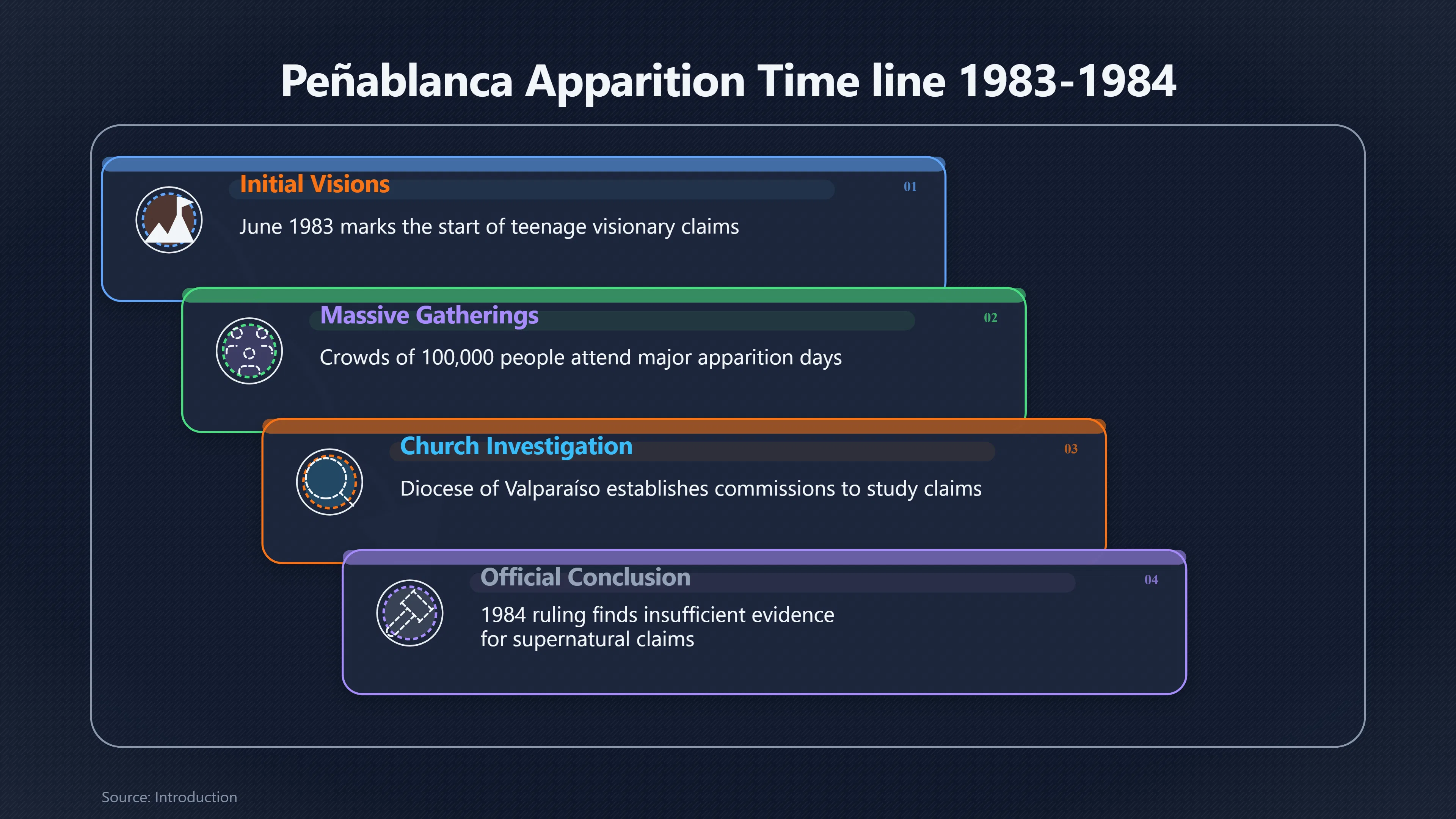
Miguel Ángel Poblete was a teenager from a difficult social background when he announced that the Virgin Mary had appeared to him on a hill known as El Membrillar, later renamed Monte Carmelo by devotees. His reported visions multiplied over several years and included calls for prayer, repentance, conversion and devotion to the Rosary, together with warnings about moral decline and future suffering if humanity failed to change. The messages echoed themes familiar from other twentieth-century Marian apparition traditions, making them immediately recognisable to many Catholic believers.[Wikipedia]WikipediaMiguel Ángel PobleteMiguel Ángel Poblete
The speed with which the movement expanded was striking. Local residents were soon joined by visitors from across Chile, and major apparition days reportedly drew crowds approaching 100,000 people. Pilgrims described witnessing ecstatic states, unusual lights, healings and other extraordinary signs, although such claims were never independently verified. Even after official scepticism increased, many followers continued to visit the site regularly, treating it as a genuine place of pilgrimage.[Wikipedia]WikipediaMiguel Ángel PobleteMiguel Ángel Poblete
From the beginning, Church authorities reacted cautiously. The Diocese of Valparaíso established investigative commissions rather than immediately endorsing the visions. Early investigations raised concerns about inconsistencies, possible manipulation and the reliability of testimony. By 1984 the local Church had concluded that there was insufficient evidence to recognise the apparitions as supernatural, although this judgement did not eliminate popular devotion among committed followers.[Wikipedia]WikipediaMiguel Ángel PobleteMiguel Ángel Poblete
Television, pilgrimage and collective belief
Peñablanca illustrates how collective belief can be strengthened through repeated public performance. Thousands gathered at announced times expecting something extraordinary to happen. Many participants watched not only the visionary but also one another, searching for emotional reactions, physical signs or confirmation that others had witnessed the same event. Such settings often reinforce expectation without requiring deliberate deception or shared hallucination.
Television greatly amplified this process. Chilean broadcasters covered the gatherings extensively, transforming a local religious claim into a national event. Images of enormous crowds climbing the hillside, praying together and waiting for the visionary encouraged additional visitors, creating a feedback loop between media coverage and public participation. The spectacle itself became part of the evidence for many observers: if so many people attended, the event appeared worthy of serious attention regardless of whether the supernatural claims could be verified.[De Gruyter Brill]degruyterbrill.comDe Gruyter Brill Eine Marienerscheinung in Zeiten der DiktaturDe Gruyter Brill Eine Marienerscheinung in Zeiten der Diktatur
Modern scholarship increasingly treats Peñablanca as an example of a religious event entering the public sphere through mass media rather than remaining a purely local devotional experience. Researchers have examined the apparition as a carefully observable social process, tracing how rituals, repeated gatherings, media exposure and institutional responses gradually transformed an isolated report into a nationally recognised phenomenon.[De Gruyter Brill]degruyterbrill.comDe Gruyter Brill Eine Marienerscheinung in Zeiten der DiktaturDe Gruyter Brill Eine Marienerscheinung in Zeiten der Diktatur
Political suspicion under military rule
The apparitions occurred during one of the most turbulent years of the dictatorship. Chile experienced severe economic hardship, growing opposition protests and increasing political repression in 1983. Against this background, any event capable of attracting enormous crowds inevitably acquired political significance.
Almost immediately, competing interpretations emerged. Some supporters regarded the Virgin’s messages as transcending politics, offering moral guidance to a divided nation. Others interpreted individual messages as carrying indirect political meaning, especially references to violence, communism or Chile’s future. Meanwhile, critics suspected that the extraordinary media attention surrounding the apparitions conveniently diverted attention from nationwide protests and the government’s mounting political difficulties.[Wikipedia]WikipediaMiguel Ángel PobleteMiguel Ángel Poblete
One of the most persistent controversies concerned allegations that elements connected to the dictatorship, particularly the security services, had encouraged or manipulated the phenomenon. These claims have circulated for decades and became part of the historical narrative surrounding Peñablanca. However, despite the durability of the allegations, historians have not produced conclusive evidence demonstrating that the apparitions themselves were orchestrated as a state operation. Instead, many scholars now treat the “manipulation hypothesis” as an important historical phenomenon in its own right: a reflection of widespread distrust generated by authoritarian politics rather than a settled historical fact.[De Gruyter Brill]degruyterbrill.comDe Gruyter Brill12. Die Manipulationshypothese als Teil der Geschichte voDe Gruyter Brill12. Die Manipulationshypothese als Teil der Geschichte vo
The dictatorship nevertheless shaped how every aspect of the apparitions was interpreted. Because Chilean public life was saturated with political suspicion, neither believers nor sceptics viewed the gatherings as religious events alone. Every crowd, television broadcast and official statement became open to competing political readings.
Why the spectacle still matters
Peñablanca remains significant because it demonstrates that collective belief does not spread only through private faith or isolated visions. Public ritual, repeated media exposure, institutional investigation and political context all interacted to sustain national attention.
The episode also illustrates the limits of simple labels such as “mass hysteria”. The crowds included committed Catholics, curious visitors, journalists, sceptics and political observers whose motivations differed considerably. Many participants never claimed to witness miracles personally but attended because the gatherings had become important national events. Others remained convinced of the apparitions despite the Church’s refusal to recognise them officially. Treating everyone present as irrational misses the diversity of reasons people came.
For historians of Chile, Peñablanca therefore stands at the intersection of religion, media and authoritarian politics. It shows how a reported miracle could become a national spectacle, how television could magnify religious expectation, and how dictatorship-era mistrust ensured that almost every interpretation—devotional, psychological or political—became part of the story itself.
Amazon book picks
Further Reading
Books and field guides related to Why Did Thousands Believe at Penablanca?. Use these as the next step if you want deeper reading beyond the article.
The Varieties of Religious Experience
Frames extraordinary religious experiences historically.

Endnotes
1.
Source: Wikipedia
Title: Miguel Ángel Poblete
Link:https://es.wikipedia.org/wiki/Miguel_%C3%81ngel_Poblete
2.
Source: Wikipedia
Title: Aparición mariana
Link:https://es.wikipedia.org/wiki/Aparici%C3%B3n_mariana
3.
Source: degruyterbrill.com
Title: De Gruyter Brill Eine Marienerscheinung in Zeiten der Diktatur
Link:https://www.degruyterbrill.com/document/doi/10.1515/9783110220551/html?lang=de
4.
Source: degruyterbrill.com
Title: De Gruyter Brill12. Die Manipulationshypothese als Teil der Geschichte vo
Link:https://www.degruyterbrill.com/document/doi/10.1515/9783110220551.5.409/html
5.
Source: degruyterbrill.com
Link:https://www.degruyterbrill.com/document/doi/10.1515/9783110220551.6.459/html
Source snippet
De Gruyter Brill13. November 1983 bis September 1984: Konsolidierung der...
Published: November 1983
6.
Source: degruyterbrill.com
Title: Eine Marienerscheinung in Zeiten der Diktatur
Link:https://www.degruyterbrill.com/document/doi/10.1515/9783110220551/html
7.
Source: degruyterbrill.com
Link:https://www.degruyterbrill.com/document/doi/10.1515/9783110220551.bm/pdf?licenseType=restricted
8.
Source: degruyterbrill.com
Link:https://www.degruyterbrill.com/document/doi/10.1515/9783110220551.5.409/pdf?licenseType=restricted
Additional References
9.
Source: researchers.uss.cl
Link:https://researchers.uss.cl/en/publications/televisi%C3%B3n-nacional-de-chile-state-violence-and-forms-of-exploita/
Source snippet
uss.clTelevisión Nacional de Chile, state violence, and forms of exploitation and censorship during the chilean civil-military dictatorsh...
10.
Source: aparicionesdejesusymaria.wordpress.com
Title: apariciones no 93 94 y 95 de nuestra senora en penablanca chile 1984
Link:https://aparicionesdejesusymaria.wordpress.com/2024/03/12/apariciones-no-93-94-y-95-de-nuestra-senora-en-penablanca-chile-1984/
Source snippet
Apariciones de Jesús y MaríaMarch 12, 2024 — APARICIONES Nº 93, 94 Y 95 DE NUESTRA SEÑORA, EN PEÑABLANCA, CHILE (1984). Publicado el 12...
Published: March 12, 2024
11.
Source: aparicionesdejesusymaria.wordpress.com
Title: apariciones no 91 y 92 de nuestra senora en penablanca chile 1984
Link:https://aparicionesdejesusymaria.wordpress.com/2024/03/04/apariciones-no-91-y-92-de-nuestra-senora-en-penablanca-chile-1984/
Source snippet
Apariciones de Jesús y MaríaMarch 4, 2024 — APARICIONES Nº 91 Y 92 DE NUESTRA SEÑORA, EN PEÑABLANCA, CHILE (1984). Publicado el 04/03/2...
Published: March 4, 2024
12.
Source: apparitionvirginmary.wordpress.com
Title: penablanca apparitions
Link:https://apparitionvirginmary.wordpress.com/2025/04/20/penablanca-apparitions/
Source snippet
wordpress.comPeñablanca Apparitions – Apparitions of the Virgin MaryApril 20, 2025 — APPARITIONS OF THE VIRGIN MARY A GLIMMER OF GRACE: T...
Published: April 20, 2025
13.
Source: youtube.com
Link:https://www.youtube.com/watch?v=0kBVVGodG94
Source snippet
Church recorded abuses by Chilean dictatorship...
14.
Source: youtube.com
Title: Augusto Pinochet: The Coup, the Torture & the West
Link:https://www.youtube.com/watch?v=K2m-fkYAWQU
Source snippet
Secret Filming | Military Junta | General Pinochet | Chilean Revolution | This Week | 1977...
15.
Source: redalyc.org
Link:https://www.redalyc.org/journal/3794/379470054007/
16.
Source: journalofdemocracy.org
Link:https://www.journalofdemocracy.org/articles/how-autocrats-use-proxies-to-control-the-media/
17.
Source: cambridge.org
Link:https://www.cambridge.org/core/journals/latin-american-research-review/article/como-pensar-la-accion-artisticocultural-de-la-dictadura-chilena-siete-cuestiones-para-su-interpretacion/62E3D0F0D353757C2D1534EC508EA6A8
18.
Source: youtube.com
Link:https://www.youtube.com/watch?v=tWYBYdXFZEI
Source snippet
Chile: The nemesis of a dictator...
Topic Tree