When Fear, Faith and Rumour Gripped Kenya
Kenya’s history of collective fear is not one single story of “mass hysteria”.
Page outline Jump by section
Introduction
The recurring pattern is a struggle over authority. Families, churches, schools, politicians, police and journalists have repeatedly competed to explain frightening events: Was a rebellious child possessed? Was an unexplained illness infectious, supernatural or stress-related? Was an unfamiliar religious movement merely unorthodox, politically subversive or genuinely dangerous? Kenya’s experience shows both sides of the problem. Imaginary conspiracies have caused fear and victimisation, while warnings about real coercion have sometimes been neglected until the consequences became catastrophic.
When “dangerous religion” was a political label
Religious alarm in Kenya long predates modern evangelical churches. Under British rule, officials and missionaries often regarded independent African religious movements as possible centres of political resistance. One important example was Dini ya Msambwa, founded by the Bukusu leader Elijah Masinde in western Kenya during the colonial period. It defended indigenous religious authority, criticised missionary Christianity and opposed policies associated with colonial rule. Research on the movement describes it not simply as an eccentric sect but as an African response to political domination, cultural disruption and the weakening of traditional institutions.[kibu.ac.ke]ajess.kibu.ac.keA History of Dini Ya Musambwa in Bungoma County, KenyaAugust 7, 2019 — 7 Aug 2019 — The study was focused on the Dini ya Musambwa, a very…
Colonial descriptions frequently blended religious difference with fears of rebellion. Dini ya Msambwa was represented as fanatical, backward or threatening partly because its spiritual message could not easily be separated from demands concerning land, authority and freedom from European control. Masinde was repeatedly detained, and the movement remained under suspicion after independence. This history matters because the word “cult” can function as a political judgement rather than a neutral description: it may identify genuine coercion, but it can also delegitimise a minority movement before its beliefs and conduct have been examined fairly.[kibu.ac.ke]ajess.kibu.ac.keA History of Dini Ya Musambwa in Bungoma County, KenyaAugust 7, 2019 — 7 Aug 2019 — The study was focused on the Dini ya Musambwa, a very…
The same caution applies to later Kenyan movements that mixed religion, identity, informal justice, economic organisation and political mobilisation. Public discussion of such groups has often alternated between romanticising them and treating every adherent as part of a single secret conspiracy. The useful questions are therefore behavioural: Did leaders control movement, money, marriage or access to medicine? Were members free to leave? Was violence authorised? Were accusations supported by evidence? These tests are more reliable than unfamiliar dress, ritual or theology.
The devil-worship panic of the 1990s
Kenya’s best-known modern moral panic developed around allegations of organised devil worship. During the early 1990s, churches, newspapers, parents and politicians circulated stories about Satanic recruitment in schools, ritual murder, secret ceremonies, drug use and wealthy conspirators. President Daniel arap Moi’s government established a commission of inquiry in 1994, chaired by Archbishop Nicodemus Kirima, to investigate what was formally called the “Cult of Devil Worship in Kenya”. The commission’s report was submitted in 1994 but was not presented to Parliament until August 1999.[go.ke]libraryir.parliament.go.keDate. 1994-10-21. Authors. Archbishop Nicodemus Kirima · Commission…Read more…
The report concluded that devil worship existed and described young people and economically vulnerable Kenyans as particular targets. It connected Satanism with an extraordinarily broad range of feared behaviour, including drug-taking, sexual nonconformity, rock music, occult symbols, resistance to authority and violent crime. Such associations made the allegation difficult to disprove: rebelliousness could be treated as evidence of recruitment, while secrecy was taken as proof that the conspiracy was well hidden.[Popula]popula.comdemons and dissidentsdemons and dissidents
Once portions of the report became public, press coverage amplified its most alarming claims. Stories of affluent Satanists in expensive cars reflected wider distrust of political and economic elites, while school disorder was sometimes interpreted as demonic infiltration. The panic offered one explanation for several contemporary anxieties at once: youth rebellion, unemployment, crime, drug use, widening inequality and the fear that powerful people operated beyond public scrutiny.[theguardian.com]theguardian.comOpen source on theguardian.com.
Scholars analysing the episode generally treat “devil worship” not only as a claim about literal religious practice but as a flexible moral and political language. It allowed speakers to condemn unwanted cultural change without proving the existence of a coordinated Satanic organisation. Accusations could also be directed against minority churches, traditional practices, Freemasonry, musicians or politically inconvenient figures. The historical record supports the existence of individual occult beliefs and crimes interpreted through supernatural ideas, but it does not establish the vast, centrally organised network imagined in the most dramatic rumours.[researchgate.net]researchgate.netResearch Gate The Political Life of Devil Worship Rumors in KenyaResearch Gate The Political Life of Devil Worship Rumors in Kenya
The commission remains culturally significant because official recognition gave rumours a new authority. Rather than settling the issue, the inquiry blurred the boundary between documented crime, religious polemic and hearsay. It is a classic example of a moral panic: real concerns about violence and exploitation became attached to an elastic enemy whose supposed influence could be found almost anywhere.

Why mysterious illnesses spread through schools
Kenyan boarding schools have experienced several episodes in which groups of pupils suddenly developed coughing, fainting, shaking, weakness, difficulty walking or other symptoms without a clear infectious or toxic cause. These incidents are often called “mass hysteria”, although “mass psychogenic illness” is the more neutral medical term. It describes genuine physical symptoms that spread through a group partly through stress, expectation, observation and social communication. It does not mean that pupils are pretending or imagining that they feel ill.[PMC]pmc.ncbi.nlm.nih.govOpen source on nih.gov.
At Starehe Girls’ Centre in Nairobi in October 2019, dozens of pupils developed a distinctive cough, sneezing and low-grade fever. The school temporarily closed as concern grew. Laboratory testing reportedly identified rhinovirus in only two samples, while a Ministry of Health mental-health team concluded that the wider outbreak was psychogenic. Fifty-two pupils were initially isolated, with the reported number later rising.[the-star.co.ke]the-star.co.ke2019 10 04 starehe girls students suffering from mass hysteria health ministry2019 10 04 starehe girls students suffering from mass hysteria health ministry
A more visually striking episode occurred at St Theresa’s Eregi Girls High School in Kakamega County in October 2023. More than 100 pupils were treated after some experienced involuntary movements, leg weakness or difficulty walking. Videos circulated rapidly online, encouraging speculation about infection, poisoning, supernatural forces and deliberate deception. Health officials reported that routine tests had not found an infectious cause and attributed the outbreak to psychological stress, including anxiety around examinations.[aciafrica.org]aciafrica.orgACI Africa Strange Illness at Kenyan Catholic School: What ReallyACI Africa Strange Illness at Kenyan Catholic School: What Really
No psychogenic diagnosis should be made merely because patients are schoolgirls or because tests are initially negative. Food poisoning, infection, environmental exposure and neurological disease must first be investigated. Even when mass psychogenic illness is the most plausible explanation, the symptoms remain involuntary and may be severe enough to require care. Prematurely calling an outbreak “hysteria” can sound dismissive, discourage reporting and conceal genuine problems in a school environment.
Boarding schools can nevertheless create conditions in which symptoms spread quickly. Pupils live in close contact, see one another becoming distressed and may have limited control over schedules, discipline, examinations and communication with home. One pupil’s unexplained illness can focus a group’s existing anxiety on a shared danger. Attention from ambulances, television crews and social media then confirms that something extraordinary appears to be happening, even when no common poison or pathogen is found. Research on African school outbreaks has repeatedly associated them with crowded conditions, strict discipline, academic pressure and other sustained sources of stress.[PMC]pmc.ncbi.nlm.nih.govOpen source on nih.gov.
The humane response combines ordinary public-health investigation with psychological support. Authorities need to test for physical hazards, communicate findings clearly, avoid ridicule and examine whether bullying, fear, overwork or conflict contributed to the episode. Closing a school may reduce immediate contagion, but lasting prevention depends on improving trust and giving pupils safe ways to express distress before it emerges as a bodily crisis.
Witchcraft accusations as persecution
Belief in harmful magic remains socially meaningful in parts of Kenya, but belief alone does not explain violence. Witchcraft accusations frequently emerge around death, illness, inheritance, family conflict or disputes over land. An older person may be blamed for a relative’s misfortune, then threatened, expelled or killed. In these cases, the central historical issue is not whether supernatural harm can be demonstrated; it is how an accusation converts suspicion into permission for violence.
Killings in the Gusii region attracted national condemnation in October 2021 after four older women accused of witchcraft were attacked and burned. The Kenya National Commission on Human Rights stressed that people were being killed on the basis of allegations that could not be substantiated in court. HelpAge International likewise described the incident as part of a broader need to protect older people from accusations, lynching and dispossession.[HelpAge International]helpage.orgHelp Age International Older people in Kenya must be protected from witchcraftHelp Age International Older people in Kenya must be protected from witchcraft
Research based on Kenyan media reports found that victims of witchcraft-related elder killings were disproportionately between 70 and 90 years old, frequently women and commonly attacked in or near their homes. Because many incidents occur in rural communities and may be reported as ordinary assault, arson or family conflict, published figures are likely to understate the scale of the problem.[Cambridge University Press & Assessment]cambridge.orgOpen source on cambridge.org.
Kilifi and Kwale counties have also recorded attacks and displacement linked to witchcraft allegations. A local study drawing on chiefs’ reports and police records described its figures as conservative and found notable concentrations of reported killings in parts of Kilifi. Shelters have received elderly people who say accusations by relatives or neighbours forced them from their homes.[hakiyetu.ke]hakiyetu.keWitchcraft and abuse of the elderly in Kilifi and Kwale CountyWitchcraft and abuse of the elderly in Kilifi and Kwale County
These are sometimes described as witch panics, but many are more intimate and calculated than that phrase suggests. A community may genuinely fear supernatural attack, yet an accusation can also serve material interests by removing someone from valuable property or settling a family grievance. Gender, age, poverty, dementia and social isolation can make a person especially vulnerable. Collective belief supplies the justification; local conflict may determine the target.
Kenyan law cannot prove or disprove supernatural powers, but it can address threats, assault, murder, arson and unlawful seizure of land. Effective prevention therefore requires more than telling communities that witchcraft is irrational. It involves protecting threatened people, prosecuting attackers, resolving land disputes, supporting older residents and challenging religious or political figures who legitimise mob punishment.

Shakahola: apocalyptic belief and organised coercion
The Shakahola deaths are fundamentally different from an imagined devil-worship conspiracy or an outbreak of stress-related illness. They concern a documented religious organisation, an isolated settlement, extensive human remains and allegations of systematic control and violence. Paul Nthenge Mackenzie led Good News International Church, an apocalyptic Christian movement based around Malindi. Prosecutors say followers were persuaded to withdraw from ordinary society, reject schooling and medicine, move to remote land in Kilifi County and fast to death in anticipation of meeting Jesus before the end of the world. Mackenzie denies the criminal allegations.[pulitzercenter.org]pulitzercenter.orginside kenyan cult starved itself deathinside kenyan cult starved itself death
The scale became clear in 2023 when investigators began exhuming bodies from shallow graves in Shakahola Forest. More than 400 bodies were eventually associated with the investigation. Although starvation was a major cause of death, post-mortem findings and witness accounts also raised evidence of strangulation, suffocation, beating and violent enforcement, including against children and people who attempted to leave. This evidence makes “mass suicide” an inadequate description: it risks implying a collection of wholly free individual decisions where coercion, confinement and homicide are alleged.[AP News]apnews.comOpen source on apnews.com.
Survivor accounts suggest that apocalyptic belief worked alongside practical systems of control. Followers were separated from relatives and ordinary sources of information. Education and medical treatment were portrayed as corrupt. Fasting was organised according to a supposed order of salvation, while guards reportedly monitored the settlement. Some adherents may initially have accepted demanding religious teachings voluntarily, but isolation and escalating pressure reduced their ability to reconsider or escape.[Pulitzer Center]pulitzercenter.orginside kenyan cult starved itself deathinside kenyan cult starved itself death
Economic and emotional vulnerability also mattered. People arrived seeking healing, certainty, fellowship or answers to family hardship. Such motives are not evidence of gullibility. High-control leaders commonly build trust by offering meaning and belonging before introducing more extreme demands. Mackenzie’s message also drew on recognisable religious themes—fasting, distrust of worldly institutions and expectation of Christ’s return—while pushing them towards deadly conclusions rejected by mainstream Christian bodies.
The tragedy exposed serious failures by state institutions. Mackenzie had previously attracted complaints and legal attention, yet his organisation was able to relocate followers to a large, remote property. The Kenya National Commission on Human Rights and a Senate inquiry identified failures in intelligence-sharing, law enforcement, child protection and the response to earlier warnings. The Senate committee concluded that the disaster could not be explained simply by weak religious-registration rules; failures of existing agencies were also central.[go.ke]libraryir.parliament.go.keBunge Library FINAL REPORT-AD HOC COMMITTEE ON SHAKAHOLA-1Bunge Library FINAL REPORT-AD HOC COMMITTEE ON SHAKAHOLA-1
The treatment of survivors became another point of dispute. Some people rescued while continuing to refuse food were threatened with, or subjected to, criminal proceedings under laws concerning attempted suicide. The Kenya National Commission on Human Rights argued that this risked revictimising people who needed medical care, trauma support and careful assessment of coercion.[KNCHR]knchr.orgOpen source on knchr.org.
The legal process has continued for years because the investigation involves hundreds of deaths, multiple burial sites and several overlapping prosecutions. In February 2026, Mackenzie and seven others pleaded not guilty to additional charges connected with 52 deaths near Kwa Binzaro, close to Shakahola. In April 2026, a Mombasa court ruled that Mackenzie and 30 co-accused had a case to answer in proceedings concerning 191 murder counts, moving that trial into its defence stage. These are ongoing criminal cases, so allegations should not be confused with final convictions.[reuters.com]reuters.comOpen source on reuters.com.
Regulation without creating another panic
Shakahola produced strong demands for tighter control of churches and preachers. Suggested reforms have included compulsory registration, financial disclosure, minimum training for religious leaders, stronger umbrella organisations and a specialist body to oversee religious institutions. Kenya’s Senate committee favoured a hybrid arrangement combining state oversight with religious self-regulation.[go.ke]parliament.go.keParliament of Kenya House adopts report on Shakahola deaths, supportsParliament of Kenya House adopts report on Shakahola deaths, supports
The difficulty is that freedom of conscience and worship is constitutionally protected, and Kenya has an enormous variety of churches, mosques, indigenous traditions and independent ministries. A vague law against “cults” could be used against unpopular minorities, political critics or unconventional but peaceful believers. Kenya’s colonial history and the devil-worship commission both show how easily official suspicion can convert religious difference into presumed guilt.
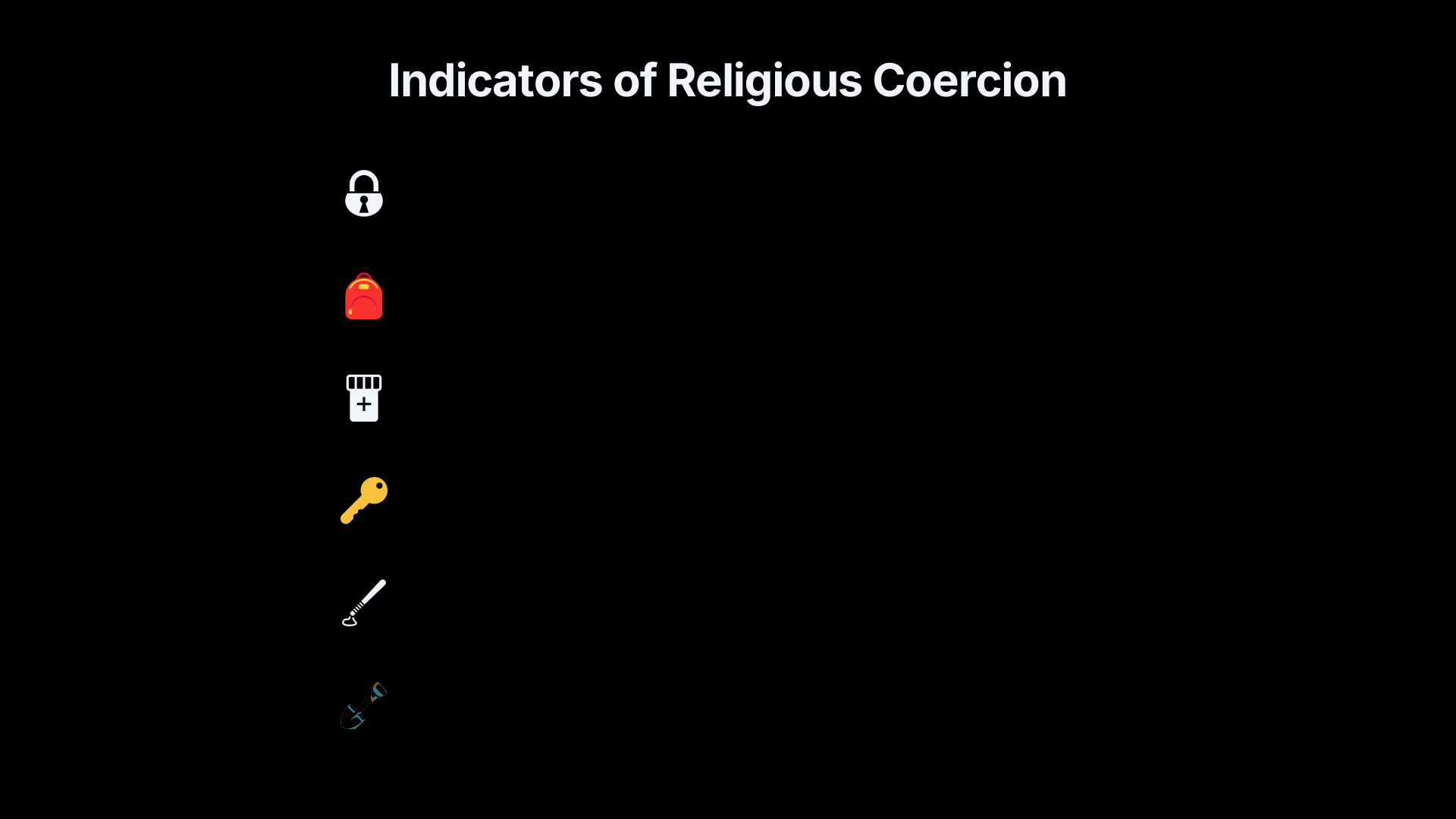
A more defensible approach regulates harmful conduct rather than theology. Warning signs include:
- preventing members from leaving or contacting relatives;
- removing children from education without lawful alternatives;
- withholding necessary medical treatment from dependants;
- forced fasting, beatings, confinement or sexual abuse;
- confiscating property through deception or threats;
- concealing deaths or burials;
- using armed guards or internal punishments;
- repeatedly defying court, child-protection or public-health orders.
These behaviours can be investigated without deciding which doctrines are spiritually true. Religious freedom does not include freedom to imprison, assault, defraud or kill, while unusual prophecy by itself is not proof of criminality.
Reform also depends on institutions acting on information already available. Shakahola was not hidden solely by religious secrecy: it was protected by remoteness, fragmented records, inconsistent policing and failures to connect complaints concerning missing relatives, children, unlawful schooling and previous arrests. Better coordination between local administrators, police, health workers, schools and child-protection agencies may prevent more harm than a sweeping prohibition on “cults”.
What Kenya’s episodes have in common
Kenya’s cult scares, witchcraft accusations and school illness outbreaks do not share a single psychological cause. Their common element is uncertainty under pressure. When familiar institutions fail to provide convincing explanations, people turn to stories that make danger legible: secret Satanists, a malicious neighbour, poisoned food, demonic attack, miraculous healing or an approaching apocalypse.
Those stories spread most effectively when they connect with existing tensions. Devil-worship rumours drew power from distrust of elites and fear of youth disorder. School outbreaks developed in environments shaped by close observation, discipline and academic stress. Witchcraft accusations attached private misfortune to vulnerable older people. Mackenzie’s movement offered certainty and salvation while isolating followers from institutions that might challenge his authority.
Media attention can either clarify or intensify such events. Reporting helped expose Shakahola and forced public scrutiny of state failures. Yet dramatic coverage has also repeated supernatural allegations as though repetition itself were evidence, especially during school scares and Satanic panics. Images of distressed pupils, anonymous claims and labels such as “cult” can travel far faster than laboratory results, court records or corrections.
The strongest lesson is therefore not that Kenyans are unusually susceptible to superstition. Comparable processes occur wherever social stress, weak oversight and trusted authority combine. Kenya’s history is distinctive in the way colonial rule, religious pluralism, rapid church growth, boarding-school culture, land insecurity and political distrust have shaped the form those episodes take.
Why the distinction matters
Calling every disturbing collective event “mass hysteria” can blame victims and excuse institutions. The term fits neither people murdered after witchcraft accusations nor followers subjected to alleged violence at Shakahola. Likewise, calling every unconventional religious community a cult can reproduce the errors made against anti-colonial and minority movements.
A careful account asks what kind of episode is actually being described:
- Mass psychogenic illness involves real symptoms spreading through stress and social interaction after medical hazards have been investigated.
- Moral panic occurs when a person or practice is portrayed as a vast threat, often through exaggerated or weakly evidenced claims.
- Witch persecution uses supernatural accusation to justify exclusion, dispossession or violence.
- Millenarian religion centres on an expected transformation or end of the present world; it is not inherently violent.
- High-control religious abuse involves coercion, isolation, exploitation or punishment, regardless of whether the theology is mainstream or unusual.
- Hostile labelling occurs when authorities or opponents call a group a cult mainly to discredit its beliefs or politics.
Kenya has experienced all of these. Its history is most illuminating when the categories remain separate. The devil-worship panic demonstrates the damage that official endorsement can give to poorly evidenced fears. School outbreaks show how distress can become physically contagious without being fraudulent. Witchcraft killings reveal how shared belief can be weaponised against vulnerable people. Shakahola shows the opposite danger: treating warning signs as merely strange religion until isolation and coercion have already become lethal.
The enduring challenge is to remain sceptical in two directions at once—sceptical of spectacular rumours, but equally sceptical of charismatic authority and official complacency. That balance offers the best protection both for freedom of belief and for the people whose lives can be destroyed when belief becomes accusation, control or violence.
Amazon book picks
Further Reading
Books and field guides related to When Fear, Faith and Rumour Gripped Kenya. Use these as the next step if you want deeper reading beyond the article.
African religions and philosophy
Explains indigenous religious traditions underlying many Kenyan cases.

The Psychology of Pandemics
Useful for understanding rumours, panic and collective fear.

The dynamics of violence in central Africa
Helps frame political and social tensions behind episodes of fear.
The Invention of Africa
Provides broad context for colonial power, belief and religious authority in Africa.
Endnotes
1.
Source: ajess.kibu.ac.ke
Link:https://ajess.kibu.ac.ke/a-history-of-dini-ya-musambwa-in-bungoma-county-kenya-1940-2017/
Source snippet
A History of Dini Ya Musambwa in Bungoma County, KenyaAugust 7, 2019 — 7 Aug 2019 — The study was focused on the Dini ya Musambwa, a very...
Published: August 7, 2019
2.
Source: jstor.org
Link:https://www.jstor.org/stable/484219
Source snippet
Con- sequently, Bukusu had as much right to the rewards of independence as the...Read more...
3.
Source: 1997-2001.state.gov
Title: irf kenya
Link:https://1997-2001.state.gov/global/human_rights/irf/irf_rpt/irf_kenya.html
Source snippet
State.gov2000 Annual Report for International Religious Freedom: KenyaThe Report of the 1994 Presidential Commission of Inquiry into Devi...
4.
Source: popula.com
Title: demons and dissidents
Link:https://popula.com/2019/01/21/demons-and-dissidents/
5.
Source: researchgate.net
Title: Research Gate The Political Life of Devil Worship Rumors in Kenya
Link:https://www.researchgate.net/publication/292458401_Making_peace_with_the_devil_The_political_life_of_devil_worship_rumors_in_Kenya
6.
Source: pmc.ncbi.nlm.nih.gov
Link:https://pmc.ncbi.nlm.nih.gov/articles/PMC3588562/
7.
Source: nation.africa
Title: explainer all you need to know about mass hysteria 212052
Link:https://nation.africa/kenya/life-and-style/health/explainer-all-you-need-to-know-about-mass-hysteria-212052
8.
Source: nation.africa
Title: eregi students suffered from hysteria health officials rule 4392342
Link:https://nation.africa/kenya/news/eregi-students-suffered-from-hysteria-health-officials-rule-4392342
9.
Source: helpage.org
Title: Help Age International Older people in Kenya must be protected from witchcraft
Link:https://www.helpage.org/news/older-people-must-be-protected-from-witchcraft-accusations/
10.
Source: knchr.org
Title: Press Statement Lynching of Elderly and Poor Women in Gusiiland
Link:https://www.knchr.org/Articles/ArtMID/2432/ArticleID/1123/Press-Statement-Lynching-of-Elderly-and-Poor-Women-in-Gusiiland
11.
Source: cambridge.org
Link:https://www.cambridge.org/core/journals/international-annals-of-criminology/article/exploring-the-magnitude-characteristics-and-socioeconomic-contexts-of-witchcraftrelated-eldercides-in-kenya/D8ACF5B2B1097BCD0A72B42E4B02DBE9
12.
Source: hakiyetu.ke
Title: Witchcraft and abuse of the elderly in Kilifi and Kwale County
Link:https://hakiyetu.ke/wp-content/uploads/2024/12/The-Aged-on-Edge-Witchcraft-and-abuse-of-the-elderly-in-Kilifi-and-Kwale-County.pdf
13.
Source: reuters.com
Link:https://www.reuters.com/world/africa/kenyan-court-charges-cult-leader-over-dozens-more-deaths-2026-02-11/
14.
Source: knchr.org
Title: ’s MONITORING FINDINGS OF THE SHAKAHOLA TRADEGY “MASHAKA YA SHAKAHOLA”
Link:https://www.knchr.org/Articles/ArtMID/2432/ArticleID/1191/KNCHR%E2%80%99s-MONITORING-FINDINGS-OF-THE-SHAKAHOLA-TRADEGY-%E2%80%9CMASHAKA-YA-SHAKAHOLA%E2%80%9D
15.
Source: knchr.org
Link:https://www.knchr.org/Articles/ArtMID/2432/ArticleID/1156/Press-Release-KNCHR-Calls-For-A-
16.
Source: knchr.org
Link:https://www.knchr.org/Articles/ArtMID/2432/ArticleID/1159/Press-Release-RE-VICTIMIZATION-
17.
Source: knchr.org
Title: Report on Shakahola Killings
Link:https://www.knchr.org/Articles/ArtMID/2432/ArticleID/1189/KNCHR-Report-on-Shakahola-Killings
18.
Source: knchr.org
Link:https://www.knchr.org/Articles/PgrID/2432/PageID/1/PID/2432/ev/1/CategoryID/1/CategoryName/General
19.
Source: knchr.org
Title: KNCHR State of Human Rights Report JULY 2023 NOVEMBER 2024 1
Link:https://www.knchr.org/Portals/0/KNCHR%20State%20of%20Human%20Rights%20Report%20%20JULY%202023-NOVEMBER%202024_1.pdf
Published: JULY 2023
20.
Source: knchr.org
Link:https://www.knchr.org/Offices/Western-Region/Public-Education-and-Training
21.
Source: knchr.org
Link:https://www.knchr.org/Articles/PgrID/2432/PageID/7/ArtMID/2432/CategoryID/3
22.
Source: knchr.org
Title: annual report
Link:https://www.knchr.org/Portals/0/KNCHR%202023%20-%202024%20ANNUAL%20REPORT%20Lighter%20version%20for%20ONLINE.pdf
23.
Source: knchr.org
Title: STATE OF HUMAN RIGHTS IN KENYA JULY 2023 NOVEMBER 2024
Link:https://www.knchr.org/Articles/ArtMID/2432/ArticleID/1207/STATE-OF-HUMAN-RIGHTS-IN-KENYA-JULY-2023-NOVEMBER-2024
Published: JULY 2023
24.
Source: history.com
Title: what was satanic panic 1980s
Link:https://www.history.com/articles/what-was-satanic-panic-1980s
25.
Source: researchgate.net
Link:https://www.researchgate.net/publication/19181102_Family_Hysteria_in_a_Kenyan_Setting
26.
Source: youtube.com
Title: Kenyan elders killed in witch-hunt
Link:https://www.youtube.com/watch?v=Dhg7I7ZZPYE
Source snippet
Dini Ya Msambwa...
27.
Source: youtube.com
Title: Dini Ya Msambwa
Link:https://www.youtube.com/watch?v=CkrPZUFMen4
Source snippet
This final video provides a historical breakdown of the anti-colonial Dini ya Msambwa movement in Kenya, directly aligning with the conte...
28.
Source: icwa.org
Link:https://www.icwa.org/wp-content/uploads/2015/09/DER-22.pdf
Source snippet
Institute of Current World AffairsDini ya Msambwa III: Nativism"Future historians will say, I thiuk, that the peak event of the twentieth...
29.
Source: archive.spectator.co.uk
Title: dini ya msambwa
Link:https://archive.spectator.co.uk/article/11th-august-1950/9/dini-ya-msambwa
Source snippet
» 11 Aug 1950 »In the name of Dini Ya Msambwa he proclaimed the overthrow and ejection of the white men, the appropriation of their lands...
30.
Source: libraryir.parliament.go.ke
Link:https://libraryir.parliament.go.ke/items/48d6ab48-6b7c-4cbd-b8c2-adbc3d9c80b5
Source snippet
Date. 1994-10-21. Authors. Archbishop Nicodemus Kirima · Commission...Read more...
31.
Source: taylorfrancis.com
Title: devil worship moral discourse youth kenya david samper
Link:https://www.taylorfrancis.com/chapters/edit/10.4324/9780203872659-14/devil-worship-moral-discourse-youth-kenya-david-samper
32.
Source: theguardian.com
Link:https://www.theguardian.com/world/1999/aug/12/1
33.
Source: christiancentury.org
Title: reporting satan
Link:https://www.christiancentury.org/article/2011-07/reporting-satan
34.
Source: the-star.co.ke
Title: 2019 10 04 starehe girls students suffering from mass hysteria health ministry
Link:https://www.the-star.co.ke/news/2019-10-04-starehe-girls-students-suffering-from-mass-hysteria-health-ministry
35.
Source: aciafrica.org
Title: ACI Africa Strange Illness at Kenyan Catholic School: What Really
Link:https://www.aciafrica.org/news/9292/strange-illness-at-kenyan-catholic-school-what-really-happened
36.
Source: Wikipedia
Title: Mass psychogenic illness
Link:https://en.wikipedia.org/wiki/Mass_psychogenic_illness
37.
Source: pulitzercenter.org
Title: inside kenyan cult starved itself death
Link:https://pulitzercenter.org/stories/inside-kenyan-cult-starved-itself-death
38.
Source: newyorker.com
Link:https://www.newyorker.com/magazine/2024/08/26/the-cult-in-the-forest
39.
Source: apnews.com
Link:https://apnews.com/article/54a384a5aa4842490b7ffec5139d73e8
40.
Source: libraryir.parliament.go.ke
Title: Bunge Library FINAL REPORT-AD HOC COMMITTEE ON SHAKAHOLA-1
Link:https://libraryir.parliament.go.ke/bitstreams/19ab8975-9998-40f0-a885-fd8b1b57bab8/download
41.
Source: capitalfm.africa
Title: paul mackenzie shakahola trial case to answer
Link:https://capitalfm.africa/paul-mackenzie-shakahola-trial-case-to-answer/
42.
Source: parliament.go.ke
Title: Parliament of Kenya House adopts report on Shakahola deaths, supports
Link:https://www.parliament.go.ke/sites/default/files/2024-03/The%20Senate%20Weekly%20-%20Issue%20No.%2019.pdf
43.
Source: parliament.go.ke
Link:https://parliament.go.ke/node/19888
44.
Source: Wikipedia
Title: Moral panic
Link:https://en.wikipedia.org/wiki/Moral_panic
45.
Source: Wikipedia
Title: Dini Ya Msambwa
Link:https://en.wikipedia.org/wiki/Dini_Ya_Msambwa
46.
Source: pmc.ncbi.nlm.nih.gov
Link:https://pmc.ncbi.nlm.nih.gov/articles/PMC7396040/
47.
Source: pmc.ncbi.nlm.nih.gov
Link:https://pmc.ncbi.nlm.nih.gov/articles/PMC12860665/
48.
Source: parliament.go.ke
Title: Wednesday, 29th November, 2023 at 9.30 a.m
Link:https://www.parliament.go.ke/sites/default/files/2024-02/Wednesday%2C%2029th%20November%2C%202023%20at%209.30%20a.m..pdf
49.
Source: parliament.go.ke
Title: Supplementary Order Paper Thursday 27.04.2023
Link:https://www.parliament.go.ke/sites/default/files/2023-04/Supplementary%20Order%20Paper%20-%20Thursday%2027.04.2023.pdf
50.
Source: parliament.go.ke
Link:https://parliament.go.ke/sites/default/files/2025-11/2025%20Report%20on%20State%20of%20National%20Security_0.pdf
51.
Source: parliament.go.ke
Link:https://www.parliament.go.ke/sites/default/files/2024-02/Programme%20of%20Senate%20Business%20for%20the%20week%2031.10.2023.pdf
52.
Source: parliament.go.ke
Title: Order Paper Tuesday 31.10.2023 (1)
Link:https://www.parliament.go.ke/sites/default/files/2024-02/Order%20Paper%20-%20Tuesday%2031.10.2023%20%281%29.pdf
53.
Source: libraryir.parliament.go.ke
Link:https://libraryir.parliament.go.ke/bitstreams/70be6667-f414-428a-93c0-65aa083e8118/download
54.
Source: parliament.go.ke
Title: Supplementary Order Paper Wednesday 29.11.2023 (Afternoon Sitting)
Link:https://parliament.go.ke/sites/default/files/2024-02/Supplementary%20Order%20Paper%20-%20Wednesday%2029.11.2023%20%28Afternoon%20Sitting%29.pdf
Additional References
55.
Source: paukwa.or.ke
Link:https://www.paukwa.or.ke/story-series/dinizetu/dini-ya-msambwa/
Source snippet
Dini ya MsambwaDubbed East Africa's anti-colonial religion, Dini ya Msambwa is a religious movement that was championed by the Buku...
56.
Source: facebook.com
Link:https://www.facebook.com/100063998296652/posts/dini-ya-msambwa-religion-of-the-ancestor-is-an-african-traditional-religion-that/383223703820903/
57.
Source: facebook.com
Link:https://www.facebook.com/cgtnafrica/posts/icymi-kenya-will-convert-shakahola-forest-where-more-than-200-members-of-a-chris/649796847186703/
58.
Source: facebook.com
Link:https://www.facebook.com/kenny.kaburu/posts/mass-hysteria-in-schools-unraveling-the-mystery-in-the-wake-of-the-recent-incide/10161348093679697/
59.
Source: historyonthenet.com
Link:https://www.historyonthenet.com/moral-panics-mass-hysteria-dancing-plague-salem-witch-trials-tulip-market-bubble
60.
Source: time.com
Link:https://time.com/6287440/kenya-shakahola-mackenzie-death-cult/
61.
Source: facebook.com
Link:https://www.facebook.com/NTVKenya/posts/mysterious-disease-hits-eregi-school42-more-students-from-eregi-girls-kakamega-c/875565450889337/
62.
Source: academia.edu
Link:https://www.academia.edu/36836832/Religion_of_the_Ancestor_s_Dini_Ya_Musambwa_in_East_Africa_Historical_and_Theological_Analysis
63.
Source: scribd.com
Link:https://www.scribd.com/document/833767078/Report-of-the-Presidential-Commission-of-Inquiry-Into-the-Cult-of-Devil-Worship-in-Kenya-1
64.
Source: facebook.com
Link:https://www.facebook.com/natgeo/posts/the-mass-hysteria-and-superstition-that-enabled-witch-hunts-through-history-resu/541210507376384/
Topic Tree
Follow this branch
Related pages 192
- Antigua and Barbuda
- Argentina Belief Scares
- Azerbaijan Belief
- Bahrain Beliefs
- North Korea
- +187 more in sidebar