Within Tonga
How Conversion Became a Weapon in Tonga
Conversion became a badge of political loyalty as Christian chiefs fought rivals for authority, territory and control of Tonga's future.
On this page
- Missionaries, chiefs and divided communities
- The 1837 fighting and disputed atrocities
- Why religious victory seemed to prove divine power
Page outline Jump by section
Introduction
Christian conversion in nineteenth-century Tonga was never simply a matter of private belief. As rival chiefs struggled to dominate the islands, adopting Christianity became a visible sign of political allegiance, while rejecting it could be interpreted as support for competing leaders. The result was a series of conflicts in which religious identity and civil war became tightly intertwined. Military victories were celebrated as proof of divine favour, while defeats were often interpreted as evidence that the old religious order had lost its power. Historians therefore view the Tongan conversion wars not as a straightforward conflict between Christianity and traditional religion, but as a civil war in which political ambition, chiefly rivalry and missionary influence reinforced one another.[OUP Academic]academic.oup.comOUP AcademicTonga | Patrons, Clients, and Empire: Chieftaincy and Over-rule in Asia, Africa, and the Pacific | Oxford AcademicJanuary 2…
Unlike later moral panics driven by rumours or mass media, the spread of belief in this period depended on chiefly authority, kinship networks and military success. Conversion reshaped loyalties across entire communities, making religion an increasingly important marker of who would govern Tonga’s future.
Missionaries, chiefs and divided communities
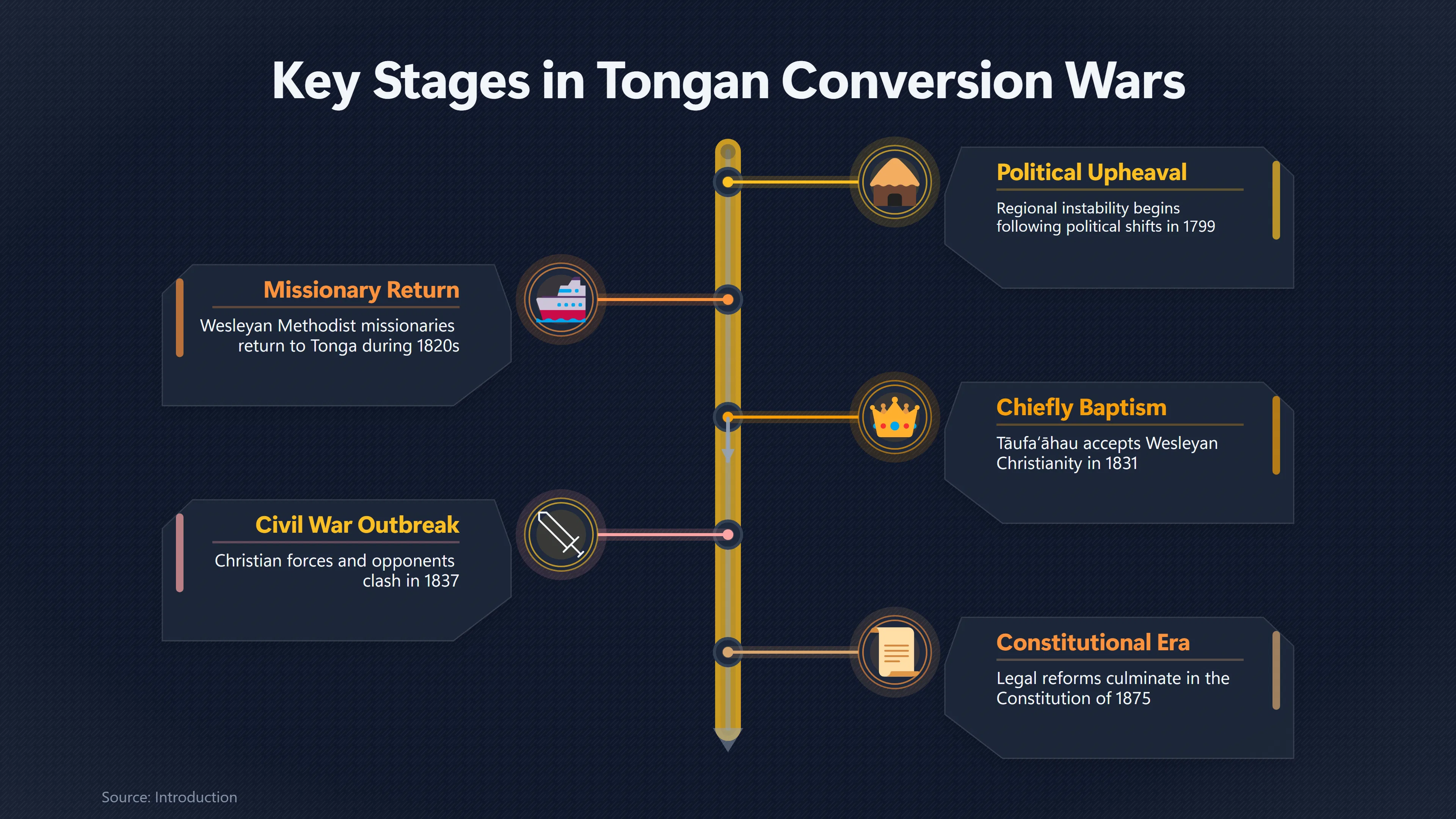
When Wesleyan Methodist missionaries returned successfully to Tonga during the 1820s, they entered a society already fragmented by decades of conflict following the political upheavals that began around 1799. Rival chiefs competed for influence across Tongatapu, Ha’apai and Vava’u, while no single authority controlled the whole archipelago. Christianity therefore spread through an existing landscape of political competition rather than into a peaceful kingdom.[National Library of New Zealand]natlib.govt.nzNational Library of New ZealandThe demise of the Tu'i Kanokupolu Ton… | Items | National Library of New Zealand | National Library of N…
The most significant convert was the chief Tāufaʻāhau, later King George Tupou I. Baptised in 1831, he embraced Wesleyan Christianity while also pursuing a long-term programme of political unification. Missionaries introduced literacy, schools, printed religious texts and new legal ideas, all of which strengthened the authority of chiefs who allied themselves with the mission. Conversion therefore offered practical as well as spiritual advantages.[Religious Studies Center]rsc.byu.eduReligious Studies Center Church Growth in Tonga | Religious Studies CenterReligious Studies CenterChurch Growth in Tonga | Religious Studies CenterJanuary 1, 2008…
For many communities, however, accepting Christianity also meant accepting the growing influence of Tāufaʻāhau. Chiefs who remained attached to older religious traditions were not merely defending inherited beliefs. They were also defending regional independence and existing political authority. This explains why conversion often spread unevenly and why entire districts could divide along both religious and political lines.
Missionaries themselves did not exercise political power independently, but they became influential advisers. Their close relationship with Christian chiefs has remained one of the most debated features of this period because contemporaries disagreed sharply over how actively they encouraged military campaigns.[media.methodist.org.uk]media.methodist.org.ukThe Bible and the SwordThe Bible and the Sword
The 1837 fighting and disputed atrocities
The civil war that erupted in 1837 became the defining example of how religion and politics merged in nineteenth-century Tonga. Christian forces loyal to Tāufaʻāhau fought opponents centred on fortified settlements, particularly on Tongatapu, in a campaign remembered for both military brutality and intense religious rhetoric.[media.methodist.org.uk]media.methodist.org.ukThe Bible and the SwordThe Bible and the Sword
The controversy surrounding these events owes much to conflicting eyewitness accounts.
Supporters of the Wesleyan mission argued that Christian communities faced genuine threats from opponents determined to destroy both the new religion and its converts. In this interpretation, armed resistance was presented as unavoidable self-defence rather than religious conquest. Missionary biographies and reports emphasised attacks on Christian villages and portrayed the conflict as necessary for survival.[media.methodist.org.uk]media.methodist.org.ukThe Bible and the SwordThe Bible and the Sword
Other observers painted a far darker picture. The trader and explorer Peter Dillon accused Wesleyan missionary John Thomas of encouraging military violence and claimed that Christian forces committed massacres against defeated opponents. Dillon argued that missionary influence had transformed an existing political struggle into what amounted to a holy war. His accusations circulated widely and shaped later European perceptions of the conflict.[eHRAF World Cultures]ehrafworldcultures.yale.edue HRAF World Cultures Holy WareHRAF World CulturesHoly War - eHRAF World Cultures…
Modern historians generally avoid accepting either narrative without qualification. Martin Daly’s detailed reassessment concludes that earlier missionary accounts often understated their political involvement, while the evidence also shows that Dillon’s highly polemical writings reflected his own perspective and grievances. The surviving records were written by participants, missionaries or foreign visitors with clear personal and denominational interests, making precise reconstruction difficult.[scholarlypublishingcollective.org]scholarlypublishingcollective.orgTHE BIBLE AND THE SWORD JOHN THOMAS AND THE TONGANTHE BIBLE AND THE SWORD: JOHN THOMAS AND THE TONGAN CIVIL WAR OF 1837 | Wesley and Methodist Studies | Scholarly Publishing Collective…
Because of these competing sources, historians continue to debate the scale of atrocities, the degree of missionary responsibility and the balance between religious conviction and political calculation. There is broad agreement, however, that the conflict cannot be reduced either to a purely religious crusade or to an ordinary dynastic war.
Why religious victory seemed to prove divine power
One reason Christianity spread rapidly after these conflicts was that military success appeared to confirm the truth of the new faith. Throughout Polynesia, warfare and religion had long been connected through beliefs that victory reflected supernatural favour. Christianity entered this cultural framework rather than replacing it immediately.
When Christian armies defeated opponents, many observers interpreted the outcome as evidence that the Christian God possessed greater power than traditional deities. Chiefs who converted after defeats were therefore responding not only to military realities but also to what appeared to be convincing spiritual proof.[OUP Academic]academic.oup.comOUP AcademicTonga | Patrons, Clients, and Empire: Chieftaincy and Over-rule in Asia, Africa, and the Pacific | Oxford AcademicJanuary 2…
Missionaries reinforced this interpretation by presenting victories as signs of divine blessing. Reports celebrated the destruction of traditional shrines, the building of churches and the rapid expansion of Christian congregations. Some accounts described mass conversions as remarkable demonstrations of God’s intervention, linking battlefield success with religious transformation.[ScienceDirect]sciencedirect.comScienceDirect Kerstening, staatsvorming en geweld op de Tonga-eilandenKerstening, staatsvorming en geweld op de Tonga-eilanden - ScienceDirect…
This mechanism helps explain why conversion accelerated once major chiefs aligned themselves with Christianity. Belief spread through collective decisions by villages and chiefly networks rather than solely through individual persuasion. Religion became embedded within emerging political authority, making loyalty to the Christian kingdom increasingly difficult to separate from loyalty to the ruling leadership.
Beyond the idea of a simple “holy war”
Modern scholarship treats the Tongan civil wars as an example of state formation, religious change and political rivalry occurring simultaneously. Rather than viewing Christianity as merely a cover for conquest, or warfare as incidental to evangelisation, historians increasingly argue that each process reshaped the other.
Tāufaʻāhau used Christian institutions to support the construction of a more centralised kingdom, while missionaries benefited from the protection of a powerful ruler committed to expanding Christianity. The resulting alliance helped lay the foundations for later legal reforms, widespread literacy and the eventual Constitution of 1875, but it also left a legacy of controversy over the relationship between religious authority and political power.[OUP Academic]academic.oup.comOUP AcademicTonga | Patrons, Clients, and Empire: Chieftaincy and Over-rule in Asia, Africa, and the Pacific | Oxford AcademicJanuary 2…
For the wider history of collective belief in Tonga, the conversion wars illustrate an important distinction. They were not episodes of mass hysteria in the psychological sense, nor were they simply fabricated moral panics. Instead, they show how sincere religious conviction, political ambition and military conflict can reinforce one another until victory itself is interpreted as proof of supernatural truth. That dynamic gave religious belief extraordinary social force and permanently altered the political and cultural landscape of Tonga.[media.methodist.org.uk]media.methodist.org.ukThe Bible and the SwordThe Bible and the Sword



Endnotes
1.
Source: academic.oup.com
Link:https://academic.oup.com/book/4628/chapter/146775369
Source snippet
OUP AcademicTonga | Patrons, Clients, and Empire: Chieftaincy and Over-rule in Asia, Africa, and the Pacific | Oxford AcademicJanuary 2...
2.
Source: media.methodist.org.uk
Title: The Bible and the Sword
Link:https://media.methodist.org.uk/media/documents/missionary-history-daly-tongan-civil-war-2010.pdf
3.
Source: scholarlypublishingcollective.org
Title: THE BIBLE AND THE SWORD JOHN THOMAS AND THE TONGAN
Link:https://scholarlypublishingcollective.org/psup/wms/article/doi/10.2307/42909828/311592/THE-BIBLE-AND-THE-SWORD-JOHN-THOMAS-AND-THE-TONGAN
Source snippet
THE BIBLE AND THE SWORD: JOHN THOMAS AND THE TONGAN CIVIL WAR OF 1837 | Wesley and Methodist Studies | Scholarly Publishing Collective...
4.
Source: sciencedirect.com
Title: ScienceDirect Kerstening, staatsvorming en geweld op de Tonga-eilanden
Link:https://www.sciencedirect.com/org/science/article/pii/S0006229492000017
Source snippet
Kerstening, staatsvorming en geweld op de Tonga-eilanden - ScienceDirect...
5.
Source: academic.oup.com
Link:https://academic.oup.com/book/4628/chapter-abstract/146775369
6.
Source: natlib.govt.nz
Link:https://natlib.govt.nz/records/20532868
Source snippet
National Library of New ZealandThe demise of the Tu'i Kanokupolu Ton... | Items | National Library of New Zealand | National Library of N...
7.
Source: rsc.byu.edu
Title: Religious Studies Center Church Growth in Tonga | Religious Studies Center
Link:https://rsc.byu.edu/regional-studies-latter-day-saint-church-history-pacific-isles/church-growth-tonga
Source snippet
Religious Studies CenterChurch Growth in Tonga | Religious Studies CenterJanuary 1, 2008...
Published: January 1, 2008
8.
Source: ehrafworldcultures.yale.edu
Title: e HRAF World Cultures Holy War
Link:https://ehrafworldcultures.yale.edu/cultures/ou09/documents/068
Source snippet
eHRAF World CulturesHoly War - eHRAF World Cultures...
9.
Source: rsc.byu.edu
Title: setting stage
Link:https://rsc.byu.edu/saints-tonga/setting-stage
Additional References
10.
Source: books.openedition.org
Title: Open Edition Books Les dynamiques religieuses dans le pacifique
Link:https://books.openedition.org/pacific/128?lang=en
Source snippet
OpenEdition BooksLes dynamiques religieuses dans le pacifique - Mémoire trouble. Histoire d’une recomposition politico-religieuse en Poly...
11.
Source: youtube.com
Link:https://www.youtube.com/watch?v=62R5dA8l7jE
Source snippet
LDKS Ep. 130: 1834 Polynesian Pentecost Unleashed: Tonga's "To 'a e 'Ofa" Pt. 1 of 2...
12.
Source: dmbi.online
Link:https://dmbi.online/index.php?do=app.entry&id=2716
Source snippet
1824 Image Image: Click to enlarge WM missionary to Tonga, born in Clent, Worcs, to a blacksmith's family on 7 November 1797. He was conv...
Published: November 1797
13.
Source: researchgate.net
Link:https://www.researchgate.net/publication/385145256_LOTU_AND_FELUPE_Reimagining_a_new_and_unifying_approach_to_climate_resilience_in_Tonga
14.
Source: maa.cam.ac.uk
Link:https://maa.cam.ac.uk/fiji-chiefdoms
15.
Source: archival.sl.nsw.gov.au
Link:https://archival.sl.nsw.gov.au/Details/archive/110087338
16.
Source: tandfonline.com
Link:https://www.tandfonline.com/doi/abs/10.1080/00223340802281635
17.
Source: geognos.com
Title: Geo Gnos Tonga Historiography — Australia-Oceania Historical Timeline | Geo Gnos
Link:https://www.geognos.com/en/place/tonga/history
18.
Source: era.ed.ac.uk
Title: ed.ac.uk The State and the Church, the State of the Church in Tonga
Link:https://era.ed.ac.uk/handle/1842/2236
19.
Source: scribd.com
Title: Steven R Fischer 2002 A History of the Pacific Islands
Link:https://www.scribd.com/document/764988605/Steven-R-Fischer-2002-A-History-of-the-Pacific-Islands
Topic Tree