Within Thailand
How Anti Communist Fear Helped Enable a Massacre
In 1976, propaganda transformed student protesters into imagined enemies and helped make mass violence appear to be national defence.
On this page
- The regional crisis and Thailand's political tensions
- Media distortion and the creation of an enemy
- The massacre, coup and long struggle over memory
Page outline Jump by section
Introduction
The violence at Bangkok’s Thammasat University on 6 October 1976 is the clearest modern example in Thailand of a political moral panic helping to legitimise mass violence. The massacre did not arise simply because of ideological disagreement. It developed through months of escalating anti-communist propaganda in which student activists, labour organisers and democratic campaigners were increasingly portrayed as traitors, foreign agents and enemies of the nation, religion and monarchy. In this atmosphere, rumours, manipulated media coverage and official rhetoric transformed political opponents into an imagined existential threat. Historians generally argue that the panic was not a spontaneous outbreak of public fear but a campaign amplified by sections of the state, right-wing organisations and sympathetic media during an exceptionally tense regional moment.[wikipedia.org]Wikipedia6 October 1976 massacre6 October 1976 massacre

Within Thailand’s wider history of collective fears, the events of October 1976 stand apart because the consequences were immediate and deadly. Rather than producing social stigma or temporary unrest, the anti-communist panic helped create conditions in which extraordinary violence appeared to many participants as an act of patriotic defence.
The regional crisis and Thailand’s political tensions
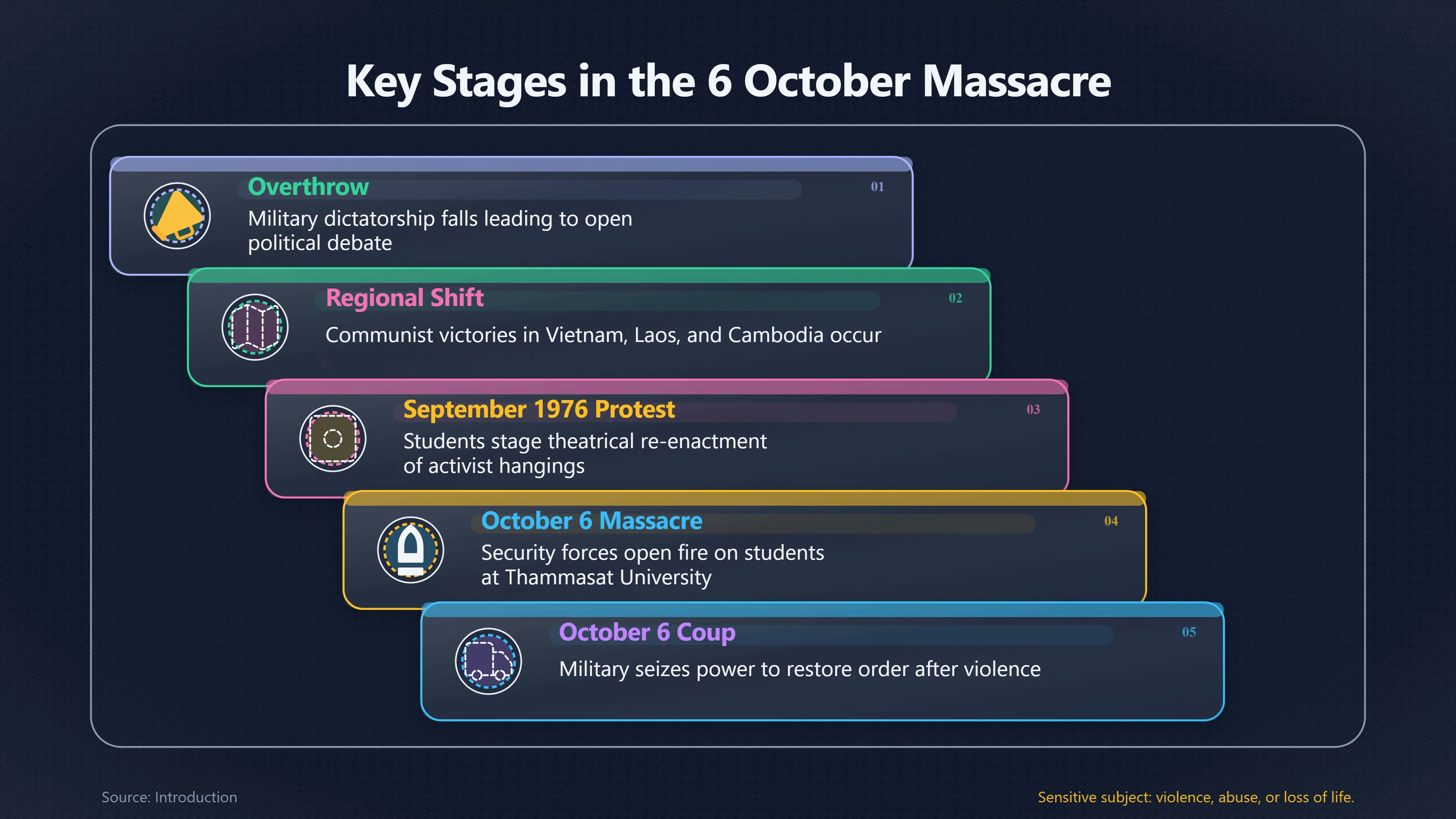
The panic surrounding Thammasat cannot be understood without the wider Cold War setting. During 1975, communist movements achieved victory in Vietnam, Laos and Cambodia. For many Thai military officers, conservative politicians and royalist organisations, these rapid changes reinforced the long-standing “domino theory” belief that Thailand might be next.
At the same time, Thailand was experiencing an unusually open political period after the military dictatorship had been overthrown in 1973. Universities became centres of debate, labour unions expanded, farmers’ organisations became more active and students criticised corruption, inequality and military influence in politics. While many protesters demanded democratic reform rather than revolution, conservative critics increasingly blurred these distinctions.
Historians note that the label “communist” was applied far more broadly than membership of the Communist Party of Thailand justified. Reformers, trade unionists, journalists and student leaders could all be portrayed as part of a single subversive movement. This simplification reduced complex political disagreements to an absolute struggle between loyal patriots and enemies of the nation.[Wikipedia]Wikipedia6 October 1976 massacre6 October 1976 massacre
Media distortion and the creation of an enemy
The most important mechanism behind the panic was the creation of a symbolic enemy rather than the discovery of a genuine conspiracy.
In September and early October 1976, demonstrations opposed the return of former military dictator Thanom Kittikachorn from exile. During one protest, students staged a theatrical re-enactment of the hanging of activists who had recently been killed elsewhere in Thailand. The performance was intended as political theatre.
The following day, however, the right-wing newspaper Dao Siam published a photograph of the play alongside claims that the hanged student resembled Crown Prince Vajiralongkorn. The implication was that the students had committed lèse-majesté by mocking the royal family. Military-controlled radio stations and right-wing broadcasters rapidly repeated and intensified these accusations, linking alleged insults to the monarchy with communist subversion.
Recent scholarship argues that the photograph acquired a political meaning far beyond what it actually depicted. Rather than functioning simply as documentary evidence, it became a propaganda image through which fears of communism, disloyalty and national collapse were condensed into a single emotionally powerful symbol. The picture helped transform ordinary student protesters into imagined existential enemies in the public imagination.[Taylor & Francis Online]tandfonline.comTaylor & Francis OnlinePhotographic realism and communism: the twin spectres in the image of the student skit in Dao Sayam: South East As…
This illustrates a classic feature of political moral panic. The emotional power of an image mattered more than careful investigation of its context. Once influential institutions repeatedly presented the students as dangerous traitors, calls for restraint became increasingly difficult to sustain.
Why anti-communist fear spread so effectively
Several factors reinforced one another.
- Cold War anxiety: Communist victories in neighbouring countries made warnings about national collapse seem plausible to many citizens.
- Official endorsement: Anti-communist rhetoric came not only from fringe activists but also from influential officials, security agencies and state-supported organisations.
- Mass organisations: Right-wing groups such as the Village Scouts, Nawaphon and the Red Gaurs mobilised large numbers of supporters through patriotic ceremonies, anti-communist education and public demonstrations, reinforcing a narrative that extraordinary measures were necessary to defend Thailand.[Cambridge University Press & Assessment]cambridge.orgCambridge University Press & AssessmentEstablishing State-Dominated Mass Organization (Chapter 4) - Infiltrating Society…
- Media amplification: Newspapers, radio broadcasts and rumours repeatedly described student activists as enemies of the monarchy and agents of foreign communism.
- Binary thinking: Complex political disagreements were reduced to a simple choice between loyalty and treason, making compromise appear impossible.
These mechanisms are familiar to scholars of moral panic. A perceived threat becomes increasingly exaggerated, evidence receives less attention than emotionally compelling stories, and violence can begin to appear defensive rather than aggressive.
The massacre, coup and immediate aftermath
Before dawn on 6 October 1976, police and armed right-wing groups surrounded Thammasat University, where protesters remained on campus. Security forces opened fire using automatic weapons and other military equipment. Some students attempting to escape were shot, while others were beaten, lynched or assaulted by mobs outside the university. Photographs taken that morning documented extraordinary public brutality, including attacks on bodies after death.
Official figures reported 46 deaths and more than 160 injuries, although many historians and survivors believe the true number of people killed was substantially higher. Thousands of students were arrested. Later that same day, the military seized power in a coup, presenting its intervention as necessary to restore order after the violence.[wikipedia.org]Wikipedia6 October 1976 massacre6 October 1976 massacre
For many scholars, the sequence is significant. The massacre was not merely followed by the coup; the climate of fear surrounding alleged communist threats made military intervention appear acceptable, even desirable, to many conservatives who believed Thailand faced imminent collapse.
Why historians describe it as a political moral panic
The Thammasat massacre is rarely analysed simply as spontaneous mob violence. Instead, historians identify several interacting processes.
First, the communist threat was presented in sweeping and often indiscriminate terms. While communist insurgency certainly existed in Thailand during the 1970s, evidence that the student protesters constituted an organised revolutionary conspiracy was weak. The accusation of communism became a flexible political label rather than a precise description.[Wikipedia]Wikipedia6 October 1976 massacre6 October 1976 massacre
Second, media narratives encouraged emotional rather than evidential judgement. The disputed photograph of the student play became proof of treason in the public imagination despite the theatrical context from which it had been removed. Recent historical research has examined precisely how this transformation occurred through visual culture and propaganda.[Taylor & Francis Online]tandfonline.comTaylor & Francis OnlinePhotographic realism and communism: the twin spectres in the image of the student skit in Dao Sayam: South East As…
Third, state institutions and organised civilian groups reinforced each other’s messages. Rather than isolated rumours spreading from below, fear circulated through newspapers, radio broadcasts, political organisations and security networks simultaneously. This gave extraordinary credibility to claims that might otherwise have been questioned.
For these reasons, the episode is often discussed alongside other historical cases in which governments or political movements portrayed dissenting minorities as existential threats whose elimination appeared necessary for national survival.
The long struggle over memory
The violence was followed by decades of limited official accountability. No comprehensive state investigation established responsibility, and the massacre remained an uncomfortable subject in public life. Many school textbooks mentioned it only briefly or avoided detailed discussion altogether.
Survivors, historians and archivists have therefore played a major role in preserving evidence through oral histories, photographs and documentary archives. The independent Documentation of 6 October project has digitised newspapers, witness testimony and official records to counter decades of silence and contested memory. Historians such as Thongchai Winichakul, himself a survivor who was imprisoned after the massacre, have argued that the ambiguity surrounding the event has become part of its history, with public memory shaped as much by forgetting as by remembrance.[Wikipedia]Wikipedia6 October 1976 massacre6 October 1976 massacre
Today the massacre remains one of the defining episodes through which many Thais debate state violence, freedom of expression, historical memory and the dangers of political dehumanisation.
Why the episode remains important
The Thammasat massacre demonstrates that political moral panics need not depend on irrational crowds acting independently. They can emerge through sustained interaction between media, organised movements, official institutions and genuine public anxieties.
For Thailand, the lesson extends beyond the Cold War. The episode shows how fear can narrow the boundary between legitimate political disagreement and imagined national betrayal. When opponents are consistently portrayed as existential enemies rather than fellow citizens, extraordinary violence becomes easier to justify, accountability becomes more difficult to secure, and the struggle over historical memory can continue for generations.
Amazon book picks
Further Reading
Books and field guides related to How Anti-Communist Fear Helped Enable a Massacre. Use these as the next step if you want deeper reading beyond the article.
The Jakarta Method: Washington's Anticommunist Crusade and th...
Places Thailand’s anti-communist panic within the wider regional and global pattern of Cold War propaganda, repression and mass killing.
Thailand: A Short History
Provides the historical background needed to understand Thailand’s monarchy, military politics, Cold War tensions and the forces surround...
The King Never Smiles: A Biography of Thailand's Bhumibol Adu...
Illuminates the monarchy’s political position and the royalist atmosphere that shaped anti-communist mobilisation in modern Thailand.
History of Thailand
Explains Thailand’s twentieth-century political development, authoritarianism, social conflict and the broader setting of the Thammasat v...
Endnotes
1.
Source: Wikipedia
Title: 6 October 1976 massacre
Link:https://en.wikipedia.org/wiki/6_October_1976_massacre
Published: October 1976
2.
Source: cambridge.org
Link:https://www.cambridge.org/core/books/abs/infiltrating-society/establishing-statedominated-mass-organization/CCD1F7CE805EB2A45A2E3D066C5B67D8
Source snippet
Cambridge University Press & AssessmentEstablishing State-Dominated Mass Organization (Chapter 4) - Infiltrating Society...
3.
Source: time.com
Link:https://time.com/4519367/thailand-bangkok-october-6-1976-thammasat-massacre-students-joshua-wong/
Source snippet
Military, police, and right-wing paramilitaries surrounded the campus, accusing the students of being communist and antimonarchical. The...
4.
Source: cambridge.org
Link:https://www.cambridge.org/core/journals/journal-of-southeast-asian-studies/article/power-and-ritual-in-the-city-mourning-and-political-juncture-at-bangkoks-sanam-luang/4D667CC1B27CBBCD629598219E474808
5.
Source: cambridge.org
Title: Infiltrating Society
Link:https://www.cambridge.org/core/books/infiltrating-society/9778077C63C71BCE2592240CC852E7DD/listing
6.
Source: cambridge.org
Link:https://www.cambridge.org/core/journals/journal-of-asian-studies/article/anniversary-of-a-massacre-and-the-death-of-a-monarch/4FD9FA295086CE51B654BCAD342D1F88
7.
Source: history.state.gov
Link:https://history.state.gov/historicaldocuments/frus1969-76ve12/d377
8.
Source: tandfonline.com
Link:https://www.tandfonline.com/doi/full/10.1080/0967828X.2024.2368468
Source snippet
Taylor & Francis OnlinePhotographic realism and communism: the twin spectres in the image of the student skit in Dao Sayam: South East As...
9.
Source: tandfonline.com
Link:https://www.tandfonline.com/doi/abs/10.1080/0967828X.2024.2368468
Source snippet
Photographic realism and communism: the twin spectres in the image of the student skit in Dao Sayam: South East Asia Research: Vol 32, No...
10.
Source: nationthailand.com
Link:https://www.nationthailand.com/thailand/politics/40031667
11.
Source: doct6.com
Link:https://doct6.com/archives/13767
12.
Source: tandfonline.com
Link:https://www.tandfonline.com/doi/full/10.1080/14672715.2015.997344
13.
Source: tandfonline.com
Link:https://www.tandfonline.com/doi/abs/10.1080/14672710802631145
14.
Source: calamitycalendar.com
Title: 6 october 1976 massacre
Link:https://calamitycalendar.com/articles/6-october-1976-massacre
Published: october 1976
15.
Source: military-history.fandom.com
Title: 6 October 1976 massacre
Link:https://military-history.fandom.com/wiki/6_October_1976_massacre
Published: October 1976
16.
Source: owiki.org
Title: 6 October 1976 massacre
Link:https://owiki.org/wiki/6_October_1976_massacre
Published: October 1976
Additional References
17.
Source: englishkyoto-seas.org
Title: vol 13 no 3 book reviews patrick jory
Link:https://englishkyoto-seas.org/2024/12/vol-13-no-3-book-reviews-patrick-jory/
Source snippet
13, No. 3, BOOK REVIEWS, Patrick Jory | CSEAS Journal, Southeast Asian StudiesDecember 26, 2024 — Hyun argues that from the BPP’s origins...
Published: December 26, 2024
18.
Source: historical.parallax.kr
Title: kr Thammasat University Massacre (
Link:https://historical.parallax.kr/a/thammasat-massacre-1976
Source snippet
University Massacre (October 6, 1976) | Historical ParallaxDecember 21, 2025 — DEATH TOLL AND CASUALTIES Official figures: * 46 killed (i...
Published: October 6, 1976
19.
Source: apnews.com
Link:https://apnews.com/article/6548fb95902726a57f11e9fcfa4b6068
Source snippet
Appointed after a 1976 military coup, his hard-line policies led to his ousting by another coup in 1977. Initially appointed by King Bhum...
20.
Source: youtube.com
Link:https://www.youtube.com/watch?v=QW2kx4nzcqw
Source snippet
AP Photographer Reflects on 1976 Lynching Photo...
21.
Source: youtube.com
Title: Thai university massacre casts forty year shadow
Link:https://www.youtube.com/watch?v=Ngm5NlafHWU
Source snippet
Thailand's anti-government student protesters connect with 1976 Thammasat University massacre...
22.
Source: youtube.com
Title: The brutal Bangkok crackdown that was hushed up for years
Link:https://www.youtube.com/watch?v=U1uvvsENsfw
Source snippet
Thai university massacre casts forty year shadow...
23.
Source: prachataienglish.com
Link:https://prachataienglish.com/node/7416
24.
Source: unredacted.com
Link:https://unredacted.com/2014/10/10/declassified-u-s-documents-help-fill-void-left-by-thailands-silence-on-38th-anniversary-of-thammasat-university-massacre/
25.
Source: youtube.com
Link:https://www.youtube.com/watch?v=NlGzZy83rz4
Source snippet
Thai student massacre remembered - YouTube...
26.
Source: researchgate.net
Link:https://www.researchgate.net/publication/374078051_Archiving_Facts_and_Documentary_Films_Sites_of_Memorial_Struggle_for_the_October_6_1976_Massacre_in_Thailand
Topic Tree