Within Jordan Panics
How Did Jordan's Institutions Amplify Fear?
Schools, hospitals, emergency services, newspapers and ministries could turn cautious responses into apparent proof that a danger was real.
On this page
- Why protective action can look like confirmation
- How rumours moved through trusted institutions
- What better crisis communication can prevent
Page outline Jump by section
Introduction
Jordan’s best-documented episodes of collective fear show that institutions do not need to spread false information deliberately to amplify public alarm. Schools, hospitals, emergency services, ministries and news organisations often acted for understandable reasons: protecting children, investigating possible hazards and reassuring anxious families. Yet those same actions could unintentionally convince the public that an unseen danger must be real. The result was a feedback loop in which precaution looked like proof, official concern generated more concern, and rumours gained credibility because trusted institutions appeared to confirm them.
The clearest example is the 1998 school vaccination scare, when more than 800 pupils sought medical attention after receiving tetanus-diphtheria vaccinations. Investigators ultimately concluded that the vast majority of cases reflected mass psychogenic illness rather than vaccine contamination. The episode remains an important case study because it demonstrates how institutional responses can unintentionally strengthen collective fear even while trying to manage it.[eAcademic]eacademic.ju.edu.joe Academic Policy and PracticePolicy and PracticeNovember 7, 2025…
Why protective action can look like confirmation
In any genuine public health emergency, authorities are expected to respond quickly. They cannot simply assume reports are harmless. The challenge is that visible precaution may itself become evidence in the public imagination.
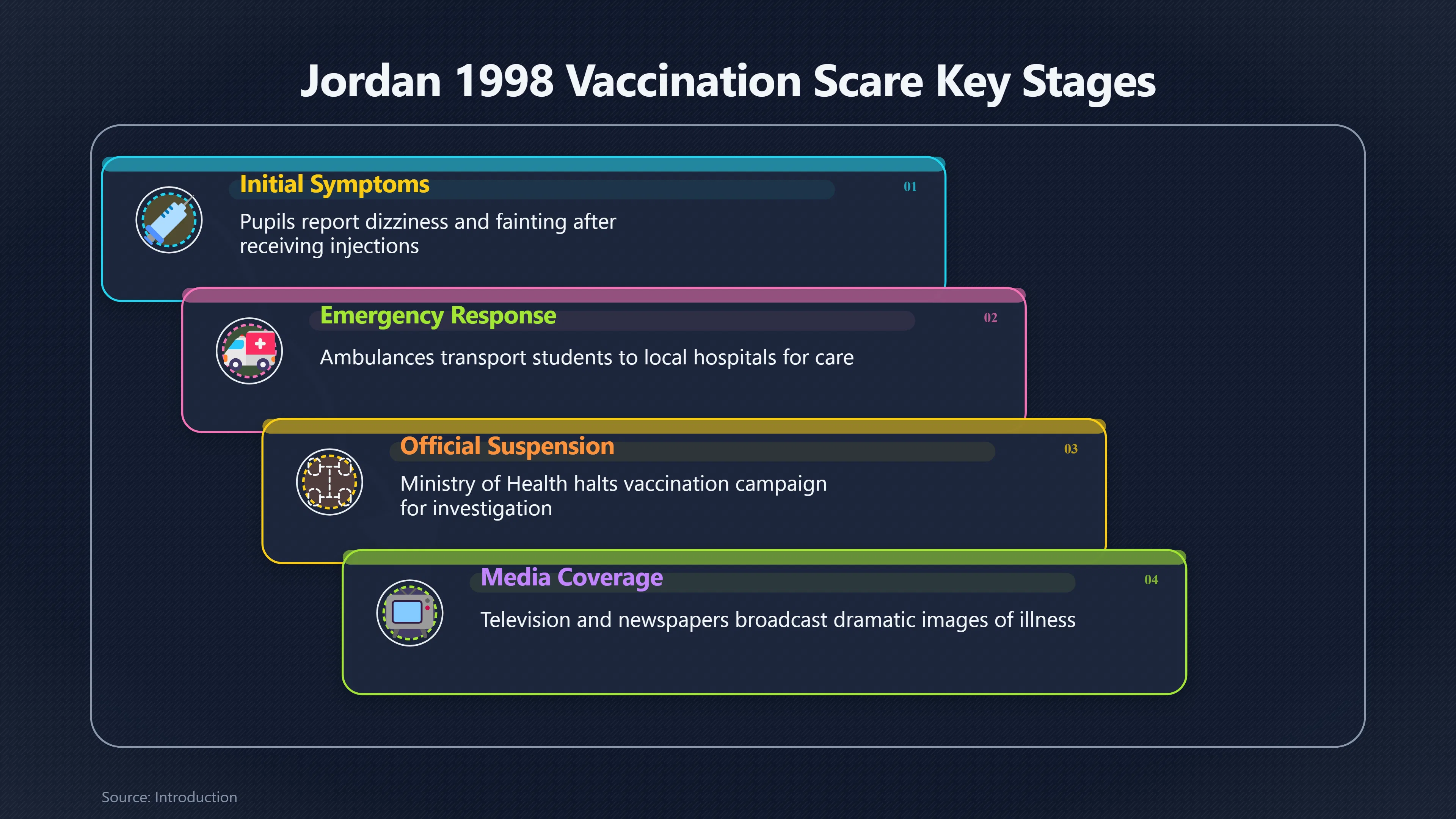
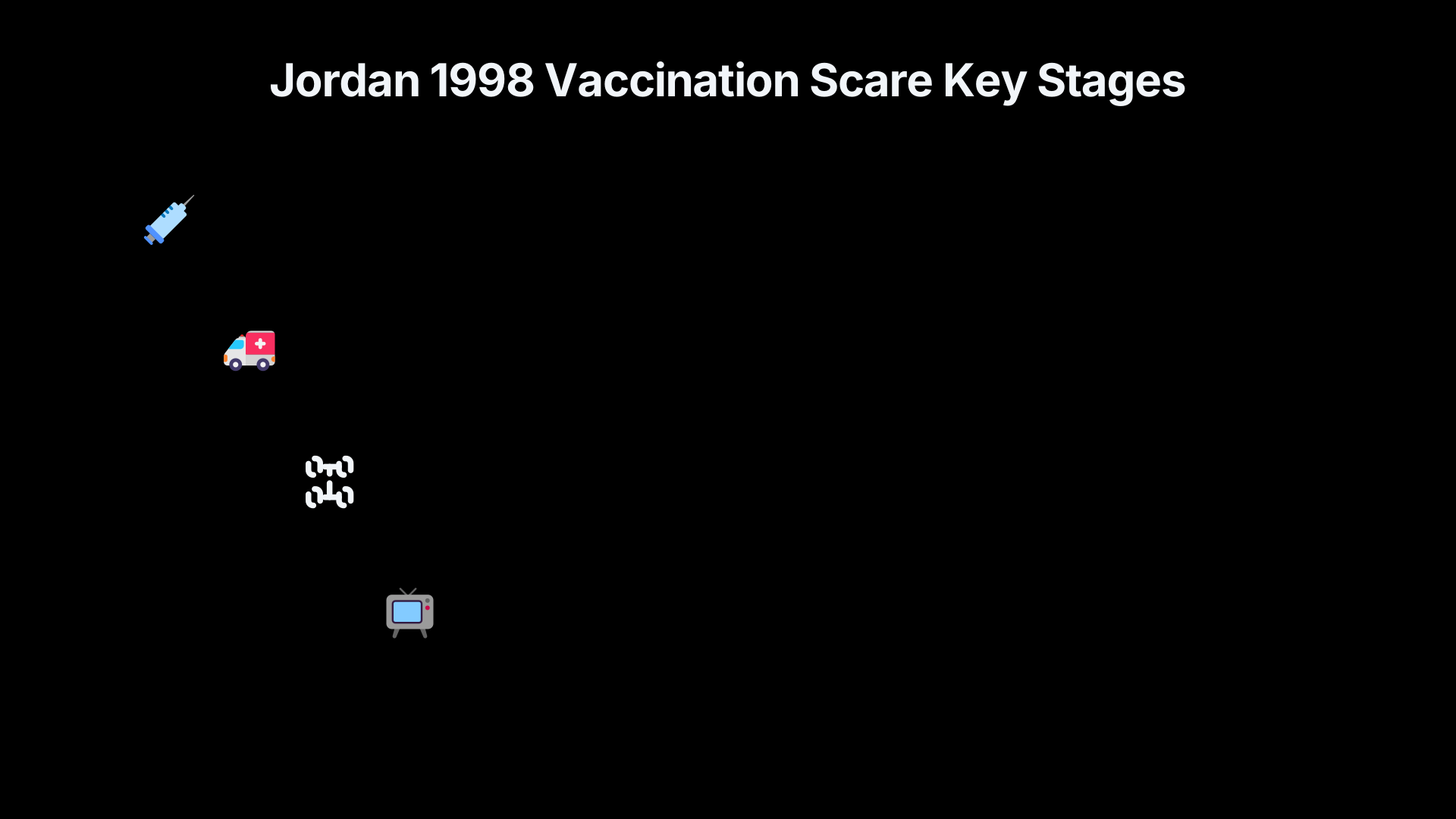
During the Jordanian vaccination programme, the first pupils reporting dizziness and fainting were treated seriously, exactly as they should have been. Ambulances transported students to hospital, senior officials visited schools, and the Ministry of Health suspended further vaccinations while an investigation began. These decisions were sensible from a safety perspective because officials initially had no way of knowing whether the vaccine might genuinely be contaminated.[eAcademic]eacademic.ju.edu.joe Academic Policy and PracticePolicy and PracticeNovember 7, 2025…
However, each institutional step also carried an unintended social message:
- Ambulances suggested an emergency.
- Hospital admissions implied severe illness.
- Suspension of the vaccination campaign hinted that authorities suspected the vaccine.
- Ministerial investigations signalled that a major danger might exist.
Parents observing these developments understandably became more anxious and were more likely to seek medical care for children experiencing ordinary headaches, dizziness or nausea after hearing about the outbreak. Researchers concluded that institutional responses became part of the mechanism by which the episode expanded.[eAcademic]eacademic.ju.edu.joe Academic Policy and PracticePolicy and PracticeNovember 7, 2025…
How rumours moved through trusted institutions
The Jordanian outbreak did not spread mainly through anonymous gossip. Instead, information travelled along highly trusted social networks.
The initial reports passed rapidly between:
- pupils watching classmates become unwell;
- teachers informing school leaders;
- parents contacting relatives and neighbours;
- hospitals receiving increasing numbers of patients;
- emergency services transporting children;
- government ministries coordinating responses;
- television, radio and newspapers reporting each new development.
Every stage increased the apparent legitimacy of the original concern. Rather than hearing “someone says children are ill”, families saw hospitals filling, officials speaking publicly and journalists providing continuous coverage. Those institutional signals gave rumours far greater authority than informal word of mouth alone.[eAcademic]eacademic.ju.edu.joe Academic Policy and PracticePolicy and PracticeNovember 7, 2025…
Researchers studying the incident described this process as unusually visible because so many institutions became involved within a matter of hours. Yet they also noted that similar patterns have appeared repeatedly in mass psychogenic illness outbreaks around the world.[eAcademic]eacademic.ju.edu.joe Academic Policy and PracticePolicy and PracticeNovember 7, 2025…
The media’s role in escalating uncertainty
Jordanian researchers gave particular attention to the role of television, radio and newspapers.
Real-time reporting meant that families across the country learned about the suspected vaccine problem almost immediately. At that early stage, there was little verified information available. Coverage therefore focused on dramatic images of sick pupils, ambulances and official investigations rather than laboratory evidence, which naturally takes much longer to produce.
The researchers argued that many members of the public interpreted these reports as confirmation that a dangerous vaccine batch had already been identified, even though investigations had not reached that conclusion. Public concern was also shaped by broader political circumstances. The authors noted that a recent water contamination controversy had already reduced confidence in official reassurances, making people more willing to believe that another government failure had occurred.[ResearchGate]researchgate.netOpen source on researchgate.net.
This does not mean journalists created the panic. Rather, rapid reporting of incomplete information interacted with existing public anxieties, producing a situation in which every new report encouraged additional families to monitor children closely for symptoms.
Hospitals became part of the social signal
Hospitals occupy a unique position during collective fear because admission itself communicates seriousness.
Clinicians could not simply refuse to examine frightened children. Many patients arrived with genuine symptoms such as dizziness, headache, weakness or fainting. These experiences were real regardless of their psychological origin.
Researchers found that hospitals faced competing pressures:
- providing appropriate medical care;
- reassuring worried parents;
- following ministerial guidance;
- avoiding accusations of overlooking genuine poisoning.
As admissions increased, however, hospitals unintentionally reinforced the perception that an epidemic of vaccine injury was unfolding. Families arriving at crowded emergency departments saw many other children receiving treatment, making it easier to believe that the threat was widespread. The social environment therefore strengthened expectations of illness even while medical staff were attempting to rule out physical causes.[ResearchGate]researchgate.netOpen source on researchgate.net.
Schools as amplifiers rather than causes
Schools frequently appear in episodes of mass psychogenic illness because they concentrate large groups of young people who closely observe one another.
The Jordanian vaccination sessions involved pupils receiving injections together, waiting together and discussing their reactions immediately afterwards. When several students became visibly distressed, classmates became alert to normal bodily sensations that might otherwise have been ignored.
Teachers also faced difficult decisions. Sending an unwell pupil to hospital was the responsible course of action. Yet repeated emergency responses made later students more likely to interpret ordinary post-vaccination discomfort as evidence that something dangerous was happening.
Research on mass psychogenic illness consistently shows that observation plays an important role. Seeing others become ill, hearing about illness from trusted adults and expecting symptoms can all increase the likelihood that genuine physical complaints will spread through a group despite the absence of a toxic exposure.[PubMed]pubmed.ncbi.nlm.nih.govPub Med Mass psychogenic illness after vaccinationMass psychogenic illness after vaccination - PubMed…
Beyond vaccination: institutional reinforcement of cultural scares
Jordan’s periodic concerns about heavy metal music illustrate a related mechanism outside public health.
Although evidence for organised Satanic activity remained weak, rumours about devil worship gained credibility when respected institutions—including some newspapers, officials and educational authorities—treated the allegations as matters deserving investigation or restriction. Concert cancellations, police attention and public warnings could therefore appear to validate fears even when concrete evidence remained limited.
Unlike the vaccination episode, these cultural scares were not investigated through detailed epidemiological studies. Nevertheless, they demonstrate a broader principle visible in Jordan and many other countries: institutional attention can transform fringe rumours into issues that appear socially important simply because recognised authorities are responding to them.
What better crisis communication can prevent
The Jordanian vaccination episode has become a valuable teaching example in public health because it illustrates how communication can either reduce or unintentionally amplify collective fear.
Several lessons emerge from later research.
Explain investigations as precaution rather than confirmation. Authorities can emphasise that suspending a programme or admitting patients does not mean a hazard has already been identified.
Coordinate public messages. Conflicting statements from ministries, hospitals and media organisations create space for speculation.
Acknowledge symptoms without dismissing them. People experiencing mass psychogenic illness have genuine physical symptoms. Simply telling them that “nothing is wrong” is rarely effective.
Release verified information quickly. Long gaps between visible emergency action and scientific findings encourage rumours to fill the vacuum.
Prepare institutions before crises occur. Schools, hospitals and emergency services benefit from training that recognises how social contagion operates during uncertain events.[edu.jo]eacademic.ju.edu.joe Academic Policy and PracticePolicy and PracticeNovember 7, 2025…

Why the mechanism still matters
Jordan’s experience demonstrates that institutions are rarely the creators of collective fear. More often, they become amplifiers because society quite reasonably trusts them.
When ambulances arrive, hospitals admit patients and ministers launch investigations, people infer that authorities must know something important. During genuine emergencies this trust saves lives. During episodes driven primarily by uncertainty and social contagion, the same trust can unintentionally magnify anxiety before evidence is available.
The enduring lesson from Jordan’s best-documented scare is therefore not that institutions should respond less seriously, but that they must recognise how every visible protective action also communicates meaning. Effective crisis management requires both careful investigation and equally careful explanation so that precaution is not mistaken for proof.
Amazon book picks
Further Reading
Books and field guides related to How Did Jordan's Institutions Amplify Fear?. Use these as the next step if you want deeper reading beyond the article.


Mistakes Were Made (But Not by Me)
Shows why institutions and individuals reinforce mistaken beliefs.
Endnotes
1.
Source: researchgate.net
Link:https://www.researchgate.net/publication/11801887_Mass_psychogenic_illness_following_tetanus-diphtheria_toxoid_vaccination_in_Jordan
2.
Source: researchgate.net
Link:https://www.researchgate.net/figure/Number-of-vaccinated-students-affected-by-district-and-vaccine-lot-29-September-5_tbl3_11801887
3.
Source: eacademic.ju.edu.jo
Title: e Academic Policy and Practice
Link:https://eacademic.ju.edu.jo/nkhuri/Lists/Published%20Research/Attachments/28/Abstract.pdf
Source snippet
Policy and PracticeNovember 7, 2025...
Published: November 7, 2025
4.
Source: pubmed.ncbi.nlm.nih.gov
Title: Pub Med Mass psychogenic illness after vaccination
Link:https://pubmed.ncbi.nlm.nih.gov/12814329/
Source snippet
Mass psychogenic illness after vaccination - PubMed...
5.
Source: pmc.ncbi.nlm.nih.gov
Title: PMCMass sociogenic illness
Link:https://pmc.ncbi.nlm.nih.gov/articles/PMC543940/
Source snippet
sociogenic illness - PMCJanuary 4, 2005 — In standard psychiatric nomenclature, mass sociogenic illness is subsumed under the general hea...
Published: January 4, 2005
6.
Source: pmc.ncbi.nlm.nih.gov
Link:https://pmc.ncbi.nlm.nih.gov/articles/PMC4884863/
Source snippet
Mass psychogenic illness following tetanus-diphtheria toxoid vaccination in Jordan. Bulletin of the World Health Organization. 2001;79(8)...
7.
Source: pmc.ncbi.nlm.nih.gov
Link:https://pmc.ncbi.nlm.nih.gov/articles/PMC3536509/
Source snippet
December 1, 2012 — A common folk theory attributes the symptoms to exposure from a nearby toxic dump, prompting environmental activist...
Published: December 1, 2012
8.
Source: pmc.ncbi.nlm.nih.gov
Link:https://pmc.ncbi.nlm.nih.gov/articles/PMC3195398/
Source snippet
induction of psychogenic illness in the context of a medical event and media exposure - PMCMay 1, 2012 — Find articles by Elizabeth Bass...
Published: May 1, 2012
9.
Source: pubmed.ncbi.nlm.nih.gov
Link:https://pubmed.ncbi.nlm.nih.gov/15632400/
10.
Source: pubmed.ncbi.nlm.nih.gov
Link:https://pubmed.ncbi.nlm.nih.gov/8138768/
Additional References
11.
Source: youtube.com
Title: 10 Strange Examples of Mass Hysteria
Link:https://www.youtube.com/watch?v=7R37NIA4Nmw
Source snippet
Why Mass Hysteria is Thriving in the 21st Century - Robert Bartholomew...
12.
Source: nejm.org
Link:https://www.nejm.org/doi/abs/10.1056/NEJM200001133420206
13.
Source: nejm.org
Link:https://www.nejm.org/doi/full/10.1056/NEJM200001133420206
14.
Source: youtube.com
Title: Mass Hysteria and the Nocebo Effect
Link:https://www.youtube.com/watch?v=wQ1QCbnUjPE
Source snippet
Recognising Anaphylaxis vs. Immunization Stress-Related Response...
15.
Source: youtube.com
Title: Why Mass Hysteria is Thriving in the 21st Century
Link:https://www.youtube.com/watch?v=vKZ9uJNEv80
Source snippet
Mass Hysteria and the Nocebo Effect...
16.
Source: youtube.com
Title: Recognising Anaphylaxis vs. Immunization Stress-Related Response
Link:https://www.youtube.com/watch?v=jfAbM4W2loY
17.
Source: youtube.com
Title: MAD GASSERS & MASS HYSTERIA
Link:https://www.youtube.com/watch?v=af_TYncO1TA
Source snippet
10 Strange Examples of Mass Hysteria...
18.
Source: scielosp.org
Title: Sci ELOPolicy and Practice
Link:https://www.scielosp.org/pdf/bwho/2001.v79n8/764-770/en
19.
Source: merip.org
Title: Press Freedom in Jordan
Link:https://www.merip.org/1998/06/press-freedom-in-jordan/
Topic Tree