Within Italy's Strange Beliefs
How Italian Witch Fears Became Persecution
From Triora to Friuli, local misfortune became organised persecution when courts forced village beliefs into stories of satanic conspiracy.
On this page
- Triora, famine and the search for scapegoats
- How torture and interrogation created conspiracies
- The Benandanti and beliefs inquisitors reshaped
Page outline Jump by section
Introduction
Italian witch panics did not unfold as a single nationwide campaign. Instead, they emerged in different regions where local hardship, village rivalries and learned ideas about witchcraft combined with judicial systems that often transformed everyday suspicions into elaborate stories of diabolical conspiracy. The best-known examples, from the Ligurian village of Triora to the inquisitorial investigations in Friuli, show that persecution was rarely driven by popular belief alone. It was shaped by the interaction between frightened communities and courts whose interrogation methods encouraged confessions that matched official expectations rather than local experience. These cases remain important because they reveal how institutions can convert rumours, misfortune and folklore into apparently convincing evidence of organised evil.[triora.hiboucoop.org]triora.hiboucoop.orgRoom of the trials | Explore TrioraRoom of the trials | Explore Triora
How local fears became organised persecution
Early modern Italy was divided among republics, duchies, bishoprics and papal territories, each with different legal traditions. As a result, witchcraft prosecutions varied considerably from one region to another. Some secular courts pursued accusations aggressively, while the Roman Inquisition could at times restrain local excesses by insisting on stronger evidence and reviewing questionable procedures. This uneven landscape helps explain why Italy experienced significant witch trials without producing a single, continuous witch hunt comparable to those in parts of Germany or Scotland.[triora.hiboucoop.org]triora.hiboucoop.orgRoom of the trials | Explore TrioraRoom of the trials | Explore Triora
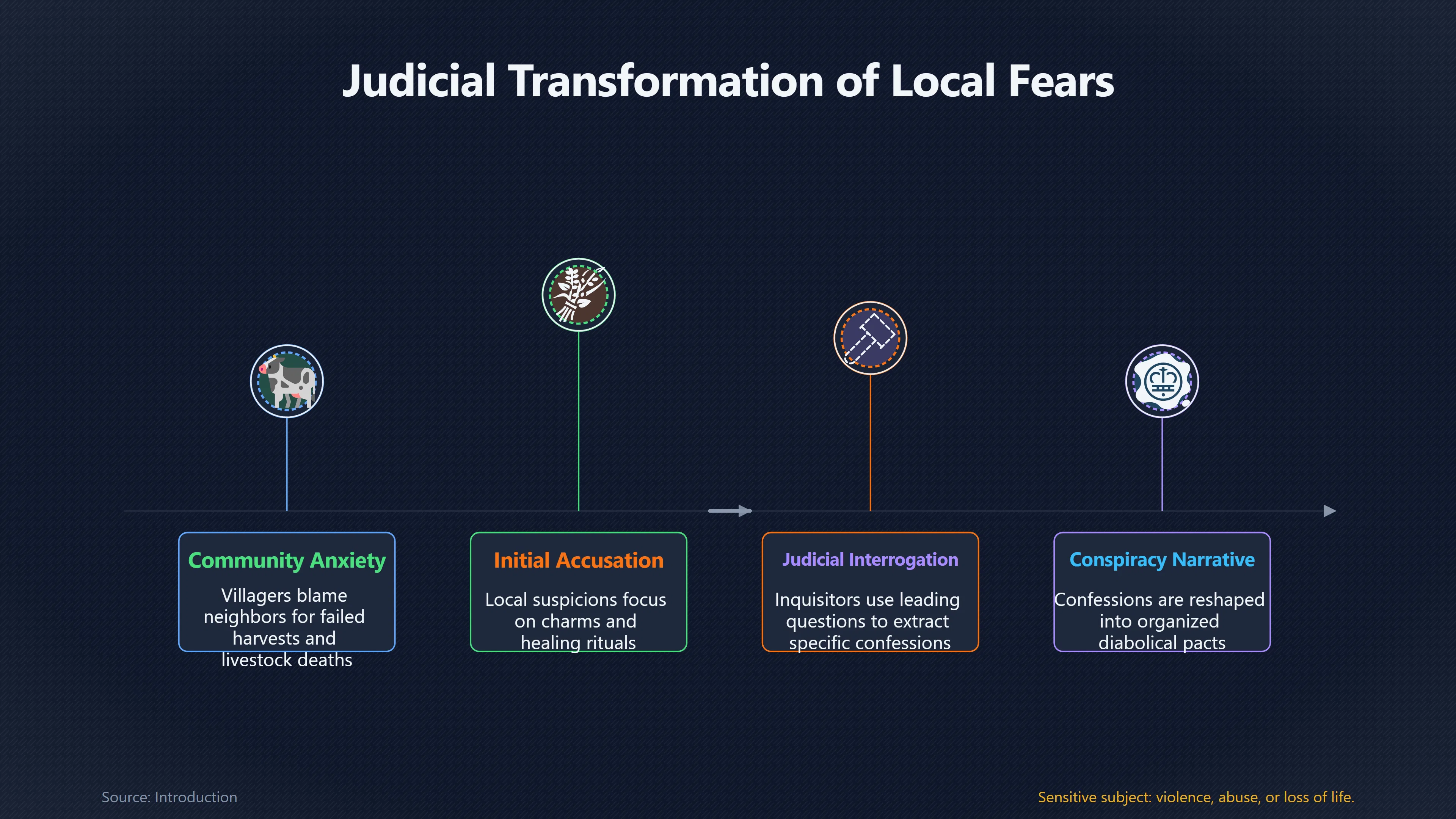
Most accusations began with ordinary concerns rather than claims of devil worship. Villagers blamed neighbours for unexplained illness, failed harvests, dead livestock or damaged food stores. These suspicions reflected genuine anxieties in communities living close to subsistence, where repeated crop failures could threaten survival.
The legal process often altered these accusations dramatically. Judges and inquisitors had been educated in demonological theories that portrayed witches as members of organised conspiracies serving the Devil. Under interrogation, suspects who initially described charms, healing rituals or local folklore could gradually be pressed into admitting attendance at secret gatherings, pacts with demons or impossible supernatural acts. Modern historians therefore distinguish carefully between village beliefs and the narratives preserved in court records, recognising that many confessions were produced within a highly unequal judicial process.[Hopkins Press]press.jhu.eduHopkins Press The Night Battles | Hopkins PressHopkins Press The Night Battles | Hopkins Press
Triora, famine and the search for scapegoats
The trials at Triora in Liguria between 1587 and 1589 illustrate how environmental crisis could become judicial persecution. Poor harvests and severe food shortages created intense pressure to identify someone responsible for the community’s suffering. Instead of accepting famine as the product of weather, economics or disease, many inhabitants became convinced that malicious neighbours had deliberately ruined crops through witchcraft.[triora.hiboucoop.org]triora.hiboucoop.orgRoom of the trials | Explore TrioraRoom of the trials | Explore Triora
Investigators quickly expanded what began as local accusations into a much larger inquiry. Women were arrested and questioned under torture, producing confessions that included familiar elements from European demonology: harmful magic, infanticide, nocturnal gatherings and dealings with the Devil. The investigation grew as each confession generated new names, creating a self-reinforcing cycle of accusation.
The surviving records reveal both the violence of the investigation and its eventual limits. Two prisoners, including Isotta Stella, died during the early interrogations. When the proceedings reached Rome, officials of the Holy Office criticised the methods used by local investigators, describing aspects of the inquiry as excessively cruel. Orders were issued to repeat interrogations, seek genuine evidence rather than relying solely on confessions, and review the cases more carefully. Ultimately, many suspects received comparatively limited penalties, several were released after failing to repeat earlier confessions, and only a small number remained subject to further proceedings.[triora.hiboucoop.org]triora.hiboucoop.orgRoom of the trials | Explore TrioraRoom of the trials | Explore Triora
This outcome complicates popular images of Triora as simply “Italy’s Salem”. The episode certainly involved severe persecution and deaths, but it also demonstrates tensions within the Italian judicial system itself, where higher authorities sometimes curtailed investigations that local courts had allowed to spiral.
How torture and interrogation created conspiracies
The Italian records repeatedly show that inquisitorial questioning was not a neutral search for facts. Interrogators worked from assumptions about what witches were supposed to have done, and their questions encouraged suspects to adopt those expectations.
Several mechanisms helped transform scattered accusations into coherent conspiracies:
- Leading questions encouraged prisoners to describe events they had not initially mentioned.
- Torture or the threat of torture increased pressure to confess and identify additional suspects.
- Repeated examinations rewarded consistency with official expectations while treating denial as evidence of deception.
- Shared demonological ideas supplied a ready-made narrative involving the Devil, nocturnal meetings and organised witchcraft.
As investigations expanded, every new confession appeared to confirm earlier ones, even though the similarities often reflected the structure of questioning rather than independent testimony. Modern historians therefore read these records critically, recognising both the information they preserve about popular belief and the distortions introduced by judicial procedure.[Hopkins Press]press.jhu.eduHopkins Press The Night Battles | Hopkins PressHopkins Press The Night Battles | Hopkins Press

The Benandanti and beliefs inquisitors reshaped
One of the most revealing Italian cases comes from Friuli in north-eastern Italy. During the late sixteenth century, inquisitors encountered men and women known as the Benandanti, who claimed that, while asleep, their spirits fought witches in order to protect crops and ensure fertile harvests. They understood themselves not as servants of evil but as defenders of their communities.[Hopkins Press]press.jhu.eduHopkins Press The Night Battles | Hopkins PressHopkins Press The Night Battles | Hopkins Press
Initially, inquisitors struggled to interpret these unusual beliefs. The Benandanti described spiritual journeys and seasonal battles that did not fit standard models of heresy. Over decades of questioning, however, officials increasingly interpreted these accounts through the familiar framework of the witches’ sabbath. Gradually, people who had claimed to oppose witches found themselves treated as witches.
Historian Carlo Ginzburg’s pioneering study of these archives transformed understanding of witchcraft in Italy because it showed the encounter between two different belief systems rather than the discovery of a hidden satanic cult. The surviving testimonies suggest a slow process in which official expectations reshaped popular traditions until they resembled the demonological theories that inquisitors already believed.[Hopkins Press]press.jhu.eduHopkins Press The Night Battles | Hopkins PressHopkins Press The Night Battles | Hopkins Press
The Benandanti therefore illustrate an important distinction. Local folklore did exist, but it did not automatically amount to organised witchcraft. Much of what later appeared in trial records emerged through prolonged interaction between interrogators and suspects rather than existing as a fixed belief before the investigation began.
Why persecution varied across Italy
Italy’s fragmented political landscape prevented a single model of witch hunting from developing. Outcomes depended upon several interacting factors:
- The severity of local famine, epidemic disease or economic hardship.
- The willingness of secular magistrates to pursue accusations aggressively.
- Whether inquisitorial authorities accepted or questioned local procedures.
- The availability of torture and the weight given to confessions.
- Local traditions concerning healing, folk religion and supernatural protection.
This variation explains why neighbouring communities could experience dramatically different levels of persecution despite sharing similar beliefs about magic and misfortune.
How historians interpret the Italian witch panics today
Modern scholarship no longer views Italian witch trials as evidence of a genuine underground religion or a continent-wide satanic conspiracy. Instead, historians see them as examples of how social stress, institutional power and judicial procedure interacted.
The Triora prosecutions show how famine and fear encouraged communities to seek human scapegoats. The Benandanti demonstrate that official authorities often reshaped local traditions into stories that fit established demonological models. Together, these cases reveal that court records are not simple transcripts of popular belief but products of negotiation, coercion and unequal power.
These episodes remain culturally important because they expose the mechanisms by which collective fear becomes institutional persecution. Economic crisis created the demand for explanation, local suspicion identified potential enemies, and legal procedures transformed fragmented accusations into apparently coherent conspiracies. The resulting records provide a powerful reminder that sincere belief and convincing testimony do not necessarily amount to reliable evidence, especially when produced under intimidation or torture.[hiboucoop.org]triora.hiboucoop.orgRoom of the trials | Explore TrioraRoom of the trials | Explore Triora
Amazon book picks
Further Reading
Books and field guides related to How Italian Witch Fears Became Persecution. Use these as the next step if you want deeper reading beyond the article.


When Prophecy Fails
The study reported in this volume grew out of some theoretical work, one phase of which bore specifically on the behavior of individuals...
Endnotes
1.
Source: triora.hiboucoop.org
Title: Room of the trials | Explore Triora
Link:https://triora.hiboucoop.org/room-of-the-trials/?lang=en
2.
Source: press.jhu.edu
Title: Hopkins Press The Night Battles | Hopkins Press
Link:https://www.press.jhu.edu/books/title/10645/night-battles
3.
Source: books.google.com
Link:https://books.google.com/books/about/The_Night_Battles.html?id=jR9nAQAAQBAJ
Source snippet
Carlo Ginzburg - Google BooksOctober 15, 2013 — THE NIGHT BATTLES: WITCHCRAFT AND AGRARIAN CULTS IN THE SIXTEENTH AND SEVENTEENTH CENTURI...
Published: October 15, 2013
4.
Source: press.jhu.edu
Title: Preorder Image: Cover of “The Night Battles” by Carlo Ginzburg,
Link:https://www.press.jhu.edu/books/title/53945/night-battles
Source snippet
Night Battles | Hopkins PressSeptember 8, 2026 — Image: Cover of "The Night Battles" by Carlo Ginzburg, featuring tan and orange tones ov...
Published: September 8, 2026
5.
Source: books.google.com.et
Link:https://books.google.com.et/books?id=5SFnAQAAQBAJ
Source snippet
Carlo Ginzburg - Google BooksOctober 15, 2013 — THE NIGHT BATTLES: WITCHCRAFT AND AGRARIAN CULTS IN THE SIXTEENTH AND SEVENTEENTH CENTURI...
Published: October 15, 2013
6.
Source: books.google.com
Title: The Night Battles
Link:https://books.google.com/books/about/The_Night_Battles.html?id=LngTuKdHLiIC
Source snippet
Carlo Ginzburg - Google BooksTHE NIGHT BATTLES: WITCHCRAFT AND AGRARIAN CULTS IN THE SIXTEENTH AND SEVENTEENTH CENTURIES Carlo GinzburgJH...
7.
Source: youtube.com
Title: Secret Italy
Link:https://www.youtube.com/watch?v=ZanSlDGdtBQ
Source snippet
The Roman Inquisition - Quality History...
8.
Source: youtube.com
Title: The Roman Inquisition
Link:https://www.youtube.com/watch?v=MrSgFawBmho
Source snippet
Lore: The Fey Witches of Sicily...
Additional References
9.
Source: museoditriora.it
Link:https://museoditriora.it/en/witchcraft/
Source snippet
Witchcraft • Museo di TrioraImage: Witchcraft WITCHCRAFT On the edge between the known and unknown worlds Image: StregoneriaPrincipale 3...
10.
Source: routledge.com
Link:https://www.routledge.com/The-Night-Battles-RLE-Witchcraft-Witchcraft-and-Agrarian-Cults-in-the-Sixteenth-and-Seventeenth-Centuries/Ginzburg/p/book/9781138997998
Source snippet
IAN CULTS IN THE SIXTEENTH AND SEVENTEENTH CENTURIES By Carlo Ginzburg Copyright 1983 240 Pages by Routledge * * * Also availa...
11.
Source: tidsskrift.dk
Title: Sporsøgeren Carlo Ginzburg | Religionsvidenskabeligt Tidsskrift
Link:https://tidsskrift.dk/rvt/article/view/5327
Source snippet
July 15, 1992 — SPORSØGEREN CARLO GINZBURG FORFATTERE * Ole Bay DOI: [https://doi.org/10.7146/rt.v0i21.5327](https://doi.org/10.7146/rt.v0i21.5327) NØGLEORD: Carlo Ginzburg, Heks...
Published: July 15, 1992
12.
Source: openlibrary.org
Title: I Benandanti by Carlo Ginzburg | Open Library
Link:https://openlibrary.org/books/OL16546719M/I_Benandanti
Source snippet
BY CARLO GINZBURG, JOHN TEDESCHI, AND ANNE C. TEDESCHI * ★★★ 3.0 (1 rating) * 22 Want to read *...
13.
Source: openlibrary.org
Title: Open Library I benandanti by Carlo Ginzburg | Open Library
Link:https://openlibrary.org/books/OL17885962M/I_benandanti
Source snippet
BY CARLO GINZBURG, JOHN TEDESCHI, AND ANNE C. TEDESCHI * ★...
14.
Source: openlibrary.org
Title: I BENANDANTI
Link:https://openlibrary.org/books/OL50357343M/I_BENANDANTI
Source snippet
by Carlo Ginzburg | Open LibraryAn edition of I BENANDANTI (1966) I BENANDANTI BY CARLO GINZBURG * * 1 Want to read Image: Cover of: I BE...
15.
Source: reddit.com
Title: How were witch trials finally refuted?
Link:https://www.reddit.com/r/AskHistorians/comments/17dm9q5
Source snippet
How were witch trials finally refuted?...
16.
Source: youtube.com
Title: Italian Witchcraft Trials with Debora Moretti
Link:https://www.youtube.com/watch?v=WSjR276_QbE
Source snippet
The Italian Village of Witches: Magic and Superstition...
17.
Source: youtube.com
Title: The Italian Village of Witches: Magic and Superstition
Link:https://www.youtube.com/watch?v=6SUGnO6sNRw
Source snippet
Secret Italy - The Triora Witch Trials...
Topic Tree