Within Bhutan Panics
How Bhutan Countered Fear During COVID
Pandemic rumours about infection, quarantine and vaccination forced Bhutanese authorities to pair health measures with constant reassurance.
On this page
- False claims about infection and quarantine
- Vaccine rumours and public uncertainty
- Briefings, visible leadership and trust
Page outline Jump by section
Introduction
Bhutan’s experience of COVID-19 was marked not by large-scale anti-vaccine movements or widespread rejection of public health measures, but by a steady stream of rumours that threatened to undermine confidence during a period of extraordinary uncertainty. False claims about infections, quarantine rules, vaccine side effects and government decisions circulated through messaging apps and social media, mirroring patterns seen across the world. What distinguished Bhutan’s response was the emphasis on rapid public communication, visible political leadership and trusted local networks rather than relying solely on enforcement. This combination helped the country maintain unusually high public confidence throughout its vaccination campaign and pandemic response.[World Health Organization]who.intWorld Health Organization A rapid and coordinated response to COVID-19 in BhutanWorld Health Organization A rapid and coordinated response to COVID-19 in Bhutan
Rather than treating misinformation as a separate problem from disease control, Bhutan’s authorities integrated rumour management into their wider public health strategy. Daily briefings, community outreach, direct engagement with local leaders and constant clarification of false claims became part of the national response alongside testing, quarantine and vaccination.
False claims about infection and quarantine
As Bhutan imposed some of the world’s strictest border controls and quarantine measures, rumours quickly emerged around the movement of infected people, alleged hidden outbreaks and changing quarantine requirements. Like many small societies where news travels rapidly through personal networks, unverified messages could spread faster than official announcements.
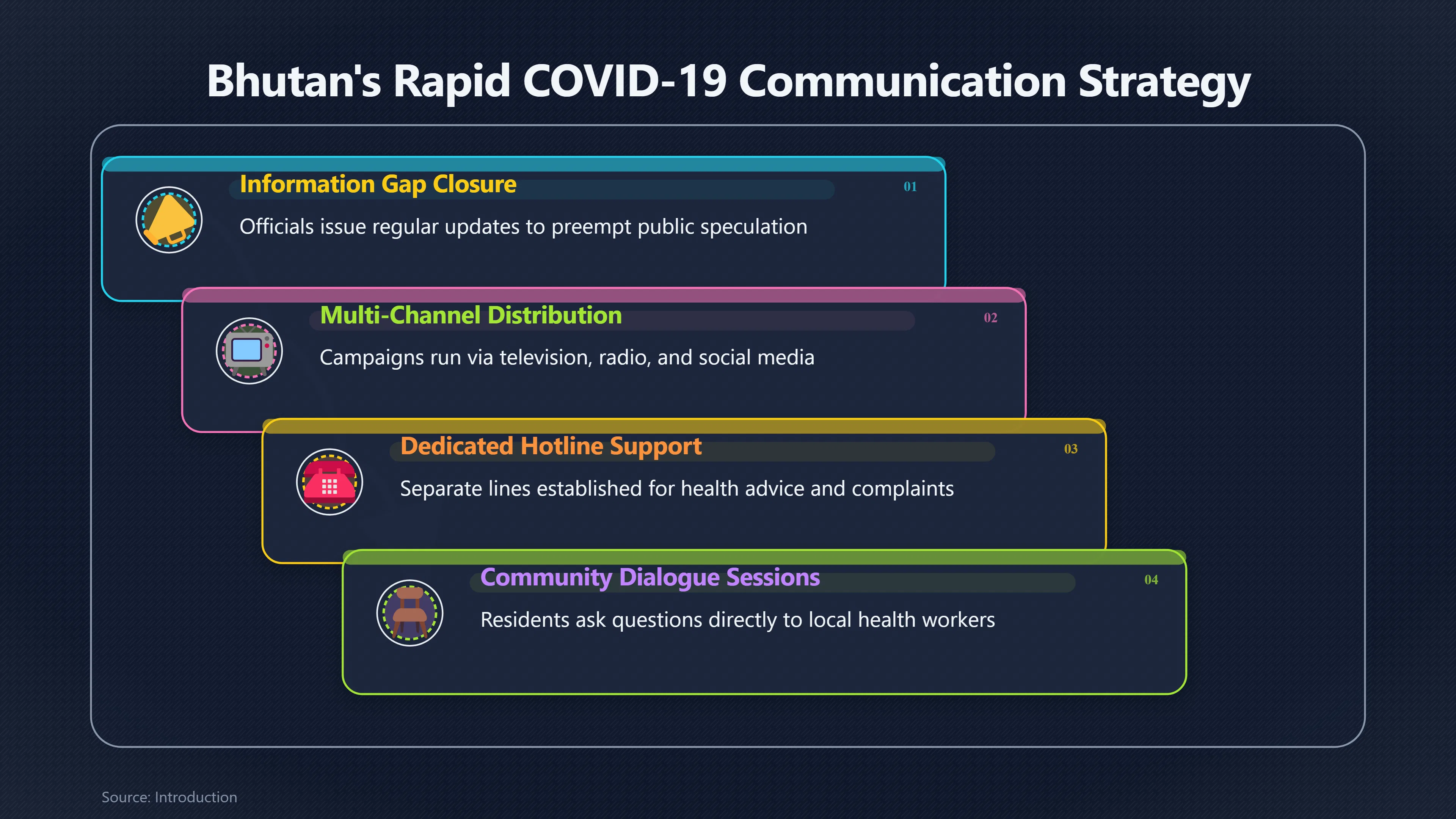
The country’s first defence was frequent, highly visible communication. The Ministry of Health, the Prime Minister’s Office and other agencies issued regular updates explaining new cases, quarantine procedures and contact-tracing decisions. Instead of allowing information gaps to develop, officials attempted to answer public questions before speculation could become established. WHO has described Bhutan’s response as unusually rapid and coordinated, supported by years of emergency preparedness before the pandemic began.[World Health Organization]who.intWorld Health Organization A rapid and coordinated response to COVID-19 in BhutanWorld Health Organization A rapid and coordinated response to COVID-19 in Bhutan
The government also invested heavily in public information systems. According to the World Bank, thousands of awareness campaigns were conducted through television, radio, printed material, social media and dedicated telephone hotlines. Separate helplines were established for health advice, public information and complaints, making it easier for citizens to verify circulating stories rather than relying on rumours alone.[World Bank]worldbank.orgWorld Bank Two Years of Bhutan’s Pandemic ResponseWorld Bank Two Years of Bhutan’s Pandemic Response
This approach recognised that misinformation often thrives when official information is difficult to obtain. By making authoritative information highly accessible, Bhutan reduced the space in which speculation could flourish.
Vaccine rumours and public uncertainty
Bhutan’s vaccination programme achieved exceptionally high coverage, but success did not mean an absence of misinformation. Health workers reported encountering rumours about vaccine safety, exaggerated claims about side effects and misleading social media posts that created uncertainty before the second-dose campaign.
One commonly reported concern involved false online claims that the second vaccine dose would be significantly more painful or even fatal. Community health workers found themselves answering questions from residents who had encountered alarming social media posts. Rather than dismissing these fears, they explained expected side effects, discussed vaccine benefits and corrected specific false claims during community visits.[UNICEF]unicef.orgEngaging local leaders to keep their communities safe from COVID-19 | UNICEF BhutanJune 21, 2021…
Officials also recognised practical reasons why vaccine uptake might fall. Some people worried about temporary side effects affecting their work, while others faced competing demands during the agricultural season. Public health messaging therefore combined factual corrections with practical planning, encouraging communities to organise around vaccination dates and reassuring people about expected reactions.[UNICEF]unicef.orgEngaging local leaders to keep their communities safe from COVID-19 | UNICEF BhutanJune 21, 2021…
Unlike countries where vaccine debates became strongly polarised, Bhutan saw relatively limited organised anti-vaccine activism. International observers have instead attributed the country’s high vaccination rates to strong institutional trust, extensive community engagement and consistent messaging from trusted national figures.[unicef.org]unicef.orgUNICEF hails Bhutan’s successful completion of full COVID-19 vaccinations for 90% of the eligible populationJuly 27, 2021…

Why visible leadership mattered
A distinctive feature of Bhutan’s pandemic communication was the prominence of trusted national leaders. Public messages came not only from technical experts but also from senior political leaders, the monarchy and respected local authorities.
This mattered because public confidence during crises depends as much on trust as on scientific information. Rather than leaving communication entirely to central government departments, Bhutan involved district officials, village leaders, teachers, religious figures and volunteer organisations in explaining public health measures.
UNICEF-supported programmes trained local leaders across multiple districts to discuss COVID-19 precautions, vaccination and misinformation directly with residents. These conversations were designed to address both factual misunderstandings and broader anxieties created by prolonged restrictions.[UNICEF]unicef.orgEngaging Communities to ensure safety and wellbeing of families during COVID-19 pandemic | UNICEF Bhutan…
The country’s volunteer network also became an important communication channel. Volunteers helped distribute information, support quarantine arrangements and connect remote communities with official advice, reinforcing messages delivered through national media. International reporting has highlighted this coordinated mobilisation as one reason Bhutan maintained exceptionally high vaccination uptake despite difficult geography.[The Washington Post]washingtonpost.combhutan covid vaccinationConducted from July 20 to 26, the campaign was driven by over 4,800 health workers and aided by a national volunteer force called "desuun…
Correcting rumours through community engagement
Bhutan’s strategy reflected modern public health thinking that simply issuing corrections is often insufficient. Officials instead focused on risk communication and community engagement, sometimes known as RCCE, which combines factual information with local dialogue.
Community sessions encouraged residents to ask questions directly of health workers instead of relying on forwarded social media messages. Local government representatives, school staff, religious leaders and village health workers received training so they could respond consistently to common misconceptions.
This was particularly important in rural areas, where trusted local relationships often carried greater weight than anonymous online information. By equipping respected community figures with accurate information, the government attempted to interrupt the social transmission of rumours before they became widespread beliefs.[UNICEF]unicef.orgEngaging Communities to ensure safety and wellbeing of families during COVID-19 pandemic | UNICEF Bhutan…
The World Bank likewise notes that Bhutan’s COVID-19 programme included extensive social and behaviour change communication alongside medical preparedness, recognising that effective pandemic control required influencing public behaviour as well as treating disease.[World Bank]worldbank.orgWorld Bank Two Years of Bhutan’s Pandemic ResponseWorld Bank Two Years of Bhutan’s Pandemic Response
What the episode reveals about collective fear
Bhutan’s COVID-19 experience fits more comfortably within the history of rumour management than classic cases of mass hysteria. There is little evidence that false beliefs overwhelmed public life or produced sustained collective delusions comparable with major anti-vaccine movements elsewhere.
Instead, the pandemic illustrates how uncertainty naturally generates rumours during emergencies. Fear of infection, changing regulations and rapidly evolving scientific knowledge created ideal conditions for misinformation. The important historical story lies less in the rumours themselves than in how authorities responded.
Bhutan demonstrated that frequent communication, visible leadership, trusted local intermediaries and rapid correction of false claims can significantly reduce the social impact of pandemic rumours. While misinformation never disappeared, it was met with an organised effort to reassure the public rather than allowing uncertainty to spread unchecked.
Within Bhutan’s broader history of collective fears, the COVID-19 pandemic therefore represents an example of governance aimed at preventing rumour from becoming panic. It complements earlier episodes such as the 2018 headhunter scare by showing that, in a closely connected society, trust and communication are often as important as formal authority in shaping public responses to uncertainty.

Endnotes
1.
Source: who.int
Title: World Health Organization A rapid and coordinated response to COVID-19 in Bhutan
Link:https://www.who.int/about/accountability/results/who-results-report-2020-mtr/country-story/2021/bhutan
2.
Source: who.int
Link:https://www.who.int/news-room/feature-stories/detail/invest-in-preparedness-health-emergency-readiness-lessons-from-bhutan
3.
Source: unicef.org
Link:https://www.unicef.org/bhutan/stories/engaging-local-leaders-keep-their-communities-safe-covid-19
Source snippet
Engaging local leaders to keep their communities safe from COVID-19 | UNICEF BhutanJune 21, 2021...
Published: June 21, 2021
4.
Source: unicef.org
Link:https://www.unicef.org/bhutan/stories/engaging-communities-ensure-safety-and-wellbeing-families-during-covid-19-pandemic
Source snippet
Engaging Communities to ensure safety and wellbeing of families during COVID-19 pandemic | UNICEF Bhutan...
5.
Source: unicef.org
Link:https://www.unicef.org/bhutan/press-releases/unicef-hails-bhutans-successful-completion-full-covid-19-vaccinations-90-eligible
Source snippet
UNICEF hails Bhutan’s successful completion of full COVID-19 vaccinations for 90% of the eligible populationJuly 27, 2021...
Published: July 27, 2021
6.
Source: unicef.org
Title: Vaccinating Bhutan against COVID-19 | UNICEF Bhutan
Link:https://www.unicef.org/bhutan/stories/vaccinating-bhutan-against-covid-19
Source snippet
Vaccinating Bhutan against COVID-19 | UNICEF Bhutan...
7.
Source: unicef.org
Link:https://www.unicef.org/press-releases/unicef-commends-bhutan-vaccinating-almost-all-children-life-saving-vaccines-historic
Source snippet
UNICEF commends Bhutan for vaccinating almost all children with life-saving vaccines in historic featApril 26, 2024 — Statement UNICEF CO...
Published: April 26, 2024
8.
Source: worldbank.org
Title: World Bank Two Years of Bhutan’s Pandemic Response
Link:https://www.worldbank.org/en/country/bhutan/brief/two-years-of-bhutan-pandemic-response
9.
Source: washingtonpost.com
Title: bhutan covid vaccination
Link:https://www.washingtonpost.com/world/2021/07/28/bhutan-covid-vaccination/
Source snippet
Conducted from July 20 to 26, the campaign was driven by over 4,800 health workers and aided by a national volunteer force called "desuun...
10.
Source: worldbank.org
Link:https://www.worldbank.org/en/results/2021/05/10/world-bank-helps-bhutan-s-covid-19-response-with-5-million-emergency-aid-package
Additional References
11.
Source: youtube.com
Title: Access to Information during the #COVID19 Crisis Virtual Webinar
Link:https://www.youtube.com/watch?v=gcWzZFxsq_c
Source snippet
Bhutan's journey through the pandemic and building a resilient health system | Lyonpo Dechen Wangmo...
12.
Source: youtube.com
Link:https://www.youtube.com/watch?v=je2jTO9OfAc
Source snippet
Access to Information during the #COVID19 Crisis Virtual Webinar...
13.
Source: youtube.com
Link:https://www.youtube.com/watch?v=k0MtEPVqT6w
Source snippet
Madeline Drexler's Brown Bag Seminar...
14.
Source: youtube.com
Title: Madeline Drexler’s Brown Bag Seminar
Link:https://www.youtube.com/watch?v=cBCiYNrfuXE
Source snippet
Building Resilient Health Systems in the Shadow of COVID-19...
15.
Source: bhutan.un.org
Title: 134122 bhutan vaccination nation un resident coordinator’s blog
Link:https://bhutan.un.org/en/134122-bhutan-vaccination-nation-un-resident-coordinator%E2%80%99s-blog
16.
Source: youtube.com
Title: Building Resilient Health Systems in the Shadow of COVID-19
Link:https://www.youtube.com/watch?v=otU575bR4AI
17.
Source: bhutan.un.org
Title: 141371 bhutan responds double crisis
Link:https://bhutan.un.org/en/141371-bhutan-responds-double-crisis
18.
Source: bhutan.un.org
Link:https://bhutan.un.org/en/97737-unbhutan4covid-19
Topic Tree