Within Saint Kitts and Nevis
How Colonial Law Turned Belief into Crime
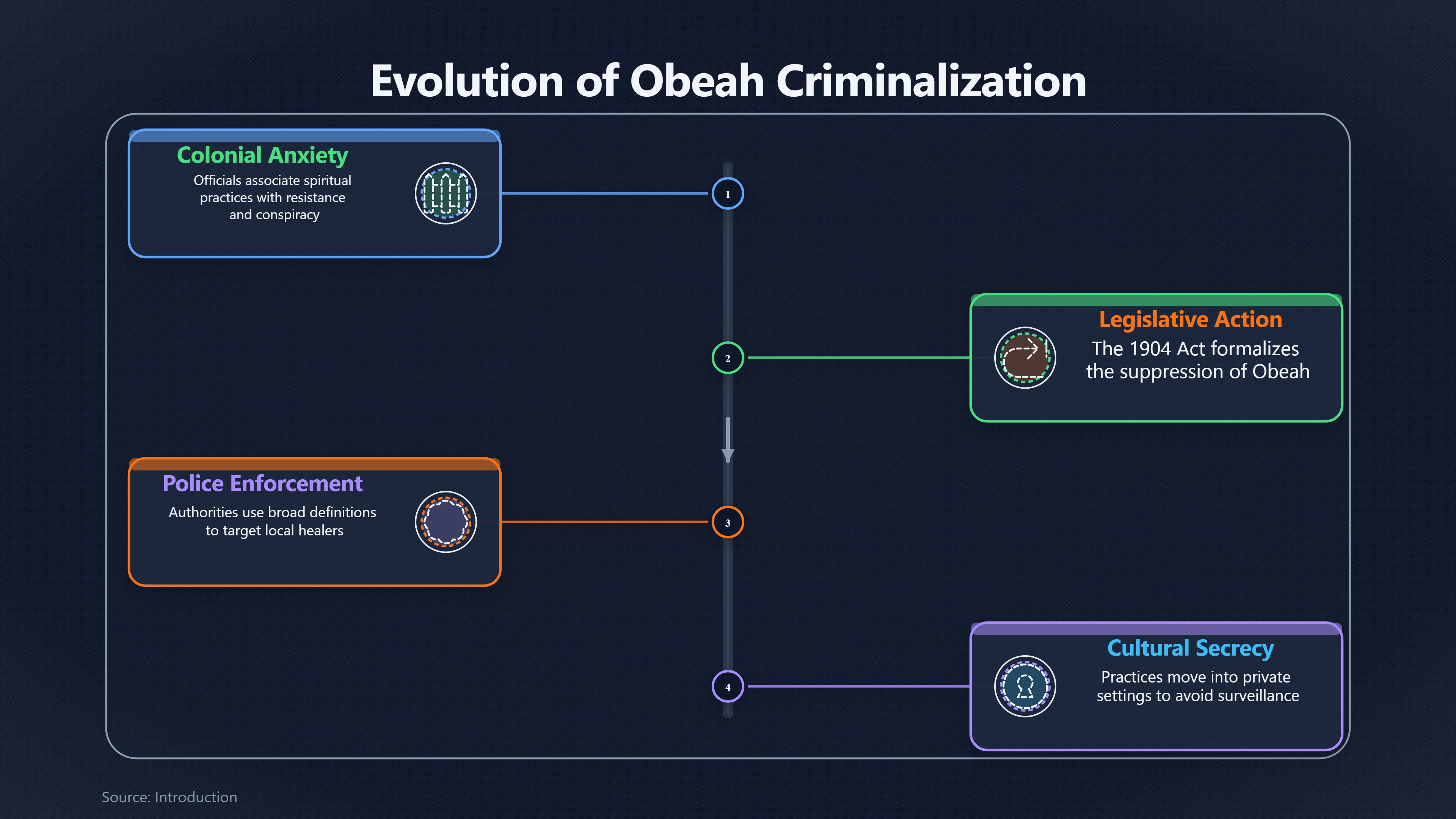
The 1904 Obeah Act turned disputed supernatural claims into criminal offences and gave police broad power over marginalised practices.
On this page
- What the 1904 Obeah Act prohibited
- Policing, courts and summary punishment
- The law's long cultural legacy
Page outline Jump by section
Introduction
The Obeah Act of 1904 marked one of the clearest examples of how colonial governments in Saint Kitts and Nevis transformed disputed spiritual beliefs into criminal offences. Rather than targeting only demonstrable crimes such as assault or poisoning, the legislation made it an offence to claim supernatural powers, perform certain rituals for payment, or possess objects that police or magistrates associated with obeah. In practice, the law blurred the line between fraud, religion, healing and feared magic, giving colonial authorities broad discretion to suppress African-derived spiritual traditions and the people who practised them. The Act formed part of a wider legal pattern across the British Caribbean, but it had particular significance in the Leeward Islands, including Saint Christopher (St Kitts) and Nevis, where officials regarded obeah as both a challenge to colonial authority and a source of social disorder.[obeahhistories.org]obeahhistories.orgObeah Histories Legislation | Obeah HistoriesObeah HistoriesLegislation | Obeah HistoriesSeptember 18, 2012…
What the 1904 Obeah Act prohibited
The Leeward Islands Obeah Act of 1904 applied across the colony, which included Saint Christopher and Nevis. It closely followed the influential Jamaican Obeah Law of 1898, reflecting a regional effort to standardise the suppression of practices colonial governments grouped under the single label “obeah”.[Obeah Histories]obeahhistories.orgObeah Histories Legislation | Obeah HistoriesObeah HistoriesLegislation | Obeah HistoriesSeptember 18, 2012…
The Act criminalised activities that were often defined in deliberately broad language. Rather than requiring proof that supernatural powers existed or that physical harm had occurred, it focused on behaviour such as:
- professing or pretending to possess supernatural knowledge or powers;[cambridge.org]cambridge.orgCambridge University Press & AssessmentOBEAH, VAGRANCY, AND THE BOUNDARIES OF RELIGIOUS FREEDOM: ANALYZING THE PROSCRIPTION OF “PRETENDIN…
- accepting money or rewards for spiritual services;
- using objects, charms or rituals identified by officials as instruments of obeah;
- encouraging others to believe that such powers could influence health, fortune or misfortune.
This wording gave courts considerable latitude. A prosecution did not depend upon proving that magic had worked. Instead, the offence lay in the alleged practice itself or in representing oneself as having supernatural powers. The law therefore shifted the legal question away from evidence of harm towards the criminalisation of particular forms of belief and authority.[Cambridge University Press & Assessment]cambridge.orgCambridge University Press & AssessmentOBEAH, VAGRANCY, AND THE BOUNDARIES OF RELIGIOUS FREEDOM: ANALYZING THE PROSCRIPTION OF “PRETENDIN…
Modern historians argue that this approach reflected a deeper colonial objective. Obeah practitioners frequently occupied respected positions as healers, advisers or ritual specialists within Afro-Caribbean communities. By making their work inherently suspect, governments weakened an alternative source of social influence that existed outside official churches, colonial medicine and state institutions.[Cambridge University Press & Assessment]cambridge.orgCambridge University Press & AssessmentOBEAH, VAGRANCY, AND THE BOUNDARIES OF RELIGIOUS FREEDOM: ANALYZING THE PROSCRIPTION OF “PRETENDIN…
Policing, courts and summary punishment
The practical effect of the Act extended well beyond occasional prosecutions. Because offences could often be tried summarily before magistrates, police enjoyed substantial discretion over who became the subject of investigation.
In many cases, prosecutions relied on testimony that an individual had claimed unusual powers, accepted payment for rituals or possessed items interpreted as evidence of obeah. The legislation did not require a coherent definition of obeah itself. Its ambiguity became one of its strongest enforcement tools, allowing authorities to classify a wide range of healing practices, divination, protective rituals or spiritual consultations under the same criminal category.[Cambridge University Press & Assessment]cambridge.orgCambridge University Press & AssessmentOBEAH, VAGRANCY, AND THE BOUNDARIES OF RELIGIOUS FREEDOM: ANALYZING THE PROSCRIPTION OF “PRETENDIN…
The consequences extended beyond convictions:
- respected local healers could lose their reputations through prosecution alone;
- clients became reluctant to seek traditional spiritual or healing services openly;
- spiritual practices increasingly moved into private settings, making them appear even more secretive to colonial officials;
- police surveillance reinforced official assumptions that African-derived beliefs were inherently suspicious.
This dynamic created a self-reinforcing cycle. Criminalisation encouraged secrecy, while secrecy was then cited as evidence that practitioners were engaged in dangerous or fraudulent activities. Historians caution against treating surviving police records as neutral descriptions of popular religion because the archive itself was shaped by laws designed to suppress those practices.[Cambridge University Press & Assessment]cambridge.orgCambridge University Press & AssessmentOBEAH, VAGRANCY, AND THE BOUNDARIES OF RELIGIOUS FREEDOM: ANALYZING THE PROSCRIPTION OF “PRETENDIN…
Why colonial governments treated belief as a public threat
The Act cannot be understood simply as an attempt to prevent fraud. Across the British Caribbean, anti-obeah legislation emerged from a longer history of colonial anxiety about enslaved and formerly enslaved populations.
Since the eighteenth century, colonial officials had repeatedly associated obeah with resistance, conspiracy and hidden networks of influence. Whether or not particular accusations were justified, administrators believed that respected spiritual practitioners could mobilise communities, undermine plantation discipline or challenge official authority. These fears survived emancipation, even as legal justifications shifted from slave discipline to public order and fraud.[Obeah Histories]obeahhistories.orgObeah Histories Legislation | Obeah HistoriesObeah HistoriesLegislation | Obeah HistoriesSeptember 18, 2012…
The 1904 Act therefore reflected several overlapping concerns:
- Political control. Independent spiritual leaders exercised influence outside colonial institutions.
- Religious hierarchy. Christian churches generally enjoyed official legitimacy, while African-derived traditions were treated as superstition rather than religion.
- Racial assumptions. Colonial officials frequently portrayed African cultural practices as primitive or irrational, reinforcing wider imperial ideas about civilisation.
- Administrative convenience. Broad legal definitions allowed magistrates to intervene without having to prove conventional criminal offences.
Seen in this context, the Act regulated who could claim legitimate spiritual authority rather than merely preventing deception.
Did the law target harmful acts or belief itself?
The answer is complicated because the legislation combined genuine concerns about exploitation with sweeping restrictions on religious and cultural practice.
There were undoubtedly occasions across the Caribbean when individuals claiming supernatural powers deceived clients or exploited fear for financial gain. Colonial authorities often presented the Obeah Act as consumer protection against fraud.
However, modern legal historians argue that the statutes went much further. Their language criminalised the public expression of particular forms of spiritual authority even when no measurable harm could be demonstrated. Danielle Boaz has shown that many surviving Anglophone Caribbean laws prohibited “pretending to possess supernatural powers”, a formulation that effectively required courts to distinguish between approved and prohibited religious claims. Unlike mainstream religious traditions, obeah practitioners received no comparable protection for freedom of belief or worship.[Cambridge University Press & Assessment]cambridge.orgCambridge University Press & AssessmentOBEAH, VAGRANCY, AND THE BOUNDARIES OF RELIGIOUS FREEDOM: ANALYZING THE PROSCRIPTION OF “PRETENDIN…
This distinction is important. The law was not simply punishing fraudulent conduct; it was also determining which supernatural claims society would recognise as legitimate and which would automatically become matters for criminal justice.
The law’s long cultural legacy
The influence of the 1904 Act extended well beyond the colonial period. Even where prosecutions became less frequent, anti-obeah legislation helped reinforce the idea that African-derived spiritual traditions were inherently illegal, shameful or socially dangerous.
Its legacy can still be seen in several ways:
- enduring public suspicion surrounding the word “obeah”;
- the persistence of colonial stereotypes in popular discussion;
- reluctance among practitioners to identify themselves publicly;
- continuing debates over whether anti-obeah laws are compatible with modern constitutional protections for religious freedom.
Scholars note that a number of Anglophone Caribbean jurisdictions have retained or only partially reformed anti-obeah legislation inherited from the colonial era, making these laws unusual survivors of nineteenth- and early twentieth-century imperial governance.[Cambridge University Press & Assessment]cambridge.orgCambridge University Press & AssessmentOBEAH, VAGRANCY, AND THE BOUNDARIES OF RELIGIOUS FREEDOM: ANALYZING THE PROSCRIPTION OF “PRETENDIN…
In Saint Kitts and Nevis, the legal history also illustrates a broader historical lesson. The Obeah Act did not simply prohibit a specific practice. It institutionalised a particular colonial understanding of belief, defining some spiritual traditions as respectable religion while classifying others as criminal deception. For historians studying collective fear, moral regulation and the policing of unpopular beliefs, the Act demonstrates how governments can convert contested ideas about the supernatural into enduring legal categories whose cultural effects outlast the societies that created them.
Amazon book picks
Further Reading
Books and field guides related to How Colonial Law Turned Belief into Crime. Use these as the next step if you want deeper reading beyond the article.

Obeah and other powers
Directly addresses colonial criminalisation of obeah and related laws.
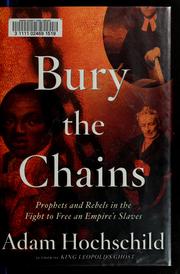
Bury the Chains
First published 2004. Subjects: Abolitionismus, Abolitionisme, Mouvements antiesclavagistes, Histoire, Slavernij.
The fear of French negroes
Provides broader context for colonial anxieties surrounding Afro-Caribbean peoples and beliefs.
Endnotes
1.
Source: cambridge.org
Link:https://www.cambridge.org/core/journals/journal-of-law-and-religion/article/abs/obeah-vagrancy-and-the-boundaries-of-religious-freedom-analyzing-the-proscription-of-pretending-to-possess-supernatural-powers-in-the-anglophone-caribbean/11EEE1AD5948F72F423FE174FFE61F87
Source snippet
Cambridge University Press & AssessmentOBEAH, VAGRANCY, AND THE BOUNDARIES OF RELIGIOUS FREEDOM: ANALYZING THE PROSCRIPTION OF “PRETENDIN...
2.
Source: cambridge.org
Link:https://www.cambridge.org/core/books/cultural-politics-of-obeah/obeah-in-the-courts-18901939/DC36F64021BD8B2FFDFED90CD9CF9CEF
3.
Source: cambridge.org
Title: The emergence of Caribbean spiritual politics (Chapter 1)
Link:https://www.cambridge.org/core/books/cultural-politics-of-obeah/emergence-of-caribbean-spiritual-politics/FC51D36577DC37AC641288F0AC718D28
4.
Source: obeahhistories.org
Title: Obeah Histories Legislation | Obeah Histories
Link:https://obeahhistories.org/law/
Source snippet
Obeah HistoriesLegislation | Obeah HistoriesSeptember 18, 2012...
Published: September 18, 2012
5.
Source: obeahhistories.org
Title: Timeline | Obeah Histories
Link:https://obeahhistories.org/about/
6.
Source: skn.caribdesigns.com
Link:https://skn.caribdesigns.com/laws/?ee=1&eeFolder=Act02and09TOC&eeListID=1
Additional References
7.
Source: ciu.gov.kn
Title: st kitts and nevis citizenship unit confirms rescission of fincen advisory
Link:https://ciu.gov.kn/st-kitts-and-nevis-citizenship-unit-confirms-rescission-of-fincen-advisory/
Source snippet
KITTS AND NEVIS CITIZENSHIP UNIT CONFIRMS RESCISSION OF FINCEN ADVISORY - St Kitts & NevisFebruary 27, 2026 — ST. KITTS AND NEVIS CITIZEN...
Published: February 27, 2026
8.
Source: stkittsnevisflag.com
Title: It was a landmark in the long struggle against sl
Link:https://stkittsnevisflag.com/discover-stkitts-nevis/historical-overview/significant-historical-events-in-st-kitts-and-nevis/1807-abolition-of-the-slave-trade-and-effects/
Source snippet
The 1807 Abolition of the Slave Trade — St Kitts and NevisJune 7, 2026 — THE 1807 ABOLITION OF THE SLAVE TRADE AND ITS EFFECTS ON ST KITT...
Published: June 7, 2026
9.
Source: youtube.com
Title: The Forbidden Healers: Black Midwives and the Obeah Laws
Link:http://www.youtube.com/watch?v=lKU2pXMNxp4
Source snippet
Obeah law Caribbean colonial history Archival Irruptions: Moravians, Obeah, and Hidden Caribbean Histories Dis A Fi Mi history Podcast...
10.
Source: britishnewspaperarchive.co.uk
Title: st christopher gazette
Link:https://www.britishnewspaperarchive.co.uk/titles/st-christopher-gazette
Source snippet
Christopher Gazette in British Newspaper ArchiveFebruary 2, 2021 — ON THIS DAY JUNE 23, 1871 Image: cover page of St. Christopher Gazette...
Published: February 2, 2021
11.
Source: lawcommission.gov.kn
Title: Revised Acts of St
Link:https://lawcommission.gov.kn/revised-acts-of-st-kitts-and-nevis/revised-acts-of-st-kitts-and-nevis/
Source snippet
Kitts and Nevis – St. Kitts and Nevis Law CommissionJuly 2, 2023 — Government of St. Kitts & Nevis The Law Commission - An arm of the Min...
Published: July 2, 2023
12.
Source: youtube.com
Title: Archival Irruptions: Moravians, Obeah, and Hidden Caribbean Histories
Link:http://www.youtube.com/watch?v=crP-n_zfkZc
Source snippet
Obeah Is Jamaican Culture: How Colonialism Criminalized Our Tradition...
13.
Source: irb-cisr.gc.ca
Title: National Documentation Packages
Link:https://www.irb-cisr.gc.ca/en/country-information/ndp/Pages/index.aspx?pid=13052
Source snippet
Immigration and Refugee Board of CanadaAugust 1, 2025 — GENDER, DOMESTIC VIOLENCE AND CHILDREN 5.1...
Published: August 1, 2025
14.
Source: youtube.com
Title: Should Obeah be Criminalized in Jamaica or Not? | TVJ All Angles
Link:http://www.youtube.com/watch?v=ExMK286AR1A
Source snippet
How Colonial Jamaica Turned Obeah Into A Crime with Dr. Katharine Gerbner...
15.
Source: youtube.com
Title: Obeah Is Jamaican Culture: How Colonialism Criminalized Our Tradition
Link:http://www.youtube.com/watch?v=DPBdkCWxEc8
Source snippet
Should Obeah be Criminalized in Jamaica or Not? | TVJ All Angles...
16.
Source: youtube.com
Title: How Colonial Jamaica Turned Obeah Into A Crime with Dr. Katharine Gerbner
Link:http://www.youtube.com/watch?v=u0LjnvBHQ2c
Source snippet
The Forbidden Healers: Black Midwives and the Obeah Laws...
Topic Tree