Within Egyptian Panics
How Does Uncertainty Become a National Scare?
Religious expectation, institutional distrust and sensational reporting can transform uncertain events into nationwide belief or fear.
On this page
- Visions, illness, rumours and moral panics
- The roles of media, officials and institutions
- Why careful labels change how harm is understood
Page outline Jump by section
Introduction
Egypt’s best-known episodes of collective fear rarely begin with certainty. Instead, they often emerge from ambiguous events: unexplained lights in the sky, clusters of unexplained illness, unfamiliar youth culture, disease outbreaks or alarming rumours about crime. Whether those events become local curiosities or nationwide panics depends less on the original incident than on how trusted institutions, religious authorities, the media and ordinary citizens interpret uncertainty.
Across modern Egyptian history, similar patterns appear repeatedly. When reliable information is scarce, competing explanations flourish. Official silence or contradictory statements can deepen suspicion rather than calm it, while sensational reporting and, more recently, social media can rapidly transform isolated claims into national stories. Yet the outcomes differ. Some episodes, such as reported religious visions, have offered reassurance and solidarity. Others have produced arrests, discrimination, unnecessary policy decisions or fear that outlasted the original event. Understanding these mechanisms helps explain why apparently unrelated incidents have followed remarkably similar social pathways.[Cambridge University Press & Assessment]cambridge.orgCambridge University Press & AssessmentTarantism, dancing mania and demonopathy: the anthro-political aspects of ‘mass psychogenic illnes…
Visions, illness, rumours and moral panics
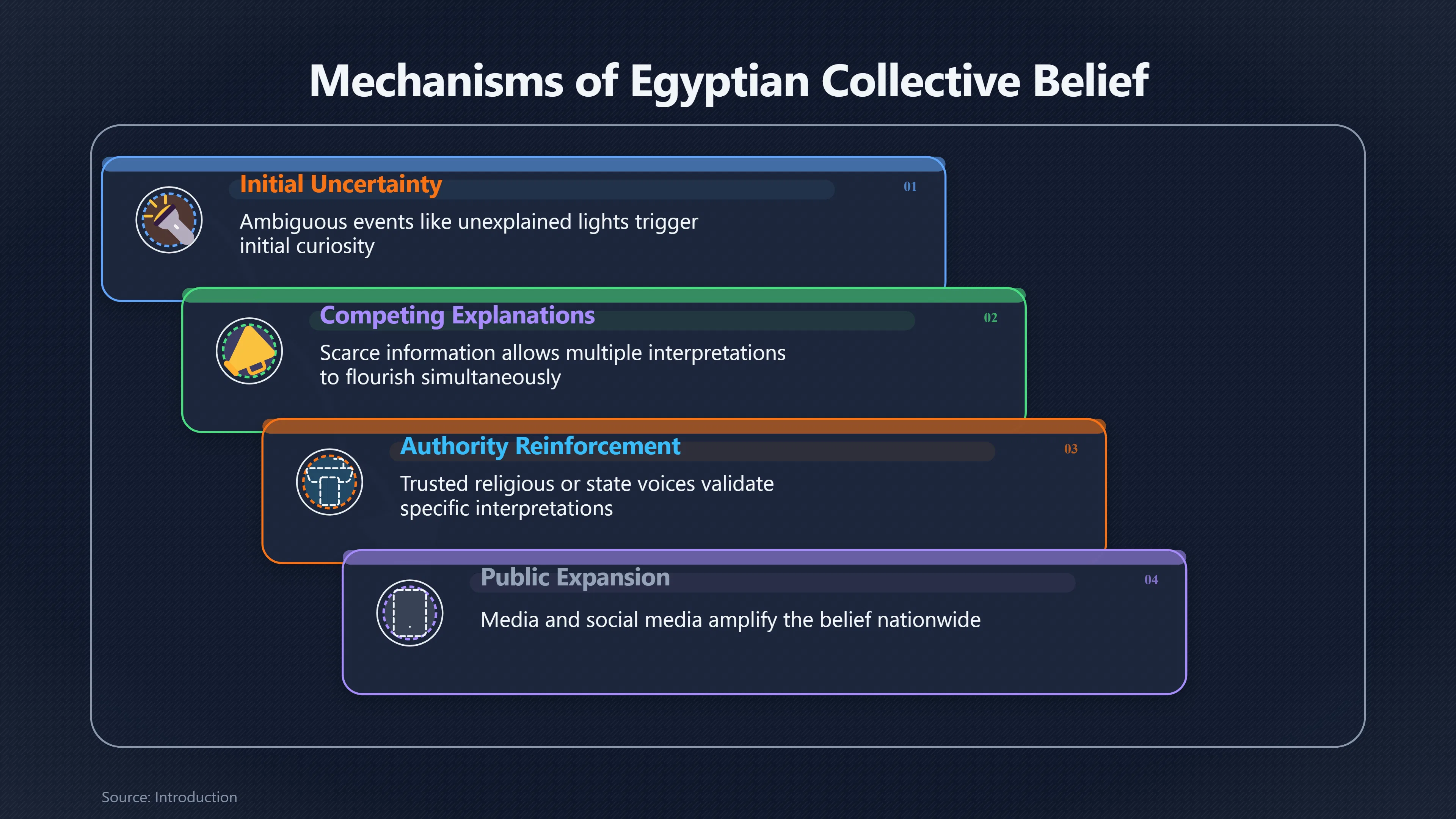
Egypt’s collective-belief episodes are diverse, but they often follow a common sequence: uncertainty creates competing explanations, respected voices reinforce one interpretation, public attention expands, and the belief becomes socially significant regardless of whether the original claim can be verified.
Religious experiences illustrate one pathway. During the reported Marian apparitions at Zeitoun after 1968, thousands interpreted ambiguous lights and shapes through established Christian and Muslim traditions. The country’s recent military defeat in 1967 created a climate in which many people sought signs of hope and divine reassurance. Because church leaders publicly accepted the reports and the state did not suppress the gatherings, the events became a source of comfort rather than a moral panic directed against an alleged enemy.
School illness outbreaks represent a different mechanism. When groups of pupils suddenly develop headaches, fainting or breathing difficulties without an identifiable environmental cause, investigators today often consider the possibility of mass psychogenic illness. The symptoms are genuine, but stress, expectation and observation can contribute to their spread through a closely connected community. Researchers emphasise that such episodes should not be dismissed as people “pretending” to be ill, and that insensitive language can worsen both stigma and public distrust.[New England Journal of Medicine]nejm.orgNew England Journal of MedicineMass Psychogenic Illness Attributed to Toxic Exposure at a High School | New England Journal of MedicineJa…
Rumour panics occupy another category. Stories about child abductions, organ trafficking or hidden conspiracies have periodically spread across Egypt, especially during periods of political instability or heightened concern about crime. Such rumours rarely succeed because people are unusually gullible. Instead, they attach themselves to genuine anxieties about public safety, corruption or weak institutional accountability. When official information arrives slowly or appears inconsistent, rumours may seem more believable than reassurance.
The heavy-metal “Satanism” scare of the late 1990s demonstrates how moral panics develop. Following police raids and sensational newspaper coverage, young music fans were portrayed as members of dangerous occult networks threatening Egyptian society. Newspapers published dramatic descriptions of supposed Satanic rituals, identified clothing and musical tastes as warning signs, and encouraged readers to see ordinary youth culture as evidence of organised evil. Subsequent research found little evidence supporting the extraordinary allegations, leading many scholars to interpret the episode as a classic moral panic shaped by wider cultural anxieties rather than proof of an organised Satanic movement.[newswise.com]newswise.comTracking a Moral Panic | NewswiseTracking a Moral Panic | NewswiseDecember 11, 2000…
Why media, officials and institutions matter so much
Uncertainty rarely becomes a nationwide scare without amplification. In Egypt, three groups have repeatedly played crucial roles: the media, state institutions and trusted religious authorities.
Traditional newspapers historically possessed enormous agenda-setting power. During the Satanism scare, repeated headlines, dramatic imagery and interviews with self-described experts reinforced the impression that Egypt faced an organised threat. Rather than investigating whether the central claims were well supported, much reporting focused on identifying supposed warning signs and expanding the narrative. Researchers studying the episode argue that this media environment helped transform a limited police investigation into a national cultural crisis.[Newswise]newswise.comTracking a Moral Panic | NewswiseTracking a Moral Panic | NewswiseDecember 11, 2000…
Government responses also shape public reactions. Decisive action can reassure people when it is proportionate and transparent. However, visible interventions may unintentionally convince the public that an uncertain threat must be genuine simply because authorities appear to be treating it as an emergency. Conversely, delayed communication, contradictory statements or perceived secrecy can encourage alternative explanations and conspiracy theories.
Religious institutions occupy a distinctive position in Egypt because they are trusted by many communities. Their responses can either stabilise uncertainty or legitimise a particular interpretation. During reported Marian apparitions, official church recognition encouraged believers to understand the events within an accepted religious framework rather than through rumours of danger. In other situations, competing religious and political interpretations have increased disagreement rather than reduced it.
Social media has accelerated these dynamics. Earlier rumours depended largely on newspapers, television and word of mouth. Today, dramatic claims can circulate nationally within hours, while corrections often spread more slowly. Research on online rumours consistently shows that unverified claims receive substantial support before reliable evidence becomes available, particularly during rapidly developing events.[arXiv]arxiv.orgOpen source on arxiv.org.
Why uncertainty spreads so effectively
Several recurring social conditions help explain why certain fears gain traction while others disappear quickly.
Institutional distrust. Where confidence in official information is limited, people often rely more heavily on family networks, neighbours or social media. Rumours become alternative ways of making sense of uncertainty rather than simple mistakes.
Periods of national stress. Military defeat, political upheaval, economic hardship and public-health crises increase people’s desire for explanations. Ambiguous events become more meaningful because they appear to confirm wider fears or hopes.
Existing cultural narratives. New rumours rarely emerge from nowhere. They usually borrow familiar ideas—hidden conspiracies, threats to children, moral decline or divine intervention—that audiences already recognise.
Visible emotional reactions. Crowds themselves become evidence for later observers. Seeing many people frightened, gathering or sharing warnings persuades others that the threat must be real, creating a feedback loop in which behaviour reinforces belief.
Research into mass psychogenic illness and rumour transmission repeatedly finds that anxiety, observation and social communication can spread reactions rapidly even when no common physical cause is identified. This does not imply irrationality. People often make reasonable decisions based on incomplete information within stressful environments.[nejm.org]nejm.orgNew England Journal of MedicineMass Psychogenic Illness Attributed to Toxic Exposure at a High School | New England Journal of MedicineJa…
Why careful labels change how harm is understood
The language used to describe these episodes matters because different labels imply different explanations and different responsibilities.
Calling every collective event “mass hysteria” risks implying that participants behaved irrationally or imagined their experiences. Modern researchers increasingly prefer more specific terms, such as mass psychogenic illness, moral panic, rumour panic or collective religious experience, because each describes a different process with different evidence requirements.[Cambridge University Press & Assessment]cambridge.orgCambridge University Press & AssessmentTarantism, dancing mania and demonopathy: the anthro-political aspects of ‘mass psychogenic illnes…
The distinction also affects public policy. A school illness outbreak requires careful medical investigation and compassionate communication, even if no environmental hazard is eventually identified. A moral panic demands scrutiny of media claims and proportional law enforcement. A religious vision can be analysed historically without attempting to prove or disprove its supernatural meaning. A rumour panic requires rapid, credible communication that addresses the underlying uncertainty rather than simply dismissing frightened citizens.
Using precise language also helps separate genuine threats from exaggerated ones. Egypt has experienced real terrorism, real public-health emergencies and real criminal activity. Recognising that some widely shared rumours later prove false does not mean all public fears are unfounded. The central question is whether the available evidence supports the scale of the claimed danger.

What Egypt’s experience reveals
Egypt’s history shows that public panic is rarely created by one dramatic event alone. It usually develops when uncertainty meets social stress, trusted institutions struggle to establish a convincing explanation, and communication systems reward dramatic interpretations over cautious ones.
The country’s experiences also demonstrate that collective belief is not inherently harmful. Shared religious experiences have sometimes fostered hope and solidarity, while other episodes have encouraged compassion towards communities under stress. Harm becomes more likely when uncertainty hardens into accusations, stereotypes or policy driven by fear rather than evidence.
Seen together, Egypt’s visions, illness outbreaks, media scares and recurring rumours reveal a consistent lesson: uncertainty is socially powerful. The question is not simply whether people believe extraordinary claims, but who defines their meaning, whose explanations gain authority, and whether institutions respond in ways that reduce fear or unintentionally amplify it.
Amazon book picks
Further Reading
Books and field guides related to How Does Uncertainty Become a National Scare?. Use these as the next step if you want deeper reading beyond the article.
Extraordinary Popular Delusions and the Madness of Crowds
Rating: 4.0/5 from 5 Google Books ratings
Directly addresses recurring patterns in collective scares.

Endnotes
1.
Source: cambridge.org
Link:https://www.cambridge.org/core/journals/psychological-medicine/article/abs/tarantism-dancing-mania-and-demonopathy-the-anthropolitical-aspects-of-mass-psychogenic-illness/A2C2EF387B94BC12E4BBB526B5443534
Source snippet
Cambridge University Press & AssessmentTarantism, dancing mania and demonopathy: the anthro-political aspects of ‘mass psychogenic illnes...
2.
Source: arxiv.org
Link:https://arxiv.org/abs/1511.07487
3.
Source: newswise.com
Title: Tracking a Moral Panic | Newswise
Link:https://www.newswise.com/articles/tracking-a-moral-panic
Source snippet
Tracking a Moral Panic | NewswiseDecember 11, 2000...
Published: December 11, 2000
4.
Source: arxiv.org
Link:https://arxiv.org/abs/1804.03461
5.
Source: pmc.ncbi.nlm.nih.gov
Link:https://pmc.ncbi.nlm.nih.gov/articles/PMC7396040/
6.
Source: nejm.org
Link:https://www.nejm.org/doi/full/10.1056/NEJM200001133420206
Source snippet
New England Journal of MedicineMass Psychogenic Illness Attributed to Toxic Exposure at a High School | New England Journal of MedicineJa...
7.
Source: journals.sagepub.com
Title: Sage Journals Prime-time Satanism: rumor-panic and the work of iconic topoi
Link:https://journals.sagepub.com/doi/10.1177/1470357205048939
Source snippet
Sage JournalsPrime-time Satanism: rumor-panic and the work of iconic topoi - Joshua Gunn, 2005...
8.
Source: nejm.org
Link:https://www.nejm.org/doi/abs/10.1056/NEJM200001133420206
Additional References
9.
Source: etheses.whiterose.ac.uk
Link:https://etheses.whiterose.ac.uk/id/eprint/36794/
Source snippet
Satanic Cult Conspiracy: How online conspiracy theory discourses construct moral panic - White Rose eTheses OnlineMay 21, 2025 — THE SATA...
Published: May 21, 2025
10.
Source: youtube.com
Link:https://www.youtube.com/watch?v=mnmv9erAqkM
Source snippet
Why Did Hundreds of People Dance Until They Died?...
11.
Source: youtube.com
Title: The Virgin Mary’s Apparition in Zeitun
Link:https://www.youtube.com/watch?v=tVU8bhbQInw
Source snippet
Episode 72. Mass Psychogenic Illness with Robert Baloh– Author of Medically Unexplained Symptoms...
12.
Source: youtube.com
Title: One Million Eyewitnesses Saw the Blessed Mother in Egypt!?
Link:https://www.youtube.com/watch?v=Fw2wlVmOFOM
Source snippet
The Virgin Mary's Apparition in Zeitun - 1968...
13.
Source: youtube.com
Title: Why Did Hundreds of People Dance Until They Died?
Link:https://www.youtube.com/watch?v=epIMKVsHIMo
Source snippet
Did You Know a Town Once Danced Itself to Death? | Punch...
14.
Source: taylorfrancis.com
Link:https://www.taylorfrancis.com/chapters/edit/10.4324/9781315134741-13/dynamics-rumor-panics-satanic-cults-jeffrey-victor
15.
Source: ouci.dntb.gov.ua
Link:https://ouci.dntb.gov.ua/en/works/4LWbeDj7/
16.
Source: psychiatryonline.org
Link:https://psychiatryonline.org/doi/10.1176/appi.ajp.158.6.981
17.
Source: core.ac.uk
Title: Satanic abuse, false memories, weird beliefs and moral panics
Link:https://core.ac.uk/outputs/42628845
18.
Source: youtube.com
Title: Did You Know a Town Once Danced Itself to Death? | Punch
Link:https://www.youtube.com/watch?v=RNMFrwJ5o6M
Topic Tree