Within Armenian Panics
How Soviet Rule Tried to Erase Religion
Soviet authorities used confiscation, propaganda and repression to recast organised religion as backward and politically dangerous.
On this page
- Why organised religion threatened Soviet power
- Propaganda, confiscation and repression
- How belief survived in homes and local customs
Page outline Jump by section
Introduction
After Armenia was incorporated into the Soviet Union in 1920, the new communist authorities launched a long-term campaign to weaken organised religion and replace it with an officially atheist worldview. In Soviet Armenia, this was not a spontaneous public panic about religion but a state-directed programme of confiscation, propaganda, legal restrictions and periodic repression. The principal target was the Armenian Apostolic Church, an institution that had long served not only as a religious body but also as a symbol of Armenian identity and historical continuity.

The campaign reflected a broader Soviet belief that religion was a relic of the past and a potential rival to communist authority. Yet Armenia posed a particular challenge. Even when churches were closed, clergy arrested and religious education suppressed, many Armenians continued to preserve religious practices within families, village traditions and cultural ceremonies. The result was not the disappearance of religion but a transformation in how belief was expressed and transmitted across generations.
Why organised religion threatened Soviet power
Marxist-Leninist ideology regarded religion as both an obstacle to socialist progress and a competing source of loyalty. The Soviet state sought to build a society in which political commitment to the Communist Party replaced traditional religious authority. Churches, monasteries and clergy were therefore viewed not simply as religious institutions but as independent organisations capable of influencing communities outside state control.[NYU Press]nyupress.orgNYU Press Religion in the Soviet UnionNYU Press Religion in the Soviet Union
In Armenia, these concerns were intensified by the unique position of the Armenian Apostolic Church. Unlike many other religious institutions in the Soviet Union, it was deeply entwined with Armenian language, literature, education and national memory. For centuries it had helped preserve Armenian identity during periods of foreign rule. Weakening the Church therefore became part of the broader Soviet effort to reshape national identity around socialist rather than religious values.[World Council of Churches]oikoumene.orgWorld Council of Churches Country profile: Armenia | World Council of ChurchesWorld Council of ChurchesCountry profile: Armenia | World Council of ChurchesJanuary 1, 2004…
The authorities generally framed their campaign as a struggle against “backwardness” and superstition rather than against Armenian culture itself. In practice, however, the distinction often proved impossible to maintain because religious traditions and national identity were so closely connected.
Propaganda, confiscation and repression
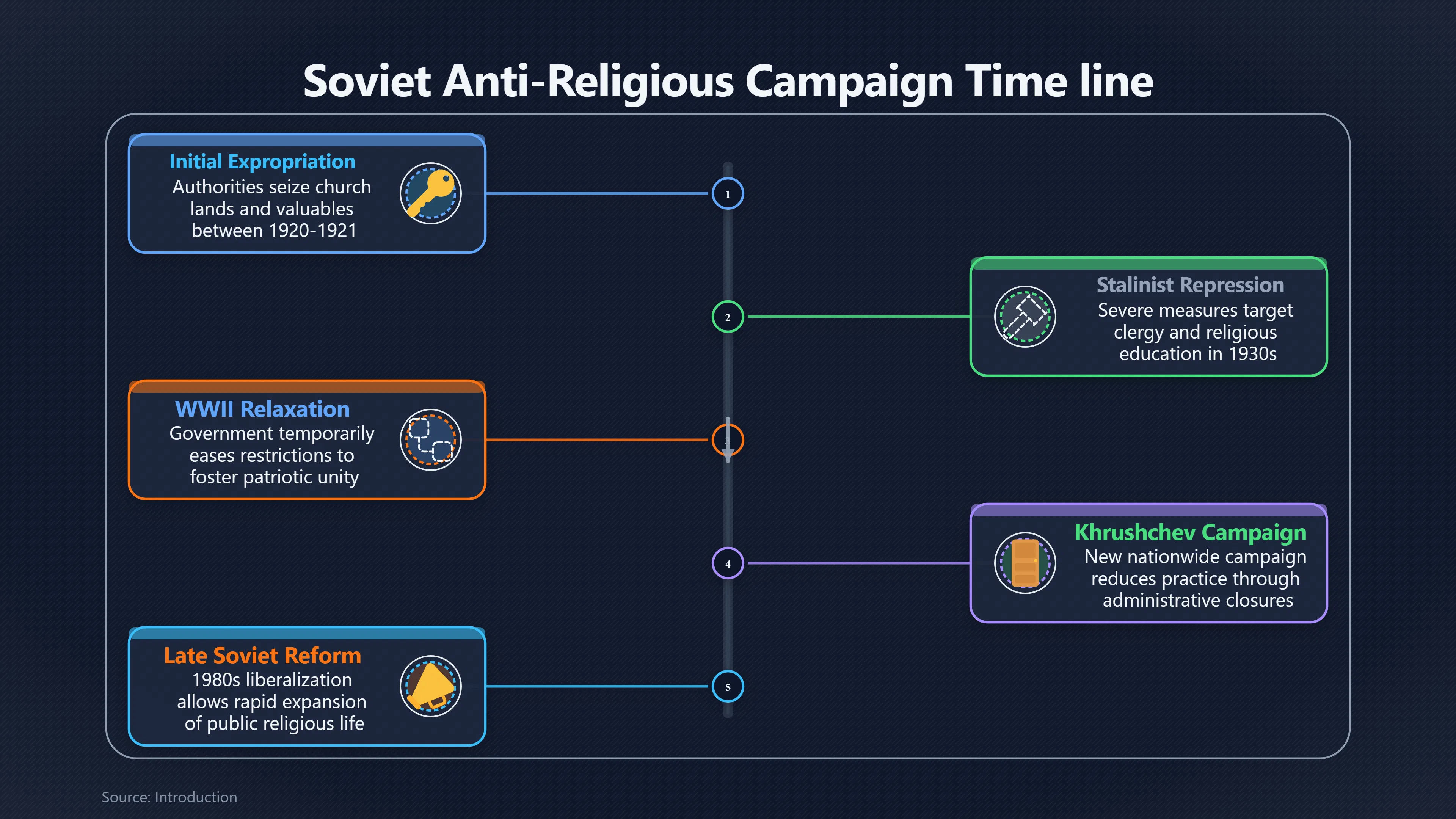
The first years of Soviet rule brought rapid measures against church institutions. Following the Bolshevik model introduced elsewhere in the USSR, revolutionary authorities confiscated church lands, valuables and other property. Archival research on Soviet Armenia shows that the expropriation of Armenian Apostolic Church property began almost immediately after Sovietisation between late 1920 and early 1921, reflecting the belief that church wealth should become state property.[Pan-Armenian Digital Library]arar.sci.amPan-Armenian Digital LibraryԵկեղեցու սեփականության բռնագրավումը Խորհրդային Հայաստանում (1920 թ. դեկտեմբեր – 1921 թ. փետրվար) - Pan-Armeni…
Confiscation was accompanied by wider efforts to reduce the Church’s influence:
- Church schools and most forms of religious education were closed.
- Religious publications became tightly restricted or prohibited.
- Clergy faced surveillance, taxation, arrest or exclusion from public life.
- Many churches and monasteries were closed, repurposed as warehouses, museums or public buildings, or allowed to fall into neglect.
- State schools promoted scientific atheism while portraying religion as an outdated survival incompatible with socialism.[nyupress.org]nyupress.orgNYU Press Religion in the Soviet UnionNYU Press Religion in the Soviet Union
Public propaganda formed another important part of the campaign. Soviet organisations such as the League of the Militant Godless organised lectures, exhibitions and publications that ridiculed religious belief and celebrated atheism as a mark of modern citizenship. Rather than relying solely on police repression, the authorities attempted to reshape everyday attitudes by encouraging young people to reject religious customs in favour of secular Soviet rituals and holidays.[Wikipedia]WikipediaUSSR anti religious campaign (1928–1941USSR anti religious campaign (1928–1941
The intensity of repression varied over time. During Stalin’s rule, particularly in the late 1920s and 1930s, anti-religious measures became especially severe across the Soviet Union. During the Second World War the Soviet government temporarily relaxed some restrictions to encourage patriotic unity, including allowing limited church activity. However, new pressure emerged under Nikita Khrushchev in the late 1950s and early 1960s, when another nationwide campaign sought to reduce religious practice through church closures and administrative restrictions rather than mass executions.[The Library of Congress]loc.govThe Library of Congress Internal Workings of the Soviet UnionThe Library of CongressInternal Workings of the Soviet Union - Revelations from the Russian Archives | Exhibitions - Library of Congress…

How belief survived in homes and local customs
Despite decades of official atheism, religious life did not disappear from Armenia. Instead, much of it moved away from public institutions into private and community settings.
Families quietly continued practices such as baptisms, funeral rites, the observance of major feast days and visits to ancient churches whenever circumstances allowed. In many rural communities, local customs blended cultural identity with religious tradition so closely that separating one from the other proved difficult for Soviet officials.
The authorities could regulate registered churches more easily than informal belief. While public expressions of faith might carry professional or educational risks, private devotion often continued with little documentation. This made the real level of religious belief difficult for Soviet authorities themselves to measure.[World Council of Churches]oikoumene.orgWorld Council of Churches Country profile: Armenia | World Council of ChurchesWorld Council of ChurchesCountry profile: Armenia | World Council of ChurchesJanuary 1, 2004…
The Armenian Apostolic Church also retained limited institutional continuity. Unlike some religious bodies that were almost entirely eliminated, the Mother See at Etchmiadzin survived under heavy state supervision. Its leadership operated within strict political constraints, but the continued existence of the Catholicos provided an important symbolic focus for Armenian Christians inside and outside the Soviet Union. Historians note that the Soviet government partly tolerated this limited institutional survival because of its diplomatic value in maintaining connections with the Armenian diaspora and projecting an image of religious freedom abroad, even while closely monitoring church activity.[NYU Press]nyupress.orgNYU Press Religion in the Soviet UnionNYU Press Religion in the Soviet Union
Why the campaign never fully succeeded
The Soviet campaign achieved many of its immediate administrative goals. Thousands of clergy lost their positions, religious education almost disappeared from public life, monasteries closed and generations of Armenians grew up in officially atheist schools. Religious participation declined substantially compared with the pre-Soviet era.[Refworld]refworld.orgU.S. Department of State Annual Report on International Religious Freedom for 2002 - Armenia | RefworldOctober 7, 2002…
Yet the campaign failed in its larger ambition of eliminating religion altogether. Several factors limited its success:
- Religion remained part of national identity. Many Armenians viewed the Church as a guardian of their history rather than simply a place of worship.
- Private transmission continued. Religious traditions survived within households even when public observance became risky.
- Ancient sacred sites retained cultural importance. Historic churches continued to attract respect as symbols of Armenian civilisation even among less observant citizens.
- Political liberalisation late in the Soviet period created new opportunities. During the reforms of the 1980s, public religious life expanded rapidly, demonstrating that belief had persisted beneath decades of official atheism.[doi.org]doi.orgArmenia and Karabakh | Christianity in North Africa and West Asia | Edinburgh Scholarship Online | Oxford Academic…
Why this matters in Armenia’s history of collective belief
Soviet Armenia’s anti-religious campaign differs from episodes of moral panic or spontaneous collective fear. It was a centrally organised policy intervention driven by ideology rather than by rumours, popular hysteria or public anxieties about hidden religious groups.
Nevertheless, it belongs within Armenia’s wider history of contested belief because it illustrates how governments can redefine religion as a social danger requiring state intervention. Soviet propaganda portrayed organised religion as politically suspect, economically backward and scientifically false, encouraging citizens to see religious commitment as incompatible with modern socialist life. This official narrative justified decades of restrictions on institutions that many Armenians regarded as central to their cultural identity.
The campaign also shaped later debates. After Armenia regained independence in 1991, the Armenian Apostolic Church quickly regained a prominent public role, while new religious movements sometimes became the focus of fresh public suspicion. In that sense, the Soviet attempt to erase religion left a lasting legacy: it changed the relationship between faith, national identity and the state, but it did not extinguish the religious traditions it sought to replace.
Amazon book picks
Further Reading
Books and field guides related to How Soviet Rule Tried to Erase Religion. Use these as the next step if you want deeper reading beyond the article.
A Concise History of the Armenian People
Explains Armenia's religious and political development.

The Soviet century
Provides context for Soviet ideological campaigns including religion.
Endnotes
1.
Source: doi.org
Link:https://doi.org/10.3366/edinburgh/9781474428057.003.0017
Source snippet
Armenia and Karabakh | Christianity in North Africa and West Asia | Edinburgh Scholarship Online | Oxford Academic...
2.
Source: Wikipedia
Title: Religion in the Soviet Union
Link:https://en.wikipedia.org/wiki/Religion_in_the_Soviet_Union
3.
Source: Wikipedia
Title: USSR anti religious campaign (1928–1941)
Link:https://en.wikipedia.org/wiki/USSR_anti-religious_campaign_%281928%E2%80%931941%29
4.
Source: refworld.org
Link:https://www.refworld.org/reference/annualreport/usdos/2002/en/31505
Source snippet
U.S. Department of State Annual Report on International Religious Freedom for 2002 - Armenia | RefworldOctober 7, 2002...
Published: October 7, 2002
5.
Source: history.com
Title: joseph stalin religion atheism ussr
Link:https://www.history.com/articles/joseph-stalin-religion-atheism-ussr
6.
Source: doi.org
Link:https://doi.org/10.5334/pp.13
7.
Source: nyupress.org
Title: NYU Press Religion in the Soviet Union
Link:https://nyupress.org/9780814715390/religion-in-the-soviet-union/
8.
Source: loc.gov
Title: The Library of Congress Internal Workings of the Soviet Union
Link:https://www.loc.gov/exhibits/archives/intn
Source snippet
The Library of CongressInternal Workings of the Soviet Union - Revelations from the Russian Archives | Exhibitions - Library of Congress...
9.
Source: oikoumene.org
Title: World Council of Churches Country profile: Armenia | World Council of Churches
Link:https://www.oikoumene.org/resources/documents/country-profile-armenia
Source snippet
World Council of ChurchesCountry profile: Armenia | World Council of ChurchesJanuary 1, 2004...
Published: January 1, 2004
10.
Source: arar.sci.am
Link:https://arar.sci.am/publication/44100
Source snippet
Pan-Armenian Digital LibraryԵկեղեցու սեփականության բռնագրավումը Խորհրդային Հայաստանում (1920 թ. դեկտեմբեր – 1921 թ. փետրվար) - Pan-Armeni...
11.
Source: arar.sci.am
Link:https://arar.sci.am/dlibra/publication/400622/edition/370753/content
12.
Source: arar.sci.am
Link:https://arar.sci.am/dlibra/publication/44100/edition/39555
13.
Source: archaeologyethnographynationalacademysciencesarmenia.academia.edu
Link:https://archaeologyethnographynationalacademysciencesarmenia.academia.edu/Departments/Contemporary_Anthropological_Studies/Documents?page=3
Additional References
14.
Source: cambridge.org
Link:https://www.cambridge.org/core/journals/politics-and-religion/article/abs/soviet-religious-policy-in-the-baltics-under-khrushchev-19571964-domestic-repression-and-international-engagement/C0C6816D3DEC3CB8A58694AF909BB851
Source snippet
Cambridge University Press & AssessmentSoviet Religious Policy in the Baltics under Khrushchev, 1957–1964: Domestic Repression and Intern...
15.
Source: youtube.com
Title: Armenian Catholicos Who Defied the Soviet Union
Link:https://www.youtube.com/watch?v=7gyeVC4_v_M
Source snippet
Armenian church Soviet union How Soviet-era Suppression Shaped Armenian Church Practice — And Why It's Changing Now Full Armor Apologetics...
16.
Source: youtube.com
Title: Catholicos and Commissar: The Armenian Church Under the Soviet Regime
Link:https://www.youtube.com/watch?v=VCVVpGitL5M
Source snippet
Religion in the Soviet Union: Life of Religious People Under Communist Rule...
17.
Source: youtube.com
Title: Religion in the Soviet Union: Life of Religious People Under Communist Rule
Link:https://www.youtube.com/watch?v=V7AQecMOz9c
Source snippet
USSR Anti-Religious Campaign (1928–1941)...
18.
Source: academic.oup.com
Title: Ross (ed
Link:https://academic.oup.com/edinburgh-scholarship-online/book/62094/chapter-abstract/548700501
Source snippet
"and Karabakh | Christianity in North Africa and West Asia | Edinburgh Scholarship Online | Oxford AcademicJanuary 22, 2026 — [https://doi..."](https://doi...")...
Published: January 22, 2026
19.
Source: youtube.com
Title: How Soviet-era Suppression Shaped Armenian Church Practice
Link:https://www.youtube.com/watch?v=sWFnG18CqOQ
Source snippet
Armenian Catholicos Who Defied the Soviet Union...
20.
Source: peterlang.com
Link:https://www.peterlang.com/document/1068898
21.
Source: youtube.com
Link:https://www.youtube.com/watch?v=F0ER7PECJV0
Source snippet
How Soviet-era Suppression Shaped Armenian Church Practice...
22.
Source: bakuresearchinstitute.org
Title: The Campaign Against Religion and the Promotion of Atheism in the Soviet Union
Link:https://bakuresearchinstitute.org/en/the-campaign-against-religion-and-the-promotion-of-atheism-in-the-soviet-union/
23.
Source: jgkeegan.com
Title: Survival: The Russian Orthodox Church
Link:https://jgkeegan.com/papers/roc.htm
Topic Tree