When Crisis Reshaped Belief in Micronesia
The Federated States of Micronesia has no well-documented equivalent of the European witch trials, the great Melanesian “cargo cults” or a modern nationwide outbreak of mass psychogenic illness.
Page outline Jump by section
Introduction
These episodes matter because they show how collective belief changes under pressure. Earthquakes, missionary competition, colonial rule, family conflict and rapid social change did not simply erase older ideas. People reworked them. Traditional priests could become anti-missionary prophets; ancestral possession could become an involuntary response to domestic stress; and a strongly Christian national identity could produce suspicion of a tiny Muslim community. The evidence is uneven, however, and the safest interpretation is not that Micronesia repeatedly succumbed to “mass hysteria”, but that island communities used familiar religious languages to understand disruption, inequality and distress.[friendsoftobi.org]friendsoftobi.orgin MicronesiaThe Distribution of Spirit Possession and Trance in Micronesia…
Why the evidence is unusually difficult
The modern country consists of four culturally distinct states—Yap, Chuuk, Pohnpei and Kosrae—spread across a vast area of the western Pacific. Treating them as one psychological or religious culture can be misleading. Even practices found across several islands differed in social purpose, local meaning and relationship to political authority. Researchers studying spirit possession, for example, found broad regional similarities but warned that the surviving accounts were fragmented, written in several colonial languages and often based on travellers’ impressions or later memories.[friendsoftobi.org]friendsoftobi.orgin MicronesiaThe Distribution of Spirit Possession and Trance in Micronesia…
Colonial records also carry their authors’ assumptions. Missionaries and administrators frequently described indigenous ritual as superstition, heathenism, frenzy or deception. Such language may tell us as much about foreign efforts to establish authority as it does about islanders’ beliefs. Conversely, later retellings can simplify episodes into romantic stories of resistance or make ordinary religious experience sound like pathology.
This is why labels require care:
- A millenarian movement promises a dramatic transformation of the present world, often through divine or ancestral intervention.
- A moral panic magnifies a perceived threat to social order and identifies a group or practice as dangerously deviant.
- Mass psychogenic illness describes symptoms spreading through a connected group without an identified organic cause; it should not be diagnosed retrospectively from vague reports.
- Spirit possession is a cultural interpretation of altered speech, movement or consciousness. It is not automatically an illness, fraud or collective delusion.
- “Cult” may mean a system of ritual worship in older scholarship, but in modern public language it often implies manipulation or abuse. That implication is not supported for most Micronesian examples discussed here.
The 1889 Yap revival: prophecy after an earthquake
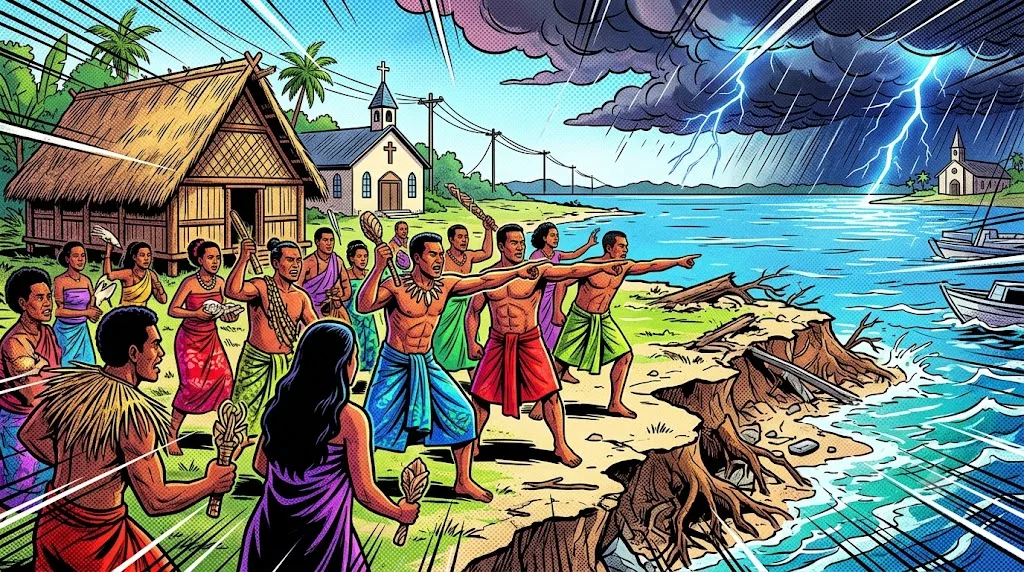
The clearest Micronesian example of a prophetic religious mobilisation occurred on Yap during the early years of Spanish colonial and Catholic missionary activity. Missionaries had arrived in 1886 and were attempting to establish schools, baptise converts and displace older ritual authority. In March 1889, a strong earthquake affected Yap. Soon afterwards, seven local ritual specialists associated with Lamer promoted a revival of a traditional fertility observance. They reportedly predicted that foreign missionaries would be driven from the island.[micsem.org]micsem.orgCatholic Church in Micronesia: YapAn earthquake in Lamer in March 1889, The same seven men from Lamer began a revival of a fertility cult…
The episode was not merely a frightened reaction to a natural disaster. The earthquake supplied a powerful sign at a moment when island society was being confronted by two linked forces: a colonial government claiming political control and missionaries claiming religious truth. In a society where ritual specialists had long mediated relationships with divine powers, ancestors, fertility and social order, a disruptive natural event could be interpreted as evidence that those relationships had been disturbed.
The revival therefore joined several concerns:
- the physical shock and uncertainty created by the earthquake;
- resistance to missionary teaching and compulsory cultural change;
- defence of the authority of local priests;
- anxiety about whether foreign presence had offended powerful beings;
- hope that correct ritual action could restore prosperity and remove outsiders.
The surviving narrative largely comes through mission history, so the precise size and intensity of the movement are difficult to establish. There is no strong evidence that it became a violent mass uprising or that the entire island accepted the prophecy. What is documented is a recognisable revitalisation movement: local specialists responded to colonial disruption by renewing older ritual, interpreting catastrophe through religious signs and promising a reversal of foreign power.
Was it a “cargo cult”?
Probably not. The term “cargo cult” was developed mainly for diverse Melanesian movements that expected ancestors or supernatural powers to deliver wealth and transform colonial inequalities. Modern anthropologists increasingly criticise the phrase because it groups very different movements together and can caricature Pacific peoples as irrationally imitating Western technology.[Open Encyclopedia of Anthropology]anthroencyclopedia.comOpen Encyclopedia of Anthropology Cargo cultsOpen Encyclopedia of AnthropologyCargo cultsMarch 29, 2018 — by L Lindstrom · 2018 · Cited by 55 — The modal cargo cult was an agitation…
The Yap revival did contain millenarian elements: prophecy, anticipated expulsion of foreigners and ritual renewal during crisis. Yet the known evidence centres on fertility, traditional authority and resistance to missionisation, not the expected arrival of manufactured goods. Calling it an anti-missionary revitalisation movement is both more precise and less loaded.
The movement also complicates the common assumption that conversion was a simple progression from “traditional religion” to Christianity. On Yap, acceptance of Catholicism was slow, uneven and shaped by chiefs, kin groups and changing colonial administrations. Older religious authority did not disappear at first contact; it competed, adapted and sometimes openly challenged the new order.[micsem.org]micsem.orgCatholic Church in Micronesia: YapAn earthquake in Lamer in March 1889, The same seven men from Lamer began a revival of a fertility cult…
Spirit possession in Chuuk: belief, distress and social communication
Spirit possession is much better documented in Chuuk than any supposed episode of mass hysteria. Historical accounts describe recognised mediums who deliberately entered trance and acted as intermediaries between living families and ancestral spirits. They might diagnose illness, reveal hidden information, advise a lineage or transmit messages from the dead. Possession therefore belonged to an organised social institution rather than an uncontrolled epidemic.[friendsoftobi.org]friendsoftobi.orgin MicronesiaThe Distribution of Spirit Possession and Trance in Micronesia…
During the twentieth century, researchers observed a significant change. The older, publicly recognised medium became less common, while possession increasingly appeared as an involuntary experience affecting women, often amid family conflict or personal pressure. Episodes could include shaking, altered voices, unusual strength, convulsions and speech attributed to deceased relatives. More than fifty Chuukese case histories collected by researchers formed the basis of this interpretation.[friendsoftobi.org]friendsoftobi.orgin MicronesiaThe Distribution of Spirit Possession and Trance in Micronesia…
The researchers argued that possession could function as a culturally understood way of expressing grievances that a woman might otherwise find difficult to voice directly. A dead relative speaking through her could criticise neglect, expose tensions or demand reconciliation with greater authority than the woman might possess in everyday family life. In this reading, the event was neither simply fabricated nor proof of literal spirit control. It was a meaningful social and psychological performance through which distress became audible.[micsem.org]micsem.orgOpen source on micsem.org.
This interpretation must be handled carefully. Saying that family stress helped trigger an episode does not mean the sufferer consciously staged it. Altered states, dissociation, trauma responses and culturally patterned behaviour can be experienced as involuntary and physically real. Nor does a psychological explanation cancel the spiritual meaning recognised by the person and her relatives.
Why it is not a documented mass-possession epidemic
Chuukese possession cases share features with events elsewhere that have been called mass psychogenic illness: symptoms are socially intelligible, emotional pressure matters and behaviours can be shaped by observation and expectation. Yet the available research describes repeated individual or family-centred incidents, not a clearly bounded outbreak sweeping through a school, workplace or village in a short period. The evidence therefore does not justify presenting Chuuk as the site of a proven “possession epidemic”.[friendsoftobi.org]friendsoftobi.orgin MicronesiaThe Distribution of Spirit Possession and Trance in Micronesia…
The distinction is important. “Mass hysteria” is often used loosely to dismiss unfamiliar behaviour, particularly when women or young people are involved. The Chuuk evidence instead points to continuity and transformation: an older institution of ancestral mediation survived in a less formal form as social structures, Christianity and family life changed.
Pohnpei and the shift from priestly oracles to involuntary possession
Pohnpei shows a similar movement from authorised ritual office to less predictable personal experience. Nineteenth-century accounts describe recognised mediums connected to priestly traditions. These specialists entered possession states and served as oracles, helping leaders obtain information from supernatural beings. Such roles were part of systems of rank, sacred authority and political decision-making.[friendsoftobi.org]friendsoftobi.orgin MicronesiaThe Distribution of Spirit Possession and Trance in Micronesia…
Those official mediums appear to have disappeared around or after the Second World War. By the mid-1970s, however, possession was again reported with some frequency, especially among adolescents, women and adults of lower status. Researchers interpreted this not as the simple survival of an unchanged custom but as a shift in who could become possessed and what possession accomplished. A controlled privilege of ritual specialists had become an involuntary condition experienced by people with less formal authority.[friendsoftobi.org]friendsoftobi.orgin MicronesiaThe Distribution of Spirit Possession and Trance in Micronesia…
This change offers a useful explanation for why older beliefs can persist after their institutions collapse. Christian conversion and colonial government weakened hereditary priesthoods, but they did not necessarily remove ideas about spirits, ancestors or supernatural causation. Instead, those ideas could migrate into domestic life, healing practices and individual episodes of distress.
Documentation from Kosrae is much thinner. Severe nineteenth-century depopulation through introduced disease, followed by intensive missionisation, disrupted both cultural transmission and the production of records. Researchers found only scattered historical references to possession there. Absence from the archive should therefore not be confused with proof that such beliefs never existed.[friendsoftobi.org]friendsoftobi.orgin MicronesiaThe Distribution of Spirit Possession and Trance in Micronesia…
Christianity, colonial power and fear of rival religions
Missionary Christianity did not enter the Caroline Islands as a single united force. Catholic and Protestant missions competed for converts, schools and political influence, while Spanish, German, Japanese and American administrations successively altered the balance of authority. On Pohnpei, missionary competition and the conversion of influential clan leaders helped create geographical and kin-based divisions between Catholic and Protestant communities that remained socially visible long afterwards.[Persée]persee.frPerséeWhere Church and State meet: responses to civil and religious power in colonial Micronesia - Persée…
In this environment, religious adherence became more than private belief. Churches provided education, leadership networks and community identity. Conversion could realign a clan, village or chiefly relationship. Suspicion of another denomination was therefore sometimes entangled with competition over status and access to colonial institutions rather than disagreement about theology alone.
The modern Federated States of Micronesia is constitutionally secular in the legal sense: its declaration of rights prohibits laws establishing a religion or impairing free exercise. Religious freedom is generally respected, and recent reporting has not identified widespread state persecution of religious minorities.[wikipedia.org]WikipediaConstitution of the Federated States of MicronesiaConstitution of the Federated States of Micronesia
Yet strong identification of national culture with Christianity has occasionally created a low-level moral panic around non-Christian faiths. In 2017, some social-media users advocated constitutional changes that would exclude non-Christian groups, while some pastors publicly opposed the presence of Islam. Later reports noted claims of discrimination and vandalism affecting the country’s very small Ahmadiyya Muslim community.[U.S. Department of State]2021-2025.state.govU.S. Department of StateFederated States of MicronesiaSome Christians on social media advocated amending the constitution to prohibit the…
This did not develop into a nationwide campaign of violence or legal prohibition. It is better understood as a social scare: an unfamiliar minority religion was portrayed by some voices as a threat to Christian identity despite the tiny size of the community and the constitutional protection of worship. The gap between the scale of the feared danger and the evidence of actual harm is one hallmark of moral-panic thinking.
What these cases have in common
The Yap revival, Chuukese possession and modern suspicion of minority religion are not versions of one phenomenon. One was an anti-colonial prophetic movement, another a changing tradition of ancestral communication and the third an identity-based social scare. Their similarities lie in the conditions that made belief especially consequential.
Rapid change weakened established authority. Missionaries challenged priests; colonial administrations displaced chiefs and ritual offices; modern education and wage labour altered households. When old channels of influence weakened, prophecy or possession could provide a different kind of voice.
Belief translated private pressure into public meaning. An earthquake became evidence of disturbed relations with sacred powers. Family conflict became a message delivered by an ancestor. Anxiety about cultural continuity became opposition to a small foreign-associated faith.
Small communities allowed stories to travel through trusted relationships. On islands where kinship, church and village networks overlap, testimony from relatives, clergy or respected leaders can carry exceptional weight. This does not make islanders uniquely credulous. It means that belief spreads through social structures, as it does elsewhere, but often through dense face-to-face networks.
Colonial observers controlled much of the written record. Missionaries documented practices they hoped to replace, while administrators classified movements according to their own concerns about disorder. Modern readers must separate observed conduct from hostile interpretation.
Christianisation changed supernatural belief rather than simply abolishing it. Spirits could be redefined as devils, ancestral experience could coexist with church membership, and Christian prophecy could merge with older expectations of restoration. Religious change was layered, not absolute.[friendsoftobi.org]friendsoftobi.orgin MicronesiaThe Distribution of Spirit Possession and Trance in Micronesia…

Myths to avoid
The first misleading claim is that the Federated States of Micronesia had famous “cargo cults” resembling those of Vanuatu or Papua New Guinea. The evidence supports a Yapese prophetic revival and several travelling religious traditions, but not a major FSM movement organised around the imminent supernatural delivery of Western goods.
The second is that spirit possession proves a history of mass mental illness. Chuuk and Pohnpei had culturally recognised possession traditions with changing social functions. Some episodes may be understandable through stress, dissociation or psychological conflict, but the historical record does not establish a countrywide epidemic.
The third is that missionaries simply defeated irrational beliefs. Missionisation was part of colonial transformation and generated resistance, negotiation and new religious mixtures. Christianity itself became locally embedded and is now central to many communities, but its arrival involved contests over schooling, political legitimacy and social authority.
The fourth is that every tightly organised or unfamiliar religious group is a “cult”. The term can obscure more than it reveals. A minority church, indigenous ritual body or prophetic movement should be judged by evidence of coercion, exploitation or harm, not merely by unusual theology or outsider status.
Why this history still matters
Micronesia’s strongest contribution to the study of collective belief is not a spectacular panic but a record of how supernatural ideas adapt. The ritual specialist does not simply vanish; authority reappears through prophecy. The formal medium disappears; possession returns through people with little ordinary power. A constitutional democracy protects religious freedom, yet sections of society may still fear a tiny minority as a threat to national identity.
These patterns challenge the dismissive language of “hysteria”. Beliefs spread because they answer questions that institutions have failed to settle: why disaster struck, why outsiders prosper, why a family is in conflict, why social roles feel intolerable or what holds a community together. The beliefs may be disputed, but the pressures beneath them are real.
The most defensible conclusion is therefore modest. The Federated States of Micronesia has a documented history of prophetic resistance, spirit-mediated responses to distress and occasional religious scares, but the archive does not support sensational claims of repeated mass delusion. Its importance lies in showing how culture gives crisis a language—and how that language changes when political and religious power changes hands.
Amazon book picks
Further Reading
Books and field guides related to When Crisis Reshaped Belief in Micronesia. Use these as the next step if you want deeper reading beyond the article.
Collapse
Explores how island societies respond to environmental and social crises, including Pacific examples.

Guns, Germs, and Steel
Provides broad context for cultural change and historical development in Oceania.
Purity and danger
Explains how societies construct ideas of danger, taboo, and disorder.

Endnotes
1.
Source: friendsoftobi.org
Title: in Micronesia
Link:https://www.friendsoftobi.org/tobithenandnow/ifiridoitch/hezelanddobbins1996.htm
Source snippet
The Distribution of Spirit Possession and Trance in Micronesia...
2.
Source: micsem.org
Link:https://micsem.org/pubs/books/catholic/yap/index.htm
Source snippet
Catholic Church in Micronesia: YapAn earthquake in Lamer in March 1889, The same seven men from Lamer began a revival of a fertility cult...
Published: March 1889
3.
Source: 2021-2025.state.gov
Link:https://2021-2025.state.gov/reports/2017-report-on-international-religious-freedom/federated-states-of-micronesia/
Source snippet
U.S. Department of StateFederated States of MicronesiaSome Christians on social media advocated amending the constitution to prohibit the...
4.
Source: micsem.org
Link:https://www.micsem.org/pubs/articles/religion/frames/christmicrofr.htm
Source snippet
Christianity in MicronesiaThe movement was led by seven local priests who prophesied that all foreign missionaries would be driven from Y...
5.
Source: micsem.org
Link:https://www.micsem.org/pubs/articles/socprobs/frames/spiritposschkfr.htm
6.
Source: micsem.org
Link:https://www.micsem.org/pubs/articles/socprobs/frames/posstranfr.htm
7.
Source: micsem.org
Link:https://micsem.org/micronesian-counselo/spirit-possession-in-chuuk-socio-cultural-interpretation/
8.
Source: micsem.org
Link:https://micsem.org/pubs/articles/socprobs/frames/americananthrofr.htm
9.
Source: encyclopedia.com
Link:https://www.encyclopedia.com/environment/encyclopedias-almanacs-transcripts-and-maps/micronesian-religions-overview
10.
Source: Wikipedia
Title: Religion in the Federated States of Micronesia
Link:https://en.wikipedia.org/wiki/Religion_in_the_Federated_States_of_Micronesia
11.
Source: Wikipedia
Title: Constitution of the Federated States of Micronesia
Link:https://en.wikipedia.org/wiki/Constitution_of_the_Federated_States_of_Micronesia
12.
Source: state.gov
Title: 547499 MICRONESIA 2023 INTERNATIONAL RELIGIOUS FREEDOM REPORT
Link:https://www.state.gov/wp-content/uploads/2024/04/547499-MICRONESIA-2023-INTERNATIONAL-RELIGIOUS-FREEDOM-REPORT.pdf
13.
Source: 2021-2025.state.gov
Link:https://2021-2025.state.gov/reports/2020-report-on-international-religious-freedom/micronesia/
14.
Source: history.com
Title: Salem Witch Trials: What Caused the Hysteria?
Link:https://www.history.com/articles/salem-witch-trials-hysteria-factors
15.
Source: 2021-2025.state.gov
Title: marshall islands
Link:https://2021-2025.state.gov/reports/2023-report-on-international-religious-freedom/marshall-islands/
16.
Source: Wikipedia
Title: Cargo cult
Link:https://en.wikipedia.org/wiki/Cargo_cult
17.
Source: Wikipedia
Title: Religion in the Marshall Islands
Link:https://en.wikipedia.org/wiki/Religion_in_the_Marshall_Islands
18.
Source: Wikipedia
Title: Witch hunts in Papua New Guinea
Link:https://en.wikipedia.org/wiki/Witch_hunts_in_Papua_New_Guinea
19.
Source: Wikipedia
Link:https://en.wikipedia.org/wiki/Ulithi
20.
Source: Wikipedia
Title: Religion in Yap
Link:https://en.wikipedia.org/wiki/Religion_in_Yap
21.
Source: Wikipedia
Title: Mass psychogenic illness
Link:https://en.wikipedia.org/wiki/Mass_psychogenic_illness
22.
Source: micsem.org
Link:https://micsem.org/article/religion-in-the-marshall-islands/
23.
Source: micsem.org
Link:https://www.micsem.org/pubs/books/Summoning-the-Powers-Beyond.pdf
24.
Source: micsem.org
Link:https://micsem.org/category/
25.
Source: micsem.org
Link:https://micsem.org/print/?id=2129
26.
Source: micsem.org
Link:https://www.micsem.org/pubs/articles/religion/lifeedgeworld.htm
27.
Source: micsem.org
Link:https://micsem.org/article/sustainable-human-development-in-the-federated-states-of-micronesia/
28.
Source: micsem.org
Title: 1997 publications list
Link:https://micsem.org/publication-list/1997-publications-list/
29.
Source: digitalcommons.wcl.american.edu
Link:https://digitalcommons.wcl.american.edu/aulr/vol73/iss6/5/
30.
Source: persee.fr
Link:https://www.persee.fr/doc/jso_0300-953x_1987_num
Source snippet
PerséeWhere Church and State meet: responses to civil and religious power in colonial Micronesia - Persée...
31.
Source: anthroencyclopedia.com
Title: Open Encyclopedia of Anthropology Cargo cults
Link:https://www.anthroencyclopedia.com/entry/cargo-cults
Source snippet
Open Encyclopedia of AnthropologyCargo cultsMarch 29, 2018 — by L Lindstrom · 2018 · Cited by 55 — The modal cargo cult was an agitation...
Published: March 29, 2018
32.
Source: sk.sagepub.com
Link:https://sk.sagepub.com/ency/edvol/globalreligion/chpt/micronesia
33.
Source: nchr.gov.pk
Title: Ahmadiya Report
Link:https://nchr.gov.pk/wp-content/uploads/2024/04/Ahmadiya-Report.pdf
34.
Source: thearda.com
Title: Millenarian Movement
Link:https://www.thearda.com/us-religion/history/timelines/entry?eid=23&etype=3
35.
Source: GOV.UK
Title: country policy and information note ahmadis pakistan march 2025 accessible
Link:https://www.gov.uk/government/publications/pakistan-country-policy-and-information-notes/country-policy-and-information-note-ahmadis-pakistan-march-2025-accessible
Published: march 2025
Additional References
36.
Source: catholicsandcultures.org
Title: Yapese were legendarily resistant to outside influences,
Link:https://www.catholicsandcultures.org/micronesia-cultural-traditions-and-catholicism-guide-life-yap
Source snippet
Catholics & CulturesCultural traditions and Catholicism guide life on Yap, Micronesia15 Apr 2019 — Yap is the most heavily Catholic of th...
37.
Source: researchgate.net
Title: Research Gate What Happened to Cargo Cults?
Link:https://www.researchgate.net/publication/233500477_What_Happened_to_Cargo_Cults_Material_Religions_in_Melanesia_and_the_West
Source snippet
Material Religions in...23 Feb 2026 — Melanesian religious and political movements that want to discard the term 'cargo cult' for reason...
38.
Source: justice.gov
Link:https://www.justice.gov/file/279306/dl?inline=
39.
Source: cl.usembassy.gov
Title: secretary antony j blinken 2023 international religious freedom report rollout
Link:https://cl.usembassy.gov/secretary-antony-j-blinken-2023-international-religious-freedom-report-rollout/
40.
Source: academia.edu
Link:https://www.academia.edu/5368224/Apocalyptic_and_Millenarian_Movements
41.
Source: academia.edu
Link:https://www.academia.edu/30902753/New_Religious_Movements_in_Oceania
42.
Source: appg-ahmadiyyamuslim.org.uk
Link:https://appg-ahmadiyyamuslim.org.uk/report/
43.
Source: spectrummagazine.org
Link:https://spectrummagazine.org/post-archives/cargo-cults-they-have-hope/
44.
Source: au.org
Link:https://www.au.org/about-au/history/is-america-a-christian-nation/
45.
Source: joshuaproject.net
Link:https://joshuaproject.net/people_groups/13554/rm
Topic Tree
Follow this branch
Related pages 192
- Antigua and Barbuda
- Argentina Belief Scares
- Azerbaijan Belief
- Bahrain Beliefs
- North Korea
- +187 more in sidebar