Within Sierra Leone Beliefs
How Witchcraft Accusations Turn Misfortune Into Blame
Witchcraft claims can turn illness, grief and family conflict into accusations that expose vulnerable people to punishment and exclusion.
On this page
- Why suspicion follows illness and unexplained loss
- Why children and isolated people become targets
- Protection, mediation and human rights responses
Page outline Jump by section
Introduction
In Sierra Leone, belief in witchcraft remains a meaningful way for many people to explain illness, sudden death, family conflict or unexpected misfortune. The belief itself is part of a wider cultural and religious landscape and should not be dismissed simply as superstition. The greatest harm arises when suspicion hardens into accusation. Once someone is identified as the supposed source of hidden harm, they may face violence, banishment, social isolation, loss of property or lasting psychological trauma. Researchers, child-protection specialists and human-rights organisations therefore distinguish between respecting people’s spiritual beliefs and preventing abuse committed in the name of those beliefs.[PMC]pmc.ncbi.nlm.nih.govental health interventions - PMCApril 9, 2021…
Why suspicion follows illness and unexplained loss
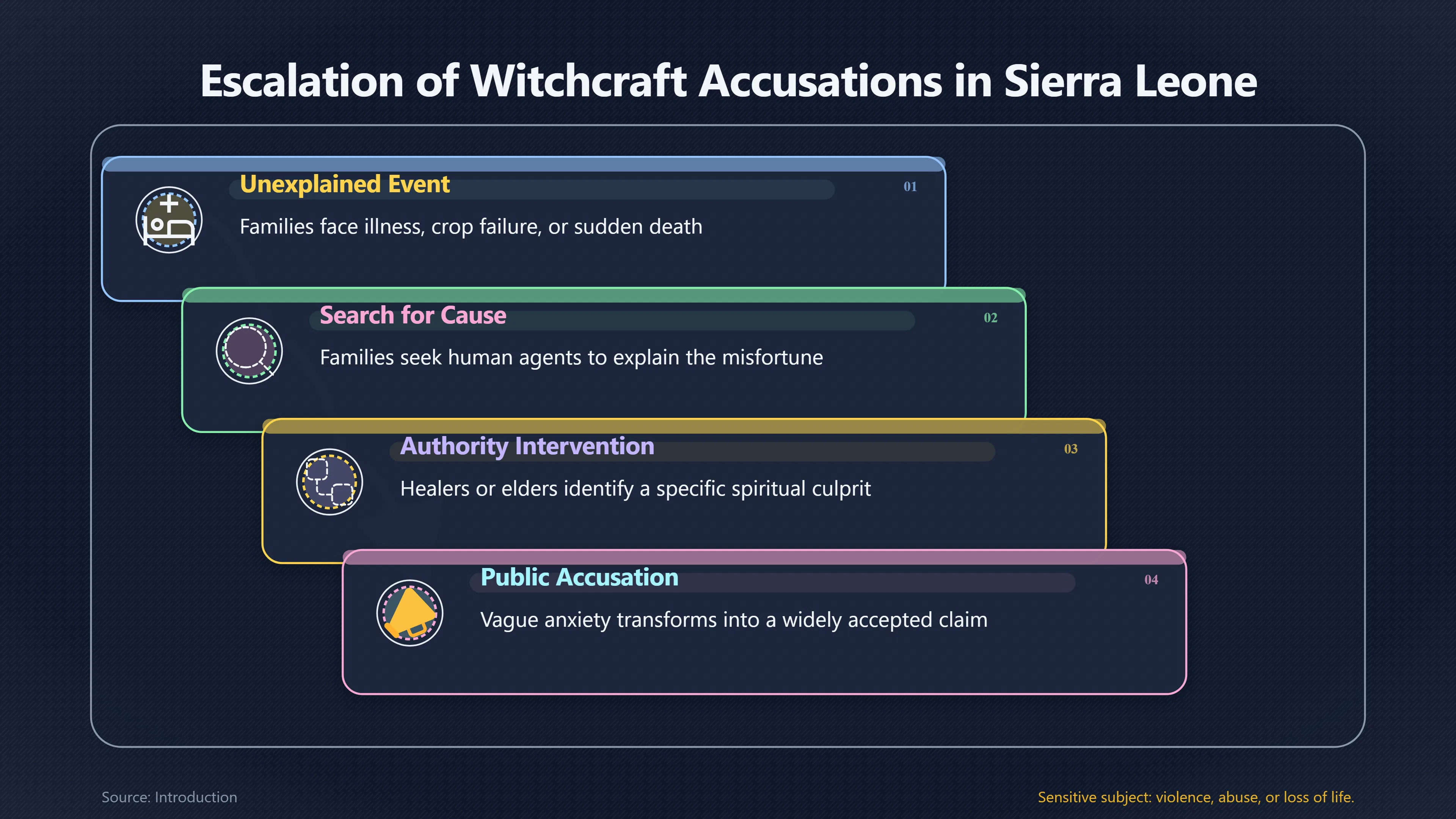
Witchcraft accusations rarely appear at random. They usually emerge when ordinary explanations seem inadequate for deeply upsetting events. A child’s unexplained illness, repeated miscarriages, crop failure, business collapse or an unexpected death may leave families searching for a cause. In communities where hidden spiritual forces are widely accepted as possible explanations, suspicion can shift from asking what happened to asking who caused it.
This search for a human agent can be emotionally powerful because it offers a sense of order during grief or uncertainty. Instead of accepting that disease, poverty or accident may have no deliberate cause, an accusation identifies a person who can supposedly be blamed. Anthropological research from Sierra Leone shows that such suspicions often remain uncertain until someone regarded as having spiritual authority—a traditional healer, pastor, diviner or respected elder—claims to identify a culprit. That intervention can transform vague anxiety into a widely accepted accusation.[PMC]pmc.ncbi.nlm.nih.govental health interventions - PMCApril 9, 2021…
The process is also shaped by everyday social pressures. Long-running family disputes, inheritance disagreements, jealousy, domestic conflict or economic hardship may all make certain individuals more vulnerable to becoming suspected witches. The accusation can then appear to confirm tensions that already existed rather than arising from new evidence.
Why children and isolated people become targets
Not everyone faces equal risk. Research from Sierra Leone and elsewhere in West Africa shows that accusations often fall on people with the least ability to defend themselves.
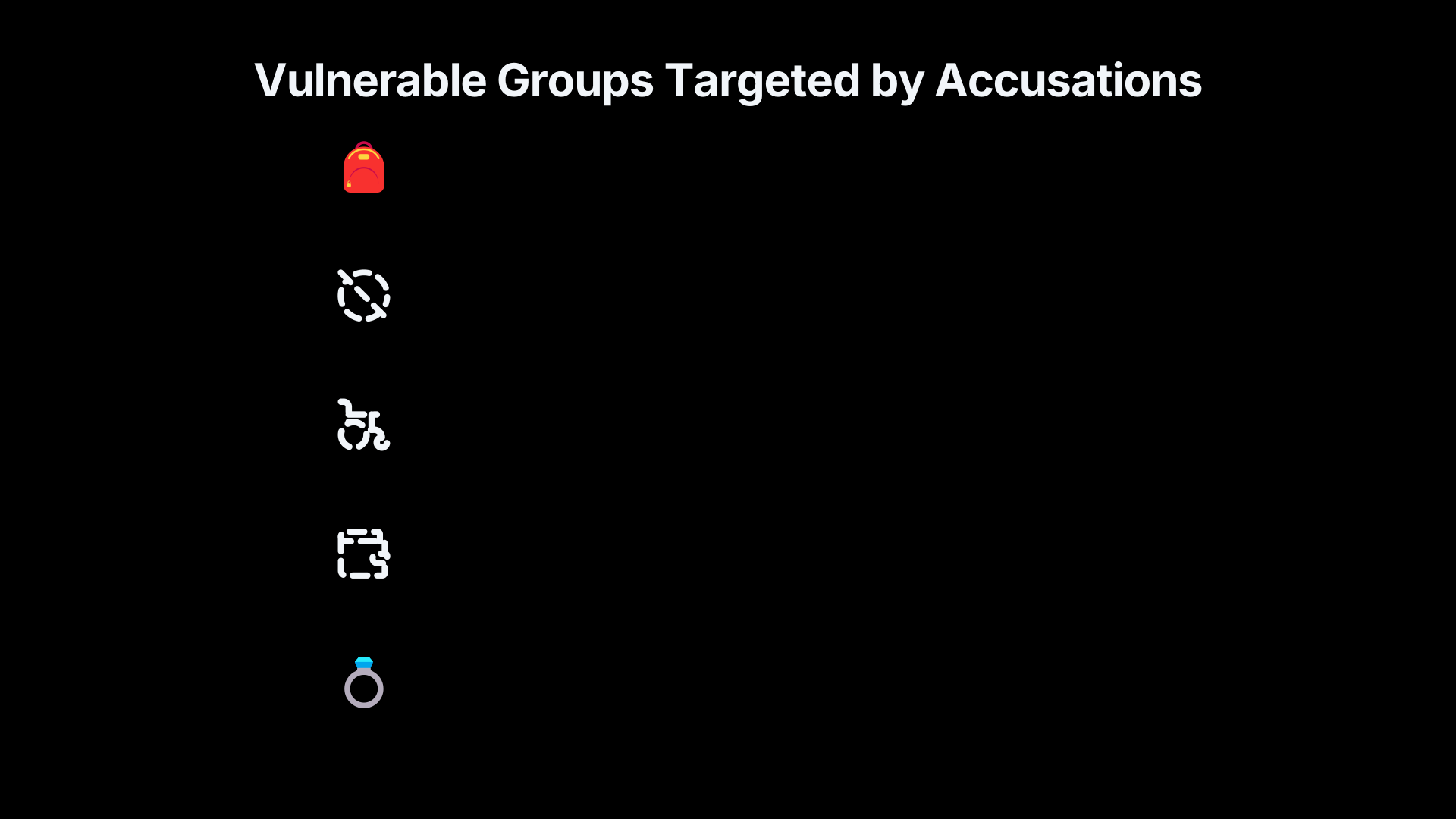
Those particularly vulnerable include:
- children living with foster families or in unstable households;
- elderly people, especially older women living alone;
- people with disabilities or mental illness;
- widows or individuals lacking strong family protection;
- socially isolated or economically dependent relatives.
Children deserve particular attention because accusations can fundamentally alter their lives. A qualitative study conducted in Freetown found that many child “confessions” were better understood as an idiom of distress—a culturally recognised way of expressing fear, trauma or emotional suffering rather than reliable evidence of supernatural activity. Children living with bereavement, neglect, abuse or severe family conflict sometimes came to believe accusations made against them or repeated stories suggested by adults.[PMC]pmc.ncbi.nlm.nih.govental health interventions - PMCApril 9, 2021…
The researchers found that accusations rarely developed through the child alone. Instead, they emerged through interactions between family members, peers, teachers, religious leaders and traditional healers. Once respected adults endorsed the idea that a child was practising witchcraft, the child often faced intense pressure to confess, even if the confession reflected confusion, fear or a desire to satisfy authority figures rather than personal belief.[PMC]pmc.ncbi.nlm.nih.govental health interventions - PMCApril 9, 2021…
How accusations produce real harm
The consequences of being labelled a witch can be severe even when no formal legal action follows.
People accused of witchcraft may experience:
- physical assault or threats;
- forced confessions or coercive “deliverance” rituals;
- exclusion from family or community life;
- eviction from their homes;
- loss of employment or livelihood;
- psychological trauma, shame and lasting stigma.
The accusation itself often becomes difficult to escape. Denials may be interpreted as further proof of deception, while attempts to defend oneself can be viewed as evidence of hidden spiritual power. This circular logic means that ordinary standards of evidence no longer apply.
Children may be removed from school, abandoned by relatives or subjected to repeated religious interventions intended to remove supposed spiritual powers. Even when no physical violence occurs, the long-term emotional effects of rejection and fear can be profound.[PMC]pmc.ncbi.nlm.nih.govental health interventions - PMCApril 9, 2021…
Why belief alone is not the problem
It is important not to confuse belief in witchcraft with persecution.
Many Sierra Leoneans who accept the possibility of witchcraft do not accuse neighbours of practising it. Anthropological studies describe widespread uncertainty rather than absolute certainty. People may believe supernatural harm is possible while remaining sceptical about specific accusations or about individuals claiming the ability to identify witches.[PMC]pmc.ncbi.nlm.nih.govental health interventions - PMCApril 9, 2021…
This distinction matters because public discussion sometimes oversimplifies the issue by portraying either all traditional beliefs as dangerous or all accusations as harmless cultural practices. The evidence suggests a more complicated reality. The greatest risks emerge when social tensions, grief, poverty or conflict combine with individuals who claim certainty about identifying hidden supernatural enemies.

Protection, mediation and human-rights responses
Efforts to reduce harm increasingly focus on protecting vulnerable people without dismissing local belief systems outright.
Researchers studying Sierra Leone recommend approaches that recognise the emotional and cultural significance of witchcraft beliefs while preventing abuse. Their recommendations include:
- strengthening child-protection services;
- training teachers, social workers and healthcare staff to recognise accusations as safeguarding concerns;
- supporting families experiencing conflict or bereavement before suspicion escalates;
- improving access to mental-health services for distressed children;
- encouraging dialogue with religious leaders and traditional healers so that vulnerable people are not pressured into harmful confessions.
The Freetown study argues that effective responses must address entire family and community systems rather than focusing only on the accused child. Because accusations often reflect broader poverty, trauma, conflict and insecurity, reducing those underlying pressures can lower the likelihood that children become scapegoats.[PMC]pmc.ncbi.nlm.nih.govental health interventions - PMCApril 9, 2021…
Human-rights organisations similarly stress that freedom of religion and belief does not justify assault, degrading treatment, forced confession or exclusion. Their focus is not on eliminating spiritual beliefs but on preventing violence and discrimination carried out in the name of those beliefs.[PMC]pmc.ncbi.nlm.nih.govental health interventions - PMCApril 9, 2021…
Why the issue remains important
Witchcraft accusations remain significant in Sierra Leone because they reveal how communities respond to uncertainty, grief and social stress. When illness, poverty or family conflict lacks an obvious explanation, blaming an individual can appear to restore order even though it creates new victims.
Modern research increasingly reframes the problem away from questions about whether supernatural powers exist and towards understanding how accusations spread, why certain people become targets and how communities can protect vulnerable individuals while respecting cultural traditions. This shift has helped move discussion from punishment towards safeguarding, mediation, mental-health support and the prevention of avoidable harm.[PMC]pmc.ncbi.nlm.nih.govental health interventions - PMCApril 9, 2021…
Amazon book picks
Further Reading
Books and field guides related to How Witchcraft Accusations Turn Misfortune Into Blame. Use these as the next step if you want deeper reading beyond the article.


Mistakes Were Made (But Not by Me)
Explains blame, justification and belief persistence.
Endnotes
1.
Source: pmc.ncbi.nlm.nih.gov
Link:https://pmc.ncbi.nlm.nih.gov/articles/PMC8035751/
Source snippet
ental health interventions - PMCApril 9, 2021...
Published: April 9, 2021
Additional References
2.
Source: researchgate.net
Link:https://www.researchgate.net/publication/350779450_Child_witchcraft_confessions_as_an_idiom_of_distress_in_Sierra_Leone_results_of_a_rapid_qualitative_inquiry_and_recommendations_for_mental_health_interventions
Source snippet
r mental health interventionsCHILD WITCHCRAFT CONFESSIONS AS AN IDIOM OF DISTRESS IN SIERRA LEONE; RESULTS OF A RAPID QUALITATIVE INQUIRY...
3.
Source: researchgate.net
Link:https://www.researchgate.net/publication/258062163_Children_enacting_idioms_of_witchcraft_and_spirit_possession_as_a_response_to_trauma_Therapeutically_beneficial_and_for_whom
Source snippet
Request PDFMethods We employed rapid qualitative inquiry methodology, with an inductive and iterative approach, combining emic and etic...
4.
Source: link.springer.com
Link:https://link.springer.com/article/10.1186/s13034-021-00370-w
Source snippet
witchcraft confessions as an idiom of distress in Sierra Leone; results of a rapid qualitative inquiry and recommendations for mental hea...
5.
Source: dare.uva.nl
Link:https://dare.uva.nl/search?identifier=e63e27a7-4eab-46f1-a73f-73430a39b9dc
Source snippet
Yoder J.T.V.M. de Jong W.A. Tol J.A. Duncan A. Bayo R. Reis Date 9-4-2021 Title Child witchcraft confessions as an idiom of distress in S...
6.
Source: researchprofiles.ku.dk
Link:https://researchprofiles.ku.dk/en/publications/child-witchcraft-confessions-as-an-idiom-of-distress-in-sierra-le/
Source snippet
In this study we approach child witchcraft as an idiom of distress. In an environment that may prohibit children...
7.
Source: research.vu.nl
Link:https://research.vu.nl/en/publications/child-witchcraft-confessions-as-an-idiom-of-distress-in-sierra-le/
Source snippet
In this study we approach child witchcraft as an idiom of distress. In an environment that...
8.
Source: pure.johnshopkins.edu
Title: Yoder *, Joop T.V.M. d
Link:https://pure.johnshopkins.edu/en/publications/child-witchcraft-confessions-as-an-idiom-of-distress-in-sierra-le/
Source snippet
witchcraft confessions as an idiom of distress in Sierra Leone; results of a rapid qualitative inquiry and recommendations for mental hea...
9.
Source: youtube.com
Title: Dispatches: Return To Africa’s Witch Children | Extreme Christianity Documentary
Link:https://www.youtube.com/watch?v=5Y06sKAg9Do
Source snippet
3 Cry Witch: Take My Land, Take My Life - BBC Africa Eye Documentary...
10.
Source: youtube.com
Title: Meet the anti-witch hunter
Link:https://www.youtube.com/watch?v=yzBi8KVSwlY
Source snippet
2 Dispatches: Return To Africa's Witch Children | Extreme Christianity Documentary...
11.
Source: researchgate.net
Title: * November 20
Link:https://www.researchgate.net/publication/346876284_Child_Witchcraft_Confessions_as_an_Idiom_of_Distress_in_Sierra_Leone_Results_of_a_Rapid_Qualitative_Inquiry_and_Recommendations_for_Mental_Health_Interventions
Source snippet
(PDF) Child Witchcraft Confessions as an Idiom of Distress in Sierra Leone; Results of a Rapid Qualitative Inquiry and Recommendations fo...
Topic Tree