Within Tajikistan
How Extremism Became an Elastic Political Label
The destruction of Tajikistan's main Islamic opposition party shows how a security label can spread from armed threats to peaceful dissent.
On this page
- From peace settlement to party ban
- The disputed revolt and mass prosecutions
- How the extremist label spread beyond the party
Page outline Jump by section
Introduction
The banning of the Islamic Renaissance Party of Tajikistan (IRPT) in 2015 marked a turning point in the country’s political and religious life. What had been the only legally registered Islamic political party in Central Asia became officially classified as an extremist and terrorist organisation, ending its role in the power-sharing arrangements that followed Tajikistan’s civil war. Supporters of the government describe the ban as a necessary response to an armed conspiracy against the state. Critics, including United Nations experts and international human rights organisations, argue that the authorities used a genuine security crisis to redefine peaceful political opposition as extremism, allowing the label to expand far beyond those accused of violence.[hrw.org]hrw.orgHuman Rights WatchWorld Report 2016: Tajikistan | Human Rights Watch…
The significance of the IRPT case therefore extends beyond one political party. It illustrates how an elastic security concept can reshape public debate, narrow the space for legal opposition and influence how religious belief and political dissent are understood in modern Tajikistan.
From peace settlement to party ban
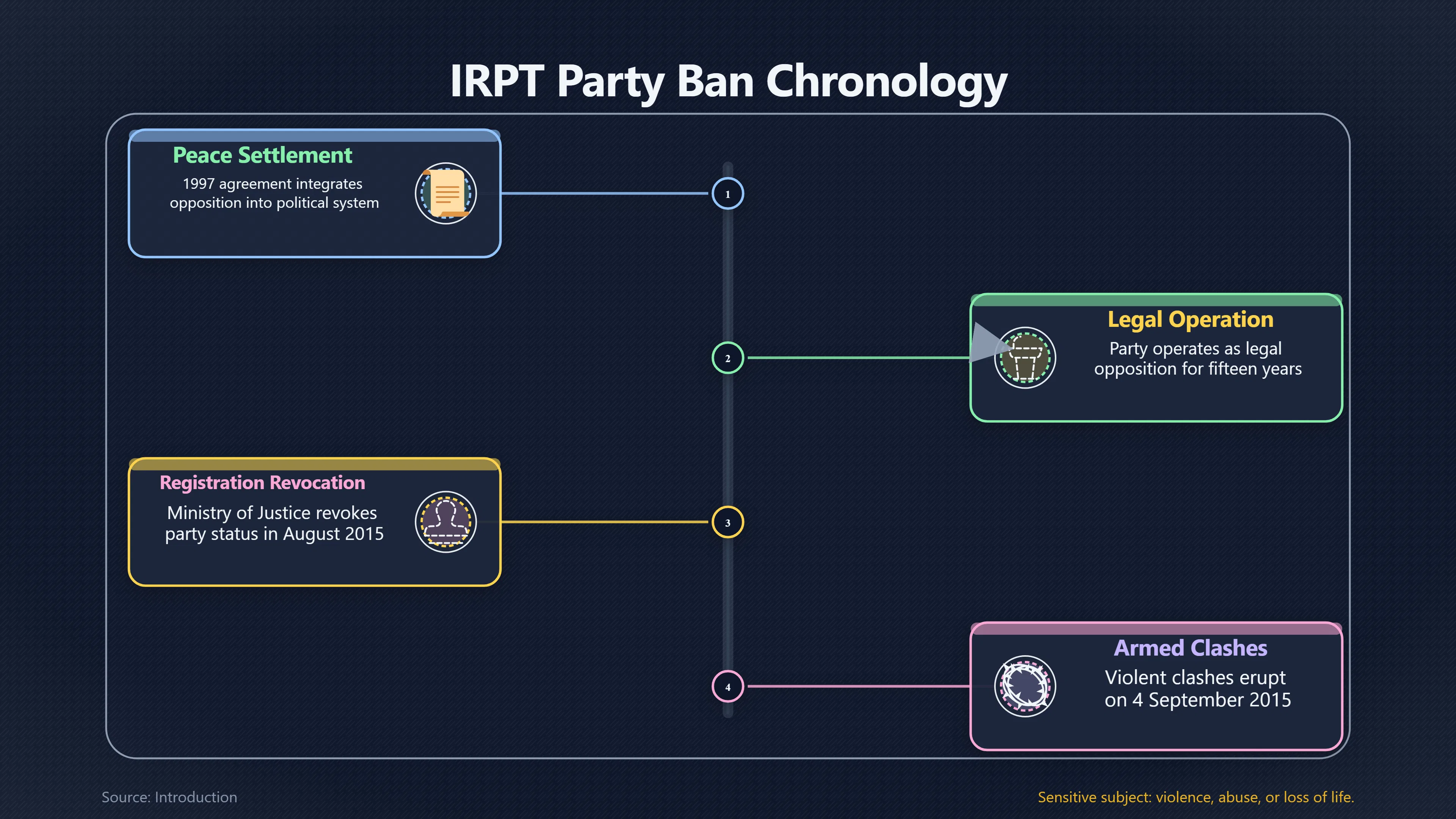
The IRPT emerged from the 1997 peace agreement that ended Tajikistan’s civil war. The settlement integrated elements of the former United Tajik Opposition into the political system and was widely regarded as a compromise designed to prevent renewed conflict. For roughly fifteen years, the IRPT operated as a legal opposition party, participated in elections and held parliamentary seats.
Its position deteriorated steadily during the 2010s. The party faced growing administrative pressure, critical coverage in state media and increasing restrictions on its activities. Parliamentary elections in March 2015 left it without representation after international observers raised concerns about intimidation and electoral irregularities. In August 2015, the Ministry of Justice revoked the party’s registration, arguing that it no longer met legal requirements for a national political party. Human Rights Watch and other organisations viewed the decision as the culmination of a long campaign to eliminate meaningful political competition.[Human Rights Watch]hrw.orgHuman Rights WatchWorld Report 2016: Tajikistan | Human Rights Watch…
The closure was especially symbolic because the IRPT had often been presented internationally as evidence that Islamic political participation could coexist with constitutional politics in Central Asia. Its disappearance removed the last significant legal opposition party with an independent nationwide organisation.
The disputed revolt and mass prosecutions
Only days after the party’s forced closure, armed clashes erupted on 4 September 2015 involving forces loyal to Deputy Defence Minister Abduhalim Nazarzoda. The government described the violence as an attempted coup and alleged that senior IRPT figures had helped organise it.
The party’s leadership, including its chairman Muhiddin Kabiri, who had already left the country, denied any involvement. International observers have not disputed that serious violence occurred, but many have questioned whether the authorities produced convincing public evidence linking the party’s leadership to Nazarzoda’s actions. Human Rights Watch, Amnesty International and successive UN experts have argued that the government’s case relied on secret proceedings and evidence that was never subjected to meaningful public scrutiny.[hrw.org]hrw.orgHuman Rights WatchWorld Report 2016: Tajikistan | Human Rights Watch…
Within weeks:
- the IRPT was formally declared an extremist and terrorist organisation;
- dozens of senior members were arrested;
- approximately two hundred members and supporters were reportedly detained or investigated;
- lawyers representing IRPT defendants themselves became targets of criminal prosecution; and
- many proceedings were held behind closed doors.[hrw.org]hrw.orgOpen source on hrw.org.
In June 2016, fourteen senior IRPT figures received sentences ranging from lengthy imprisonment to life terms. Amnesty International described the proceedings as fundamentally unfair, citing allegations of torture, lack of transparency and severe restrictions on defence lawyers.[amnesty.org]amnesty.orgAmnesty InternationalTajikistan: 14 high-ranking members of political opposition party sentenced to long prison terms in unfair trial - A…
How the extremist label spread beyond the party
The importance of the IRPT case lies not only in the destruction of one organisation but in how the definition of extremism expanded afterwards.
Before 2015, official counter-extremism policy primarily focused on organisations associated with violent militancy. After the ban, international observers increasingly argued that the same language was applied to a much broader range of peaceful political and religious activity. Individuals accused of sympathy for the IRPT, lawyers defending party members, independent journalists and critics living abroad all became vulnerable to accusations connected with extremism or terrorism.[refworld.org]refworld.orgAmnesty International Report 2016/17 - Tajikistan | Refworld…
This broader application had several practical effects:
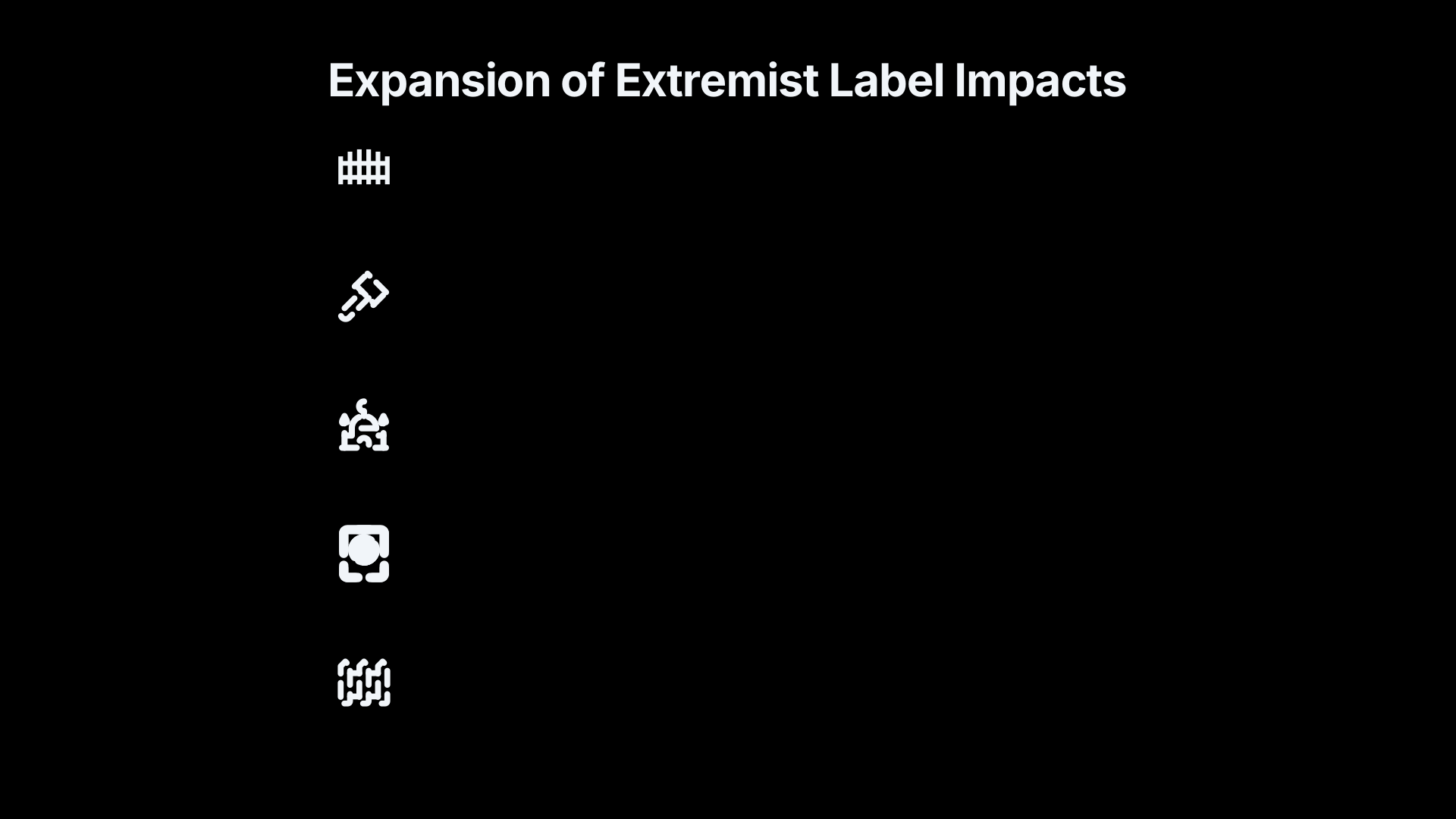
- Political opposition became easier to criminalise. Once the party itself had been designated extremist, continuing association with former members or publicly defending them could itself become legally dangerous.[Human Rights Watch]hrw.orgHuman Rights WatchWorld Report 2016: Tajikistan | Human Rights Watch…
- Legal defence became risky. Several lawyers representing IRPT defendants were themselves prosecuted and imprisoned, creating a chilling effect on legal representation in politically sensitive cases.[Refworld]refworld.orgAmnesty International Report 2016/17 - Tajikistan | Refworld…
- Religious conservatism became more politically suspect. International observers argued that official rhetoric increasingly blurred distinctions between violent extremism, political Islam and ordinary expressions of religious identity.[Human Rights Watch]hrw.orgHuman Rights WatchTajikistan's Fight Against Political Islam | Human Rights WatchMarch 15, 2016…
- Exile did not end pressure. Human Rights Watch documented efforts to pursue opposition figures outside Tajikistan through extradition requests, detentions and other forms of transnational pressure.[Human Rights Watch]hrw.orgOpen source on hrw.org.
The result was an increasingly broad security vocabulary in which extremist affiliation could encompass activities that, according to international human rights bodies, would ordinarily fall within protected political or religious expression.
Why the case is so heavily disputed
The central disagreement is not whether Tajikistan faces genuine security threats. The country borders Afghanistan, experienced a destructive civil war and has seen some of its citizens recruited by violent extremist organisations. Those realities are widely acknowledged.
The dispute concerns proportionality and evidence.
The Tajik government maintains that decisive action against the IRPT prevented renewed instability and dismantled networks connected to violent conspiracy. Official statements have consistently linked the party to terrorism and unconstitutional attempts to seize power.[Refworld]refworld.orgOpen source on refworld.org.
International organisations have instead argued that:
- the trials lacked transparency;
- key evidence remained secret;
- allegations of torture were not independently investigated;
- political rather than criminal conduct became increasingly associated with extremism; and
- eliminating peaceful opposition may ultimately weaken, rather than strengthen, long-term political stability.[amnesty.org]amnesty.orgAmnesty InternationalTajikistan: 14 high-ranking members of political opposition party sentenced to long prison terms in unfair trial - A…
Because the principal proceedings were conducted behind closed doors, independent verification of many of the government’s allegations remains limited, contributing to continuing controversy.
Why the IRPT ban matters beyond Tajikistan
The IRPT’s destruction has become a widely discussed case in studies of authoritarian governance and counter-extremism. Rather than focusing solely on one party, researchers use it to examine how states can broaden security concepts over time.
The episode demonstrates how a category originally associated with armed violence can gradually absorb peaceful political competition, religious activism and legal advocacy. In that sense, the expansion of the extremist label resembles a political moral panic: a real security concern provides the framework through which an increasingly diverse range of behaviour is interpreted as dangerous.
For Tajikistan, the long-term consequence has been the disappearance of legal Islamic opposition from formal politics. For scholars of collective fear and state power, the case illustrates how the language of security can reshape public life by changing who is regarded as a legitimate political participant and who becomes defined as an existential threat.
Amazon book picks
Further Reading
Books and field guides related to How Extremism Became an Elastic Political Label. Use these as the next step if you want deeper reading beyond the article.
Political order and political decay
Useful for understanding institutional change and state power.

Endnotes
1.
Source: ecoi.net
Link:https://www.ecoi.net/en/document/1276228.html
2.
Source: amnesty.org
Title: International Tajikistan: Opposition party leaders arrested, risk torture
Link:https://www.amnesty.org/en/documents/eur60/2465/2015/en/
Source snippet
Amnesty InternationalTajikistan: Opposition party leaders arrested, risk torture - Amnesty International...
3.
Source: amnesty.org
Link:https://www.amnesty.org/en/documents/eur60/4214/2016/en/
Source snippet
Amnesty InternationalTajikistan: 14 high-ranking members of political opposition party sentenced to long prison terms in unfair trial - A...
4.
Source: refworld.org
Link:https://www.refworld.org/reference/annualreport/amnesty/2017/en/115692
Source snippet
Amnesty International Report 2016/17 - Tajikistan | Refworld...
5.
Source: amnesty.org
Link:https://www.amnesty.org/en/documents/eur60/4855/2016/en/
Source snippet
Amnesty InternationalTajikistan: A year of secrecy, growing fears and deepening injustice - Amnesty International...
6.
Source: refworld.org
Link:https://www.refworld.org/reference/annualreport/usdos/2016/en/109728
7.
Source: refworld.org
Link:https://www.refworld.org/reference/annualreport/amnesty/2016/109066
8.
Source: ecoi.net
Link:https://www.ecoi.net/en/document/1394338.html
9.
Source: amnesty.de
Link:https://www.amnesty.de/jahresbericht/2016/tadschikistan
10.
Source: refworld.org
Link:https://www.refworld.org/reference/annualreport/uscirf/2016/en/110075
11.
Source: ecoi.net
Link:https://www.ecoi.net/en/document/1162302.html
12.
Source: ecoi.net
Link:https://www.ecoi.net/en/document/1234639.html
13.
Source: amnesty.de
Title: Drohendes unfaires Verfahren | Amnesty International
Link:https://www.amnesty.de/urgent-action/ua-209-2015-1/drohendes-unfaires-verfahren
14.
Source: hrw.org
Link:https://www.hrw.org/world-report/2016/country-chapters/tajikistan
Source snippet
Human Rights WatchWorld Report 2016: Tajikistan | Human Rights Watch...
15.
Source: hrw.org
Link:https://www.hrw.org/news/2015/09/14/tajikistan-reverse-political-party-closure
16.
Source: hrw.org
Link:https://www.hrw.org/news/2016/02/17/tajikistan-severe-crackdown-political-opposition
17.
Source: amnesty.org.uk
Link:https://www.amnesty.org.uk/knowledge-hub/all-resources/urgent-action-update-27extremisme28099-trial-held-behind-closed-doors-tajikistan/
18.
Source: hrw.org
Link:https://www.hrw.org/news/2016/03/15/tajikistans-fight-against-political-islam
Source snippet
Human Rights WatchTajikistan's Fight Against Political Islam | Human Rights WatchMarch 15, 2016...
Published: March 15, 2016
19.
Source: hrw.org
Title: Tajikistan: Violent Retaliation Against Activists | Human Rights Watch
Link:https://www.hrw.org/news/2016/09/28/tajikistan-violent-retaliation-against-activists
20.
Source: hrw.org
Link:https://www.hrw.org/news/2016/06/07/tajikistan-verdicts-opposition-activists-travesty-justice
21.
Source: hrw.org
Title: Tajikistan: Opposition Activists Detained | Human Rights Watch
Link:https://www.hrw.org/news/2015/09/18/tajikistan-opposition-activists-detained
Additional References
22.
Source: youtube.com
Title: Civil War in Tajikistan: Key Moments and Peace Process
Link:https://www.youtube.com/watch?v=S5ZxsMroM_Q
Source snippet
UN News: OHCHR on the Banning of Tajikistan's Islamic Party[https://www.youtube.com/watch?v=UqQc714S8w0](https://www.youtube.com/watch?v=UqQc714S8w0) news.un.org...
23.
Source: youtube.com
Title: Human Rights in Tajikistan: HRW/NHC Presentation at OSCE
Link:https://www.youtube.com/watch?v=vW77Kq_O3zc
Source snippet
Civil War in Tajikistan: Key Moments and Peace Process...
24.
Source: youtube.com
Title: Sisters Split By Tajikistan’s Crackdown On Muslims
Link:https://www.youtube.com/watch?v=zMUEosx6evY
Source snippet
Human Rights in Tajikistan: HRW/NHC Presentation at OSCE...
25.
Source: freedomhouse.org
Title: Tajikistan: Banning Opposition Party Confirms Dictatorship | Freedom House
Link:https://freedomhouse.org/article/tajikistan-banning-opposition-party-confirms-dictatorship
26.
Source: uscirf.gov
Title: tajikistan uscirf criticizes crackdown religious freedom
Link:https://www.uscirf.gov/news-room/releases-statements/tajikistan-uscirf-criticizes-crackdown-religious-freedom
27.
Source: youtube.com
Title: Yorov’s Sentence Extended: Lawyer of Jailed IRPT Leaders
Link:https://www.youtube.com/watch?v=xLgDzcERGw4
28.
Source: odihr.osce.org
Link:https://odihr.osce.org/odihr/188876
Topic Tree