Within Laos Belief Panics
How Can Illness Turn Into a Village Accusation?
When unexplained sickness strikes, suspicion can turn a troubled neighbour into a feared source of danger and drive them from home without proof.
On this page
- How suspicion forms around illness and misfortune
- Divination, rumour and pressure to conform
- Expulsion, refuge and the human cost in Nakasang
Page outline Jump by section
Introduction
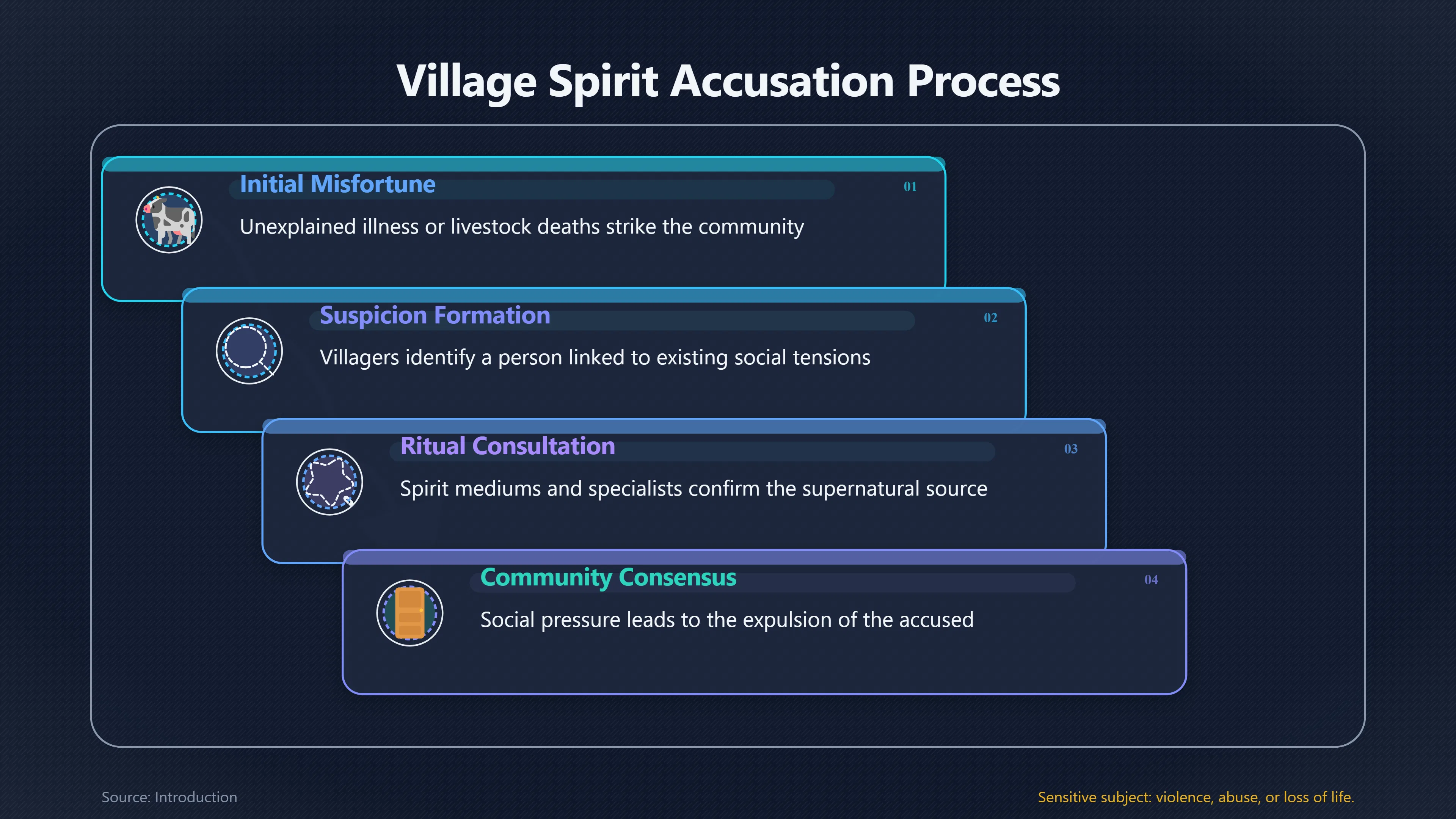
In Laos, accusations that a neighbour is harbouring a dangerous spirit can have consequences similar to a witch panic, even though they do not involve formal witch trials or a central legal system. When unexplained illness, livestock deaths or repeated misfortune strike a village, suspicion may gradually settle on one person or family. Once that suspicion hardens, social pressure, divination and community consensus can lead to expulsion without any material proof. Rather than being isolated stories, these accusations reveal how communities have sometimes used spiritual explanations to cope with uncertainty, settle disputes or remove people seen as troublesome. Recent research has shown that this process has also produced places of refuge, most notably the southern Lao village of Nakasang, where many of those driven from their homes have attempted to rebuild their lives.[J-STAGE]jstage.jst.go.jpOpen source on go.jp.
How suspicion forms around illness and misfortune
Belief in spirits remains an important part of everyday life for many Lao communities alongside Buddhism. Spirits may be understood as protectors, ancestors or potentially dangerous forces, and illness is often interpreted through both spiritual and physical explanations rather than as an either-or choice. Older research into rural Laos found that people commonly explained mental and physical illness using a mixture of supernatural, social, psychological and bodily causes, reflecting a broad rather than exclusively spiritual understanding of disease.[PubMed]pubmed.ncbi.nlm.nih.govPub Med"Folk" explanations of mental illness in rural laosPubMed"Folk" explanations of mental illness in rural laos - PubMedJuly 1, 1979…
The most feared accusations concern the so-called ravenous spirit, often referred to in English-language scholarship as phi pop. According to local belief, such a spirit inhabits a human host and attacks others by consuming their internal organs, leading to mysterious sickness or death. When several unexplained illnesses occur close together, especially if conventional explanations appear inadequate, villagers may begin searching for a hidden human source of the danger.[J-STAGE]jstage.jst.go.jpOpen source on go.jp.
Suspicion rarely develops in a social vacuum. Anthropologist Ian Baird argues that accusations often emerge where illness coincides with existing tensions such as arguments over land, unequal wealth, family disputes or longstanding personal conflicts. The accusation therefore functions not only as an explanation for suffering but also as a way of identifying someone who is perceived as socially dangerous or out of step with community expectations.[J-STAGE]jstage.jst.go.jpOpen source on go.jp.
Divination, rumour and pressure to conform
Unlike the organised witch trials seen in early modern Europe, Lao spirit accusations usually develop through village-level decision-making rather than formal courts. Rumours spread after deaths or unexplained illnesses, relatives compare stories, and ritual specialists or spirit mediums may be consulted to identify the supposed source of misfortune. Once influential villagers become convinced, the accused person faces enormous pressure regardless of whether they deny the accusation.[J-STAGE]jstage.jst.go.jpOpen source on go.jp.
The accusation can become self-reinforcing. If another person falls ill after suspicion has already settled on one household, that new illness may be interpreted as further confirmation rather than coincidence. This creates a feedback loop in which ordinary events strengthen an already accepted explanation.
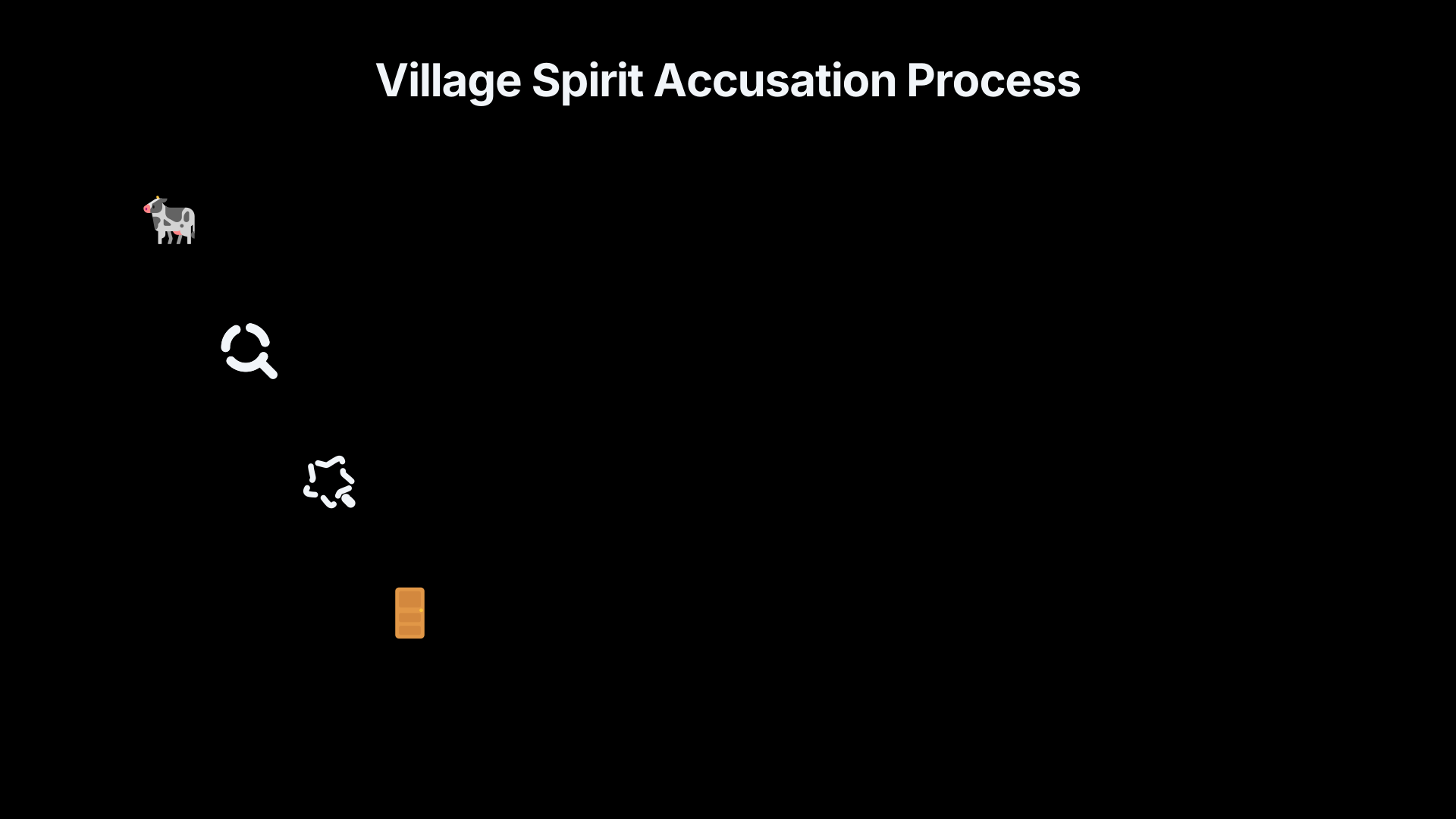
Recent ethnographic research also highlights a more uncomfortable reality. Community leaders themselves acknowledge that not everyone labelled as harbouring a dangerous spirit is believed to be genuinely possessed. Some accusations may instead provide a culturally acceptable way to expel individuals considered disruptive, including people accused of petty crime, domestic violence or persistent conflict for whom legal remedies are unavailable or difficult to pursue. Others may simply be socially unpopular or viewed as outsiders. In these cases, spiritual language masks what is fundamentally a social or political decision.[J-STAGE]jstage.jst.go.jpOpen source on go.jp.
Expulsion, refuge and the human cost in Nakasang
The clearest documented example is Nakasang in Champasak Province, near the Mekong River. For decades it has been known across parts of Laos as a destination for people expelled from their home villages after being accused of harbouring a ravenous spirit. Some also arrive from neighbouring Cambodia, reflecting the shared cultural traditions of the border region.[J-STAGE]jstage.jst.go.jpOpen source on go.jp.
Rather than rejecting newcomers, Nakasang developed institutions to receive them. New arrivals participate in repeated purification and healing rituals led by respected spirit specialists. These ceremonies are intended both to remove any dangerous spirit and to reassure the wider community that residents can live safely together. Participation is structured over an extended period, creating a recognised path from accusation towards social acceptance.[J-STAGE]jstage.jst.go.jpOpen source on go.jp.
For those who have been expelled, however, the consequences are severe:
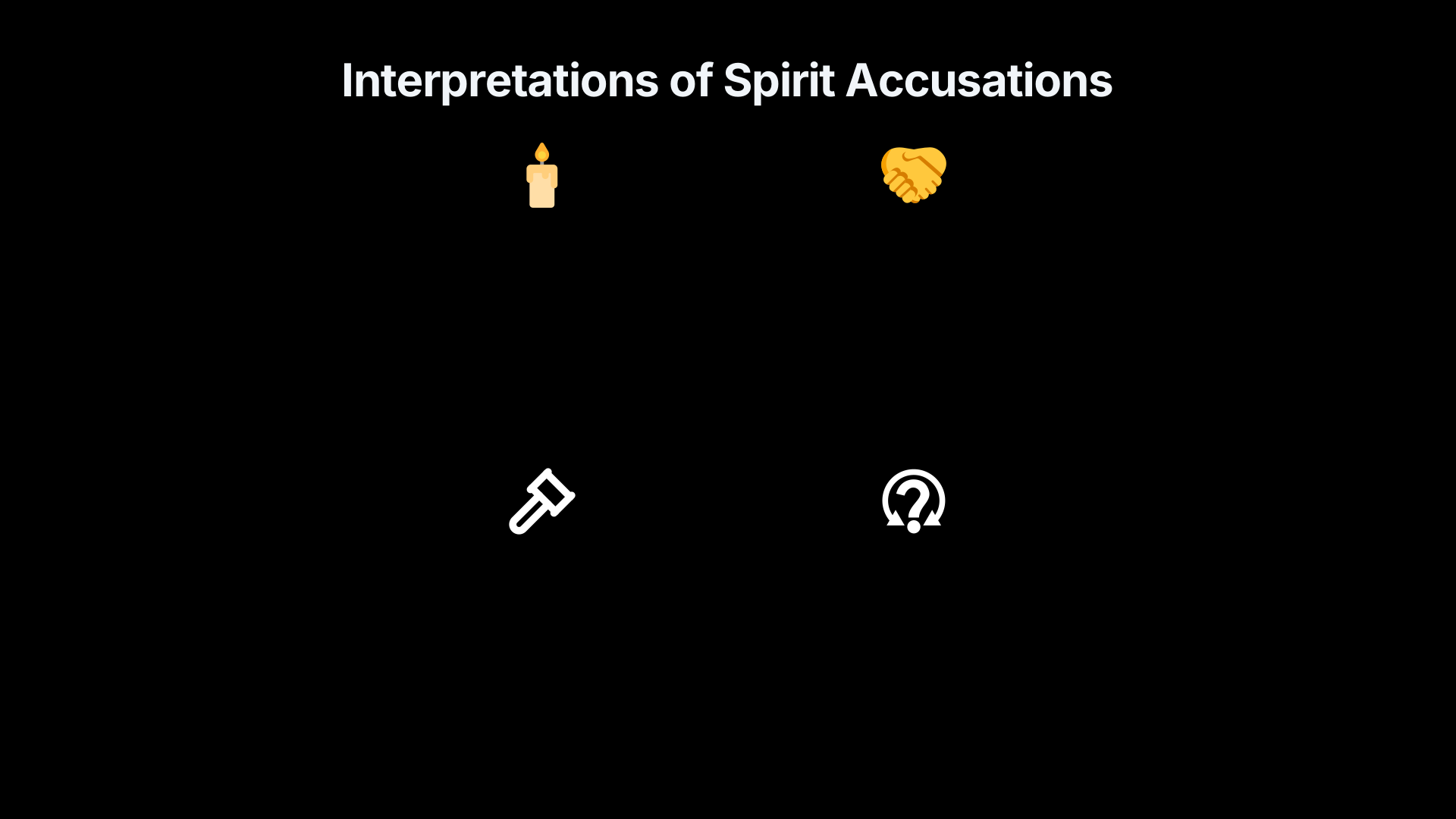
- Loss of home, farmland and established livelihoods.
- Separation from relatives and long-standing social networks.
- Lasting stigma, even after undergoing purification rituals.
- Emotional distress caused by being blamed for illness or death without evidence.
Some families relocate together, while others leave alone, effectively becoming internal refugees because of a spiritual accusation rather than any criminal conviction.[J-STAGE]jstage.jst.go.jpOpen source on go.jp.
Journalistic reporting from Nakasang illustrates these human stories through people who insist they never possessed a harmful spirit but were blamed after neighbours died from unexplained stomach illnesses or other diseases. Village committees sometimes accepted these accusations rapidly, leaving little practical opportunity for the accused to resist.[South China Morning Post]scmp.comSouth China Morning Post Demonic possession in LaosSouth China Morning PostDemonic possession in Laos - is it real, or a pretext for village chiefs to banish troublemakers and nonconformis…
Why historians and anthropologists interpret these accusations cautiously
Modern researchers generally reject simple explanations that portray these episodes either as proof that dangerous spirits exist or as examples of irrational mass hysteria. Instead, they examine how spiritual belief interacts with real social pressures.
Several mechanisms appear repeatedly in the evidence:
- Illness creates uncertainty. When disease has no obvious explanation, communities seek meaningful causes.
- Existing tensions matter. Accusations often fall on people already involved in disputes or occupying marginal social positions.
- Collective belief shapes behaviour. Once enough respected villagers accept an accusation, opposing it becomes increasingly difficult.
- Ritual provides conflict resolution. Expulsion and later purification offer a culturally recognised way of restoring communal harmony, even though they may cause profound injustice to individuals.[go.jp]jstage.jst.go.jpOpen source on go.jp.
This interpretation differs from describing every accusation as deliberate persecution. Many participants sincerely believe they are protecting their families from a genuine supernatural threat. At the same time, the belief system can be used to legitimise exclusion in situations where evidence for wrongdoing is absent.
Why these cases remain important
Spirit accusations in Laos demonstrate that collective fear does not require courts, newspapers or nationwide moral panics to produce serious consequences. Small communities facing unexplained illness may arrive at a shared explanation that feels compelling within their cultural framework, even when it cannot be verified.
The documented experience of Nakasang is particularly significant because it reveals both sides of the process: the exclusion of accused individuals from their original villages and the creation of a recognised place where those same people can seek refuge, undergo ritual healing and attempt to recover a social identity. Rather than treating these accusations simply as folklore, contemporary scholarship sees them as a window into how belief, illness, community cohesion and social conflict can become tightly intertwined in everyday life.[go.jp]jstage.jst.go.jpOpen source on go.jp.
Amazon book picks
Further Reading
Books and field guides related to How Can Illness Turn Into a Village Accusation?. Use these as the next step if you want deeper reading beyond the article.

The Spirit Catches You and You Fall Down
First published 1997. Subjects: Asian Americans, Attitude, Attitude of Health Personnel, Child, Communication.
Purity and danger
First published 1966. Subjects: Purity, Ritual, Ritual Purity, Taboo, Pollution, Cultural Anthropology.
Illness as metaphor
First published 1978. Subjects: AIDS (Disease), Acquired Immunodeficiency Syndrome, Cancer, Cancer in literature, Literature.

A history of Laos
First published 1997. Subjects: History, Laos, history, Asian studies, Political science.
Endnotes
1.
Source: jstage.jst.go.jp
Link:https://www.jstage.jst.go.jp/article/seas/13/1/13_109/_article/-char/en
2.
Source: repository.kulib.kyoto-u.ac.jp
Link:https://repository.kulib.kyoto-u.ac.jp/items/db08cf57-ed2e-4b00-9959-423f717b9886
3.
Source: pubmed.ncbi.nlm.nih.gov
Title: Pub Med”Folk” explanations of mental illness in rural laos
Link:https://pubmed.ncbi.nlm.nih.gov/453350/
Source snippet
PubMed"Folk" explanations of mental illness in rural laos - PubMedJuly 1, 1979...
Published: July 1, 1979
4.
Source: scmp.com
Title: South China Morning Post Demonic possession in Laos
Link:https://www.scmp.com/magazines/post-magazine/long-reads/article/2103274/demonic-possession-laos-it-real-or-pretext
Source snippet
South China Morning PostDemonic possession in Laos - is it real, or a pretext for village chiefs to banish troublemakers and nonconformis...
5.
Source: jstage.jst.go.jp
Link:https://www.jstage.jst.go.jp/browse/seas/13/1/_contents/-char/ja
Source snippet
Asian StudiesApril 25, 2024 — These rituals have undergone modifications because of the socioeconomic changes brought about by sedentariz...
Published: April 25, 2024
6.
Source: pubmed.ncbi.nlm.nih.gov
Link:https://pubmed.ncbi.nlm.nih.gov/25234302/
Additional References
7.
Source: englishkyoto-seas.org
Title: Vol. 13, No. 1, Ian G. Baird | CSEAS Journal, Southeast Asian Studies
Link:https://englishkyoto-seas.org/2024/04/vol-13-no-1-ian-g-baird/
Source snippet
13, No. 1, Ian G. Baird | CSEAS Journal, Southeast Asian StudiesApril 25, 2024 — VOL. 13, NO. 1, IAN G. BAIRD Published April 25, 2024 Co...
Published: April 25, 2024
8.
Source: rfa.org
Title: christians 02102023141433
Link:https://www.rfa.org/english/news/laos/christians-02102023141433.html/
Source snippet
Christian families in Laos driven from their village – Radio Free AsiaFebruary 10, 2023 — * # Christian families in Laos driven from thei...
Published: February 10, 2023
9.
Source: youtube.com
Title: Every Mythical Creature In Thailand Folklore Explained In 8 Minutes
Link:https://www.youtube.com/watch?v=HG5oJqPkMt4
Source snippet
Mekong Water Data Hour: Drivers of River Level Change Along the Thai-Lao Border...
10.
Source: youtube.com
Title: Behind the Ritual: Meeting a traditional Hmong Shaman in Laos
Link:https://www.youtube.com/watch?v=O33ltrt3XKs
Source snippet
Every Mythical Creature In Thailand Folklore Explained In 8 Minutes...
11.
Source: researchgate.net
Link:https://www.researchgate.net/publication/386370201_Where_Do_the_Ravenous_Spirits_Phi_Pop_Go_Nakasang_Village_in_Southern_Laos_as_a_Place_of_Cultural_Healing
12.
Source: researchgate.net
Link:https://www.researchgate.net/figure/Accused-Phi-Pop-Sit-under-the-Ta-Ho-in-Nakasang-Village-Awaiting-the-Healing-Ritual_fig3_386370201
13.
Source: kci.go.kr
Link:https://www.kci.go.kr/kciportal/mobile/ci/sereArticleSearch/ciSereArtiView.kci?sereArticleSearchBean.artiId=ART003205760
14.
Source: kci.go.kr
Link:https://www.kci.go.kr/kciportal/ci/sereArticleSearch/ciSereArtiView.kci?sereArticleSearchBean.artiId=ART003205760
15.
Source: researchgate.net
Link:https://www.researchgate.net/publication/35395164_Recovering_Khmer_ethnic_identity_from_the_Thai_national_past_an_ethnography_of_the_localism_movement_in_Surin_Province
16.
Source: kclpure.kcl.ac.uk
Link:https://kclpure.kcl.ac.uk/portal/en/publications/a-village-possessed-by-witches-a-mixed-methods-casecontrol-study-/
Topic Tree