Within Gambia Panics
Why Fear Became So Hard to Challenge
Fear spread most destructively when political power made supernatural claims difficult to question and dangerous to resist.
On this page
- Authority, obedience and public performance
- How coercion created apparent belief
- Political persecution behind spiritual claims
Page outline Jump by section
Introduction
In The Gambia, fear became most destructive not when rumours spread on their own, but when political authority transformed supernatural claims into state action. Under President Yahya Jammeh’s authoritarian rule, beliefs about witchcraft and miracle healing were no longer simply matters of private faith or local tradition. They were reinforced by security forces, state media and a political culture in which openly questioning the president could carry serious personal risks. This combination of inherited beliefs and coercive power made public disbelief dangerous and public conformity appear widespread.
The result was not merely the spread of extraordinary claims but the creation of a system in which fear, obedience and apparent belief reinforced one another. The 2008–09 witch-hunting campaign and the Presidential Alternative Treatment Programme for HIV/AIDS illustrate how dictatorship can convert rumours and miracle claims into instruments of political control, making resistance difficult even for those who privately doubted them.[Amnesty International]amnesty.orgAmnesty InternationalThe Gambia: Hundreds accused of “witchcraft” and poisoned in government campaign - Amnesty InternationalMarch 18, 2009…
Why fear became so hard to challenge
The Gambian experience demonstrates an important distinction. Collective belief is often described as something that spreads naturally through communities, but under an authoritarian government belief can also be manufactured through power.
Several features of Jammeh’s rule helped create this environment:
- The president presented himself as possessing exceptional spiritual insight and divine favour.
- Independent media, civil society organisations and opposition politicians operated under constant pressure, limiting opportunities to question official claims.
- Security services were routinely used to enforce political loyalty.
- Public criticism of presidential decisions carried genuine risks of arrest, intimidation or loss of employment.
When citizens cannot freely disagree, outward agreement becomes a poor guide to what people actually believe. Public compliance may reflect fear rather than conviction, yet widespread compliance itself creates the impression that extraordinary claims must be true. Political scientists sometimes describe this as preference falsification: individuals conceal private disbelief because they believe everyone else accepts the official story.
In The Gambia, this dynamic was especially powerful because presidential authority was combined with existing cultural beliefs about witchcraft and spiritual danger. The government did not invent these beliefs, but it dramatically increased their political force.[nih.gov]pmc.ncbi.nlm.nih.govOpen source on nih.gov.
Authority, obedience and public performance
The witch-hunting campaign illustrates how authoritarian power transformed accusation into apparent certainty.
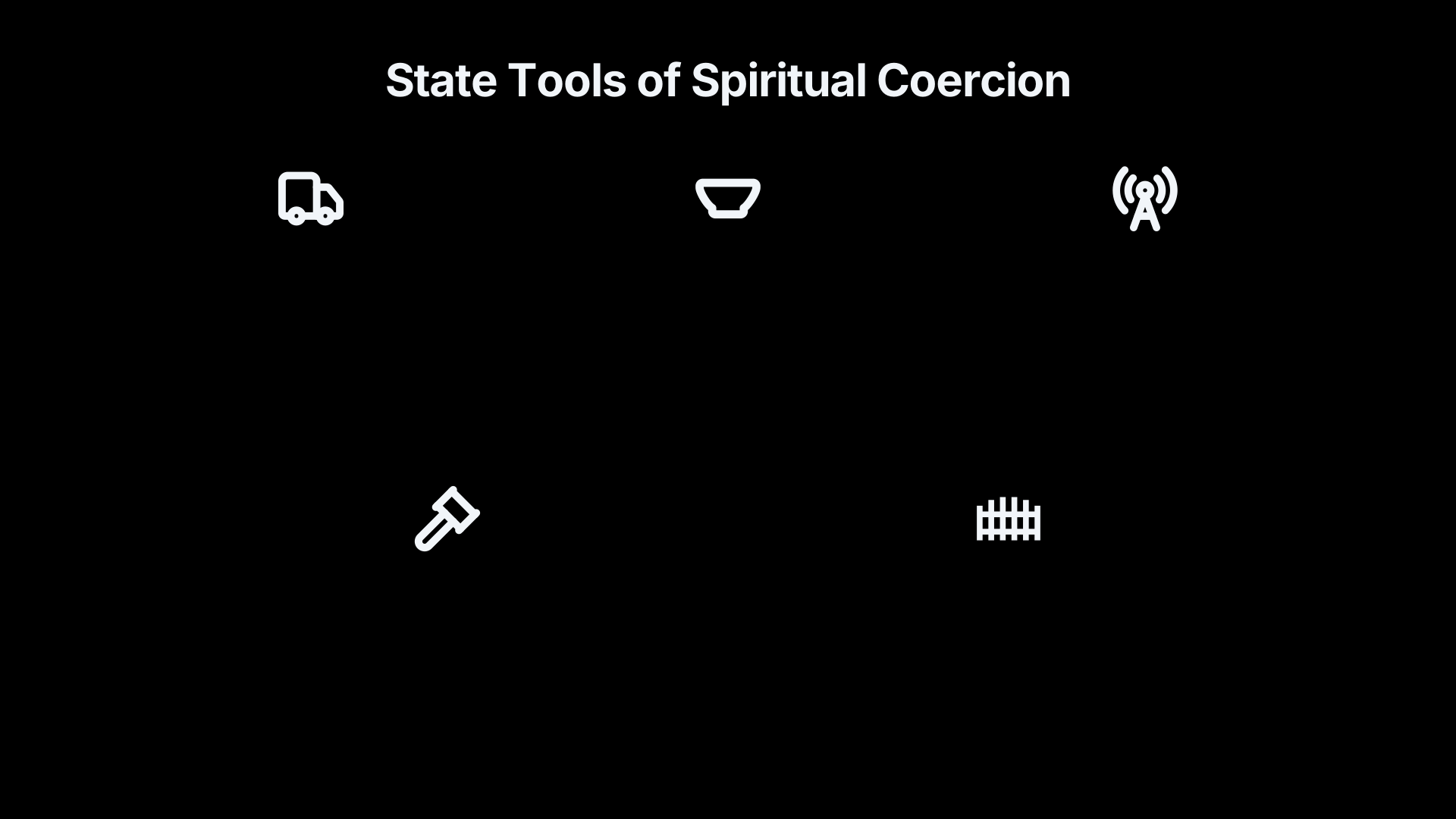
According to the Truth, Reconciliation and Reparations Commission (TRRC), witch hunters travelled with soldiers, police officers, intelligence personnel and members of pro-government groups. Villagers were gathered by armed officials before selected individuals were publicly identified as witches. The presence of uniformed personnel communicated that these accusations carried state authority rather than remaining local suspicions.[Scribd]scribd.comVolume 11 2009 Witch Hunt Exercise2009 Gambia Witch-Hunt Report | PDF | Witchcraft | The Gambia…
The rituals themselves also became political performances.
Victims were removed in government vehicles, compelled to undergo public “cleansing” ceremonies and forced to consume herbal mixtures presented as removing supernatural powers. Such events created visible demonstrations of presidential authority. Observers saw neighbours submitting to the process, not because the accusations had been independently verified, but because refusal was practically impossible.
This matters because authoritarian systems often rely on visible acts of obedience. Each public ritual encouraged the impression that everyone accepted the official explanation, even when many participants were acting under duress.
How coercion created apparent belief
One of the clearest lessons from the Gambian cases is that coercion can create the appearance of genuine popular belief.
The HIV/AIDS treatment programme provides a particularly revealing example. Jammeh declared that he possessed a God-given herbal cure and used state television to broadcast patient testimonies and treatment sessions. Medical evidence supporting the programme was absent, yet repeated official broadcasts gave the impression that success was unquestioned.[PMC]pmc.ncbi.nlm.nih.govOpen source on nih.gov.
Subsequent research and the TRRC found that many participants entered the programme because of intense political pressure rather than genuine confidence in the treatment. Patients were instructed to stop taking antiretroviral medicines, while security personnel and presidential officials helped enforce participation. Witnesses described being pressured into making public statements claiming they had been cured, regardless of their actual condition.[moj.gov.gm]moj.gov.gmMinistry of Justice Gambia REPORTVOLUME 1 (PART A) COMPENDIUM ON FINDINGS A…
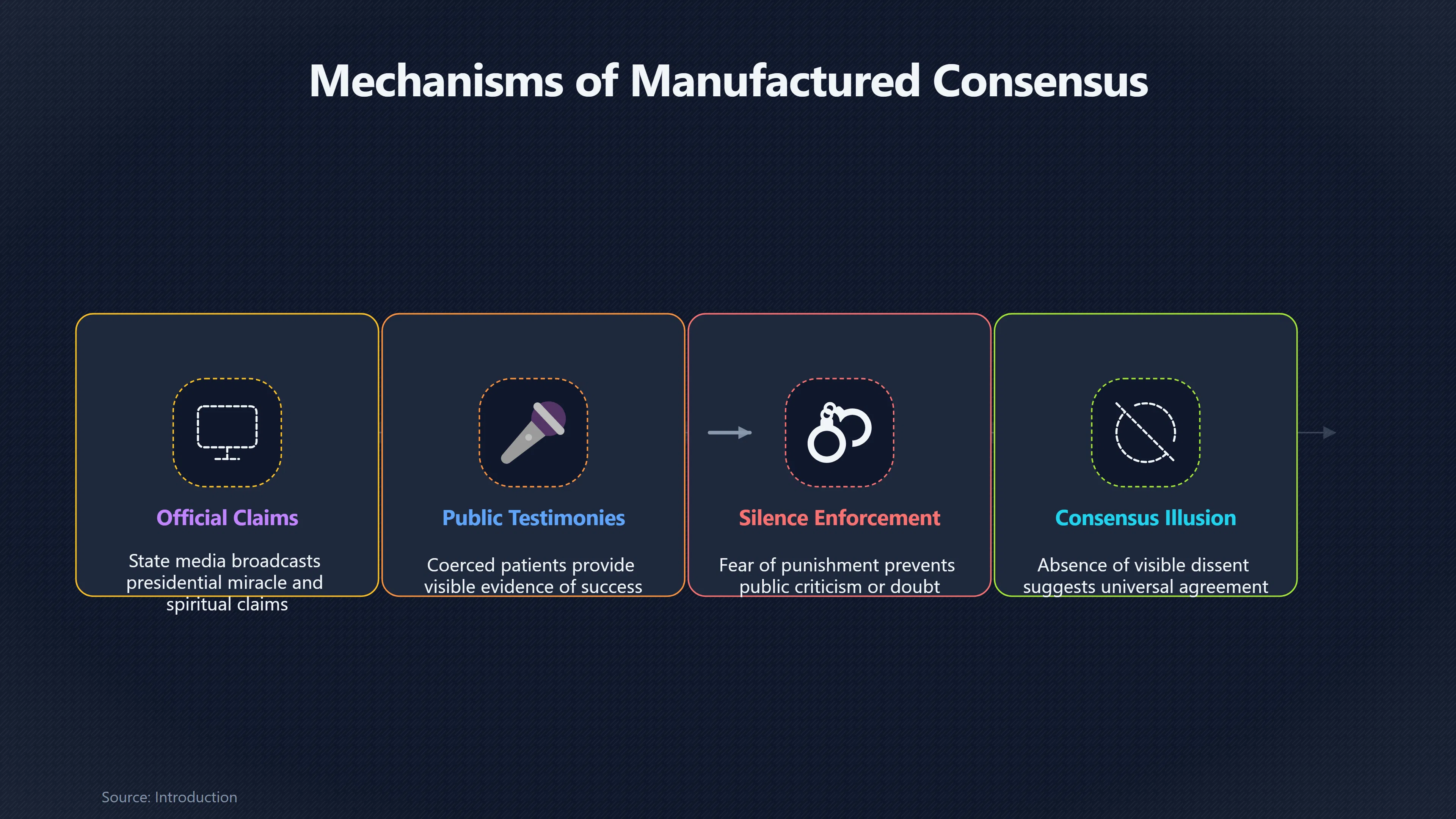
The result was a self-reinforcing cycle:
- Official claims generated media coverage.
- Public testimonies appeared to confirm the claims.
- The absence of visible criticism suggested universal agreement.
- Fear of contradicting the president discouraged independent discussion.
- Continued silence strengthened the illusion that the miracle cure worked.
Rather than demonstrating widespread spontaneous belief, the programme showed how authoritarian institutions can manufacture the appearance of consensus.
Political persecution behind spiritual claims
The spiritual language surrounding these campaigns cannot be separated from political power.
The witch hunts were presented as protecting communities from supernatural threats, yet they relied upon arrests, detention, forced confessions and intimidation carried out by state institutions. Amnesty International documented victims being transported by security forces, forced to drink hallucinogenic substances and threatened at gunpoint. Hundreds reportedly fled affected areas, while critics of the campaign also faced arrest.[Amnesty International]amnesty.orgAmnesty InternationalThe Gambia: Hundreds accused of “witchcraft” and poisoned in government campaign - Amnesty InternationalMarch 18, 2009…
This combination of spiritual accusation and political coercion had several consequences:
- Ordinary disagreement became dangerous. Challenging the campaign could be interpreted as opposing the president rather than disputing supernatural claims.
- Victims became socially isolated. Once officially labelled as witches, many continued to experience stigma even after the campaign ended.
- Communities struggled to resist collectively. Individuals who privately doubted the accusations could not safely organise public opposition.
The TRRC later concluded that the campaign involved torture, arbitrary detention and other grave human rights violations, emphasising that state institutions had been central to its operation rather than merely failing to prevent it.[Ministry of Justice Gambia]moj.gov.gmMinistry of Justice Gambia REPORTVOLUME 1 (PART A) COMPENDIUM ON FINDINGS A…
Why dictatorship strengthened extraordinary claims
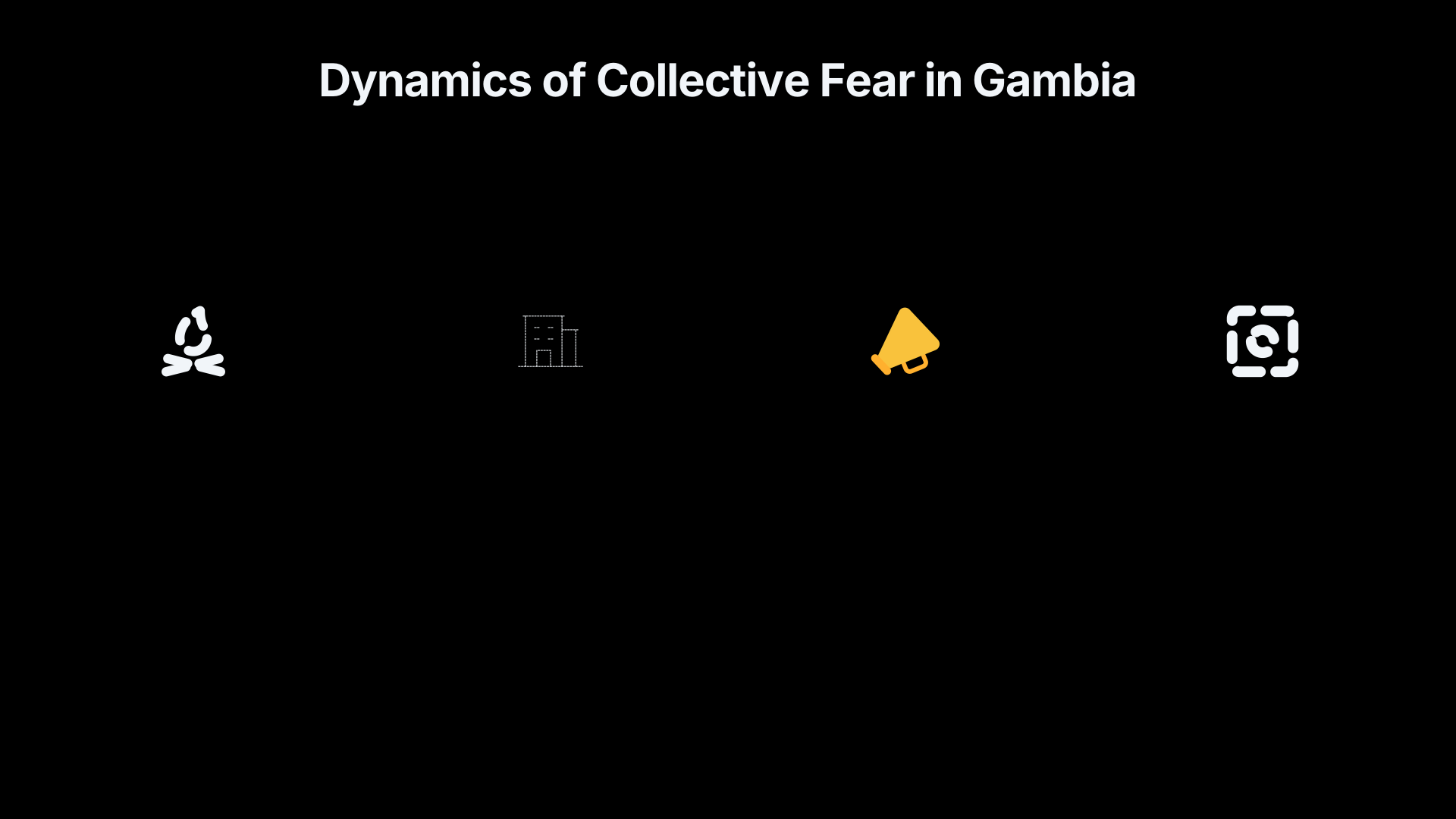
The Gambian experience shows several mechanisms through which authoritarian rule amplified fear and belief.
Control of information. State broadcasting repeatedly promoted presidential miracle claims while independent criticism remained limited, allowing unsupported assertions to dominate public discussion.[PMC]pmc.ncbi.nlm.nih.govOpen source on nih.gov.
Fear of punishment. Citizens evaluating extraordinary claims also had to consider the consequences of expressing disbelief. This altered behaviour regardless of private opinions.
Symbolic authority. Presidential endorsement gave supernatural claims unusual legitimacy. Beliefs that might otherwise have remained local traditions acquired the force of government policy.
Institutional enforcement. Police, intelligence services and other state bodies converted symbolic beliefs into concrete action through arrests, transport, detention and forced participation.
Together, these mechanisms made fear appear socially validated. The apparent popularity of official beliefs often reflected political coercion more than voluntary acceptance.
Lasting lessons
The Gambian cases are best understood not simply as episodes of superstition but as examples of how authoritarian governments can weaponise belief.
Historians, human rights investigators and public health researchers generally agree that Jammeh’s government exploited both inherited cultural ideas and presidential power. Neither element alone fully explains the events. Traditional beliefs about witchcraft existed before Jammeh’s rule, but they became far more destructive when backed by armed state institutions. Likewise, unsupported medical claims became dangerous because political authority compelled participation and suppressed criticism.[nih.gov]pmc.ncbi.nlm.nih.govOpen source on nih.gov.
This distinction remains important when interpreting episodes of collective fear. The Gambian experience cautions against describing every large-scale panic as simple “mass hysteria”. In these cases, fear spread most effectively because disbelief itself became risky. The state’s coercive power created an environment in which rumours, miracle claims and supernatural accusations could be treated as official truth, making public resistance both socially and politically hazardous.


Endnotes
1.
Source: amnesty.org
Link:https://www.amnesty.org/en/latest/press-release/2009/03/gambia-hundreds-accused-e2809cwitchcrafte2809d-and-poisoned-government-campaign-20/
Source snippet
Amnesty InternationalThe Gambia: Hundreds accused of “witchcraft” and poisoned in government campaign - Amnesty InternationalMarch 18, 2009...
Published: March 18, 2009
2.
Source: pmc.ncbi.nlm.nih.gov
Link:https://pmc.ncbi.nlm.nih.gov/articles/PMC6586965/
3.
Source: scribd.com
Title: Volume 11 2009 Witch Hunt Exercise
Link:https://www.scribd.com/document/947739521/Volume-11-2009-Witch-Hunt-Exercise
Source snippet
2009 Gambia Witch-Hunt Report | PDF | Witchcraft | The Gambia...
4.
Source: amnesty.org
Title: International Hundreds released as Gambian witch hunts end
Link:https://www.amnesty.org/en/latest/news/2009/04/hundreds-released-gambian-witch-hunts-end-20090408/
Source snippet
Amnesty InternationalHundreds released as Gambian witch hunts end - Amnesty International...
5.
Source: gambia.dk
Title: TRR C Final Report: Ministry of Justice downloads
Link:https://www.gambia.dk/forums/topic.asp?TOPIC_ID=17977
6.
Source: gambia.dk
Title: TRR C PRESS BRIEFING: SUBMISSION OF FINAL REPORT
Link:https://www.gambia.dk/forums/topic.asp?TOPIC_ID=17956
7.
Source: amnesty.org
Title: Hundreds accused of ‘witchcraft’ persecuted in The Gambia
Link:https://www.amnesty.org/en/latest/news/2009/03/hundreds-accused-039witchcraft039-persecuted-gambia-20090318/
8.
Source: moj.gov.gm
Title: Ministry of Justice Gambia REPORT
Link:https://moj.gov.gm/wp-content/uploads/2024/12/Volume-1-Compendium-Part-A.pdf
Source snippet
VOLUME 1 (PART A) COMPENDIUM ON FINDINGS A...
9.
Source: refworld.org
Link:https://www.refworld.org/reference/annualreport/amnesty/2010/73417
10.
Source: pubmed.ncbi.nlm.nih.gov
Link:https://pubmed.ncbi.nlm.nih.gov/31239630/
Additional References
11.
Source: news.sky.com
Link:https://news.sky.com/story/yahya-jammeh-the-gambian-president-who-claimed-to-cure-aids-10733487
Source snippet
Sky NewsYahya Jammeh: The Gambian President who claimed to cure AIDS | World News | Sky News...
12.
Source: youtube.com
Title: Bringing Down Jammeh
Link:https://www.youtube.com/watch?v=DpBEy9Jm31w
Source snippet
Gambia TRRC witch hunt TRRC begins hearing on jammeh’s witch Hunting EYEAFRICA TV...
13.
Source: youtube.com
Title: Africa Matters: The Gambia’s ‘witch hunt’ victims await justice
Link:https://www.youtube.com/watch?v=F1x0NjAOays
Source snippet
Bringing Down Jammeh - BBC Africa Eye Documentary...
14.
Source: onlinelibrary.wiley.com
Link:https://onlinelibrary.wiley.com/doi/full/10.1002/casp.70147
Source snippet
of Individual and Collective Stigma Resulting From the 2008–9 Witch‐Hunts Carried Out by the Gambian Dictatorship: Implications for Trans...
15.
Source: researchgate.net
Link:https://www.researchgate.net/publication/334065167_The_Impact_of_the_Presidential_Alternative_Treatment_Program_on_People_Living_with_HIV_and_the_Gambian_HIV_Response
16.
Source: factcheckgambia.org
Link:https://factcheckgambia.org/2022/08/07/factsheet-what-you-should-know-about-yayha-jammehs-witch-hunting-exercise/
17.
Source: theguardian.com
Link:https://www.theguardian.com/world/2009/mar/19/gambia-witchcraft-hallucinogenics
18.
Source: theguardian.com
Link:https://www.theguardian.com/global-development/2018/jun/01/survivors-yahya-jammehs-bogus-aids-cure-sue-former-gambian-leader
19.
Source: hhrjournal.org
Link:https://www.hhrjournal.org/2019/06/12/the-impact-of-the-presidential-alternative-treatment-program-on-people-living-with-hiv-and-the-gambian-hiv-response/
20.
Source: factcheckgambia.org
Link:https://factcheckgambia.org/factsheet-jammehs-alternative-treatment-programme/
Topic Tree