Within Britain in Belief
When Did Public Concern Become Moral Panic?
British moral panics grew when media and authorities turned selected threats into symbols of wider social breakdown.
On this page
- What makes a scare a moral panic
- How newspapers and authorities amplify threats
- Why disproportionate reactions can outlast the evidence
Page outline Jump by section
Introduction
Britain has played a central role in shaping how scholars understand moral panic: periods when public concern about a real or perceived threat grows far beyond the available evidence, often through intense media attention, political rhetoric and demands for swift action. The modern concept emerged from research into British society itself, making the United Kingdom not only the setting for many influential moral panics but also the birthplace of the academic framework used to analyse them.[Routledge]routledge.comFolk Devils and Moral PanicsFolk Devils and Moral Panics - 1st Edition - Stanley Cohen - Routledge…

Not every public alarm is a moral panic. Some concerns are justified and lead to important reforms. The key question is whether the reaction becomes disproportionate to the available evidence, whether particular people are turned into symbolic “folk devils”, and whether extraordinary social or legal responses outlast the facts that originally prompted them. Britain’s experience shows how newspapers, broadcasters, campaigners and government institutions can combine—sometimes unintentionally—to transform isolated incidents into national crises.
When did public concern become moral panic?
The sociologist Stanley Cohen developed the modern idea of moral panic after studying clashes between the Mods and Rockers at English seaside resorts during the 1960s. While fights certainly occurred, Cohen argued that newspapers transformed relatively limited disturbances into symbols of a wider collapse in youth behaviour. Media reports increasingly portrayed the groups as dangerous outsiders, encouraging politicians, police and the public to interpret later incidents through the same dramatic narrative.[PMC]pmc.ncbi.nlm.nih.govPMCOn Folk Devils, Moral Panics and New Wave Public HealthPMCOn Folk Devils, Moral Panics and New Wave Public Health
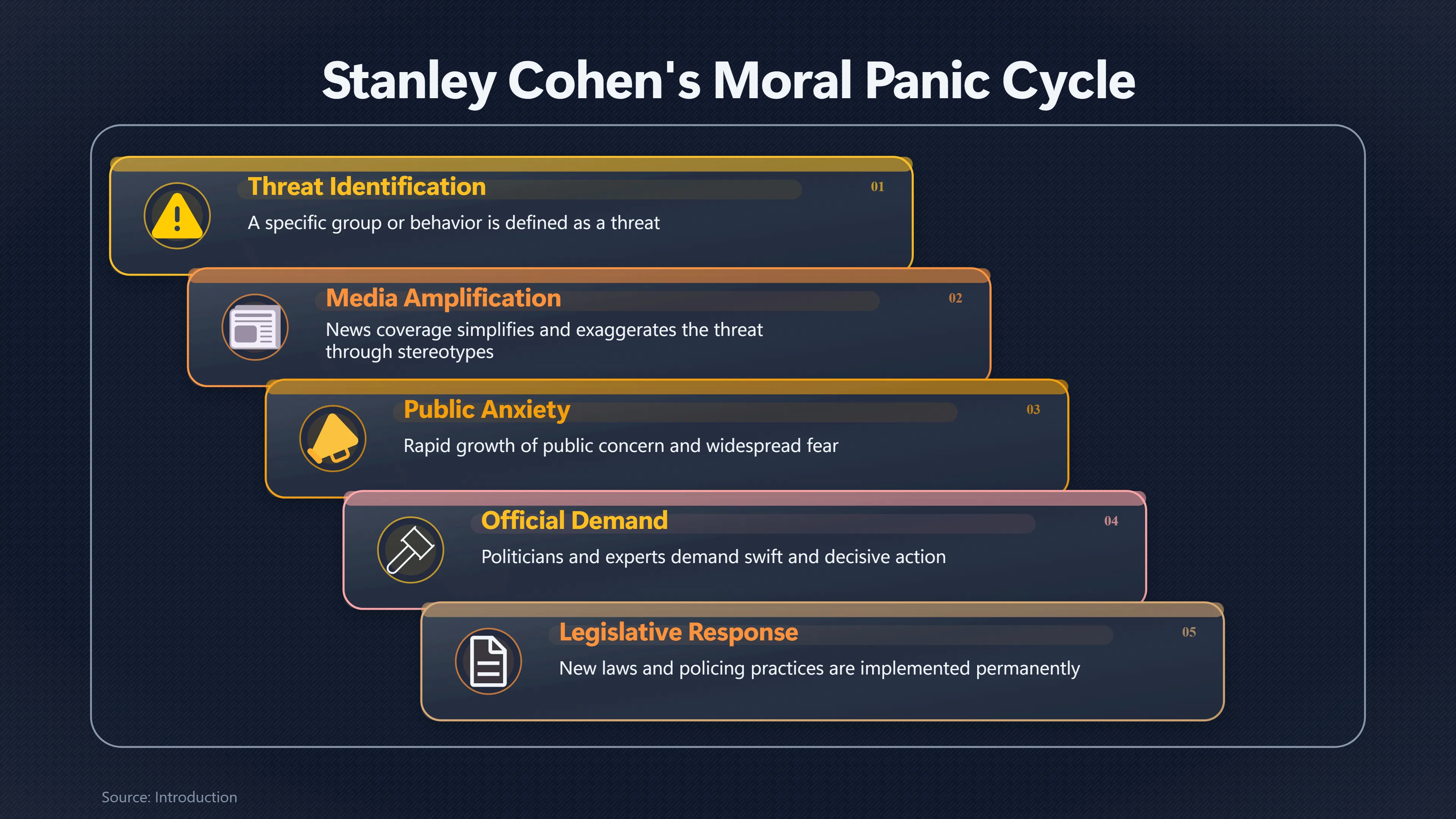
Cohen described a recurring pattern:
- A person, group or behaviour becomes defined as a threat to society.
- News coverage simplifies and exaggerates that threat through memorable images and stereotypes.
- Public anxiety grows rapidly.
- Politicians, officials and recognised experts demand action.
- New laws, policing practices or restrictions follow, even if the original threat later appears less significant than first believed.[PMC]pmc.ncbi.nlm.nih.govPMCOn Folk Devils, Moral Panics and New Wave Public HealthPMCOn Folk Devils, Moral Panics and New Wave Public Health
His work also introduced the influential idea of “folk devils”: individuals or groups who come to represent broader social fears. In Britain these have ranged from youth subcultures and horror-film distributors to supposed secret satanic networks, “hoodies”, asylum seekers and other highly visible symbols of wider anxieties, depending on the era.[Routledge]routledge.comFolk Devils and Moral PanicsFolk Devils and Moral Panics - 1st Edition - Stanley Cohen - Routledge…
How newspapers and authorities amplify threats
British moral panics rarely depended on newspapers alone. They became powerful because several institutions often reinforced one another.
Newspapers frequently favoured dramatic headlines, repeated isolated incidents as if they formed an emerging pattern and highlighted the most alarming interpretations. Television and radio could then extend these stories to national audiences. Politicians often responded to public concern with promises of tougher enforcement, while police operations, parliamentary debates or official inquiries generated fresh headlines, creating a feedback loop in which media coverage and government action appeared to validate one another.[PMC]pmc.ncbi.nlm.nih.govPMCOn Folk Devils, Moral Panics and New Wave Public HealthPMCOn Folk Devils, Moral Panics and New Wave Public Health
This process does not necessarily involve deliberate misinformation. Journalists may report genuine events, police may investigate legitimate concerns and ministers may respond sincerely. The amplification occurs when uncertainty is gradually replaced by increasingly confident narratives before the available evidence justifies such certainty.
Case studies that shaped Britain’s understanding of moral panic
Mods and Rockers
The Easter and Whitsun holiday disturbances of 1964 remain the classic British example because they inspired the theory itself.
Cohen showed that many newspaper reports overstated the scale and novelty of the violence. Limited confrontations became national symbols of youth disorder, encouraging stronger policing and reinforcing stereotypes about both groups. His research argued that media attention itself helped transform relatively local events into a nationwide cultural conflict.[PMC]pmc.ncbi.nlm.nih.govPMCOn Folk Devils, Moral Panics and New Wave Public HealthPMCOn Folk Devils, Moral Panics and New Wave Public Health
The “video nasties” controversy
During the early 1980s, campaigners warned that violent horror films released on home video threatened children’s behaviour and public morality. Newspapers coined the label “video nasties”, while campaign groups and politicians argued that unrestricted access to such films risked encouraging violent crime.
The resulting campaign contributed to the Video Recordings Act 1984, introducing statutory classification for home video releases. Although concern about children’s access to violent material was genuine, later researchers argued that claims about widespread behavioural effects often exceeded the available evidence and that sensational reporting magnified public anxiety.[Routledge]routledge.comFolk Devils and Moral PanicsFolk Devils and Moral Panics - 1st Edition - Stanley Cohen - Routledge…
The controversy also demonstrated how new technologies can become focal points for wider fears about changing family life, declining parental authority and cultural change rather than merely debates about entertainment.
Satanic ritual abuse allegations
Britain experienced its own version of the wider international Satanic Panic during the late 1980s and early 1990s.
Investigations in places including Cleveland, Rochdale and Orkney led to children being removed from families after allegations of organised satanic abuse. Extensive police investigations and later inquiries generally failed to uncover evidence supporting claims of large secret satanic networks operating in Britain. Several official reviews criticised investigative methods, interviewing techniques and professional assumptions that had encouraged belief in hidden conspiracies despite weak corroborating evidence.[University of Portsmouth]researchportal.port.ac.ukUniversity of Portsmouth The myth of moral panics: sex, snuff, and SatanUniversity of PortsmouthThe myth of moral panics: sex, snuff, and Satan - University of Portsmouth…
These cases remain important because they illustrate how moral panics can spread through professional networks as well as the popular press. Social workers, therapists, police officers and campaign groups sometimes reinforced one another’s expectations, making contradictory evidence easier to dismiss.
Why some scares spread so quickly
British moral panics often emerge during periods of rapid social change, when older assumptions about authority, family life or national identity appear uncertain.
Several recurring conditions increase the likelihood of amplification:
- Visible social change, especially involving youth culture, immigration, sexuality or new technology.
- Highly emotional incidents that appear to confirm existing fears.
- Continuous media coverage, encouraging audiences to perceive rare events as increasingly common.
- Pressure for immediate political action, making caution appear equivalent to inaction.
- Simple explanations for complicated social problems.[PMC]pmc.ncbi.nlm.nih.govPMCOn Folk Devils, Moral Panics and New Wave Public HealthPMCOn Folk Devils, Moral Panics and New Wave Public Health
These mechanisms help explain why very different episodes—from seaside fights to horror films and alleged ritual abuse—share remarkably similar patterns despite involving completely different subjects.
Why disproportionate reactions can outlast the evidence
One reason moral panics matter is that their consequences often survive long after public attention fades.
Some panics produce lasting legislation, changes to policing, stricter censorship or new professional guidance. Others permanently damage the reputations of individuals or communities that became identified as symbolic threats. Children removed from families during ritual-abuse investigations, for example, experienced consequences that continued long after official inquiries questioned the original allegations.
At the same time, not every policy introduced during a moral panic is necessarily harmful. Classification systems for films, safeguarding reforms or improved child-protection procedures may continue to serve useful purposes even if the fears that accelerated their introduction later appear exaggerated. Distinguishing between justified reform and disproportionate reaction therefore requires examining both the original evidence and the long-term outcomes.
Debates about the idea of moral panic itself
Although the concept remains highly influential, it is not beyond criticism.
Some scholars argue that describing an episode as a moral panic risks dismissing legitimate public concern too quickly. Others suggest that the theory can understate genuine crime, abuse or social harm by focusing primarily on exaggerated reactions. More recent research has also questioned whether all panics follow the same pattern or whether digital media have changed the process enough to require new analytical approaches.[University of Portsmouth]researchportal.port.ac.ukUniversity of Portsmouth The myth of moral panics: sex, snuff, and SatanUniversity of PortsmouthThe myth of moral panics: sex, snuff, and Satan - University of Portsmouth…
These debates have encouraged historians and sociologists to use the concept carefully. Rather than assuming every controversy is a moral panic, they ask whether evidence, media coverage, political responses and public anxiety remained proportionate throughout the episode.
Why British moral panics remain culturally important
Britain’s importance lies not simply in the number of its moral panics but in the lasting influence of the ideas developed to explain them. Stanley Cohen’s work continues to shape research on media, crime, public policy and social conflict around the world, while British case studies remain standard examples in sociology, criminology and journalism.[Routledge]routledge.comFolk Devils and Moral PanicsFolk Devils and Moral Panics - 1st Edition - Stanley Cohen - Routledge…
These episodes also reveal a broader lesson about democratic societies. Public fears rarely arise from imagination alone. They usually begin with genuine uncertainty or real incidents. What transforms them into moral panics is the interaction between media narratives, institutional authority and public emotion, producing responses that may continue long after the original evidence has been reassessed.
Amazon book picks
Further Reading
Books and field guides related to When Did Public Concern Become Moral Panic?. Use these as the next step if you want deeper reading beyond the article.
Extraordinary Popular Delusions and the Madness of Crowds
Rating: 4.0/5 from 5 Google Books ratings
Explores recurring episodes of collective belief and social contagion.

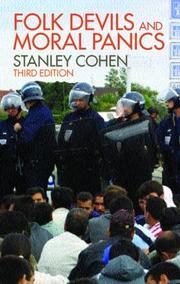
Folk devils and moral panics
Introduced the modern concept of moral panic from British case studies.
Endnotes
1.
Source: routledge.com
Title: Folk Devils and Moral Panics
Link:https://www.routledge.com/Folk-Devils-and-Moral-Panics-1st-Edition/Cohen/p/book/9781138834743
Source snippet
Folk Devils and Moral Panics - 1st Edition - Stanley Cohen - Routledge...
2.
Source: pmc.ncbi.nlm.nih.gov
Title: PMCOn Folk Devils, Moral Panics and New Wave Public Health
Link:https://pmc.ncbi.nlm.nih.gov/articles/PMC6885862/
3.
Source: researchportal.port.ac.uk
Title: University of Portsmouth The myth of moral panics: sex, snuff, and Satan
Link:https://researchportal.port.ac.uk/en/publications/the-myth-of-moral-panics-sex-snuff-and-satan/
Source snippet
University of PortsmouthThe myth of moral panics: sex, snuff, and Satan - University of Portsmouth...
4.
Source: Wikipedia
Title: Moral panic
Link:https://en.wikipedia.org/wiki/Moral_panic
5.
Source: pmc.ncbi.nlm.nih.gov
Link:https://pmc.ncbi.nlm.nih.gov/articles/PMC13038130/
Source snippet
sociologist Jock Young in 1971 (2009) when he used the term to describe the socially constructed and symb...
6.
Source: doi.org
Title: Moral Panic
Link:https://doi.org/10.1002/9781118524275.ejdj0054
Additional References
7.
Source: openlab.bmcc.cuny.edu
Title: video stanley cohens study folk devils and moral panics 1972
Link:https://openlab.bmcc.cuny.edu/crj-102-criminology-oer-course-hub/video-stanley-cohens-study-folk-devils-and-moral-panics-1972/
Source snippet
Stanley Cohen’s “Mods, Rockers, and Moral Panics” (1972) – CRJ 102 | Criminology | OER Course HubJune 30, 2025 — Labeling Theory Videos...
Published: June 30, 2025
8.
Source: savemyexams.com
Title: Media Reporting of Crime: Moral Panics | AQA GCSE Sociology
Link:https://www.savemyexams.com/gcse/sociology/aqa/17/revision-notes/crime-and-deviance/the-media-and-public-debates-over-crime/media-reporting-of-crime-moral-panics/
Source snippet
December 17, 2024 — MEDIA REPORTING OF CRIME: MORAL PANICS (AQA GCSE SOCIOLOGY): REVISION NOTE Exam code: 8192 Download PDF Image: Cara H...
Published: December 17, 2024
9.
Source: youtube.com
Title: 14 British ‘Video Nasties’ The Government Actually Made Illegal To Own
Link:https://www.youtube.com/watch?v=QlJJRfJiIgc
Source snippet
Generation E | Channel 5 Documentary | 1997 | Ecstasy, Rave Culture & 90s Britain...
10.
Source: youtube.com
Title: Open University Learning Zone: Moral Panics
Link:https://www.youtube.com/watch?v=urkQ4cXe5nY
Source snippet
14 British 'Video Nasties' The Government Actually Made Illegal To Own...
11.
Source: youtube.com
Title: Don’t Panic
Link:https://www.youtube.com/watch?v=JKaIqGh6LWM
Source snippet
Stanley Cohen: Folk Devils and Moral Panics...
12.
Source: youtube.com
Title: Stanley Cohen: Folk Devils and Moral Panics
Link:https://www.youtube.com/watch?v=AKhLAzdiCfQ
Source snippet
Open University Learning Zone: Moral Panics - The Agony And The Ecstasy...
13.
Source: journals.sagepub.com
Link:https://journals.sagepub.com/doi/10.1177/07311214231193355
Source snippet
Scott, K. J. Reed, P. Hall, M. Winters, G. Kwan, K. Park, 2024October 3, 2023 — MORAL PANIC THEORY AND MOBILITY (IN)JUSTICE The concept o...
Published: October 3, 2023
14.
Source: sciencedirect.com
Title: ScienceDirect Moral Panic
Link:https://www.sciencedirect.com/topics/medicine-and-dentistry/moral-panic
Source snippet
Moral Panic - an overview | ScienceDirect Topics...
15.
Source: researchgate.net
Link:https://www.researchgate.net/publication/342952856_Child_Protection_Anxieties_and_the_Formation_of_UK_Child_Welfare_and_Protection_Practices
16.
Source: open.edu
Link:https://www.open.edu/openlearn/society-politics-law/discovering-disorder-young-people-and-delinquency/content-section-3.4
Topic Tree