Within Belgian Belief Scares
Was Antoinism Really a Belgian Cult?
Antoinism shows why the word cult can mislead when a healing religion is peaceful, decentralised and socially accepted.
On this page
- Louis Antoine and the movement's beliefs
- Healing temples and working class appeal
- Why sect and cult labels remain contested
Page outline Jump by section
Introduction
Antoinism is often mentioned in discussions of Belgium’s religious minorities because it began near Liège in the early twentieth century and centred on spiritual healing. Yet it also illustrates why the label “cult” can be misleading. While some journalists and anti-sect campaigners have grouped Antoinism alongside other unconventional religious movements, historians and scholars of religion generally describe it as a small new religious movement whose organisation, beliefs and social practices differ markedly from the coercive or abusive groups that usually dominate modern debates about cults. Understanding Antoinism therefore helps explain a wider Belgian controversy: whether unfamiliar religions should be judged by their minority status, or by evidence of demonstrable harm.
Was Antoinism Really a Belgian Cult?
The answer depends largely on what someone means by the word “cult”.
In everyday language, “cult” often suggests an authoritarian group led by a charismatic figure who isolates followers, demands unquestioning obedience and exploits members. By contrast, in religious studies the word has historically been used more neutrally for a new or small religious movement. Because these meanings have become so confused, many scholars now prefer terms such as new religious movement or simply refer to the group’s own name.
Belgium’s experience reflects this ambiguity. During the 1990s, public concern about destructive sects increased after several international tragedies involving apocalyptic religious movements. Belgian politicians investigated organisations that might pose risks through fraud, coercion or psychological abuse. However, the parliamentary inquiry also acknowledged that the word “sect” itself was pejorative and that minority religions should not automatically be treated as dangerous. It distinguished between ordinary religious groups and organisations that caused demonstrable harm.[Voltairenet]voltairenet.orgRapport de la Commission d'enquête parlementaire belge sur les pratiques illégales des sectes - Vers une ébauche de définition…
Antoinism has sometimes appeared in discussions of Belgian “sects” simply because it originated outside the country’s recognised historic religions. That does not mean it fits the popular stereotype of a coercive cult.
Louis Antoine and the Movement’s Beliefs
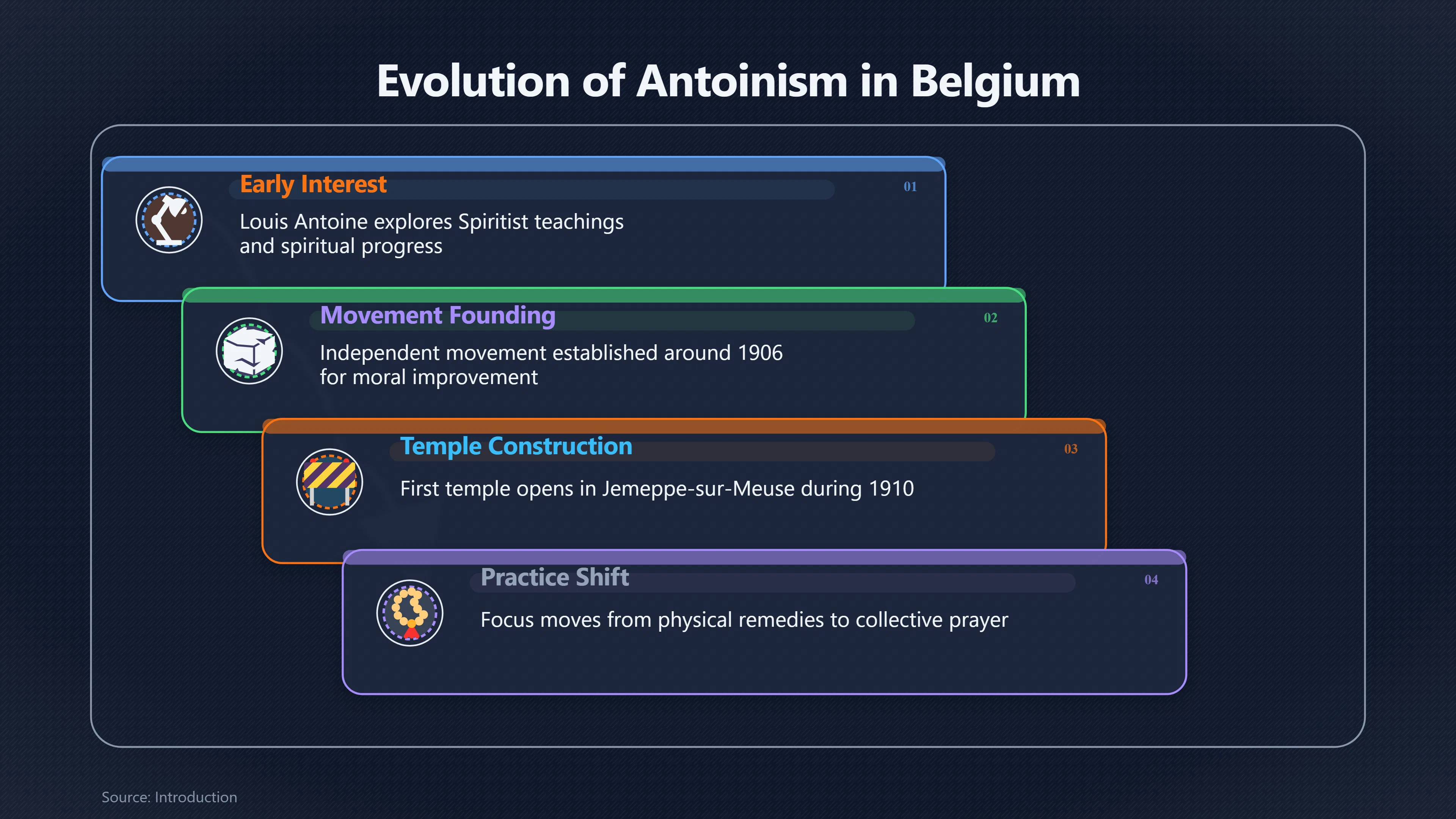
Antoinism was founded by Louis Antoine (1846–1912), a former steelworker from the industrial region around Liège. After working in Belgium, Germany and Poland, he became interested in Spiritism before gradually developing his own religious teaching. Around 1906 he separated from Spiritist organisations and established an independent movement centred on moral improvement, faith, prayer and spiritual healing.[ScienceDirect]sciencedirect.comEconophysics of a religious cult: The Antoinists in Belgium [1920–2000] - ScienceDirectJune 1, 2012…
His teachings combined several influences:
- Christian ethical language centred on love, forgiveness and compassion.
- Belief in reincarnation and spiritual progress.
- The idea that illness had an important spiritual dimension.
- Faith healing through prayer rather than medical procedures.
After criticism and legal difficulties surrounding unlicensed healing practices, Antoine increasingly abandoned physical remedies and focused on collective prayer and what followers described as spiritual healing. This shift became an enduring feature of the movement.[Musée virtuel de l'Antoinisme]antoinisme.blogg.orgMusée virtuel de l'AntoinismeLa Belgique et ses dieux (1985) - Musée virtuel de l'Antoinisme…
Unlike many movements later criticised as destructive cults, Antoinism developed a relatively simple religious structure. It has no elaborate missionary programme, no requirement to abandon family life, and no central authority exercising detailed control over members’ daily behaviour.

Healing Temples and Working-Class Appeal
Antoinism emerged in one of Europe’s great industrial regions. Coal miners, steelworkers and their families often faced dangerous working conditions, chronic illness and limited access to effective medical treatment. In this setting, Antoine’s message of hope, moral dignity and spiritual healing attracted considerable interest.
The movement rapidly established temples, beginning with the first at Jemeppe-sur-Meuse in 1910. Most Belgian temples were built before the Second World War, particularly in the French-speaking regions around Liège, where the movement’s support remained strongest. Today dozens of Antoinist temples still exist in Belgium and neighbouring France, although membership has declined from its early twentieth-century peak.[Wikipedia]WikipediaList of Antoinist templesList of Antoinist temples
Services remain deliberately simple. Public ceremonies typically consist of silent prayer, readings from Antoine’s teachings and a collective blessing known as the “General Operation”. Donations are anonymous rather than compulsory, and the movement has traditionally avoided aggressive recruitment campaigns. Researchers studying its finances and institutional history have noted its unusually decentralised organisation and gradual demographic decline rather than expansion through intensive proselytising.[ScienceDirect]sciencedirect.comEconophysics of a religious cult: The Antoinists in Belgium [1920–2000] - ScienceDirectJune 1, 2012…
Why Sect and Cult Labels Remain Contested
Antoinism occupies an unusual place in Belgium’s wider debate about sects because it possesses some characteristics that often attract suspicion while lacking many of the features normally associated with harmful groups.
Reasons some observers have questioned it include:
- its origins outside mainstream Christianity;
- its emphasis on spiritual healing;
- unusual beliefs such as reincarnation;
- distinctive religious dress in some congregations.
At the same time, evidence generally points away from the characteristics most often associated with abusive cults:
- no strong pattern of isolation from wider society;
- no highly authoritarian leadership after the founders’ deaths;
- no extensive financial demands on followers;
- no systematic programme of recruitment or psychological control documented in mainstream historical research.
Belgium’s 1997 parliamentary inquiry became influential precisely because it tried to separate unconventional belief from demonstrable harm. The commission argued that the existence of unusual doctrines alone should not justify official suspicion. Instead, attention should focus on illegal practices, fraud, abuse, coercion or threats to public safety.[Voltairenet]voltairenet.orgRapport de la Commission d'enquête parlementaire belge sur les pratiques illégales des sectes - Vers une ébauche de définition…
That distinction remains important. Some anti-sect literature has continued to list Antoinism among minority religious movements, while historians of Belgian religion more often present it as a peaceful healing religion that became socially embedded rather than socially disruptive. Its survival for more than a century, open temples and relatively low-profile public presence have reinforced this interpretation.[ScienceDirect]sciencedirect.comEconophysics of a religious cult: The Antoinists in Belgium [1920–2000] - ScienceDirectJune 1, 2012…
What Antoinism Reveals About Belgium’s Cult Debate
Antoinism demonstrates that Belgium’s history of religious controversy is more complicated than a simple division between recognised religions and dangerous cults.
The movement undoubtedly challenged conventional religious boundaries by combining Christian ideas with spiritual healing and reincarnation. Early newspapers often portrayed it as exotic or eccentric, and its healing claims attracted scepticism. Yet over time it became a familiar part of Belgium’s religious landscape rather than a source of sustained public alarm.
For historians, the real significance of Antoinism lies less in its theology than in what it reveals about classification. It shows that minority religions can be labelled “sects” because they are unfamiliar, while lacking the coercive practices that modern discussions of harmful cults usually have in mind. In Belgium’s broader history of collective fears and religious panics, Antoinism therefore serves as a caution against assuming that unconventional belief is, by itself, evidence of social danger.
Amazon book picks
Further Reading
Books and field guides related to Was Antoinism Really a Belgian Cult?. Use these as the next step if you want deeper reading beyond the article.

The Oxford handbook of new religious movements
Places Antoinism within wider scholarship on new religious movements.
The kingdom of the cults
Illustrates influential popular approaches to minority religions.
Endnotes
1.
Source: voltairenet.org
Link:https://www.voltairenet.org/article7315.html
Source snippet
Rapport de la Commission d'enquête parlementaire belge sur les pratiques illégales des sectes - Vers une ébauche de définition...
2.
Source: sciencedirect.com
Link:https://www.sciencedirect.com/science/article/pii/S0378437112000088
Source snippet
Econophysics of a religious cult: The Antoinists in Belgium [1920–2000] - ScienceDirectJune 1, 2012...
Published: June 1, 2012
3.
Source: voltairenet.org
Link:https://www.voltairenet.org/article7349.html
Source snippet
Rapport de la Commission d'enquête parlementaire belge sur les pratiques illégales des sectes - Les pratiques thérapeutiques i...
4.
Source: Wikipedia
Title: List of Antoinist temples
Link:https://en.wikipedia.org/wiki/List_of_Antoinist_temples
5.
Source: sciencedirect.com
Link:https://www.sciencedirect.com/science/article/abs/pii/S0378437112000088
6.
Source: voltairenet.org
Title: Commission d’enquête parlementaire belge sur les pratiques illégales des sectes
Link:https://www.voltairenet.org/article3165.html
7.
Source: voltairenet.org
Link:https://www.voltairenet.org/article7317.html
8.
Source: voltairenet.org
Link:https://www.voltairenet.org/article7283.html
9.
Source: antoinisme.blogg.org
Link:https://antoinisme.blogg.org/la-belgique-et-ses-dieux-1985-a116846026
Source snippet
Musée virtuel de l'AntoinismeLa Belgique et ses dieux (1985) - Musée virtuel de l'Antoinisme...
10.
Source: antoinisme.blogg.org
Title: 8. – A new religion k
Link:https://antoinisme.blogg.org/faith-healing-sect-established-in-belgium-herald-democrat-january-9-19-a214955595
Source snippet
healing sect established in Belgium (Herald Democrat, January 9, 1911) - Musée virtuel de l'AntoinismeNovember 2, 2023 — FAITH HEALING SE...
Published: January 9, 1911
Additional References
11.
Source: monument.heritage.brussels
Title: Guillaume Van Haelenlaan
Link:https://monument.heritage.brussels/nl/Vorst/Guillaume_Van_Haelenlaan/132/29151
Source snippet
tempel – Inventaris van het bouwkundig erfgoedAugust 19, 2024 — ONDERZOEK EN REDACTIE 2016-2019 ID Urban: 29151 lees meer BESCHRIJVING A...
Published: August 19, 2024
12.
Source: senate.be
Title: Schriftelijke vraag nr
Link:https://www.senate.be/www/?LANG=nl&LEG=7&MIval=Vragen%2FSchriftelijkeVraag&NR=832
Source snippet
7-832November 12, 2020 — SCHRIFTELIJKE VRAAG NR. 7-832 VAN ANDRÉ FRÉDÉRIC (PS) D.D. 12 NOVEMBER 2020 AAN DE MINISTER VAN BINNENLANDSE ZAK...
Published: November 12, 2020
13.
Source: bmgn-lchr.nl
Link:https://bmgn-lchr.nl/article/view/URN%3ANBN%3ANL%3AUI%3A10-1-105982
14.
Source: opus-info.org
Link:https://opus-info.org/index.php/Rapport_fait_au_nom_de_la_commission_d%E2%80%99enqu%C3%AAte_du_parlement_Belge_en_vue_de_lutter_contre_les_pratiques_ill%C3%A9gales_des_sectes
15.
Source: youtube.com
Title: New Religious Movements, Cults, and Denominations
Link:https://www.youtube.com/watch?v=JtPpPRVoHeI
Source snippet
What's the Difference Between Cults and Religion?...
16.
Source: youtube.com
Title: Antoinism: The Only Religion Born in Belgium
Link:https://www.youtube.com/watch?v=bAcyWV8DkOo
Source snippet
New Religious Movements, Cults, and Denominations...
17.
Source: arxiv.org
Title: arXiv Logistic Modeling of a Religious Sect Features
Link:https://arxiv.org/abs/1309.1964
18.
Source: researchgate.net
Title: 221659371 Econophysics of a religious cult The Antoinists in Belgium 1920 2000
Link:https://www.researchgate.net/publication/221659371_Econophysics_of_a_religious_cult_The_Antoinists_in_Belgium
19.
Source: liquisearch.com
Title: List of Groups Referred To As Cults or Sects in Government Documents
Link:https://www.liquisearch.com/list_of_groups_referred_to_as_cults_or_sects_in_government_documents/belgium/parliamentary_inquiry_commission_1997
20.
Source: youtube.com
Title: Belgium: The Danger of Cults
Link:https://www.youtube.com/watch?v=gboLmWE5WT4
Source snippet
From the Cult Watchers to the Anti-Cult Wars...
Topic Tree