Within North Korea
Who Controls the Supernatural in North Korea?
Official miracle tales and underground divination reveal competing ways North Koreans manage authority, uncertainty and danger.
On this page
- How propaganda turns leaders into figures recognised by nature
- Why fortune telling survived famine and state repression
- What public repetition can and cannot reveal about private belief
Page outline Jump by section
Introduction
North Korea presents an unusual picture of supernatural belief. On the one hand, the state has long promoted official stories that surround the Kim family with extraordinary signs from nature, portraying the country’s leaders as figures whose lives are marked by symbolic events and historical destiny. On the other hand, it has criminalised or harshly restricted many unofficial spiritual practices, including fortune-telling, shamanistic rituals and independent religious activity, arguing that they undermine socialist order and loyalty to the state.[State Department]state.govDepartment Democratic People's Republic of KoreaState DepartmentDemocratic People's Republic of Korea - United States Department of State…
This contrast reveals an important feature of North Korean society. The question is not simply whether people believe in the supernatural, but who is allowed to define it. Official miracle narratives reinforce political authority, while private attempts to seek guidance through fortune-tellers, shamans or religious communities create alternative sources of trust during periods of uncertainty. Evidence from defectors, human-rights investigations and scholars suggests that these unofficial beliefs survived even severe repression, particularly during and after the famine of the 1990s.[uscirf.gov]uscirf.gov2025 North Korea Country Update (003UNITED STATES COMMISSION on INTERNATIONAL RELIGIOUS FREEDOM COUNTRY UPDATE: North Korea December 2025December 7, 2025…
How propaganda turns leaders into figures recognised by nature
North Korean propaganda rarely presents miracles in the style of conventional religion. Instead, it uses symbolic stories in which nature itself appears to acknowledge the Kim family’s historical role. Mountains, weather, forests and celestial phenomena become political witnesses rather than objects of worship.
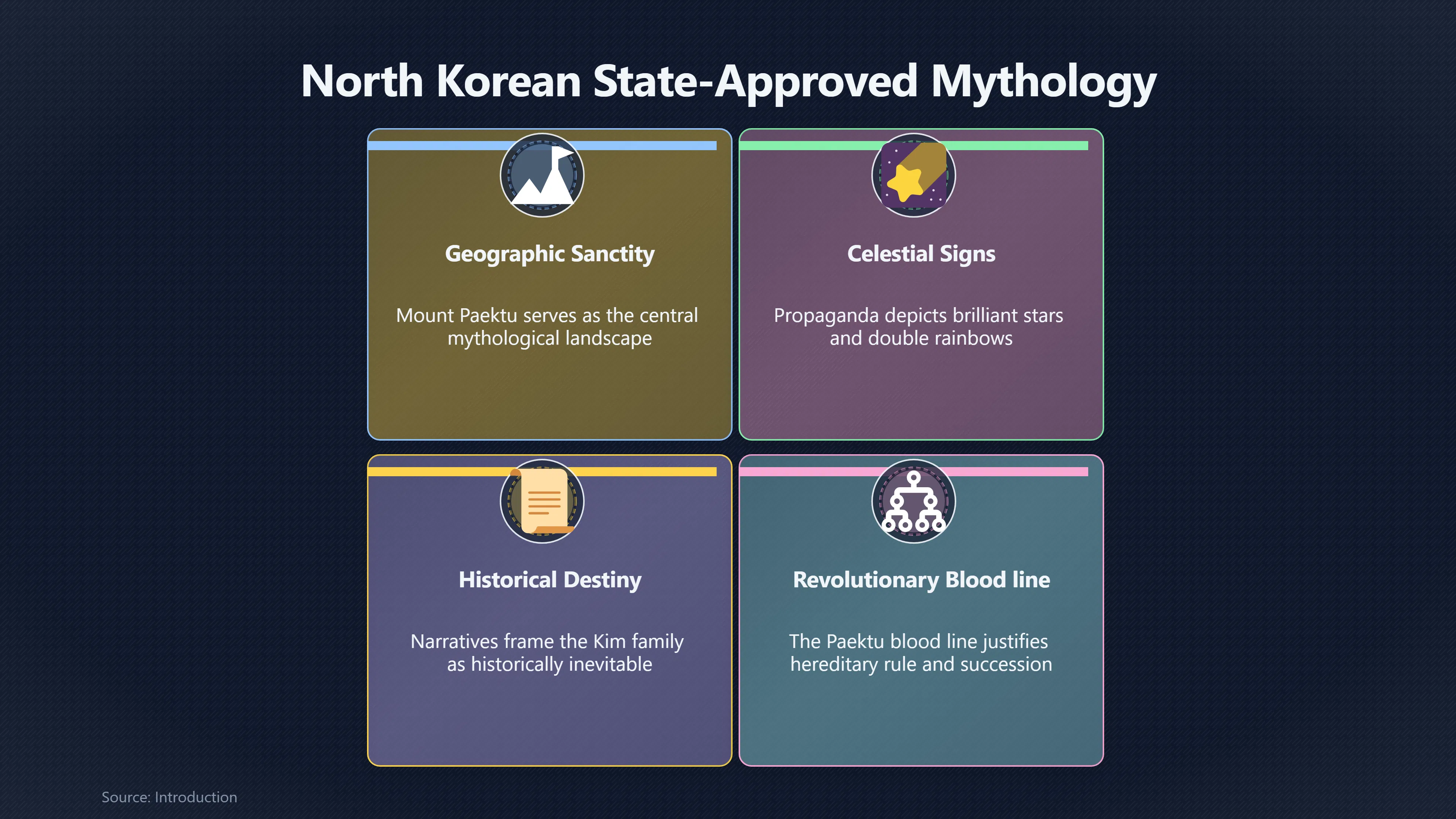
The best-known example concerns Kim Jong-il’s official biography. State narratives associated his birth with Mount Paektu, a mountain already central to Korean national mythology, and described extraordinary natural signs including a brilliant star and a double rainbow. Historians generally regard these stories as political mythology rather than historical fact, designed to reinforce the legitimacy of hereditary succession.[University of Edinburgh Research]research.ed.ac.ukUniversity of Edinburgh ResearchNew Goddess on Mount Paektu: Myth and Transformation in North Korean Landscape - University of Edinburgh…
Mount Paektu occupies a special place in these narratives because it links several layers of meaning:
- It has long-standing importance in Korean folklore and national identity.
- It was presented as the centre of Kim Il-sung’s anti-Japanese guerrilla struggle.
- It became the symbolic birthplace of the revolutionary “Paektu bloodline” that supposedly entitled successive members of the Kim family to rule.[University of Edinburgh Research]research.ed.ac.ukUniversity of Edinburgh ResearchNew goddesses at Paektu Mountain: Two contemporary Korean myths - University of Edinburgh Research Explor…
Scholars emphasise that these stories should not be understood simply as attempts to persuade people that impossible events literally occurred. Their political purpose is to surround the ruling family with an atmosphere of destiny, inevitability and sacred history. Similar techniques have appeared in many personality cults, where extraordinary biographies substitute for democratic legitimacy.[University of Edinburgh Research]research.ed.ac.ukUniversity of Edinburgh ResearchNew Goddess on Mount Paektu: Myth and Transformation in North Korean Landscape - University of Edinburgh…
Why fortune-telling survived famine and repression
Despite decades of official atheism, traditional Korean spiritual practices never disappeared from North Korea. Shamanistic customs, ancestor-related rituals and fortune-telling remained embedded in everyday culture, particularly outside official institutions.
The economic collapse and famine known as the “Arduous March” during the 1990s appears to have strengthened demand for divination. When employment, food supplies and state guarantees became unreliable, many people sought practical guidance from fortune-tellers about illness, marriage, travel, trading opportunities and family decisions. Recent research on North Korean funeral and mourning practices similarly argues that hardship encouraged renewed interest in older spiritual traditions, although often with a focus on immediate survival rather than the afterlife.[KCI]kci.go.krKCIReligious Characteristics of North Korean Mourning and Funeral CultureKCIReligious Characteristics of North Korean Mourning and Funeral Culture
Investigations by human-rights organisations and religious-freedom monitors report that fortune-tellers have been consulted by a remarkably broad cross-section of society, including:
- Market traders trying to reduce financial risk.
- Families facing illness or marriage decisions.
- Officials concerned about careers or political danger.
- Individuals considering escape from North Korea.[ecoi.net]ecoi.netUSDOS – US Department of State (Author): “2020 Report on International Religious Freedom: North Korea”, Document #2051679 - ecoi.net…
This does not necessarily indicate widespread belief in supernatural powers. Rather, fortune-telling often functions as a way of managing uncertainty when reliable information is scarce and formal institutions cannot be trusted.
Why unofficial belief is treated as a political threat
North Korea officially distinguishes between state-approved ideology and what it calls “superstitious activity”. Although the constitution contains limited language about religious freedom, numerous investigations conclude that independent religious practice and many forms of traditional divination remain heavily restricted in practice.[USCIRF]uscirf.govReligious Freedom Conditions in North Korea | USCIRFReligious Freedom Conditions in North Korea | USCIRF…
Authorities have repeatedly described fortune-telling and shamanism as harmful superstitions that weaken socialist consciousness. Criminal provisions have reportedly been used against people who profit from fortune-telling, while campaigns have warned citizens against relying on predictions instead of the state’s guidance.[ecoi.net]ecoi.netUSDOS – US Department of State (Author): “2020 Report on International Religious Freedom: North Korea”, Document #2051679 - ecoi.net…
The state’s concern is understandable in political rather than supernatural terms. A fortune-teller, pastor or shaman offers an alternative authority capable of answering life’s most important questions independently of the ruling party. That creates a competing source of confidence, loyalty and influence.
For similar reasons, Christianity has often faced particularly severe repression. Human-rights organisations argue that independent religious communities establish networks of trust beyond state supervision, making them especially threatening from the regime’s perspective.[USCIRF]uscirf.govReligious Freedom Conditions in North Korea | USCIRFReligious Freedom Conditions in North Korea | USCIRF…
What public repetition can—and cannot—reveal about private belief
One of the hardest questions for historians is whether ordinary North Koreans genuinely believe official miracle stories.
There is no simple answer because public behaviour inside North Korea cannot easily be separated from coercion, social pressure and censorship. Citizens regularly repeat official narratives in schools, workplaces and public ceremonies, but repetition alone does not demonstrate sincere private belief.
Researchers studying authoritarian systems therefore distinguish between several possibilities:
- Conviction, where individuals genuinely accept official narratives.
- Habit, where stories become familiar through lifelong repetition.
- Strategic conformity, where people publicly repeat approved ideas to avoid punishment.
- Quiet scepticism, where official claims are doubted in private but never challenged openly.
Because reliable survey research inside North Korea is impossible, no one can confidently measure how many citizens belong in each category. Defector testimony suggests considerable variation depending on age, region, education and access to outside information.[State Department]state.govDepartment Democratic People's Republic of KoreaState DepartmentDemocratic People's Republic of Korea - United States Department of State…
This uncertainty also explains why sensational claims about universal belief should be treated cautiously. International reporting has sometimes exaggerated or simplified North Korean propaganda into memorable anecdotes that are difficult to verify. Scholars therefore recommend distinguishing carefully between documented official publications, defectors’ personal experiences, rumours and stories that have grown through repetition outside the country.[The Wall Street Journal]wsj.comA key figure in crafting this propaganda was Kim Gee Nam, who recently passed away at the age of 94. Serving all three generations of Kim…

Why forbidden beliefs remain culturally important
The coexistence of official miracle stories and underground divination illustrates a broader tension within North Korean society. The state seeks exclusive control over narratives that explain history, destiny and the future, while many citizens continue to draw on older Korean traditions when confronting illness, danger or uncertainty.
Rather than replacing traditional belief entirely, decades of repression appear to have reshaped it. Fortune-telling and shamanistic practices survived largely out of public view, adapting to changing economic conditions and periods of crisis. At the same time, official mythology appropriated familiar symbols—especially Mount Paektu and signs from nature—to strengthen the political authority of the Kim family.
Seen together, these competing forms of supernatural meaning reveal less about irrational belief than about power. In North Korea, control over miracle stories is also a struggle over who has the authority to interpret the past, predict the future and command public loyalty.
Amazon book picks
Further Reading
Books and field guides related to Who Controls the Supernatural in North Korea?. Use these as the next step if you want deeper reading beyond the article.


Under the Loving Care of the Fatherly Leader
Covers official miracle narratives and state ideology.
Endnotes
1.
Source: state.gov
Title: Department Democratic People’s Republic of Korea
Link:https://www.state.gov/reports/2016-report-on-international-religious-freedom/democratic-peoples-republic-of-korea/
Source snippet
State DepartmentDemocratic People's Republic of Korea - United States Department of State...
2.
Source: uscirf.gov
Title: Religious Freedom Conditions in North Korea | USCIRF
Link:https://www.uscirf.gov/countries/north-korea
Source snippet
Religious Freedom Conditions in North Korea | USCIRF...
3.
Source: uscirf.gov
Title: 2025 North Korea Country Update (003)
Link:https://www.uscirf.gov/sites/default/files/2025-12/2025%20North%20Korea%20Country%20Update%20%28003%29.pdf
Source snippet
UNITED STATES COMMISSION on INTERNATIONAL RELIGIOUS FREEDOM COUNTRY UPDATE: North Korea December 2025December 7, 2025...
Published: December 7, 2025
4.
Source: ecoi.net
Link:https://www.ecoi.net/en/document/2051679.html
Source snippet
USDOS – US Department of State (Author): “2020 Report on International Religious Freedom: North Korea”, Document #2051679 - ecoi.net...
5.
Source: kci.go.kr
Title: KCIReligious Characteristics of North Korean Mourning and Funeral Culture
Link:https://www.kci.go.kr/kciportal/landing/article.kci?arti_id=ART003206776
6.
Source: ecoi.net
Link:https://www.ecoi.net/en/document/2111933.html
Source snippet
USDOS – US Department of State (Author): “2023 Report on International Religious Freedom: North Korea”, Document #2111933 - ecoi.netJune...
7.
Source: ecoi.net
Link:https://www.ecoi.net/en/document/2092389.html
8.
Source: ecoi.net
Link:https://www.ecoi.net/en/document/1436903.html
9.
Source: ecoi.net
Link:https://www.ecoi.net/en/document/1279886.html
10.
Source: uscirf.gov
Link:https://www.uscirf.gov/news-room/releases-statements/uscirf-releases-thank-you-father-kim-il-sung-eyewitness-accounts-1
11.
Source: 2017-2021.state.gov
Title: democratic peoples republic of korea
Link:https://2017-2021.state.gov/reports/2018-report-on-international-religious-freedom/democratic-peoples-republic-of-korea/
12.
Source: uscirf.gov
Link:https://www.uscirf.gov/publication/kimilsungism-kimjongilism-and-right-freedom-religion-thought-and-conscience-north-korea
13.
Source: research.ed.ac.uk
Link:https://www.research.ed.ac.uk/en/publications/new-goddess-on-mount-paektu-myth-and-transformation-in-north-kore/
Source snippet
University of Edinburgh ResearchNew Goddess on Mount Paektu: Myth and Transformation in North Korean Landscape - University of Edinburgh...
14.
Source: wsj.com
Link:https://www.wsj.com/podcasts/the-journal/north-koreas-propaganda-mastermind/42F26762-88CB-4C5A-A660-9FB38B91C228
Source snippet
A key figure in crafting this propaganda was Kim Gee Nam, who recently passed away at the age of 94. Serving all three generations of Kim...
15.
Source: research.ed.ac.uk
Link:https://www.research.ed.ac.uk/en/publications/new-goddesses-at-paektu-mountain-two-contemporary-korean-myths/
Source snippet
University of Edinburgh ResearchNew goddesses at Paektu Mountain: Two contemporary Korean myths - University of Edinburgh Research Explor...
16.
Source: refworld.org
Link:https://www.refworld.org/reference/annualreport/uscirf/2013/54247
17.
Source: kci.go.kr
Link:https://www.kci.go.kr/kciportal/ci/sereArticleSearch/ciSereArtiView.kci?sereArticleSearchBean.artiId=ART003206776
18.
Source: kci.go.kr
Link:https://www.kci.go.kr/kciportal/ci/sereArticleSearch/ciSereArtiView.kci?sereArticleSearchBean.artiId=ART002491543
Additional References
19.
Source: youtube.com
Link:https://www.youtube.com/watch?v=P5yeZbgAfQc
Source snippet
The God of Pyongyang: How Christianity Built North Korea...
20.
Source: youtube.com
Title: Inside North Korea’s Religious Cult of Personality
Link:https://www.youtube.com/watch?v=AsYApU60oH4
Source snippet
Korean Messiah: The Religious and Ideological Roots of North Korea's Personality Cult...
21.
Source: youtube.com
Title: The belief system behind North Korea’s dictatorship
Link:https://www.youtube.com/watch?v=eLHhSK64u6E
Source snippet
Inside North Korea's Religious Cult of Personality...
22.
Source: cambridge.org
Link:https://www.cambridge.org/core/journals/modern-asian-studies/article/abs/knowing-a-sentient-mountain-space-science-and-the-sacred-in-ascents-of-mount-paektuchangbai/1F3135CCE3E298A5702D0D819E290189
23.
Source: snkh.org
Link:https://www.snkh.org/Journal_Search/Most_read_Article
24.
Source: doi.org
Link:https://doi.org/10.7312/columbia/9780231171342.003.0004
25.
Source: researchspace.bathspa.ac.uk
Link:https://researchspace.bathspa.ac.uk/13112/
26.
Source: pure.korea.ac.kr
Link:https://pure.korea.ac.kr/en/publications/nonofficial-religion-in-south-korea-prevalence-of-fortunetelling-/
27.
Source: researchspace.bathspa.ac.uk
Title: bathspa.ac.uk New goddesses at Paektu Mountain: two contemporary Korean myths
Link:https://researchspace.bathspa.ac.uk/12958/
28.
Source: theworld.org
Title: North Korea: “Natural wonders” observed when Kim Jong Il died
Link:https://theworld.org/stories/2016/07/31/north-korea-natural-wonders-observed-when-kim-jong-il-died
Topic Tree