Within Bulgaria Beliefs
What Do Bulgaria's Vampire Graves Really Prove?
Unusual Bulgarian burials reveal real fears of dangerous dead, but modern vampire stories often claim more than archaeology can prove.
On this page
- How protective burials were arranged
- What archaeology can and cannot establish
- How headlines transformed graves into legend
Page outline Jump by section
Introduction
Bulgaria’s so-called “vampire graves” are among the country’s most famous archaeological discoveries, but they are also among its most misunderstood. Headlines often suggest that archaeologists have uncovered evidence of medieval belief in literal vampires. The burials actually show something more interesting: they provide physical evidence that some communities carried out protective burial rites because they feared that certain dead people might return to harm the living. Archaeology can demonstrate that these unusual practices occurred. It cannot prove that anyone became a vampire, nor can it always reveal exactly why a particular individual was singled out. The discoveries are valuable because they preserve traces of belief rather than proof of the supernatural.
How protective burials were arranged
Several medieval graves in Bulgaria display deliberate measures apparently intended to prevent the deceased from leaving the grave. The best-known examples come from the Black Sea town of Sozopol and the archaeological complex of Perperikon.
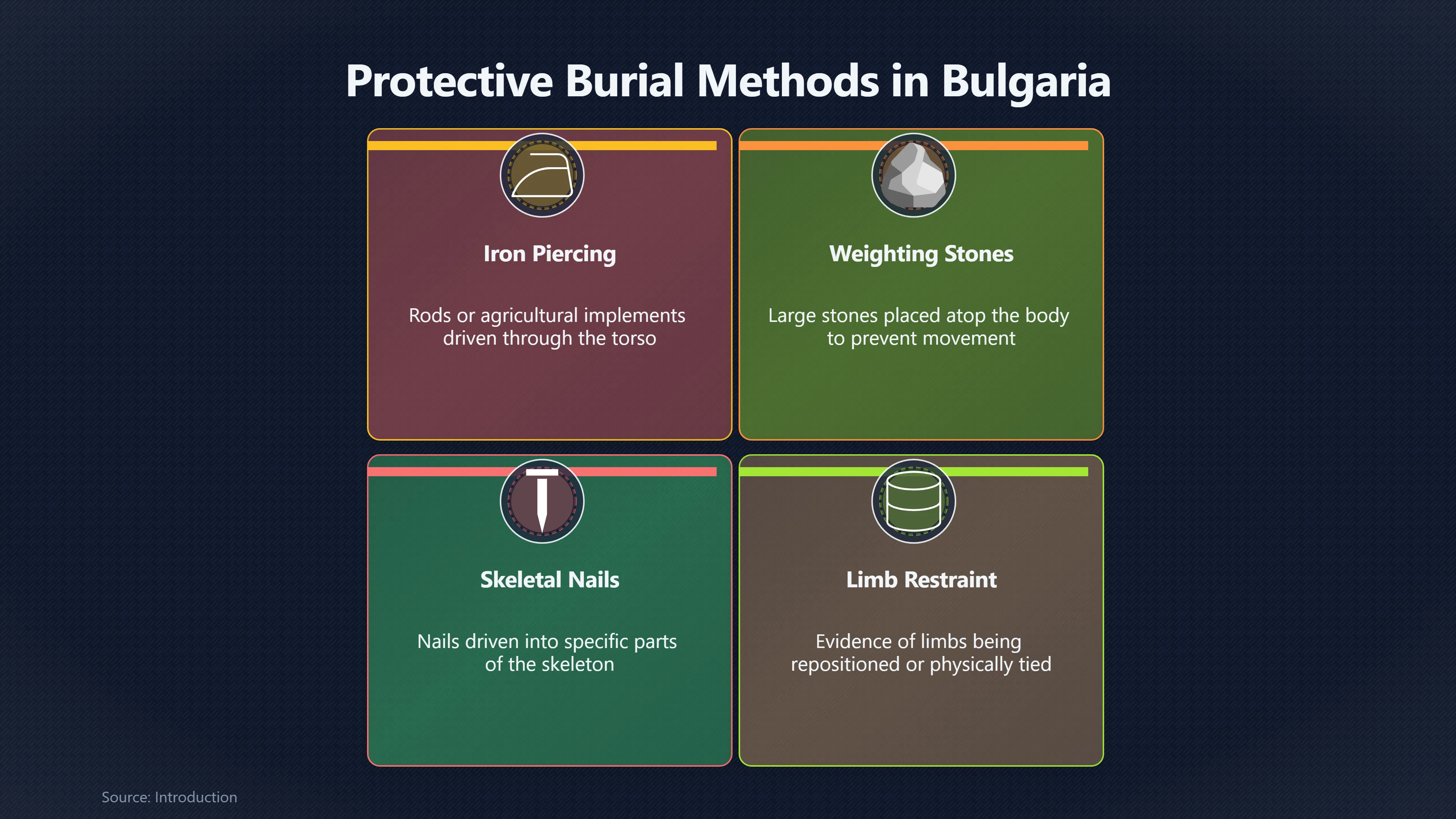
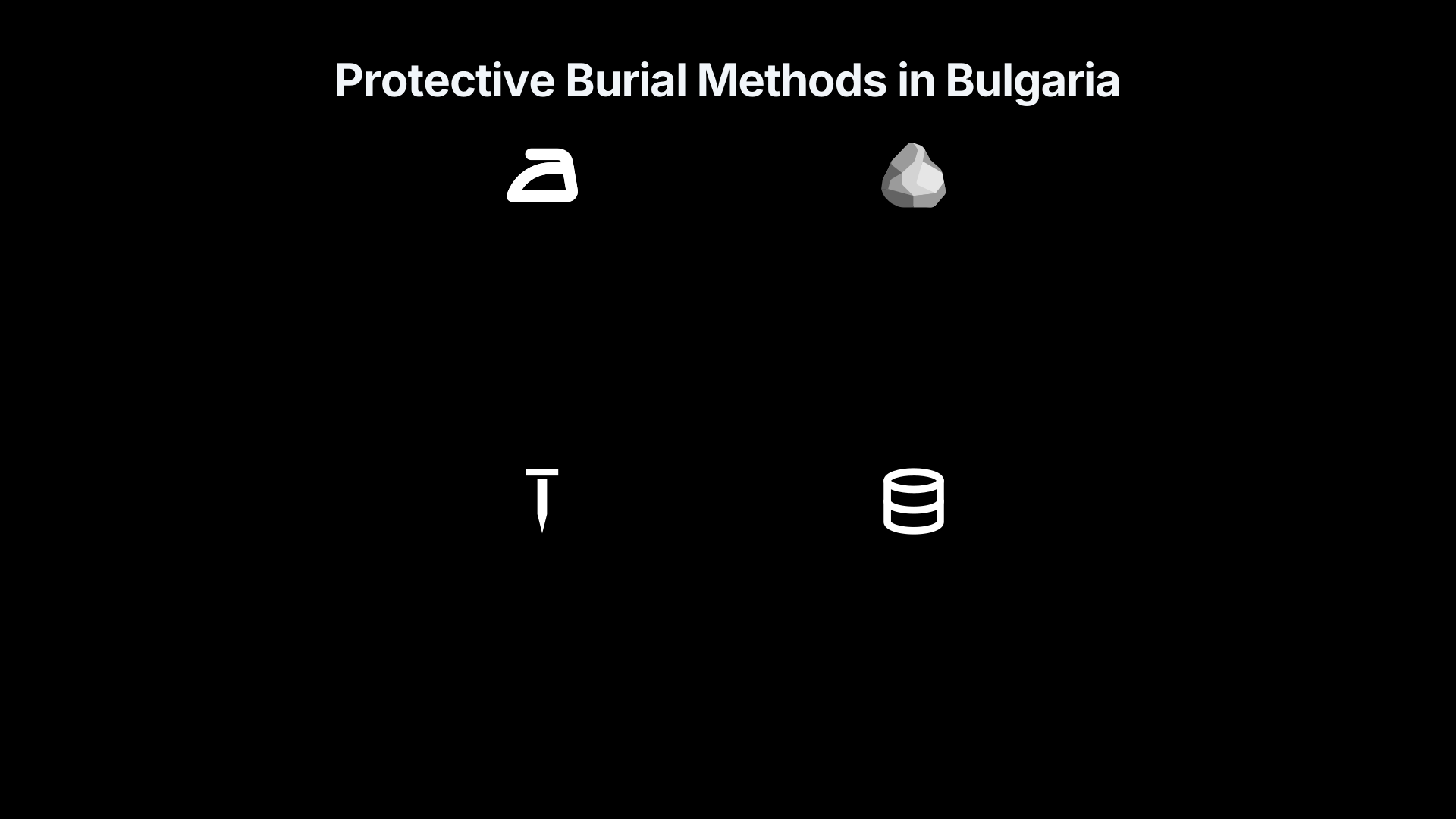
The most widely reported burials involve iron objects driven through the torso after death. In the 2012 Sozopol discovery, archaeologists uncovered two skeletons with iron rods or agricultural iron implements piercing the chest. Similar practices have since been documented at Perperikon, where excavations uncovered burials in which iron objects had likewise been placed through the body. Archaeologists interpret these as protective rites rather than evidence that the deceased was thought to have been a vampire during life.[the-independent.com]the-independent.comJune 6, 2012…
Other Bulgarian sites have produced different forms of protective treatment. Some graves contain nails driven into parts of the skeleton, stones weighing down the body, or evidence that limbs were restrained or repositioned. These variations suggest there was no single “anti-vampire” ritual. Instead, communities adapted local customs intended to immobilise the dead if they were believed capable of returning.[Old News]old-news.bnr.bgOld News Vampires in the Bulgarian lands, a scoop in foreign mediaOld NewsVampires in the Bulgarian lands, a scoop in foreign media - History and religionDecember 3, 2013…
Importantly, these actions were carried out after death. The archaeological evidence indicates burial customs, not judicial executions or organised persecution.
What archaeology can and cannot establish
The graves provide unusually direct evidence that fear of dangerous returning dead was more than a literary tradition. Unlike folklore collected centuries later, the burials are physical remains created by the people who held these beliefs.
However, archaeology also has clear limits.
It can establish:
- that unusual burial treatments occurred;
- that iron rods, ploughshares, stones or nails were intentionally placed with certain bodies;
- roughly when these burials took place;
- sometimes the age, sex and health of the deceased.
It cannot establish:
- whether the deceased was actually regarded as a vampire before death;
- precisely which event triggered the protective burial;
- whether neighbours blamed the individual for disease, misfortune or unexplained deaths;
- whether every unusual burial reflected vampire beliefs rather than another local custom.
Many of the individuals were probably ordinary people who became objects of suspicion only after death. Medieval communities often interpreted unexpected illness, epidemics or unexplained disasters through supernatural explanations. Archaeology preserves the response but rarely the conversation that produced it.
The Sozopol discoveries in context
The Sozopol burials became internationally famous because they offered dramatic visual evidence of beliefs that had previously been known mainly through folklore and written accounts.
One skeleton appears to have been pierced with an iron implement resembling a ploughshare. Some reports also describe damage to the leg that may have formed part of additional measures intended to prevent movement after death, although archaeologists remain cautious because post-burial disturbance can complicate interpretation.[The Independent]the-independent.comJune 6, 2012…
Archaeologists have repeatedly emphasised that these individuals were not “vampires” in any scientific sense. Rather, they were people buried according to customs intended to stop them from becoming dangerous revenants—a broader category of returning dead found across much of medieval and early modern Europe.[Archaeology in Bulgaria]archaeologyinbulgaria.comArchaeology in BulgariaBulgarian Minister Invokes ‘Vampires’ Found in 2004 near Deultum Archaeological Preserve to Promote Cultural Touri…
The Sozopol finds therefore illuminate popular belief rather than supernatural phenomena.
Perperikon shows the pattern was wider
Perperikon demonstrates that Sozopol was not an isolated curiosity. Excavations there uncovered comparable burials dating to the medieval period, including one discovered in 2013 and another announced in 2024.
The repeated appearance of similar protective practices at different Bulgarian sites suggests that fear of dangerous returning dead formed part of a wider cultural tradition rather than a single local legend. Archaeologists working at Perperikon have explicitly linked the newer discoveries with the earlier Sozopol finds because both display comparable methods of restraining the deceased.[bnrnews.bg]bnrnews.bgBNR NewsArchaeologists discover a second ''vampire'' grave in the necropolis of Perperikon - Radio Bulgaria in English…
Even so, relatively few graves among hundreds excavated display these features. That rarity indicates exceptional treatment reserved for particular individuals rather than routine burial practice.
How headlines transformed graves into legend
International media rapidly adopted phrases such as “vampire skeletons” and “vampire graves”. These headlines attracted enormous attention because they connected genuine archaeological discoveries with modern popular culture shaped by Gothic fiction, horror films and Dracula.
The archaeological evidence is less dramatic but ultimately more revealing.
The graves do not show:
- proof that medieval Bulgarians believed every corpse could become a vampire;
- evidence of actual supernatural events;
- confirmation of later fictional vampire traditions.
Instead, they demonstrate that some communities feared certain deceased individuals might return physically or spiritually to harm the living. Similar protective burials have been documented elsewhere in southeastern and eastern Europe, showing that Bulgaria formed part of a broader regional tradition rather than an isolated centre of vampire belief.[The Guardian]theguardian.comThe Guardian Vampire beliefs still have bite | Richard Sugg | The GuardianThe Guardian Vampire beliefs still have bite | Richard Sugg | The Guardian
The modern label “vampire grave” therefore compresses a wide variety of historical beliefs into a familiar word that readers immediately recognise, even though the underlying folklore was often more complex than modern vampire stories suggest.
Why these burials remain culturally important
The Bulgarian discoveries matter because they bridge archaeology, folklore and the history of collective belief.
They reveal that fear of dangerous returning dead influenced real behaviour. Families and communities invested time and effort in modifying burials because they believed these actions could protect the living. Such practices reflect genuine social anxieties about unexplained death, disease and misfortune rather than irrational fantasy detached from everyday life.
For historians, the graves also serve as a reminder that material evidence and folklore must be interpreted together. Archaeology can show what people did; folklore and historical sources help explain why they believed those actions were necessary. Neither type of evidence is sufficient on its own.
The enduring fascination with Bulgaria’s “vampire graves” therefore lies not in proving the existence of vampires, but in revealing how fear, tradition and community belief became permanently recorded in the archaeological record.
Amazon book picks
Further Reading
Books and field guides related to What Do Bulgaria's Vampire Graves Really Prove?. Use these as the next step if you want deeper reading beyond the article.
Extraordinary Popular Delusions and the Madness of Crowds
Rating: 4.0/5 from 5 Google Books ratings
Helps frame enduring supernatural beliefs.

Bram Stoker's Dracula omnibus
First published 1897. Subjects: Fiction, horror, Children: Grades 3-4, Dracula, count (fictitious character), fiction, Frankenstein (fict...
The Essential Dracula
An essay on the history of the vampire myth in literature accompanies an annotated version of the classic vampire tale.
Endnotes
1.
Source: the-independent.com
Link:https://www.the-independent.com/news/science/archaeology/news/vampire-graves-are-unearthed-in-bulgaria-7817898.html
Source snippet
June 6, 2012...
Published: June 6, 2012
2.
Source: old-news.bnr.bg
Title: Old News Vampires in the Bulgarian lands, a scoop in foreign media
Link:https://old-news.bnr.bg/en/post/100223927/vampires-in-the-bulgarian-lands-a-scoop-in-foreign-media
Source snippet
Old NewsVampires in the Bulgarian lands, a scoop in foreign media - History and religionDecember 3, 2013...
Published: December 3, 2013
3.
Source: bnt.bg
Title: Bulgarian archaeologists uncover ‘vampire’ burial at Perperikon (see pics)
Link:https://bnt.bg/news/bulgarian-archaeologists-uncover-39vampire-39-burial-at-perperikon-see-pics-333194news.html
Source snippet
Българска национална телевизияOctober 22, 2024 — BULGARIAN ARCHAEOLOGISTS UNCOVER 'VAMPIRE' BURIAL AT PERPERIKON (SEE PICS) 16:52, 22.10...
Published: October 22, 2024
4.
Source: archive.archaeology.org
Title: Magazine The Vampire of Lesbos
Link:https://archive.archaeology.org/online/features/halloween/vampire.html
Source snippet
Archaeology MagazineThe Vampire of Lesbos - Archaeology Magazine Archive...
5.
Source: old-news.bnr.bg
Link:https://old-news.bnr.bg/en/post/102063069/archaeologists-discover-a-second-vampire-grave-in-the-necropolis-of-perperikon
6.
Source: new.bnr.bg
Link:https://new.bnr.bg/en/post/102063069/archaeologists-discover-a-second-vampire-grave-in-the-necropolis-of-perperikon?page_1_3=4
7.
Source: sofiaglobe.com
Link:https://sofiaglobe.com/2013/09/02/bulgarian-archaeologists-find-twin-of-sozopol-vampire-at-perperikon/
8.
Source: bnrnews.bg
Link:https://bnrnews.bg/en/post/116698/archaeologists-discover-a-second-vampire-grave-in-the-necropolis-of-perperikon
Source snippet
BNR NewsArchaeologists discover a second ''vampire'' grave in the necropolis of Perperikon - Radio Bulgaria in English...
9.
Source: archaeologyinbulgaria.com
Link:https://archaeologyinbulgaria.com/2016/06/26/bulgarian-minister-invokes-vampires-found-in-2004-near-deultum-archaeological-preserve-to-promote-cultural-tourism/
Source snippet
Archaeology in BulgariaBulgarian Minister Invokes ‘Vampires’ Found in 2004 near Deultum Archaeological Preserve to Promote Cultural Touri...
10.
Source: theguardian.com
Title: The Guardian Vampire beliefs still have bite | Richard Sugg | The Guardian
Link:https://www.theguardian.com/commentisfree/2012/jun/08/vampire-beliefs-skeletons-bulgaria
Additional References
11.
Source: youtube.com
Title: Alleged vampire skeleton unearthed in Bulgaria
Link:https://www.youtube.com/watch?v=HEfjgIPgHTQ
Source snippet
The Origin of Dracula's Powers | Which Vampire Myths Were Actually Real?...
12.
Source: youtube.com
Title: Medieval Vampire Burials: England vs Eastern Europe
Link:https://www.youtube.com/watch?v=Om2BH5hA_rE
Source snippet
Alleged vampire skeleton unearthed in Bulgaria...
13.
Source: sofiaglobe.com
Link:https://sofiaglobe.com/2014/08/26/archaeology-bulgarias-latest-vampire-skeleton-found-in-plovdiv/
14.
Source: atmostfear-entertainment.com
Link:https://www.atmostfear-entertainment.com/culture/folklore/archaeological-evidence-european-vampire-burials/
15.
Source: youtube.com
Title: The Gruesome Truth About Vampire Burials
Link:https://www.youtube.com/watch?v=PI5t1iLUdgI
Source snippet
Medieval Vampire Burials: England vs Eastern Europe...
16.
Source: novinite.com
Title: Bulgarian Archaeologists Identify ‘Vampire’ as Pirate, Evil Mayor of Sozopol
Link:https://www.novinite.com/articles/140315/Bulgarian%2BArchaeologists%2BIdentify%2B%27Vampire%27%2Bas%2BPirate%2C%2BEvil%2BMayor%2Bof%2BSozopol
17.
Source: bntnews.bg
Title: Bulgarian archaeologists uncover ‘vampire’ burial at Perperikon (see pics)
Link:https://bntnews.bg/news/bulgarian-archaeologists-uncover-39vampire-39-burial-at-perperikon-see-pics-1302978news.html
18.
Source: youtube.com
Title: Vampire Origins – Mythical Beasts
Link:https://www.youtube.com/watch?v=MbZv8Kw2MOE
Source snippet
The Gruesome Truth About Vampire Burials...
19.
Source: sofiaglobe.com
Title: Archaeology: Bulgaria’s ‘Vampire of Vratsa’ – The Sofia Globe
Link:https://sofiaglobe.com/2014/07/27/archaeology-bulgarias-vampire-of-vratsa/
20.
Source: youtube.com
Title: The Origin of Dracula’s Powers | Which Vampire Myths Were Actually Real?
Link:https://www.youtube.com/watch?v=e-8qvA1Q8wk
Topic Tree