Within Eritrea
How Conscience Became Evidence of Disloyalty
Refusal of the independence referendum and military service made Jehovah's Witnesses symbols of suspected national disloyalty.
On this page
- Political neutrality and the 1993 independence referendum
- The 1994 removal of civil rights
- Indefinite detention and the continuing loyalty scare
Page outline Jump by section
Introduction
Jehovah’s Witnesses occupy a distinctive place in Eritrea’s modern history because they became identified by the state not simply as a religious minority but as people whose religious conscience was interpreted as evidence of political disloyalty. Their refusal to vote in the 1993 independence referendum and their longstanding opposition to military service on religious grounds were treated by the government as a rejection of the new nation rather than as expressions of religious neutrality. This interpretation shaped official policy for decades, leading to the withdrawal of citizenship rights, denial of civil documents, imprisonment without trial and continuing suspicion that loyalty to religious belief outweighed loyalty to the state. International human rights organisations generally describe this as a case of persecution for freedom of religion and conscience rather than a legitimate response to a security threat.[ohchr.org]ohchr.orgA HRC 29 CRP 1A/HRC/29/CRP.1August 31, 2024…
Political neutrality and the 1993 independence referendum
Jehovah’s Witnesses have a global religious teaching of political neutrality. Members generally do not vote in elections, join political parties or participate in military activities, believing that Christians should remain politically neutral while respecting secular authorities.
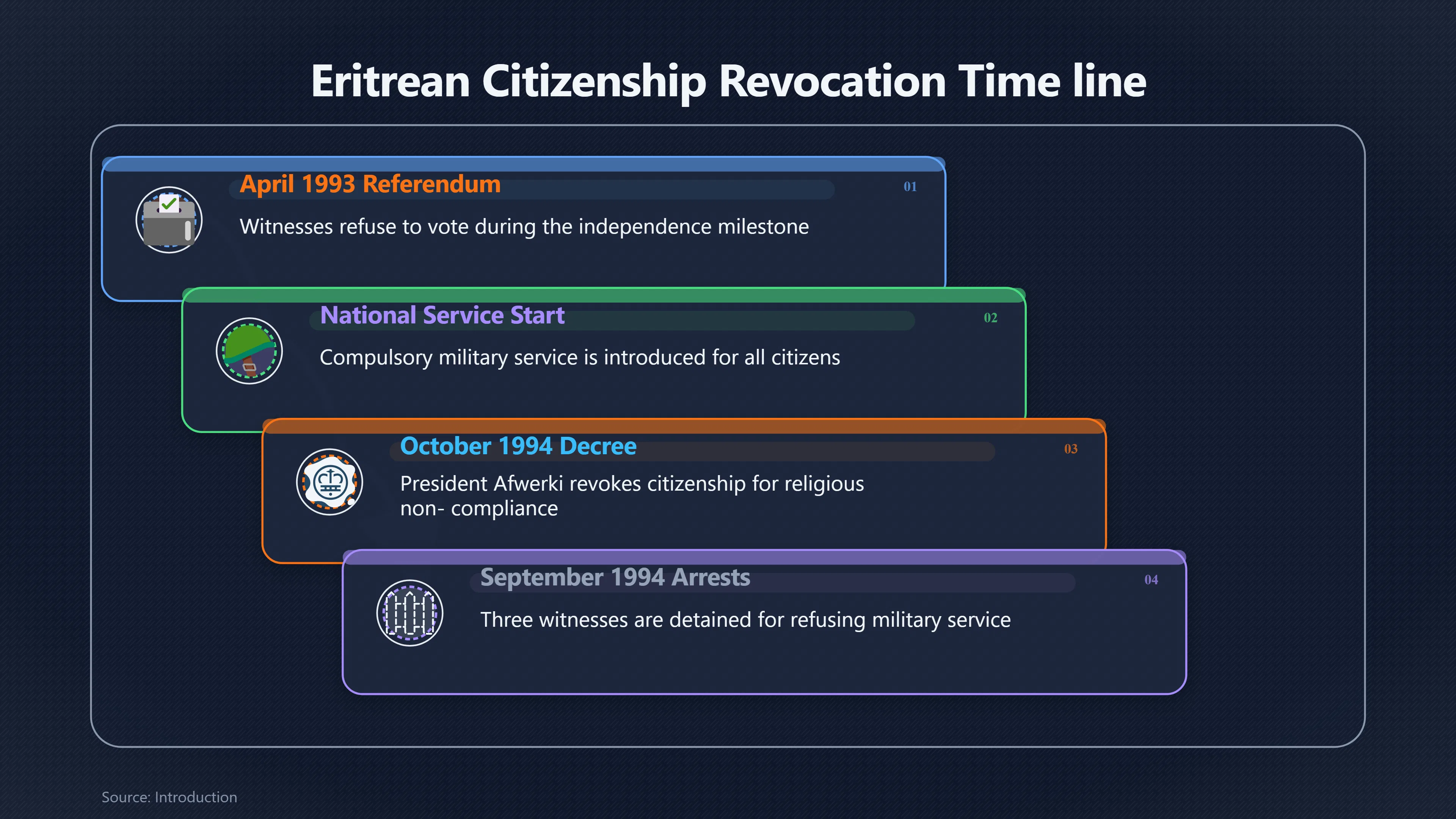
In Eritrea, however, this principle collided with an extraordinary historical moment. The internationally monitored referendum of April 1993 followed a thirty-year war for independence from Ethiopia and was widely celebrated as the birth of the new state. Participation carried immense symbolic importance. Refusing to vote was therefore interpreted by many officials not as a theological decision but as a rejection of the national struggle itself.[OHCHR]ohchr.orgA HRC 29 CRP 1A/HRC/29/CRP.1August 31, 2024…
This distinction is crucial. Jehovah’s Witnesses did not campaign against Eritrean independence or advocate Ethiopian rule. Rather, they applied the same doctrine of political neutrality that they follow in other countries. Nevertheless, in a society emerging from prolonged conflict, neutrality itself became politically charged. A decision intended by believers as religious conscience was widely understood by the authorities as evidence that they lacked commitment to the nation.[OHCHR]ohchr.orgA HRC 29 CRP 1A/HRC/29/CRP.1August 31, 2024…
The dispute therefore illustrates a broader problem found in some highly mobilised states: when national identity is closely tied to military sacrifice and participation in founding political events, refusal to participate may be interpreted as active opposition even when those involved insist they are remaining neutral.
The 1994 removal of civil rights
The conflict deepened after independence as Eritrea introduced compulsory national service. Jehovah’s Witnesses refused military service because of their religious beliefs, although they have historically accepted alternative civilian service where governments permit it.
On 25 October 1994, President Isaias Afwerki issued a presidential decree declaring that Jehovah’s Witnesses had effectively revoked their own citizenship by refusing both the independence referendum and national service. The decree became one of the most significant legal turning points affecting any religious minority in Eritrea.[ohchr.org]ohchr.orgA HRC 29 CRP 1A/HRC/29/CRP.1August 31, 2024…
The practical consequences extended far beyond voting rights. Numerous reports describe Witnesses being denied:
- national identity cards;
- passports and travel documents;
- government employment;
- business licences;
- recognition of marriages and property transactions;
- access to many normal civil services dependent upon official identification.
Because identity documents underpin everyday life in Eritrea, losing them affected employment, education, housing and family life as much as formal citizenship status. Human rights organisations have repeatedly criticised these measures as collective punishment imposed because of religious belief rather than individual criminal conduct.[refworld.org]refworld.orgUSCIRF Annual Report 2007 - Eritrea | Refworld…
Why national service became the central test of loyalty
Military service occupies an unusually important place in Eritrea’s political system. National service was originally presented as a temporary measure for national defence but evolved into an open-ended system that has drawn sustained criticism from United Nations investigators and human rights organisations.
For Jehovah’s Witnesses, conscientious objection created a direct conflict between state expectations and religious doctrine. Eritrea does not recognise a right to conscientious objection or provide a civilian alternative that avoids military training. As a result, refusal to serve has frequently led to arrest and prolonged detention.[OHCHR]ohchr.orgA HRC 29 CRP 1A/HRC/29/CRP.1August 31, 2024…
The disagreement therefore became larger than a debate about military duty. Officials increasingly portrayed refusal to serve as proof that Witnesses rejected their responsibilities as citizens. Human rights observers argue instead that conscientious objection is a recognised component of freedom of thought, conscience and religion under international human rights law. The disagreement reflects two fundamentally different understandings of citizenship: one centred on compulsory national participation and another allowing limited exemptions based on deeply held religious convictions.[OHCHR]ohchr.orgA HRC 29 CRP 1A/HRC/29/CRP.1August 31, 2024…
Indefinite detention and the continuing loyalty scare
The political suspicion surrounding Jehovah’s Witnesses did not end with the 1994 decree. Instead, it became institutionalised through repeated arrests, indefinite detention and the absence of normal legal safeguards.
Three Jehovah’s Witnesses—Paulos Eyassu, Isaac Mogos and Negede Teklemariam—were arrested in September 1994 after refusing military service. Their imprisonment became internationally known because they remained detained for decades without formal charges or trial, making them among the world’s longest-serving prisoners of conscience held solely in connection with religious beliefs and conscientious objection.[ohchr.org]ohchr.orgA HRC 29 CRP 1A/HRC/29/CRP.1August 31, 2024…
International reporting has documented repeated waves of arrests involving men, women and elderly believers attending private religious meetings or Bible studies. Although the exact number of detainees has varied over time because of releases and new arrests, organisations including Human Rights Watch and successive United Nations reports continue to document ongoing detention of Jehovah’s Witnesses years after the original dispute over the referendum.[Human Rights Watch]hrw.orgHuman Rights WatchWorld Report 2026: Eritrea | Human Rights Watch…
The continuing pattern shows that the original accusation of political disloyalty has not remained confined to the founding years of the state. Instead, it has become a lasting assumption influencing how the authorities treat the community.
Why this is better understood as persecution than a moral panic
This episode differs from classic moral panics or mass hysteria. There was no widespread public belief that Jehovah’s Witnesses posed a supernatural danger, were involved in hidden conspiracies or threatened society through rumours and collective fear.
Instead, historians and human rights researchers describe the episode as a form of state-driven suspicion in which religious neutrality was reinterpreted as political hostility. The government’s concern centred on national cohesion, military mobilisation and unquestioned civic participation rather than sensational public accusations.[OHCHR]ohchr.orgA HRC 29 CRP 1A/HRC/29/CRP.1August 31, 2024…
The result nevertheless shares an important feature with other episodes in which minority groups become symbols of supposed disloyalty. A relatively small community came to represent broader anxieties about national unity, sovereignty and security. Once that association became embedded in official policy, ordinary acts of religious observance could be viewed through a security lens rather than a religious one.
Why the case remains important
The experience of Jehovah’s Witnesses in Eritrea illustrates how religious conscience can become politically redefined during periods of nation-building and prolonged militarisation. Their refusal to vote and perform military service was understood by the community as obedience to religious doctrine, while the state interpreted the same actions as rejection of citizenship itself.
The case remains significant because it demonstrates how political neutrality can be transformed into evidence of disloyalty when governments equate national identity with compulsory participation in political and military institutions. For scholars of religion, authoritarianism and collective suspicion, Eritrea provides an unusually clear example of how a state’s perception of loyalty can shape the everyday lives of a small religious minority for decades after the original political dispute.





Endnotes
1.
Source: ohchr.org
Title: A HRC 29 CRP 1
Link:https://www.ohchr.org/Documents/HRBodies/HRCouncil/CoIEritrea/A_HRC_29_CRP-1.pdf
Source snippet
A/HRC/29/CRP.1August 31, 2024...
Published: August 31, 2024
2.
Source: refworld.org
Link:https://www.refworld.org/reference/annualreport/uscirf/2007/en/59323
Source snippet
USCIRF Annual Report 2007 - Eritrea | Refworld...
3.
Source: jw.org
Title: Historic Milestones Affecting Jehovah’s Witnesses in Eritrea
Link:https://www.jw.org/en/news/region/eritrea/historic-milestones-eritrea/
4.
Source: refworld.org
Link:https://www.refworld.org/docid/4dbe90c36e.html
Source snippet
USCIRF Annual Report 2011 - Countries of Particular Concern: Eritrea | RefworldApril 28, 2011 — USCIRF ANNUAL REPORT 2011 - COUNTRIES OF...
Published: April 28, 2011
5.
Source: 2009-2017.state.gov
Link:https://2009-2017.state.gov/j/drl/rls/hrrpt/2003/27726.htm
6.
Source: jw.org
Link:https://www.jw.org/en/news/region/eritrea/jehovahs-witnesses-in-prison/
7.
Source: jw.org
Link:https://www.jw.org/en/news/region/eritrea/jehovah-witness-facts/
8.
Source: jw.org
Link:https://www.jw.org/no/nyheter/region/eritrea/jehovas-vitner-i-fengsel/
9.
Source: hrw.org
Link:https://www.hrw.org/world-report/2024/country-chapters/eritrea
Source snippet
Human Rights WatchWorld Report 2024: Eritrea | Human Rights Watch...
10.
Source: digitallibrary.un.org
Title: ited Nations Digital Library System United Nations
Link:https://digitallibrary.un.org/record/4040412/files/A_HRC_WG.6_46_ERI_3-EN.pdf
Source snippet
ited Nations Digital Library SystemUnited Nations...
11.
Source: hrw.org
Link:https://www.hrw.org/world-report/2026/country-chapters/eritrea
Source snippet
Human Rights WatchWorld Report 2026: Eritrea | Human Rights Watch...
Additional References
12.
Source: legalclarity.org
Title: Eritrea Jehovah’s Witnesses: Detained and Stripped of Rights
Link:https://legalclarity.org/eritrea-jehovahs-witnesses-persecution-and-legal-rights/
Source snippet
April 5, 2026 — ERITREA JEHOVAH’S WITNESSES: DETAINED AND STRIPPED OF RIGHTS Since 1994, Jehovah's Witnesses in Eritrea have...
Published: April 5, 2026
13.
Source: youtube.com
Link:https://www.youtube.com/watch?v=E-AOLseXwpY
Source snippet
Eritrea: Grave human rights violations remain the norm, says UN | #HRC58...
14.
Source: csw.org.uk
Title: General Briefing: Eritrea
Link:https://www.csw.org.uk/2025/05/29/report/6522/article.htm
Source snippet
May 29, 2025 — eritrea GENERAL BRIEFING: ERITREA 29 May 2025 LEGAL FRAMEWORK The ruling People’s Front for Democracy and Justice (PFDJ...
Published: May 29, 2025
15.
Source: youtube.com
Link:https://www.youtube.com/watch?v=qjRrczupJzA
Source snippet
The Extermination of Faith in Eritrea - WGW 200...
16.
Source: youtube.com
Title: The Extermination of Faith in Eritrea
Link:https://www.youtube.com/watch?v=62cnvtmbNNM
Source snippet
Yohannes Ghebrehiwet speaks at the Human Rights Council on religious persecution in Eritrea | #HRC58...
17.
Source: youtube.com
Title: Inside the World of Jehovah’s Witnesses
Link:https://www.youtube.com/watch?v=hchu5fz_ogE
Source snippet
The African Association of Jehovah's Witnesses concerned about human rights violations...
18.
Source: ecoi.net
Link:https://www.ecoi.net/en/document/1033155.html
Source snippet
USDOS – US Department of State (Author): “2015 Report on International Religious Freedom - Eritrea”, Document #1033155 - ecoi.netAugust 1...
19.
Source: youtube.com
Title: Eritrea: Grave human rights violations remain the norm, says UN | #HRC58
Link:https://www.youtube.com/watch?v=2Y9AtI2qH98
Topic Tree