Within Pakistan Panics
How Rumours Gain Authority Before Facts Arrive
Loudspeakers, WhatsApp messages and staged videos can make uncertain claims feel publicly verified before trusted institutions respond.
On this page
- Trusted channels and emotional proof
- Institutional distrust and delayed correction
- When panic becomes persecution or violence
Page outline Jump by section
Introduction
In Pakistan, rumours become emergencies not simply because false information spreads quickly, but because uncertain claims can acquire the appearance of public truth before reliable institutions have time to investigate. A message forwarded through WhatsApp, an announcement from a mosque loudspeaker, a short video circulating on social media, or an accusation repeated by respected local figures may convince people that an immediate threat exists. When trust in police, courts, health authorities or the media is weak, these informal networks often appear more credible than official denials. The result is that fear can rapidly become collective action, sometimes leading to violence, displacement or public-health crises before the underlying claim has been verified.[arxiv.org]arxiv.orgarXiv Investigating Misinformation Dissemination on Social Media in PakistanInvestigating Misinformation Dissemination on Social Media in PakistanJune 17, 2021…
This pattern does not mean that Pakistan experiences a unique form of “mass hysteria”. Rather, recent episodes show how emotional evidence, social trust and communication technology reinforce one another. Rumours gain authority because they appear to come from multiple trusted sources at once, even when those sources ultimately rely on the same unverified story.
How rumours gain authority before facts arrive
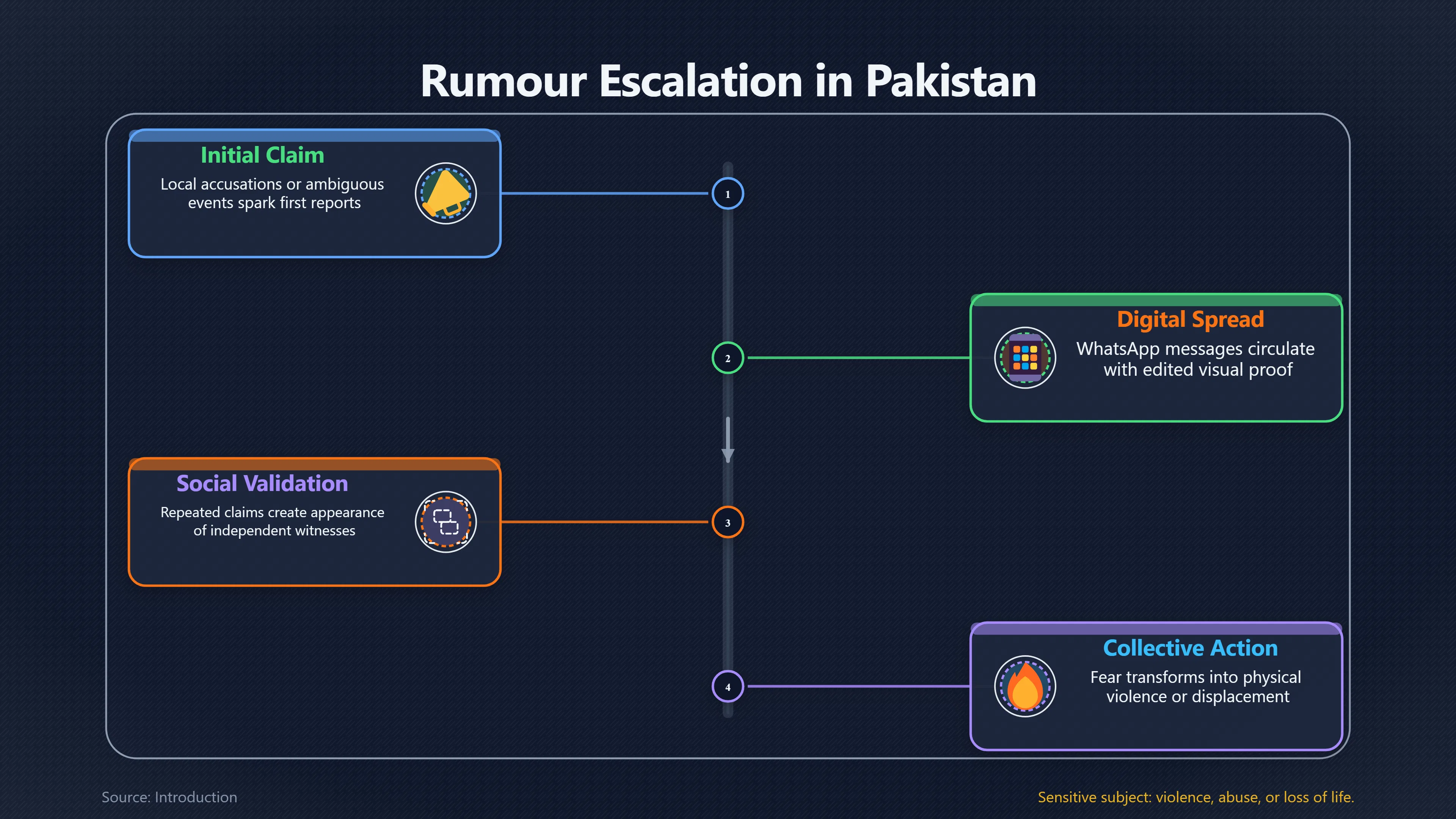
The crucial transformation is not from truth to falsehood but from uncertainty to apparent certainty. A rumour often begins with a local accusation or ambiguous event. It then passes through several stages that make it seem increasingly reliable.
Instead of waiting for confirmation, people frequently encounter the same claim through different channels within minutes:
- a neighbour reports hearing about an incident;
- a WhatsApp message includes photographs or edited video presented as “proof”;
- mosque loudspeakers urge people to respond;
- local social-media pages repeat the allegation;
- bystanders begin sharing eyewitness accounts that are themselves based on earlier rumours.
Each repetition creates the impression that many independent witnesses exist, even when all versions originate from the same unverified source. Researchers studying misinformation in Pakistan have found that emotionally charged content often gains credibility by impersonating trusted institutions, invoking religion or patriotism, or presenting fabricated visual evidence alongside dramatic claims.[arXiv]arxiv.orgarXiv Investigating Misinformation Dissemination on Social Media in PakistanInvestigating Misinformation Dissemination on Social Media in PakistanJune 17, 2021…
Because WhatsApp conversations are largely private, rumours also escape immediate public scrutiny. Unlike open social-media platforms, misleading messages are often forwarded within families, neighbourhoods and religious communities where recipients already trust the sender.
Emotional proof often outweighs factual proof
Rumours that trigger fear, outrage or moral responsibility spread especially quickly because they ask recipients to protect children, defend religion or respond to an immediate danger rather than evaluate evidence.
Visual material is especially influential. Videos recorded elsewhere, edited footage or staged scenes may be accepted because they appear emotionally convincing. Once frightened or angry crowds gather physically, the crowd itself becomes further “proof” that something serious must have happened.
Psychologists describe this as social validation: people judge uncertain situations partly by observing how others react. Large public responses therefore reinforce the original rumour regardless of its factual basis.
Why official corrections often arrive too late
Official institutions usually work more slowly than informal communication networks. Police investigate, journalists seek corroboration and courts require evidence. Rumour networks, by contrast, reward speed rather than accuracy.
Several factors widen this gap:
- investigations require time while rumours spread instantly;
- local distrust of government encourages reliance on informal sources;
- contradictory official statements can deepen suspicion;
- corrections rarely travel as widely as the original accusation;
- people who have publicly shared a rumour may resist admitting it was false.
Researchers analysing misinformation in Pakistan’s online environment note that false stories frequently combine genuine details with fabricated claims, making them harder to dismiss completely. Corrections therefore struggle against narratives that already fit existing political, religious or social anxieties.[arXiv]arxiv.orgarXiv Investigating Misinformation Dissemination on Social Media in PakistanInvestigating Misinformation Dissemination on Social Media in PakistanJune 17, 2021…

When rumours become persecution
The most dangerous rumour networks are those surrounding allegations of blasphemy. These cases demonstrate how communication systems, local authority and institutional delay can combine to produce violence before any legal investigation has established what occurred.
The attacks on the Christian community in Jaranwala in August 2023 illustrate this mechanism. Rumours alleging blasphemy spread early in the day. Calls broadcast from mosque loudspeakers encouraged mobilisation, while inflammatory material circulated through social media. Thousands of people gathered, leading to attacks on churches and homes across multiple neighbourhoods. Human Rights Commission of Pakistan investigators later concluded that the violence could not simply be treated as a spontaneous emotional reaction and found evidence suggesting organised incitement alongside the rumour itself.[HRCP]hrcp-web.orgHRCPAugust 25, 2023…
Subsequent investigations also highlighted how digital misinformation amplified local tensions. Real-time monitoring documented videos urging crowds to assemble and widely shared WhatsApp messages encouraging collective action before verified information became available.[HRCP]hrcp-web.orgHRCPUnder SiegeHRCPUnder Siege
These episodes are better understood as moral panics reinforced by organised mobilisation than as purely psychological contagion. Rumours created the initial emotional trigger, but political interests, religious leadership, crowd dynamics and failures of policing all contributed to the outcome.
Rumours and public-health emergencies
The same communication mechanisms appear in health crises, although the consequences differ.
One of the clearest examples occurred during Pakistan’s anti-polio vaccination campaign in 2019. Rumours spread that children had become seriously ill after receiving vaccine drops. Videos circulated online claiming children had been poisoned, while warnings broadcast from local mosques encouraged parents to avoid vaccination.
As panic spread, thousands of anxious parents rushed children to hospitals in Peshawar. Emergency departments became overwhelmed despite subsequent investigations finding no evidence that the vaccine itself had caused the reported illnesses. Public-health officials concluded that many symptoms had been driven by fear, misunderstanding and misinformation rather than toxic contamination. The incident also disrupted vaccination campaigns, increasing the difficulty of controlling polio transmission.[ecoi.net]ecoi.netRFE/RL – Radio Free Europe/Radio Liberty (Author): “Mass Panic, Propaganda, And Mobs: How An Anti-Polio Drive Came To A Screeching Halt I…
This episode shows that rumours need not produce violence to become emergencies. They can overload hospitals, undermine disease-control programmes and reduce long-term trust in healthcare.
Why trusted messengers matter more than technology
Although social media accelerates rumours, technology alone does not explain why people believe them.
In Pakistan, information often gains authority because it comes through institutions that carry local legitimacy:
- respected religious figures;
- extended family networks;
- neighbourhood associations;
- influential local politicians;
- teachers or community elders;
- healthcare workers or officials speaking informally.
When several trusted figures appear to endorse the same claim, recipients frequently assume independent confirmation even if everyone ultimately relies on the same original rumour.
Research into WhatsApp misinformation consistently finds that emotional appeals, religious language, impersonation of authority and repeated forwarding all increase perceived credibility. Technology amplifies existing social trust rather than replacing it.[arXiv]arxiv.orgarXiv Investigating Misinformation Dissemination on Social Media in PakistanInvestigating Misinformation Dissemination on Social Media in PakistanJune 17, 2021…
Can corrections stop the cycle?
Experience suggests that corrections work best before crowds form rather than afterwards.
Effective responses generally include rapid official communication, visible police action to protect threatened communities, trusted local leaders publicly rejecting false claims and journalists verifying events before repeating allegations. Delayed responses allow rumours to become embedded in community memory, making later corrections appear politically motivated rather than factual.
Human-rights organisations examining attacks linked to blasphemy allegations have repeatedly argued that accountability for those who deliberately incite violence—whether through loudspeaker announcements, organised online campaigns or inflammatory public messaging—is essential if future rumours are to be prevented from escalating into collective emergencies.[HRCP]hrcp-web.orgHRCPUnder SiegeHRCPUnder Siege
Understanding the mechanism
Pakistan’s recent rumour panics reveal a recurring sequence rather than isolated incidents. An uncertain claim acquires authority through trusted social networks; repeated messages create the appearance of independent confirmation; institutional responses lag behind rapid informal communication; and emotional certainty replaces factual uncertainty. Whether the subject is religion, child safety or public health, the underlying mechanism remains remarkably similar.
Recognising this pattern helps distinguish between genuine mass psychogenic illness, moral panic, organised incitement and ordinary misinformation. The emergency does not begin when a rumour is invented. It begins when enough people come to believe that immediate action is more important than waiting for evidence.
Amazon book picks
Further Reading
Books and field guides related to How Rumours Gain Authority Before Facts Arrive. Use these as the next step if you want deeper reading beyond the article.
Extraordinary Popular Delusions and the Madness of Crowds
Rating: 4.0/5 from 5 Google Books ratings
Historical treatment of rumour and crowd behaviour.

Endnotes
1.
Source: arxiv.org
Title: arXiv Investigating Misinformation Dissemination on Social Media in Pakistan
Link:https://arxiv.org/abs/2106.09338
Source snippet
Investigating Misinformation Dissemination on Social Media in PakistanJune 17, 2021...
Published: June 17, 2021
2.
Source: hrcp-web.org
Title: HRCPUnder Siege
Link:https://hrcp-web.org/hrcpweb/wp-content/uploads/2020/09/2025-Under-siege-EN.pdf
3.
Source: ecoi.net
Link:https://www.ecoi.net/en/document/2007513.html
Source snippet
RFE/RL – Radio Free Europe/Radio Liberty (Author): “Mass Panic, Propaganda, And Mobs: How An Anti-Polio Drive Came To A Screeching Halt I...
4.
Source: arxiv.org
Title: arXiv A First Look at COVID-19 Messages on Whats App in Pakistan
Link:https://arxiv.org/abs/2011.09145
5.
Source: hrcp-web.org
Link:https://hrcp-web.org/hrcpweb/wp-content/uploads/2020/09/2023-Mob-led-destruction-of-churches-in-Jaranwala.pdf
6.
Source: ecoi.net
Link:https://www.ecoi.net/en/document/2114073.html
7.
Source: hrcp-web.org
Link:https://hrcp-web.org/hrcpweb/hrcp-fact-finding-mission-to-jaranwala-finds-local-muslim-religious-leaders-complicit-in-attacks/
Source snippet
HRCPAugust 25, 2023...
Published: August 25, 2023
8.
Source: hrcp-web.org
Title: HRCPHRCP report condemns scale and frequency of mob attacks against minorities
Link:https://hrcp-web.org/hrcpweb/hrcp-report-condemns-scale-and-frequency-of-mob-attacks-against-minorities/
Additional References
9.
Source: hrw.org
Title: exploiting pakistans blasphemy laws blackmail and profit
Link:https://www.hrw.org/report/2025/06/09/conspiracy-grab-land/exploiting-pakistans-blasphemy-laws-blackmail-and-profit
Source snippet
“A Conspiracy to Grab the Land”: Exploiting Pakistan’s Blasphemy Laws for Blackmail and Profit | HRWJune 9, 2025 — USE OF BLASPHEMY ACCUS...
Published: June 9, 2025
10.
Source: youtube.com
Link:https://www.youtube.com/watch?v=fN0CqcenHOo
Source snippet
WATCH | Fake News Surge After India-Pakistan Tensions: Misinformation Floods Social Media...
11.
Source: youtube.com
Link:https://www.youtube.com/watch?v=PK6VuiPu2yQ
Source snippet
Pakistan Churches Under Attack Over Blasphemy Allegations | U.S. Calls for Investigation | News9...
12.
Source: youtube.com
Link:https://www.youtube.com/watch?v=qvs50eBO8qI
Source snippet
FACT CHECK: Is Writing 'Halwa' in Arabic Blasphemous? | VOA News...
13.
Source: youtube.com
Title: FACT CHECK: Is Writing ‘Halwa’ in Arabic Blasphemous? | VOA News
Link:https://www.youtube.com/watch?v=kLuQlQwsDgI
Source snippet
Pakistani man to remain in custody over misinformation that sparked UK rioting, lawyer says...
14.
Source: brecorder.com
Link:https://www.brecorder.com/news/40259883/jaranwala-tragedy-24-churches-several-dozen-smaller-chapels-scores-of-houses-torched-hrcp
15.
Source: cambridge.org
Link:https://www.cambridge.org/core/journals/american-political-science-review/article/misinformation-and-support-for-vigilantism-an-experiment-in-india-and-pakistan/2D7E928A185041D8B7DBAFE710CBE78B
16.
Source: GOV.UK
Link:https://www.gov.uk/government/publications/pakistan-country-policy-and-information-notes/country-policy-and-information-note-christians-and-christian-converts-pakistan-april-2024-accessible
Published: april 2024
17.
Source: ojs.pssr.org.pk
Link:https://ojs.pssr.org.pk/journal/article/view/760
18.
Source: youtube.com
Link:https://www.youtube.com/watch?v=jpLY4nKNx04
Topic Tree