Within Somalia
Why Was the Dervish Leader Called Mad?
The label 'Mad Mullah' turned a complex anti-colonial religious movement into a story of irrational fanaticism.
On this page
- Mohamed Abdullah Hassan and the Dervish resistance
- Religious mobilisation, poetry and promises of renewal
- How colonial propaganda shaped later memory
Page outline Jump by section
Introduction
The Dervish Movement is sometimes presented as the story of the “Mad Mullah”, a supposedly irrational religious fanatic who led followers into a hopeless war. That description reflects colonial propaganda far more than modern historical scholarship. Today, historians generally view the movement as a complex anti-colonial resistance that combined Islamic reform, Somali political organisation, military resistance, and an extraordinary tradition of oral poetry. The nickname “Mad Mullah” was coined and popularised by British officials and journalists during a prolonged conflict that lasted from 1899 to 1920. It helped portray a determined political opponent as mentally unstable rather than as the leader of a disciplined movement with clear religious and political goals.[Cambridge University Press & Assessment]cambridge.orgCambridge University Press & AssessmentThe ‘Mad Mullah’ and Northern Somalia | The Journal of African History | Cambridge CoreJanuary 22…
For anyone studying cults, collective belief or claims of mass irrationality in Somalia, this distinction matters. The Dervish Movement was built around shared religious conviction and expectations of moral renewal, but those beliefs should not be confused with evidence of mass hysteria or collective madness. Instead, the movement illustrates how colonial powers sometimes used psychiatric language to delegitimise anti-colonial resistance.
Why was the Dervish leader called “Mad”?
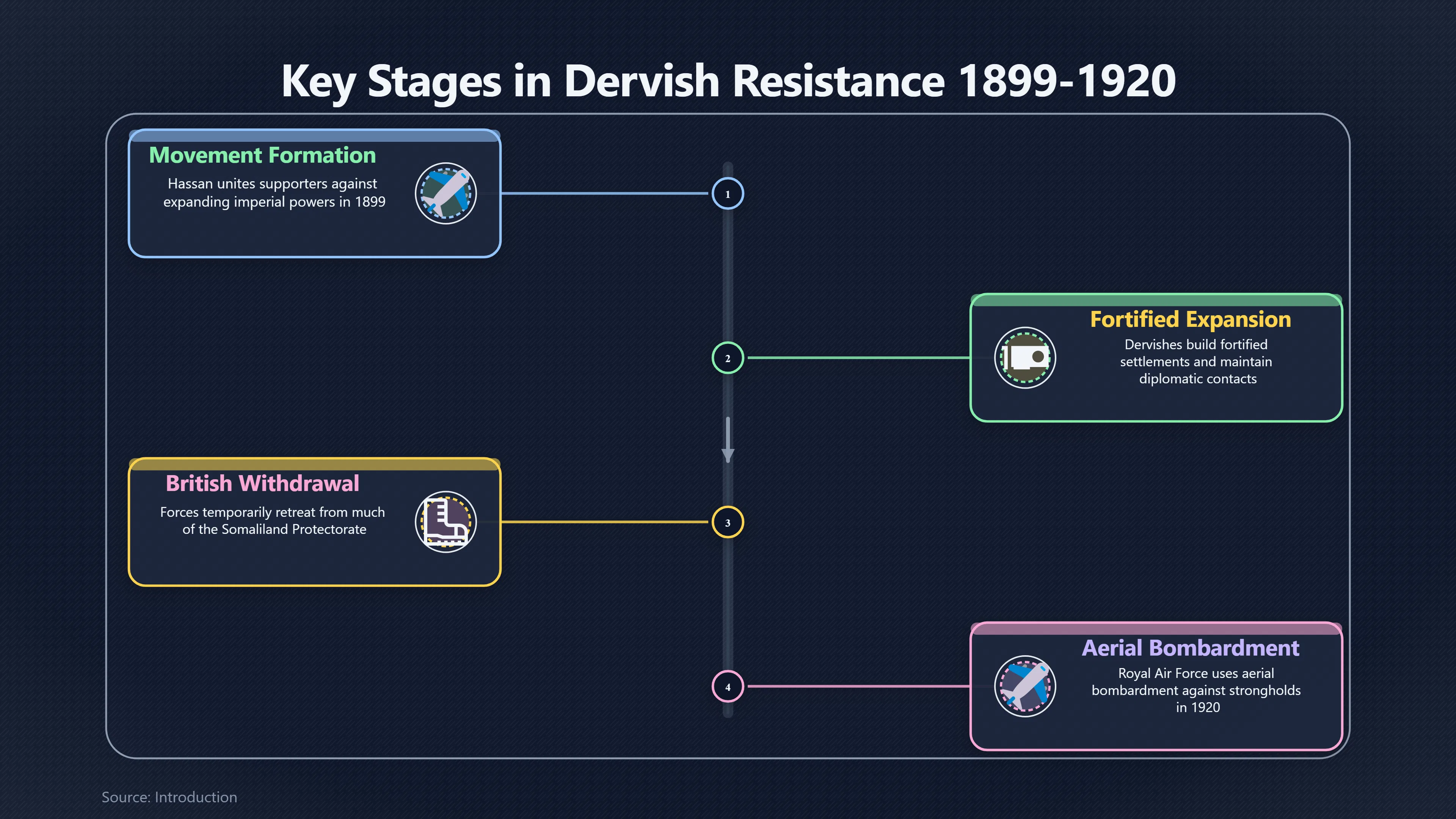
The leader of the movement, Mohamed Abdullah Hassan (often written Mohammed Abdullah Hassan), was a religious scholar, poet and leader associated with the Salihiyya Sufi order. Beginning in 1899, he united supporters across parts of the Somali territories in resistance to expanding British, Italian and Ethiopian power. The Dervishes developed military organisation, built fortified settlements, negotiated treaties and sustained armed resistance for over two decades.[Cambridge University Press & Assessment]cambridge.orgCambridge University Press & AssessmentThe ‘Mad Mullah’ and Northern Somalia | The Journal of African History | Cambridge CoreJanuary 22…
The British consistently referred to Hassan as the “Mad Mullah”. The phrase was politically useful for several reasons.
- It reduced a sophisticated political and religious movement to the actions of one supposedly irrational individual.
- It implied that resistance to colonial rule resulted from fanaticism rather than legitimate political grievances.
- It reassured audiences in Britain that military difficulties stemmed from an unpredictable extremist rather than widespread Somali opposition to imperial rule.
The label never reflected a medical diagnosis. It functioned as wartime propaganda, combining contemporary European stereotypes about Islam with colonial assumptions that resistance outside European political norms must be irrational. Modern historians generally treat the expression as a revealing example of colonial rhetoric rather than an accurate description of Hassan himself.[Cambridge University Press & Assessment]cambridge.orgCambridge University Press & AssessmentThe ‘Mad Mullah’ and Northern Somalia | The Journal of African History | Cambridge CoreJanuary 22…
Mohamed Abdullah Hassan and the Dervish resistance
Although the movement was rooted in Islamic reform, it was also a political project. Hassan criticised foreign influence, opposed missionary activity and sought to unite Somalis against imperial expansion. His followers established an organised administration, constructed forts such as those at Taleh and maintained diplomatic contacts alongside military campaigns.[Wikipedia]WikipediaDervish movement (SomaliDervish movement (Somali
The conflict became one of Britain’s longest and most expensive colonial campaigns in Africa. British forces repeatedly struggled to defeat the Dervishes, at one point temporarily withdrawing from much of the Somaliland Protectorate. The movement ultimately collapsed only after sustained military pressure, including the Royal Air Force’s use of aerial bombardment against Dervish strongholds in 1920.[Cambridge University Press & Assessment]cambridge.orgCambridge University Press & AssessmentThe ‘Mad Mullah’ and Northern Somalia | The Journal of African History | Cambridge CoreJanuary 22…
This history makes the colonial emphasis on Hassan’s supposed madness easier to understand. Describing a persistent military opponent as deranged was politically preferable to acknowledging the strength of organised anti-colonial resistance.
Religious mobilisation, poetry and promises of renewal
The Dervish Movement drew strength from shared religious commitment, but religion operated alongside political organisation rather than replacing it.
Hassan preached religious reform, emphasised moral discipline and presented resistance to foreign domination as a religious duty. Followers believed that faithful commitment would bring spiritual renewal as well as political liberation. Such expectations resemble many religious reform movements throughout history and do not, by themselves, indicate irrational or delusional thinking.[Africabib]africabib.orgAfricaBib | Divine madness: Mohammed Abdulle Hassan (1856-1920)…
One distinctive feature of the movement was its extensive use of poetry. Somali oral poetry served as political communication, historical record and moral instruction. Hassan himself composed poems praising supporters, criticising rivals and encouraging perseverance during military setbacks. These works circulated widely through oral performance, helping maintain solidarity across dispersed pastoral communities. Rather than evidence of emotional contagion, this was an organised communication system embedded within Somali culture.[digitalcommons.salve.edu]digitalcommons.salve.eduDervish Oral Poetry in Somalia: A Study in Semiotic Chora" by Erin MeehanJanuary 1, 2021…
The movement therefore relied upon several reinforcing elements:
- shared religious identity;
- charismatic but highly literate leadership;
- oral poetry as mass communication;
- military organisation;
- hopes for political and moral renewal.
These mechanisms explain its durability far better than claims of collective irrationality.

Was the movement an example of mass hysteria?
Modern scholarship does not classify the Dervish Movement as an episode of mass hysteria or mass psychogenic illness.
Several reasons support this distinction.
First, participants pursued coherent political objectives over more than twenty years. Their actions included diplomacy, taxation, fortification and military planning rather than uncontrolled or contagious behaviour.
Second, religious conviction was culturally intelligible within Somali society. Shared belief in divine support or moral renewal was not an isolated psychological phenomenon but part of broader Islamic traditions of reform and resistance.
Third, colonial observers often interpreted unfamiliar religious enthusiasm through racial and cultural stereotypes. Similar language describing opponents as fanatics, fanatical tribes or mad prophets appeared elsewhere in European colonial literature, making such descriptions better evidence of imperial attitudes than of the mental state of those being described.[Cambridge University Press & Assessment]cambridge.orgCambridge University Press & AssessmentThe ‘Mad Mullah’ and Northern Somalia | The Journal of African History | Cambridge CoreJanuary 22…
This does not mean every aspect of the movement was uncontroversial. Historians continue to debate its internal coercion, treatment of opponents and relations with different Somali communities. Those debates concern politics, warfare and leadership rather than psychiatric explanations.
How colonial propaganda shaped later memory
The phrase “Mad Mullah” proved remarkably durable. It appeared in newspapers, official correspondence, military memoirs and later popular histories, influencing generations of English-language readers. Once established, the nickname encouraged simplified narratives in which British forces confronted a single unstable religious extremist instead of a broad anti-colonial movement.[Cambridge University Press & Assessment]cambridge.orgCambridge University Press & AssessmentThe ‘Mad Mullah’ and Northern Somalia | The Journal of African History | Cambridge CoreJanuary 22…
Later Somali interpretations often reversed this portrayal. Following independence, Hassan increasingly came to be remembered as a pioneering nationalist and resistance leader. His poetry entered the national literary tradition, and the Dervish struggle became an important symbol of Somali opposition to foreign rule. Modern biographies therefore contrast sharply with colonial accounts, examining both his achievements and controversies while rejecting the assumption that “madness” explains the movement.[Africabib]africabib.orgAfricaBib | Divine madness: Mohammed Abdulle Hassan (1856-1920)…
For historians, the changing reputation of Hassan demonstrates how political labels can outlive the conflicts that created them. A wartime insult became a historical shorthand, even though subsequent research has shown that it obscures far more than it explains.
Why this case matters in the history of collective belief
The Dervish Movement is an important reminder that not every movement driven by intense religious conviction belongs in the history of cults or mass hysteria. It instead illustrates a different phenomenon: the use of claims about irrationality to delegitimise political and religious opponents.
Within Somalia’s wider history of collective belief, the episode shows why historians distinguish between sincere religious mobilisation, organised anti-colonial resistance and retrospective accusations of fanaticism. The movement’s endurance, administrative structure, literary culture and strategic objectives make it difficult to interpret as an outbreak of collective madness. The enduring significance of the “Mad Mullah” label lies not in what it reveals about Mohamed Abdullah Hassan or his followers, but in what it reveals about the language and assumptions of colonial power.


Endnotes
1.
Source: cambridge.org
Link:https://www.cambridge.org/core/journals/journal-of-african-history/article/abs/mad-mullah-and-northern-somalia/64A47DB9294A878A7FC8A0AA00589029
Source snippet
Cambridge University Press & AssessmentThe ‘Mad Mullah’ and Northern Somalia | The Journal of African History | Cambridge CoreJanuary 22...
2.
Source: africabib.org
Link:https://www.africabib.org/rec.php?RID=107521377
Source snippet
AfricaBib | Divine madness: Mohammed Abdulle Hassan (1856-1920)...
3.
Source: Wikipedia
Title: Dervish movement (Somali)
Link:https://en.wikipedia.org/wiki/Dervish_movement_%28Somali%29
4.
Source: digitalcommons.salve.edu
Title: “Dervish Oral Poetry in Somalia: A Study in Semiotic Chora” by Erin Meehan
Link:https://digitalcommons.salve.edu/doctoral_dissertations/44/
Source snippet
January 1, 2021...
Published: January 1, 2021
5.
Source: digitalcommons.salve.edu
Link:https://digitalcommons.salve.edu/dissertations/AAI28713484/
6.
Source: Wikipedia
Title: Mad Mullah
Link:https://en.wikipedia.org/wiki/Mad_Mullah
7.
Source: cambridge.org
Title: Myth and the Mullah (Chapter 5)
Link:https://www.cambridge.org/core/books/abs/oral-poetry-and-somali-nationalism/myth-and-the-mullah/A9F35B2025B53C9F1D6D5644D2A74ADC
8.
Source: cambridge.org
Title: Poetic oratory and the Dervish movement (Chapter 4)
Link:https://www.cambridge.org/core/books/abs/oral-poetry-and-somali-nationalism/poetic-oratory-and-the-dervish-movement/F19C40175E2CF92DC78C8C7F227B05C9
9.
Source: cambridge.org
Link:https://www.cambridge.org/core/books/abs/oral-poetry-and-somali-nationalism/preface/85B2952208E2D9F7A588F55F34BEA68D
10.
Source: cambridge.org
Link:https://www.cambridge.org/core/journals/journal-of-african-history/article/abs/the-mad-mullah-and-northern-somalia/64A47DB9294A878A7FC8A0AA00589029
11.
Source: africabib.org
Link:https://www.africabib.org/rec.php?RID=188616926
13.
Source: africabib.org
Link:https://www.africabib.org/rec.php?RID=18991811X
14.
Source: cambridge.org
Title: The Journal of African History: Volume 5
Link:https://www.cambridge.org/core/journals/journal-of-african-history/issue/C3D9A9F67FDE88963649BA34CBDE9083
15.
Source: mail.ajis.org
Link:https://mail.ajis.org/index.php/ajiss/article/view/2396
16.
Source: countrystudies.us
Link:https://countrystudies.us/somalia/10.htm
Additional References
17.
Source: onlinelibrary.wiley.com
Link:https://onlinelibrary.wiley.com/doi/abs/10.1002/9781118455074.wbeoe069
Source snippet
Hoehne, Markus V. Hoehne University of Leipzig, Germany Search for more papers by this author Markus V. Hoehne, Markus V. Hoehne Universi...
18.
Source: youtube.com
Link:https://www.youtube.com/watch?v=R_mRrwS8HZU
Source snippet
Sayid Mohamed Abdulle Hassan: A Defining Force in Somali History...
19.
Source: youtube.com
Title: How Somalia Fought Britain For 20 Years
Link:https://www.youtube.com/watch?v=4xUlReQQy3o
Source snippet
The Mad Mullah of Somalia | Stories of Resistance...
20.
Source: youtube.com
Link:https://www.youtube.com/watch?v=BVAhOgsjyWw
Source snippet
The Somali Leader Who Defied Three Empires | The Untold Story of the Dervish State...
21.
Source: youtube.com
Title: The Mad Mullah of Somalia | Stories of Resistance
Link:https://www.youtube.com/watch?v=chm4hdyVPwI
Source snippet
British vs The “Mad Mullah”: Corfield's Last Stand, Somaliland 1913...
22.
Source: royalafricansociety.org
Link:https://royalafricansociety.org/event/marking-100-years-of-the-dervish-movement/
Source snippet
Marking 100 years of the Dervish Movement | Royal African SocietyApril 8, 2020 — POSTPONED – MARKING 100 YEARS OF THE DERVISH MOVEMENT *...
Published: April 8, 2020
23.
Source: tandfonline.com
Link:https://www.tandfonline.com/doi/full/10.1080/13696850600793244
24.
Source: researchgate.net
Link:https://www.researchgate.net/publication/267884721_Italy_versus_the_Mad_Mullah_Negotiating_Costs_Violence_and_International_Reputation_in_the_Wars_against_Mohammed_Abdullah_Hassan_of_Somalia
25.
Source: goodidx.com
Link:https://www.goodidx.com/leader/sayyid-maxamed-cabdulle-xasan
26.
Source: library.au.int
Link:https://library.au.int/%E2%80%98mad-mullah%E2%80%99-and-northern-somalia-2
Topic Tree