Within Slovenia
How Slovenian Courts Manufactured Witch Conspiracies
Courtroom assumptions, coercive interrogation and local disputes turned witchcraft accusations into expanding conspiracies.
On this page
- From Veronika of Desenice to the major trial waves
- How accusations expanded through interrogation and torture
- Why prosecutions varied and eventually ended
Page outline Jump by section
Introduction
The witch trials in the lands that now form Slovenia were not driven by evidence of secret witch organisations. Instead, they show how early modern courts could turn isolated accusations into elaborate conspiracies through accepted legal procedures, coercive interrogation and deeply rooted beliefs about the Devil. The most intense prosecutions occurred during the seventeenth century, particularly in Styria and, later, in Carniola, where judges expected suspects to confess to impossible crimes such as attending witches’ gatherings, making pacts with the Devil and naming accomplices. Modern historians regard these records as evidence of how judicial systems manufactured conspiracy narratives rather than uncovered real underground networks.[zzds.si]kronika.zzds.siRibnica witch trial (1700–1701), the most famous witch trial in Carniola | Kronika…
Understanding this process helps explain why witch persecutions spread unevenly across the Slovenian lands, why accusations often expanded from one suspect to many others, and why the trials eventually collapsed once legal standards became more sceptical of confession-based prosecutions.
From Veronika of Desenice to the great trial waves
The earliest famous Slovenian-associated witchcraft case was not part of the great European witch hunts. In 1425, Veronika of Desenice was accused of witchcraft and poisoning after secretly marrying Frederick II of Celje against the wishes of his father, Hermann II. She was acquitted by the court, demonstrating that even contemporary judges did not accept the accusations as proven. Nevertheless, Hermann later had her killed outside the judicial process. Historians therefore see the witchcraft charge primarily as a political weapon in a dynastic struggle rather than evidence of fears about organised witchcraft.[Sistory]sistory.siOpen source on sistory.si.
Large-scale witch prosecutions developed much later. The sixteenth and especially the seventeenth century saw repeated trials across present-day Slovenian territory, particularly in Styrian lordships such as Hrastovec, Ptuj, Radgona, Ormož, Ljutomer and Maribor. Carniola experienced fewer prosecutions overall, but by around 1700 the Ribnica proceedings became one of the best documented witch trials in the region.[Portal GOV.SI]gov.siPortal GOV.SI»The Devils Killed Marina the Witch« | GOV.SIPortal GOV.SI»The Devils Killed Marina the Witch« | GOV.SI
What united these otherwise separate outbreaks was not evidence of coordinated criminal activity but a shared judicial culture. Courts increasingly accepted the European demonological theory that witches entered into pacts with the Devil, flew to nocturnal gatherings and collectively harmed crops, livestock and neighbours. Once these assumptions became legally respectable, courts began asking questions designed to confirm them rather than test whether they were true.[kronika.zzds.si]kronika.zzds.siRibnica witch trial (1700–1701), the most famous witch trial in Carniola | Kronika…
How interrogation manufactured expanding conspiracies
The Slovenian trials illustrate a broader European mechanism: conspiracy stories were often created inside the courtroom itself.
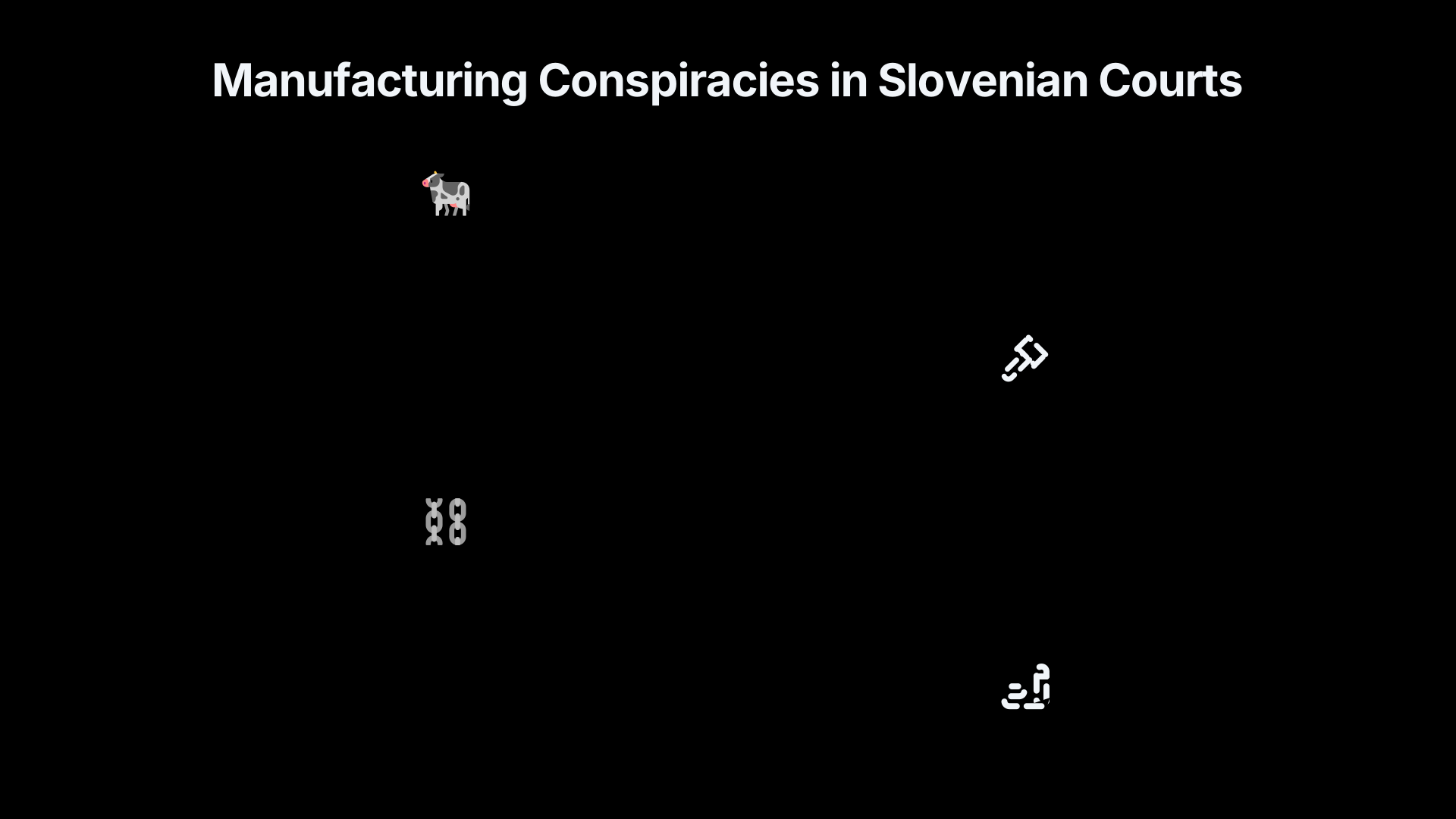
Early accusations commonly began with local disputes. Neighbours blamed one another for illness, failed harvests, unexplained deaths or damaged livestock. Such complaints alone rarely described organised groups of witches. The transformation occurred after formal prosecution began.
Judges and interrogators frequently expected suspects to confess to several standard elements:
- making a pact with the Devil;
- attending secret assemblies or witches’ sabbaths;[youtube.com]youtube.comThe Secret History of Witches | Witch Trials and Fear in History3 Stanley Cohen: Folk Devils and Moral Panics…
- learning harmful magic from other witches;
- identifying additional participants;
- describing supernatural acts accepted by demonological theory.
Because torture or the threat of torture was legally permitted in many circumstances, prisoners often supplied increasingly elaborate narratives that matched judicial expectations. Each newly named accomplice generated another investigation, allowing an accusation against one individual to grow into what appeared to be a large criminal conspiracy. Modern historians stress that these expanding networks reflected interrogation practices far more than genuine evidence of organised witchcraft.[zzds.si]kronika.zzds.siRibnica witch trial (1700–1701), the most famous witch trial in Carniola | Kronika…
This explains why surviving trial records contain remarkably similar stories despite occurring in different places. The consistency came less from independent witness testimony than from shared legal assumptions about what a witch ought to confess.
Ribnica: a case study in judicial construction
The Ribnica witch trial of 1700–1701 is the clearest Slovenian example of conspiracy construction through legal procedure.
The central figure, Marina Češarek, became the focus of proceedings built around the accepted idea that witches belonged to a wider satanic organisation. According to surviving court minutes, investigators were interested not merely in alleged acts of harmful magic but in proving participation in a collective conspiracy centred on the Devil. The concept of the witches’ sabbath formed the intellectual framework of the prosecution. At least seven people almost certainly lost their lives during the proceedings.[kronika.zzds.si]kronika.zzds.siRibnica witch trial (1700–1701), the most famous witch trial in Carniola | Kronika…
Because the complete court record survives, historians can observe how questioning gradually expanded the alleged conspiracy. Rather than uncovering independently verified networks, interrogators sought confirmation of beliefs they already held. The resulting testimony therefore reveals more about judicial thinking than about the lives of the accused.
The Ribnica records have become especially valuable precisely because they expose the mechanism behind witch prosecutions. They demonstrate how legal institutions could convert rumours into apparently detailed conspiracies while preserving those narratives in official documentation that later generations might mistakenly treat as factual descriptions.
Hrastovec and the human cost of coercion
Another well-documented Styrian case illustrates the role of torture even more starkly.
In December 1673, Marina Vukinec was interrogated at Hrastovec. Judge Volk Lovrenc Lampertič initially questioned her without torture but, after she denied the accusations, ordered severe physical torture, including the pouring of boiling fat into specially fitted boots. The official report records that prolonged abuse left Marina mentally broken. Eventually she began describing devils tormenting her in prison—statements produced only after days of extreme suffering.[Portal GOV.SI]gov.siPortal GOV.SI»The Devils Killed Marina the Witch« | GOV.SIPortal GOV.SI»The Devils Killed Marina the Witch« | GOV.SI
For historians, the significance of this record lies not in confirming supernatural beliefs but in demonstrating how confessions could be manufactured under unbearable pressure. The report also shows that village quarrels, rumours, folk healing and ordinary neighbourhood tensions became woven into larger narratives of satanic conspiracy once the legal process began.[Portal GOV.SI]gov.siPortal GOV.SI»The Devils Killed Marina the Witch« | GOV.SIPortal GOV.SI»The Devils Killed Marina the Witch« | GOV.SI
Why prosecutions differed across the Slovenian lands
The uneven geography of Slovenian witch trials reflects differences in legal administration rather than differences in belief alone.
Several factors influenced where prosecutions became particularly intense:
- Local judicial autonomy. Individual lordships and courts exercised considerable discretion in pursuing accusations.
- The willingness to authorise torture. Some jurisdictions relied more heavily on coercive interrogation than others.
- Regional political leadership. Local officials varied in their enthusiasm for prosecuting suspected witches.
- Neighbourhood conflict. Communities experiencing disputes over property, inheritance or reputation generated more accusations that courts could formalise.
Consequently, some districts experienced repeated waves of executions while neighbouring areas recorded relatively few cases. The pattern makes little sense if interpreted as evidence of genuine witch organisations but fits well with differences in judicial practice and local governance.[zzds.si]kronika.zzds.siRibnica witch trial (1700–1701), the most famous witch trial in Carniola | Kronika…
Why the manufactured conspiracies came to an end
The decline of Slovenian witch prosecutions did not occur because authorities discovered that a single conspiracy had been defeated. Instead, confidence in the legal methods that produced such conspiracies gradually weakened.
During the eighteenth century, higher authorities increasingly questioned convictions based primarily on confession and torture. Appeals became more significant, evidential standards slowly improved, and central governments exercised greater oversight over local courts. Enlightenment ideas also encouraged greater scepticism towards demonological theories that had previously underpinned prosecutions. As judicial practice changed, the self-reinforcing cycle of accusation, coerced confession and expanding conspiracy largely disappeared.[kronika.zzds.si]kronika.zzds.siRibnica witch trial (1700–1701), the most famous witch trial in Carniola | Kronika…
This transition illustrates an important historical lesson. The end of the witch trials resulted less from a sudden change in popular belief than from changes in legal institutions and standards of proof.
What the Slovenian witch trials reveal today
Modern scholarship treats the Slovenian witch trials as a study in how institutions can unintentionally manufacture convincing but false narratives.
The surviving records are invaluable historical documents, yet they must be read critically. They preserve the voices of judges, interrogators and frightened prisoners operating within a legal system that assumed organised satanic conspiracies already existed. Confessions were therefore shaped by expectation, coercion and accepted religious ideas rather than by independent corroborating evidence.
For this reason, historians view the Slovenian trials not as proof that hidden witch societies operated across the country but as evidence of how courts, interrogation techniques and prevailing beliefs combined to transform local suspicion into official conspiracies with devastating human consequences.[zzds.si]kronika.zzds.siRibnica witch trial (1700–1701), the most famous witch trial in Carniola | Kronika…




Endnotes
1.
Source: kronika.zzds.si
Link:https://kronika.zzds.si/index.php/kronika/en/article/view/479
Source snippet
Ribnica witch trial (1700–1701), the most famous witch trial in Carniola | Kronika...
2.
Source: gov.si
Title: Portal GOV.SI»The Devils Killed Marina the Witch« | GOV.SI
Link:https://www.gov.si/en/news/2024-06-01-the-devils-killed-marina-the-witch/
3.
Source: sistory.si
Link:https://www.sistory.si/11686/44672
Source snippet
January 1, 2018 — Serijske publikacije / Kronika: časopis za slovensko krajevno zgodovino ČAROVNIŠKI PROCES V RIBNICI 1700-1701 - NAJBOLJ...
Published: January 1, 2018
4.
Source: sistory.si
Link:https://www.sistory.si/eng/publication/4033
5.
Source: sistory.si
Link:https://www.sistory.si/publication/13935
6.
Source: sistory.si
Link:https://www.sistory.si/publication/59634
7.
Source: kronika.zzds.si
Link:https://kronika.zzds.si/kronika/article/view/479
8.
Source: ribnica.si
Title: RIBN IČANKA MARINA – ZADNJA SEŽGANA ČAROVNICA NA RIBNIŠKEM
Link:https://ribnica.si/objava/201540
Additional References
9.
Source: ojs.inz.si
Title: si Veliki pregon | Contributions to Contemporary History
Link:https://ojs.inz.si/pnz/sl/article/view/4284
Source snippet
"pregon | Contributions to Contemporary HistoryMay 8, 2024 — VELIKI PREGON AVTORJI * Matevž Košir Arhiv Republike Slovenije DOI: [https://d..."](https://d...")...
Published: May 8, 2024
10.
Source: journals.vu.lt
Title: lt The Noble Witch Reflected in Different Mirrors
Link:https://www.journals.vu.lt/Colloquia/en/article/view/35866
Source snippet
The Transformation of the Motif of Veronika of Desenice in the Slovenian Cultural Canon | ColloquiaJuly 4, 2024 — The Noble Witch Reflect...
Published: July 4, 2024
11.
Source: youtube.com
Link:https://www.youtube.com/watch?v=hPo_lMCn9VY
Source snippet
2 The Secret History of Witches | Witch Trials and Fear in History...
12.
Source: youtube.com
Title: The Secret History of Witches | Witch Trials and Fear in History
Link:https://www.youtube.com/watch?v=HvNHzeM3EjU
Source snippet
3 Stanley Cohen: Folk Devils and Moral Panics...
13.
Source: dspace.cuni.cz
Link:https://dspace.cuni.cz/handle/20.500.11956/185445
Source snippet
cuni.czPoslední velké čarodějnické procesy na území dnešního Slovenska (1662-1741) a Moravy (1678-1696) (srovnání) | Digitální repozitář...
14.
Source: youtube.com
Title: The Horrors of the German Witch Hunts | Human Voiced, No Ads
Link:https://www.youtube.com/watch?v=NvEzvu_uYEI
Source snippet
5 Ugly History: Witch Hunts - Brian A. Pavlac...
15.
Source: youtube.com
Title: Stanley Cohen: Folk Devils and Moral Panics
Link:https://www.youtube.com/watch?v=AKhLAzdiCfQ
Source snippet
4 The Horrors of the German Witch Hunts | Human Voiced, No Ads...
16.
Source: ojs.inz.si
Link:https://ojs.inz.si/pnz/article/view/2200
17.
Source: dlib.si
Title: d Lib.si
Link:https://www.dlib.si/stream/URN%3ANBN%3ASI%3ADOC-I7DSTNJA/2dc177a3-dfa7-4461-ae00-a50648283bb3/PDF
Source snippet
PDF datoteka (658 kB) 1. TXT datoteka (39 kB) Izvoz v EndNote (RIS format) Avtor(ji) Košir...
18.
Source: zgodovinskicasopis.si
Title: Witchcraft Trials on Slovene Territory | Historical Review
Link:https://zgodovinskicasopis.si/index.php/zc/en/article/view/1666
Topic Tree