Within Liberia
What Was Proven in Liberia's Ritual Killing Scares?
Mutilated bodies, weak investigations and election-season rumours repeatedly fuelled fears that powerful Liberians used ritual murder.
On this page
- Crime, Rumour and Missing Evidence
- The Harper Killings and Public Hangings
- Election Fears, Protests and Official Responses
Page outline Jump by section
Introduction
Liberia’s ritual killing scares sit at the difficult boundary between documented violent crime, longstanding beliefs about supernatural power, and deep political distrust. Unlike a classic moral panic based entirely on false rumours, Liberia’s history includes real homicide cases in which victims were found mutilated, alongside many allegations that were never conclusively proved. This mixture of genuine crimes, incomplete investigations and rumours about powerful people has repeatedly fuelled public suspicion that politicians or wealthy individuals seek supernatural assistance through human sacrifice.
The result has been a cycle in which every election season or unexplained killing risks becoming more than a criminal investigation. Instead, it can become a test of whether citizens believe the state is willing or able to investigate influential suspects fairly. Understanding Liberia’s ritual killing scares therefore requires separating what courts proved, what investigators could establish, and what remained the subject of widespread public belief.
Crime, rumour and missing evidence
The phrase “ritual killing” in Liberia usually refers to murders in which body parts are removed because they are believed to possess supernatural power capable of bringing wealth, influence or political success. Police investigations have confirmed that some homicide victims were mutilated after death. What has often proved much harder is demonstrating that the motive was genuinely ritualistic rather than personal revenge, robbery, concealment of evidence or another criminal purpose.
This distinction matters because public discussion has frequently treated mutilation itself as proof of ritual intent, while courts require evidence linking suspects to both the killing and the alleged motive. In many highly publicised cases, investigators struggled to collect forensic evidence, witnesses feared retaliation, and rumours spread much faster than verified information.
Weak criminal justice institutions have amplified these fears. Human rights organisations and international observers have repeatedly noted that public confidence in Liberia’s police and courts has been undermined by limited investigative capacity, slow prosecutions and perceptions that influential suspects sometimes receive different treatment from ordinary citizens. These weaknesses encourage speculation whenever investigations stall or produce incomplete explanations.[Thomson Reuters Foundation News]news.trust.orgThomson Reuters Foundation NewsRitual killings, witch trials go unpunished in LiberiaDecember 18, 2015…
The fear has therefore become self-reinforcing:
- mutilated bodies generate suspicions of ritual murder;
- uncertainty encourages rumours involving politicians or wealthy figures;
- lack of trusted investigations allows rumours to persist;
- every unresolved case becomes evidence, in many people’s minds, that powerful individuals are protected.
This dynamic explains why ritual killing scares are best understood as a combination of documented crime and political distrust rather than simply as superstition.
The Harper killings and the public hangings
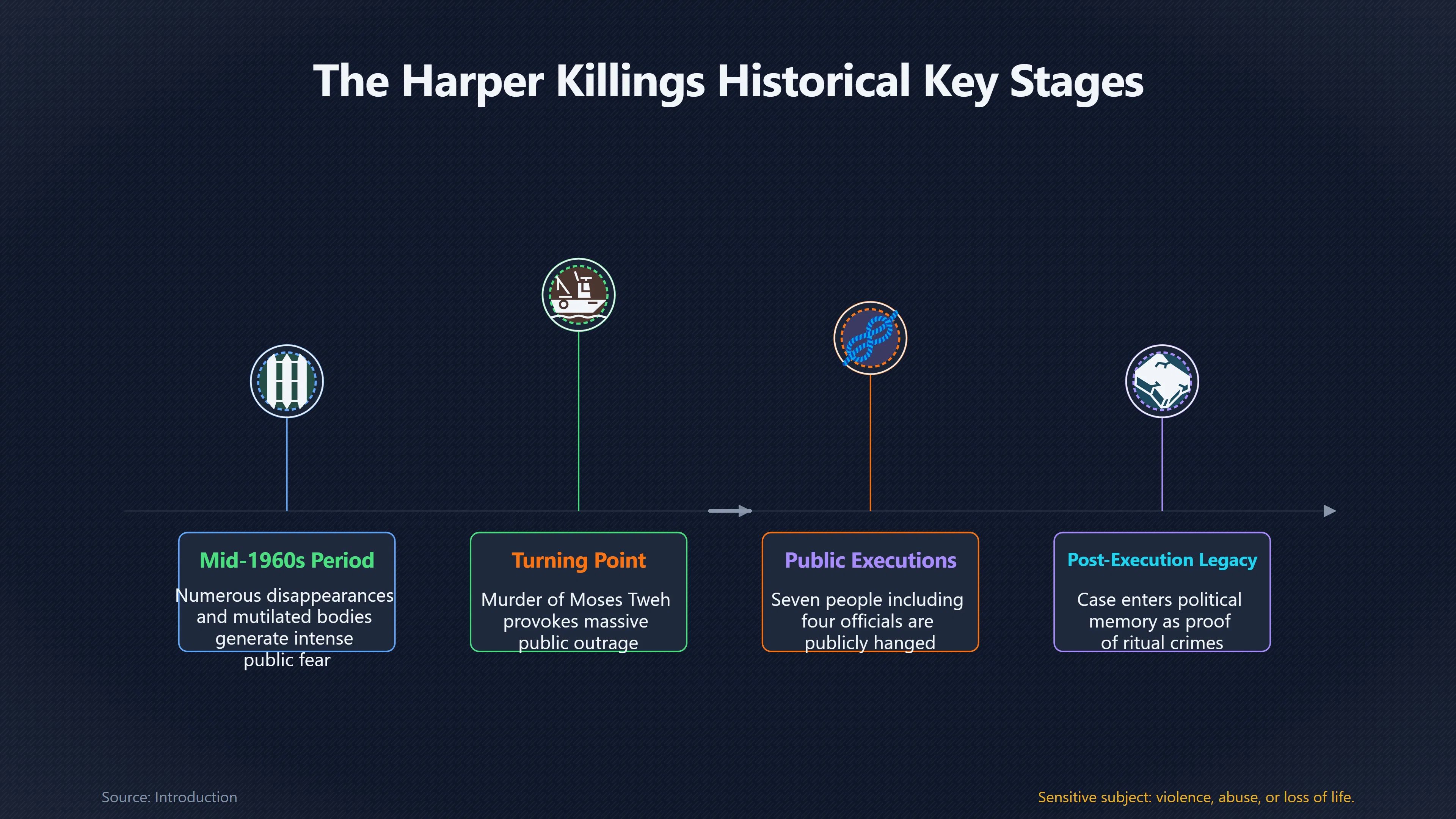
The best-known historical episode occurred in Maryland County around the city of Harper during the late 1960s and 1970s.
Over several years, numerous disappearances and murders involving mutilated bodies generated intense public fear. Contemporary accounts and later historical summaries describe more than one hundred suspected ritual killings between the mid-1960s and 1977, although not every death was investigated to modern evidential standards and historians caution against treating all reported cases as equally well documented.[Wikipedia]WikipediaWilliam TolbertWilliam Tolbert
The turning point came after the murder of the popular musician and fisherman Moses Tweh in 1977. His mutilated body provoked enormous public outrage and increased pressure on President William Tolbert’s government to demonstrate that even senior officials could be prosecuted.
Investigations eventually implicated several prominent local figures, including government officials. Multiple defendants were convicted, and in 1979 seven people—including four officials—were publicly hanged after their convictions for ritual murder. President Tolbert declared that deliberate killers would face the full force of the law and defended the executions as evidence that no one stood above the law.[The Washington Post]washingtonpost.comThe Washington Post Liberian President Warns Against Ritualistic KillingThe Washington PostLiberian President Warns Against Ritualistic Killing - The Washington Post…
The Harper prosecutions remain historically important because they illustrate both sides of Liberia’s ritual killing debate.
On one hand:
- real murders had occurred;
- convictions were obtained through the courts;
- senior officials were punished.
On the other hand:
- many earlier killings remained unresolved;
- the precise number of ritual murders has never been firmly established;
- some later commentators questioned whether every defendant had been equally responsible or whether political rivalries influenced aspects of the prosecutions.
The episode therefore entered Liberian political memory both as proof that ritual murders could occur and as an example of how criminal investigations could become entangled with struggles for political power.

Election fears and recurring political suspicion
One striking feature of Liberian public life is the repeated belief that ritual killings increase during election periods.
Human rights reporting has noted persistent public speculation that ambitious politicians seek supernatural assistance before major elections. Such allegations are difficult to verify and rarely produce prosecutable evidence, yet they recur often enough that international observers have recognised them as an important feature of Liberia’s political culture rather than isolated rumours.[Thomson Reuters Foundation News]news.trust.orgThomson Reuters Foundation NewsRitual killings, witch trials go unpunished in LiberiaDecember 18, 2015…
Political leaders themselves have sometimes addressed these fears directly. During election campaigns, candidates have publicly condemned ritual killings and warned supporters against participating in such practices, reflecting the fact that the issue remains politically sensitive even when specific allegations cannot be substantiated.[ritualkillinginafrica.org]ritualkillinginafrica.orgRitual murders and elections in Liberia | Ritual Killing In AfricaJanuary 31, 2020…
In recent years, unexplained disappearances and killings have again generated protests demanding stronger government action. Editorials, civil society organisations and opposition figures have criticised authorities for failing to reassure the public through transparent investigations. While many public claims have remained speculative, the political consequences have been real because perceptions of official silence or ineffective policing have further weakened confidence in state institutions.[ritualkillinginafrica.org]ritualkillinginafrica.orgAfricaSeptember 30, 2021…
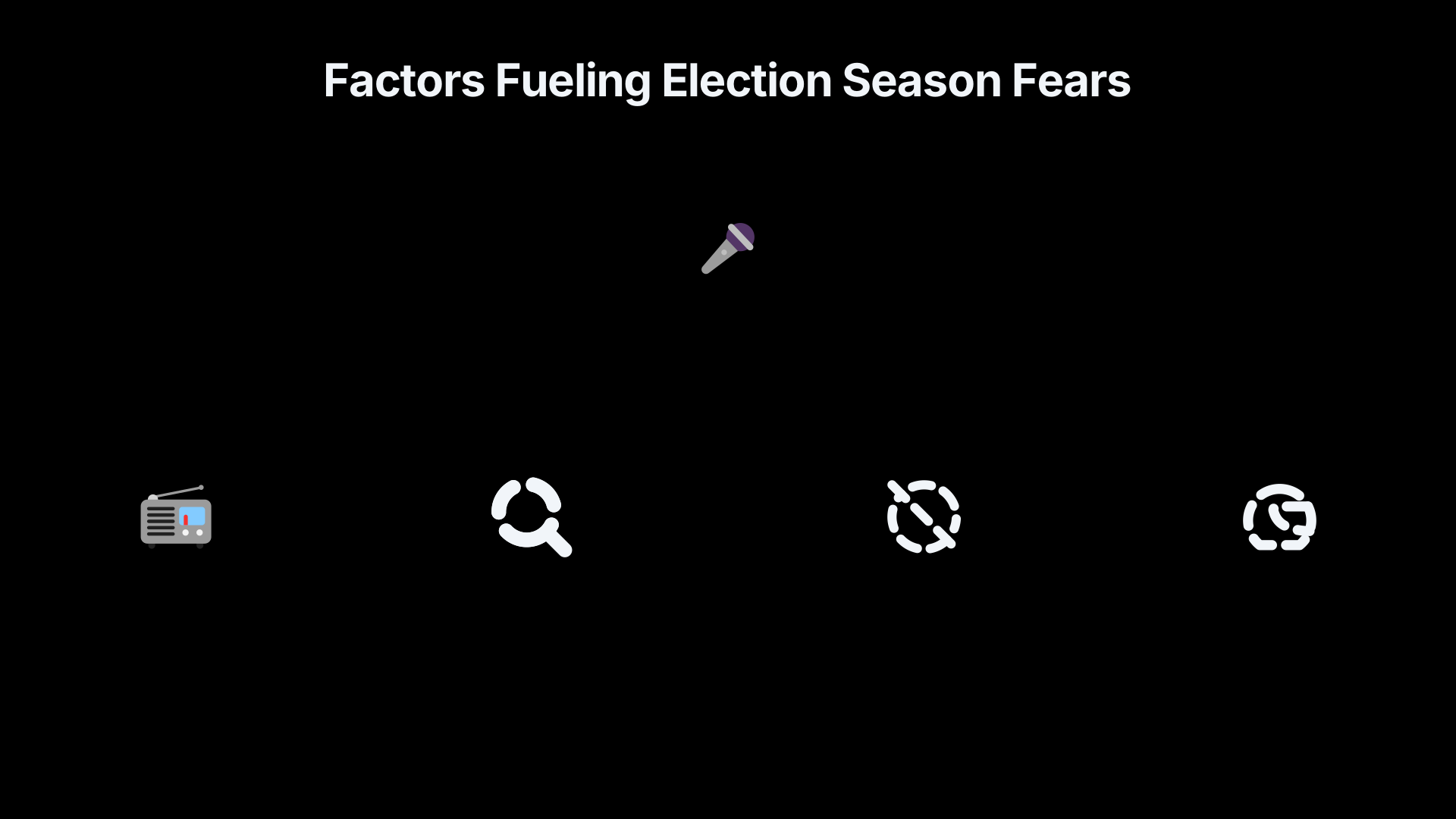
The pattern is therefore less about proving that elections cause ritual murders than about understanding why election periods create fertile conditions for suspicion:
- political competition raises the perceived value of supernatural advantage;
- heightened media attention spreads rumours rapidly;
- unresolved killings acquire political significance;
- distrust of institutions makes official explanations less persuasive.
Why rumours spread so easily
Liberia’s experience cannot be understood solely through beliefs about the supernatural. The country’s civil wars, prolonged violence and periods of weak state authority profoundly shaped how people judge official explanations.
Where police investigations appear incomplete, citizens often rely instead on community testimony, local reputation or traditional explanations. If influential individuals are believed capable of avoiding prosecution, rumours become socially credible even without conclusive evidence.
The psychology is familiar from other societies experiencing institutional weakness. People confronted with frightening events and uncertain information often prefer explanations that identify hidden actors rather than accepting that crimes remain unsolved. In Liberia, longstanding beliefs about ritual power provide a culturally meaningful framework into which these uncertainties fit.
Importantly, this does not mean every allegation is false. Some ritual murders have resulted in convictions. The problem is that confirmed cases make later unproven accusations seem more believable, even when investigators lack sufficient evidence to identify those responsible.
What can actually be said with confidence?
Several conclusions are supported by the available evidence.
First, Liberia has experienced genuine homicide cases involving mutilated bodies, and some defendants have been convicted of ritual murder, most famously following the Harper investigations in the 1970s.[The Washington Post]washingtonpost.comThe Washington Post Liberian President Warns Against Ritualistic KillingThe Washington PostLiberian President Warns Against Ritualistic Killing - The Washington Post…
Second, many other alleged ritual killings have never been conclusively solved. Public discussion often extends far beyond what investigators or courts have been able to prove.[Thomson Reuters Foundation News]news.trust.orgThomson Reuters Foundation NewsRitual killings, witch trials go unpunished in LiberiaDecember 18, 2015…
Third, fears intensify during periods of political competition because longstanding suspicions connect supernatural power with wealth and political success. Human rights observers have documented these recurring anxieties while also emphasising the lack of evidence for many specific accusations.[Thomson Reuters Foundation News]news.trust.orgThomson Reuters Foundation NewsRitual killings, witch trials go unpunished in LiberiaDecember 18, 2015…
Finally, the enduring importance of ritual killing scares lies less in any single case than in what they reveal about trust. Whenever citizens believe influential suspects cannot be investigated impartially, every unexplained death risks becoming part of a wider narrative about corruption, hidden power and unequal justice. That continuing distrust has made ritual killing one of Liberia’s most persistent and politically charged public fears.
Amazon book picks
Further Reading
Books and field guides related to What Was Proven in Liberia's Ritual Killing Scares?. Use these as the next step if you want deeper reading beyond the article.
African Religions A Very Short Introduction
Explains indigenous belief systems often misunderstood by colonial authorities.

The house at Sugar Beach
Illustrates the social and political realities behind public fears.
Endnotes
1.
Source: news.trust.org
Link:https://news.trust.org/item/20151218162423-n8153
Source snippet
Thomson Reuters Foundation NewsRitual killings, witch trials go unpunished in LiberiaDecember 18, 2015...
Published: December 18, 2015
2.
Source: Wikipedia
Title: William Tolbert
Link:https://en.wikipedia.org/wiki/William_Tolbert
3.
Source: ritualkillinginafrica.org
Title: Ritual murders and elections in Liberia | Ritual Killing In Africa
Link:https://www.ritualkillinginafrica.org/2020/01/31/ritual-murders-and-elections-in-liberia/
Source snippet
January 31, 2020...
Published: January 31, 2020
4.
Source: ritualkillinginafrica.org
Link:https://www.ritualkillinginafrica.org/2021/09/30/liberia-the-political-fallout-from-the-recent-surge-in-ritualistic-murders/
Source snippet
AfricaSeptember 30, 2021...
Published: September 30, 2021
5.
Source: ritualkillinginafrica.org
Title: ‘The Harper Seven’ | Ritual Killing In Africa
Link:https://www.ritualkillinginafrica.org/category/the-harper-seven/
6.
Source: ritualkillinginafrica.org
Link:https://www.ritualkillinginafrica.org/category/1971/
7.
Source: ritualkillinginafrica.org
Link:https://www.ritualkillinginafrica.org/category/trc/
8.
Source: ritualkillinginafrica.org
Link:https://www.ritualkillinginafrica.org/category/president-tolbert/
9.
Source: ritualkillinginafrica.org
Title: gyude bryant
Link:https://www.ritualkillinginafrica.org/category/gyude-bryant/
10.
Source: ritualkillinginafrica.org
Link:https://www.ritualkillinginafrica.org/category/2008/page/3/
11.
Source: ritualkillinginafrica.org
Link:https://www.ritualkillinginafrica.org/category/elections/page/6/
12.
Source: washingtonpost.com
Title: The Washington Post Liberian President Warns Against Ritualistic Killing
Link:https://www.washingtonpost.com/archive/national/1979/02/25/liberian-president-warns-against-ritualistic-killing/d1144e7d-02d4-481c-b038-7b1b16ad705c/
Source snippet
The Washington PostLiberian President Warns Against Ritualistic Killing - The Washington Post...
13.
Source: refworld.org
Link:https://www.refworld.org/reference/countryrep/amnesty/2006/96673
14.
Source: liberiapastandpresent.org
Title: Ritual Killings
Link:https://liberiapastandpresent.org/RitualKillingsIndex.htm
Additional References
15.
Source: afrobarometer.org
Link:https://www.afrobarometer.org/publication/ad705-liberians-want-fair-and-competitive-elections-but-mistrust-elections-commission/
Source snippet
AD705: Liberians want fair and competitive elections, but mistrust elections commission – AfrobarometerSeptember 26, 2023 — Dispatch AD70...
Published: September 26, 2023
16.
Source: cambridge.org
Link:https://www.cambridge.org/core/journals/comparative-studies-in-society-and-history/article/ritual-and-the-enemy-body-a-new-approach-to-modern-atrocity/6E87A2E7C44D7B08CF64D28B78688573
Source snippet
March 24, 2025 — RITUAL AND THE ENEMY BODY: A NEW APPROACH TO MODERN ATROCITY Published online by Cambridge University Press: 24 March 20...
Published: March 24, 2025
17.
Source: youtube.com
Title: The Maryland Ritual Killings: When Power Demanded Human Sacrifice
Link:https://www.youtube.com/watch?v=selSuFJrZIc
Source snippet
Samuel Doe Government & Ritualistic Killings In Liberia (General Butt Naked TRC Testimony)...
18.
Source: youtube.com
Link:https://www.youtube.com/watch?v=DWbgX5inSYA
Source snippet
The Odds of Ritualistic Killings in Liberia...
19.
Source: youtube.com
Title: The Odds of Ritualistic Killings in Liberia
Link:https://www.youtube.com/watch?v=eNSI1k3iXns
Source snippet
Ritualistic killings Liberia The History Of Ritualistic Killings In Liberia 🇱🇷🇱🇷 #liberia MyBlack Planet...
20.
Source: youtube.com
Title: Rumor and Reality of Ritualistic Deaths in Liberia
Link:https://www.youtube.com/watch?v=RBJSmPJ87mU
Source snippet
The Maryland Ritual Killings: When Power Demanded Human Sacrifice...
21.
Source: ecoi.net
Link:https://www.ecoi.net/en/document/2107757.html
Source snippet
USDOS – US Department of State (Author): “2023 Country Report on Human Rights Practices: Liberia”, Document #2107757 - ecoi.netApril 23...
22.
Source: researchgate.net
Link:https://www.researchgate.net/publication/394393704_Ritual_violence_in_Liberia_2_Studying_ritual_violence_in_history-Assessing_lack_of_insights_and_knowledge
23.
Source: liberiapastandpresent.org
Link:https://liberiapastandpresent.org/RitualKillingsIndexB.htm
24.
Source: youtube.com
Title: The History Of Ritualistic Killings In Liberia
Link:https://www.youtube.com/watch?v=V6uebmSRWm4
Source snippet
Rumor and Reality of Ritualistic Deaths in Liberia...
Topic Tree