Within Myanmar
How One False Story Set Mandalay Alight
A false rape allegation spread online in Mandalay, drawing crowds to a tea shop and helping trigger deadly communal violence.
On this page
- The accusation and its online spread
- Crowd mobilisation and street violence
- What the riot reveals about digital rumours
Page outline Jump by section
Introduction
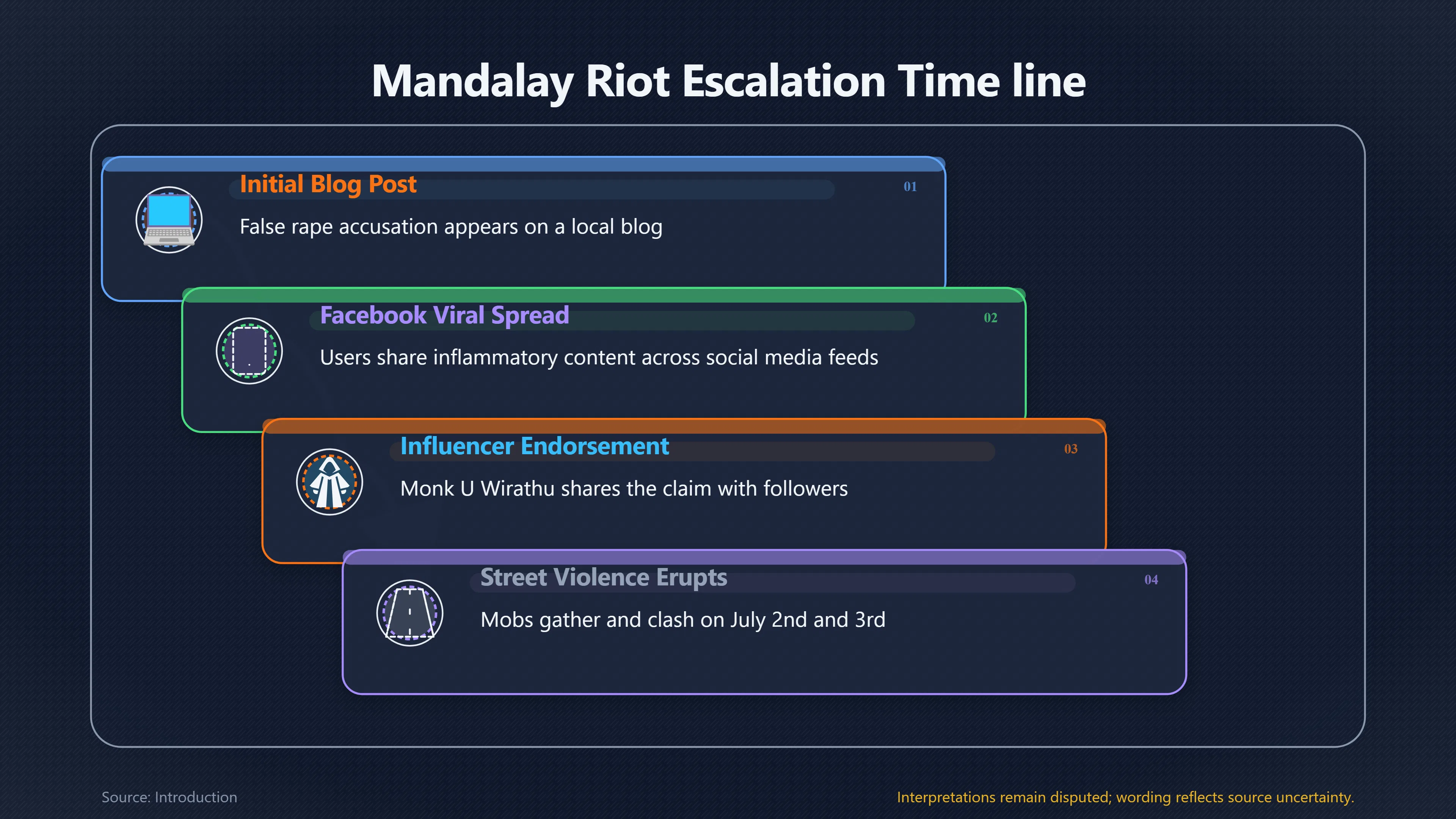
In early July 2014, a false online allegation that two Muslim tea-shop owners in Mandalay had raped a young Buddhist woman spread rapidly across Facebook and other online channels. Within hours, angry crowds gathered outside the business, street clashes erupted between Buddhists and Muslims, and two people were killed. The episode became one of Myanmar’s clearest demonstrations of how an unverified rumour, amplified through social media and existing communal tensions, could produce real-world violence.
The Mandalay riots did not arise from Facebook alone. Long-standing anti-Muslim prejudice, organised nationalist activism, distrust of official information and a weak information environment all helped make the false accusation believable to many readers. Nevertheless, the incident has become a landmark case in discussions of digital rumours, online hate speech and the dangers of treating social media as a trusted source of breaking news.[hrw.org]hrw.orgHuman Rights WatchBurma: the Clash of Church, State, and Society | Human Rights WatchJuly 9, 2014…
The accusation and its online spread
The immediate trigger was an online post claiming that the Muslim owners of the Sun Tea Shop in central Mandalay had sexually assaulted a Buddhist female employee. The accusation originated on a blog before spreading quickly through Facebook, which by 2014 had become the main gateway to the internet for many people in Myanmar. As users shared the story, it was repeated with increasingly inflammatory language and presented as established fact despite the absence of verified evidence.[WIRED]wired.comHow Facebook’s Rise Fueled Chaos and Confusion in Myanmar | WIREDHow Facebook’s Rise Fueled Chaos and Confusion in Myanmar | WIRED…
The rumour gained further momentum after it was shared by the influential Buddhist nationalist monk U Wirathu, who had a large online following. His post stated that he had contacted the alleged perpetrators and that justice would follow. Although he did not explicitly call for violence, many supporters interpreted the post as confirmation that the allegation was genuine and as a signal to mobilise. Later investigations by state media concluded that the rape accusation itself was false.[Journal of International Affairs]jia.sipa.columbia.eduJournal of International AffairsDangerous Speech, Anti-Muslim Violence, and Facebook in Myanmar | Columbia | Journal of International Aff…
The story succeeded because it fitted an already familiar narrative promoted by anti-Muslim nationalist networks. False or exaggerated claims that Muslim men posed a sexual threat to Buddhist women had circulated repeatedly in speeches, pamphlets and online campaigns. The alleged assault therefore appeared plausible to many readers before any evidence had been examined.[Journal of International Affairs]jia.sipa.columbia.eduJournal of International AffairsDangerous Speech, Anti-Muslim Violence, and Facebook in Myanmar | Columbia | Journal of International Aff…
Crowd mobilisation and street violence
As the rumour spread, hundreds of people gathered around the tea shop. Police attempted to secure the area, while rumours continued to circulate that Muslims were preparing attacks elsewhere in the city. Muslim residents also organised to protect neighbourhoods and businesses, increasing the likelihood of confrontation.
On the nights of 2 and 3 July 2014, fighting broke out in several parts of Mandalay. Mobs attacked people and property, and at least two men—one Buddhist and one Muslim—were killed. More than a dozen others were injured before authorities imposed a night-time curfew and deployed additional security forces to restore order.[Human Rights Watch]hrw.orgHuman Rights WatchBurma: the Clash of Church, State, and Society | Human Rights WatchJuly 9, 2014…
Witnesses and researchers later noted that some participants appeared unfamiliar with the local area, prompting questions about whether at least part of the violence had been organised rather than entirely spontaneous. While definitive proof of broader orchestration remains disputed, several analysts concluded that existing communal tensions were deliberately exploited by actors seeking political advantage.[Human Rights Watch]hrw.orgHuman Rights WatchBurma: the Clash of Church, State, and Society | Human Rights WatchJuly 9, 2014…
The government eventually arrested dozens of people connected with the unrest. Courts later convicted individuals for rioting, spreading false information intended to incite fear, and involvement in the killing of one of the victims.[Refworld]refworld.org2014 Country Reports on Human Rights Practices - Burma | Refworld…

Why the rumour spread so quickly
The Mandalay case illustrates how digital rumours thrive when several conditions reinforce one another rather than when a single technology causes panic.
Several factors were especially important:
- Facebook dominated online life. For many new internet users, Facebook effectively was the internet, making posts appear more authoritative than they deserved.
- Pre-existing communal fears. Nationalist campaigns had already encouraged suspicion of Muslims through stories about demographic threats, religious conversion and violence against Buddhist women.
- Weak verification. Independent fact-checking organisations were still limited, while official information often arrived too slowly to compete with viral rumours.
- Emotional framing. Allegations involving sexual violence against women are particularly effective at provoking outrage and encouraging immediate action before evidence is checked.[columbia.edu]jia.sipa.columbia.eduJournal of International AffairsDangerous Speech, Anti-Muslim Violence, and Facebook in Myanmar | Columbia | Journal of International Aff…
Researchers studying online rumours have found that emotionally charged, unverified claims often spread faster than later corrections, especially during periods of uncertainty. Mandalay provided a stark real-world example of that broader pattern.[arXiv]arxiv.orgAnalysing How People Orient to and Spread Rumours in Social Media by Looking at Conversational ThreadsNovember 23, 2015…
What the riot reveals about digital rumours
The Mandalay violence became an early warning of the risks created when social media platforms intersect with deep political and religious divisions.
Importantly, Facebook did not create anti-Muslim hostility in Myanmar. Suspicion and discrimination had much older historical roots, and nationalist organisations had already developed effective offline networks. Facebook dramatically accelerated the speed, reach and emotional intensity with which rumours could circulate, allowing thousands of people to receive essentially the same inflammatory message within a very short period.[Journal of International Affairs]jia.sipa.columbia.eduJournal of International AffairsDangerous Speech, Anti-Muslim Violence, and Facebook in Myanmar | Columbia | Journal of International Aff…
The incident also exposed the difficulty of correcting falsehoods after they have already prompted collective action. By the time authorities stated that the rape allegation lacked foundation, crowds had assembled, violence had begun and trust in official statements had already weakened.
Human rights organisations later pointed to the Mandalay riots as evidence that online hate speech was becoming an increasingly serious public safety problem. The episode foreshadowed later international criticism of Facebook’s role in Myanmar, including findings by the UN Fact-Finding Mission that the platform had played a significant part in amplifying ethnic and religious hostility because moderation systems failed to keep pace with events. Facebook subsequently removed military-linked accounts and acknowledged shortcomings in its response to harmful content in Myanmar.[fb.com]about.fb.comFacebook Removing Myanmar Military Officials From FacebookFacebookRemoving Myanmar Military Officials From FacebookAugust 28, 2018…

Why the Mandalay rumour remains important
The Mandalay riots are remembered not simply because a false story circulated online, but because they demonstrated how rumours can become catalysts for violence when they reinforce fears that already exist within society.
For historians and social scientists, the episode represents a modern form of moral panic built around digital communication rather than traditional word of mouth. The false rape allegation did not persuade people in isolation; it activated existing narratives about communal threat that had been cultivated over many years. The violence therefore illustrates the interaction between technology, organised propaganda, political tension and long-standing prejudice, rather than a simple case of irrational mass hysteria.
Within Myanmar’s recent history, the Mandalay rumour stands as one of the clearest examples of how an online falsehood crossed the boundary between the digital world and deadly street violence, influencing later debates about social media governance, hate speech and the responsibilities of technology companies during periods of communal tension.
Amazon book picks
Further Reading
Books and field guides related to How One False Story Set Mandalay Alight. Use these as the next step if you want deeper reading beyond the article.
The Chaos Machine
Investigates how engagement-driven platforms amplify outrage, misinformation and group hostility, including their role in real-world ethn...
Myanmar's Enemy Within
Explains the Buddhist nationalism, communal prejudice and political conditions that made inflammatory rumours capable of triggering viole...

An Ugly Truth
Examines Facebook's failures to control misinformation, hate speech and violent rhetoric, providing corporate context for the platform dy...
The Hidden History of Burma: Race, Capitalism, and the Crisis...
Supplies the broader historical, ethnic, economic and political background needed to understand Myanmar's communal tensions and fragile i...
Endnotes
1.
Source: wired.com
Title: How Facebook’s Rise Fueled Chaos and Confusion in Myanmar | WIRED
Link:https://www.wired.com/story/how-facebooks-rise-fueled-chaos-and-confusion-in-myanmar/
Source snippet
How Facebook’s Rise Fueled Chaos and Confusion in Myanmar | WIRED...
2.
Source: refworld.org
Link:https://www.refworld.org/reference/annualreport/usdos/2015/105961
Source snippet
2014 Country Reports on Human Rights Practices - Burma | Refworld...
3.
Source: arxiv.org
Link:https://arxiv.org/abs/1511.07487
Source snippet
Analysing How People Orient to and Spread Rumours in Social Media by Looking at Conversational ThreadsNovember 23, 2015...
Published: November 23, 2015
4.
Source: time.com
Title: un facebook myanmar rohingya violence
Link:https://time.com/5197039/un-facebook-myanmar-rohingya-violence/
Source snippet
Fact Finders Say Facebook Played a 'Determining' Role in Violence Against the RohingyaA U.N. fact-finding mission has revealed that Faceb...
5.
Source: refworld.org
Link:https://www.refworld.org/reference/annualreport/usdos/2015/107695
6.
Source: youtube.com
Title: What’s behind the $150 billion Rohingya-Facebook lawsuit? | DW News
Link:https://www.youtube.com/watch?v=1ml-OLDV7Vw
Source snippet
Facebook accused of promoting violence against Rohingya in Myanmar • FRANCE 24 English...
7.
Source: youtube.com
Link:https://www.youtube.com/watch?v=QZh-ljGAX0g
Source snippet
Myanmar's Anti-Muslim Monks | AJ+ Docs is highly relevant because it directly investigates the 2014 Mandalay riots, showing how extremist...
8.
Source: hrw.org
Link:https://www.hrw.org/news/2014/07/09/burma-clash-church-state-and-society
Source snippet
Human Rights WatchBurma: the Clash of Church, State, and Society | Human Rights WatchJuly 9, 2014...
Published: July 9, 2014
9.
Source: jia.sipa.columbia.edu
Link:https://jia.sipa.columbia.edu/news/dangerous-speech-anti-muslim-violence-and-facebook-myanmar
Source snippet
Journal of International AffairsDangerous Speech, Anti-Muslim Violence, and Facebook in Myanmar | Columbia | Journal of International Aff...
10.
Source: about.fb.com
Title: Facebook Removing Myanmar Military Officials From Facebook
Link:https://about.fb.com/news/2018/08/removing-myanmar-officials/
Source snippet
FacebookRemoving Myanmar Military Officials From FacebookAugust 28, 2018...
Published: August 28, 2018
11.
Source: about.fb.com
Link:https://about.fb.com/news/2021/02/an-update-on-myanmar/amp/
12.
Source: Lawfare
Title: Facebook’s Role in Myanmar: New Report Puts the Company on Notice | Lawfare
Link:https://www.lawfaremedia.org/article/facebooks-role-myanmar-new-report-puts-company-notice
13.
Source: techcrunch.com
Title: Facebook still isn’t taking Myanmar seriously | Tech Crunch
Link:https://techcrunch.com/2018/11/06/facebook-still-isnt-taking-myanmar-seriously/
14.
Source: hrw.org
Title: U N: Myanmar’s Threat to Block Fact-Finding Mission | Human Rights Watch
Link:https://www.hrw.org/news/2017/08/03/un-myanmars-threat-block-fact-finding-mission
15.
Source: aa.com.tr
Title: Facebook under spotlight in Myanmar
Link:https://www.aa.com.tr/en/science-technology/facebook-under-spotlight-in-myanmar/141099
16.
Source: hrw.org
Title: Dispatches: Punish Rape in Burma, Not Those Protesting it | Human Rights Watch
Link:https://www.hrw.org/news/2014/07/09/dispatches-punish-rape-burma-not-those-protesting-it
Additional References
17.
Source: irishtimes.com
Link:https://www.irishtimes.com/ireland/2025/03/12/false-facebook-reports-about-alleged-rape-sparked-fatal-myanmar-riots-new-book-claims/
Source snippet
March 12, 2025 — FALSE FACEBOOK REPORTS ABOUT ALLEGED RAPE SPARKED FATAL MYANMAR RIOTS, NEW BOOK CLAIMS CLAIMS SURVIVED FOR HOURS AS DUBL...
Published: March 12, 2025
18.
Source: aljazeera.com
Link:https://www.aljazeera.com/news/2015/10/27/how-a-false-rape-allegation-sparked-violence-in-myanmar/?gb=true
19.
Source: berkeleyjournalofinternationallaw.com
Link:https://www.berkeleyjournalofinternationallaw.com/post/internet-intermediary-liability-an-analysis-of-facebook-s-liability-in-the-myanmar-genocide
20.
Source: malaymail.com
Link:https://www.malaymail.com/news/world/2015/03/21/myanmar-court-sentences-five-to-21-years-for-fake-rape-claim-that-sparked-d/863937
21.
Source: myanmarinternet.info
Link:https://www.myanmarinternet.info/my/rohingya-crisis
22.
Source: ecoi.net
Link:https://www.ecoi.net/en/document/1338115.html
Source snippet
USDOS – US Department of State (Author): “2014 Report on International Religious Freedom - Burma”, Document #1338115 - ecoi.net...
23.
Source: youtube.com
Title: The Venerable W. | Trailer | NYFF55
Link:https://www.youtube.com/watch?v=rzBZFN-QZwY
Source snippet
What's behind the $150 billion Rohingya-Facebook lawsuit? | DW News...
24.
Source: aljazeera.com
Link:https://www.aljazeera.com/features/2015/10/28/rape-used-as-a-weapon-in-myanmar-to-ignite-fear/
25.
Source: aljazeera.com
Title: Police aim to subdue Myanmar violence | Human Rights News | Al Jazeera
Link:https://www.aljazeera.com/news/2014/7/3/police-aim-to-subdue-myanmar-violence
26.
Source: indianexpress.com
Title: U N investigators cite Facebook role in Myanmar crisis | World News
Link:https://indianexpress.com/article/world/un-investigators-cite-facebook-role-in-myanmar-crisis-5095812/
Topic Tree