Within Afghanistan Panics
Why Rumours Felt Plausible in Wartime Afghanistan
Decades of conflict made hidden plots seem plausible, allowing rumours about schools, health campaigns and foreign interference to spread quickly.
On this page
- Real violence behind imagined threats
- Propaganda, covert action and foreign suspicion
- How weak institutions amplified uncertainty
Page outline Jump by section
Introduction
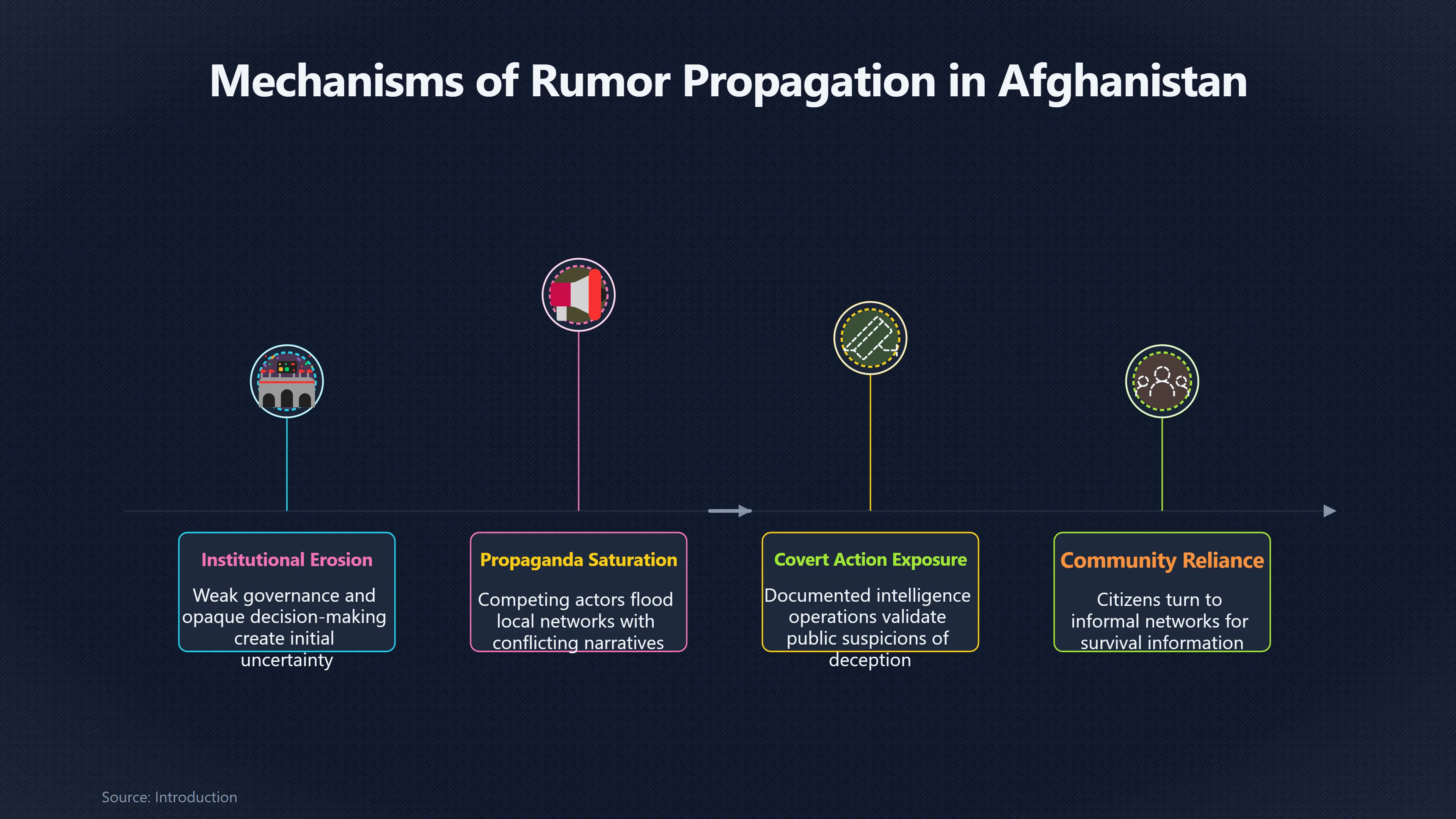
Afghanistan’s repeated rumour panics cannot be understood simply as examples of misinformation or irrational fear. For decades, ordinary Afghans lived through coups, invasion, civil war, foreign intervention, insurgency, covert operations and competing propaganda campaigns. In that environment, many rumours sounded plausible because genuine conspiracies, secret military operations and attacks on civilians were already part of everyday life. The result was a profound crisis of trust in which it became difficult to distinguish verified danger from imagined threats.
This helps explain why rumours about girls’ schools, vaccination campaigns, poisoned food, foreign aid organisations or hidden political plots spread so quickly. The central issue was not simply whether individual rumours were true or false, but how years of violence had weakened confidence in governments, media, humanitarian organisations and even scientific investigations.
Why real violence made rumours believable
Many societies experience conspiracy theories during periods of uncertainty. Afghanistan’s case was different because civilians repeatedly witnessed genuine acts of violence that had once seemed unimaginable.
Schools, hospitals, markets and mosques were all attacked during different phases of the conflict. Aid workers were kidnapped or killed. Intelligence agencies from several countries operated inside Afghanistan, while armed groups distributed propaganda alongside military operations. Ordinary people therefore learned that hidden actors could indeed influence daily life, making new rumours easier to believe.[ICRC]icrc.orgAfghanistan: Hospitals are under attack, and children are paying the price | International Committee of the Red CrossMay 30, 2017…
This blurred an important distinction between two very different questions:
- Did a specific rumour happen exactly as described?
- Was the underlying fear rooted in real experience?
Often the first answer was “probably not”, while the second was clearly “yes”.
For example, many alleged poisoning incidents in girls’ schools were never supported by toxicological evidence. Yet girls’ education had unquestionably been threatened through intimidation, bombings and targeted attacks. Parents therefore did not need to invent reasons to fear sending daughters to school; rumours merely attached themselves to existing anxieties.
Propaganda, covert action and foreign suspicion
Afghanistan became one of the world’s most heavily contested information environments. Governments, insurgent groups, foreign militaries and intelligence services all tried to influence public opinion.
Every side tried to shape public belief
The Taliban made extensive use of propaganda through local networks, religious messaging, printed “night letters”, radio broadcasts and later social media. Their messaging often portrayed foreign governments, aid agencies and the Afghan state as corrupt or anti-Islamic while presenting themselves as defenders of religion and national independence. The campaign relied not only on persuasion but also on intimidation, particularly in areas where civilians feared retaliation.[ecoi.net]ecoi.netInternational Crisis Group (Author): “Taliban Propaganda: Winning the War of Words?”, Document #1113444 - ecoi.net…
Government officials and international forces also ran strategic communications campaigns designed to win local support, promote reconstruction projects and undermine insurgent narratives. Because competing actors frequently contradicted one another, many Afghans came to assume that every public statement contained political motives.
Covert operations damaged public confidence
Suspicion was reinforced by genuine examples of intelligence activity.
One of the best-known cases occurred in neighbouring Pakistan when the US Central Intelligence Agency organised a fake vaccination campaign during the search for Osama bin Laden. Although the operation took place outside Afghanistan, news of it spread widely across the region. Medical organisations warned immediately that using healthcare as intelligence cover would undermine confidence in genuine vaccination programmes and endanger health workers. The United States later announced that it would no longer use vaccination campaigns for espionage.[BMJ]bmj.comFake vaccine campaign in Pakistan could threaten plans to eradicate polio | The BMJJuly 19, 2011…
For many Afghans, this episode appeared to confirm long-standing suspicions that humanitarian activities could conceal military or intelligence objectives. Even rumours unrelated to that operation gained credibility because at least one highly unusual conspiracy had proved real.

How weak institutions amplified uncertainty
Rumours spread fastest where trusted institutions were weakest.
Throughout much of the conflict, many communities had limited access to independent journalism, rapid forensic investigation or reliable public communication. Officials often issued statements before investigations had finished, while local media sometimes repeated unverified claims from provincial authorities or frightened witnesses.
When contradictory explanations later emerged, confidence declined further.
Instead of producing reassurance, official disagreement often reinforced suspicion that authorities were hiding information.
Three structural weaknesses repeatedly encouraged rumour:
- investigations that took days while rumours spread within hours;
- competing statements from local officials, security forces and medical staff;
- limited public confidence that any institution could provide a politically neutral account.
These conditions allowed uncertainty itself to become a driver of collective fear.
Why health campaigns became targets of suspicion
Public health illustrates how the crisis of trust extended beyond politics.
Vaccination teams worked in areas controlled by multiple armed groups while health workers sometimes faced threats, abductions or killings. Clinics were attacked, medical facilities damaged and vaccinators intimidated, making healthcare appear inseparable from the wider conflict.[ICRC]icrc.orgAfghanistan: Hospitals are under attack, and children are paying the price | International Committee of the Red CrossMay 30, 2017…
Against this background, rumours that vaccines caused infertility, gathered intelligence or served foreign political interests found receptive audiences. These beliefs were scientifically unsupported, but they developed within a society where military operations, humanitarian programmes and international intervention had become closely intertwined in public experience.
Research on Pakistan found that disclosure of the CIA’s fake vaccination programme significantly reduced childhood immunisation in areas where militant influence was strongest, demonstrating how intelligence operations could produce lasting public-health consequences beyond their immediate objective. Similar regional dynamics affected perceptions inside Afghanistan.[OUP Academic]academic.oup.comOUP AcademicIn Vaccines We Trust? The Effects of the CIA’s Vaccine Ruse on Immunization in Pakistan | Journal of the European Economic As…
More recent research on vaccine attitudes in Afghanistan likewise found that fears about hidden motives—including sterilisation, experimentation and foreign manipulation—remained common themes among hesitant groups, even though many participants also expressed trust in local health workers when communication came from credible community sources.[PMC]pmc.ncbi.nlm.nih.govGeneral publics’ perception toward COVID-19 vaccines in Afghanistan, 2021 - PMCJuly 7, 2023…
Why conspiracy thinking became a rational response to uncertainty
Calling Afghanistan’s experience simply a culture of conspiracy theories misses an important point.
Psychologists distinguish between believing every rumour and developing a heightened expectation that powerful actors may conceal important information. In Afghanistan, decades of documented covert operations, shifting alliances and opaque political decision-making encouraged the second response.
People frequently relied on:
- relatives rather than official announcements;
- local religious or community leaders rather than distant government agencies;
- eyewitness accounts rather than national media;
- informal networks that sometimes transmitted accurate warnings alongside false rumours.
These strategies could help communities survive during conflict, yet they also made sensational claims harder to correct once they began circulating.
The lasting legacy for collective scares
Afghanistan’s crisis of trust continues to shape how collective fears emerge.
Whether the subject is girls’ schools, disease outbreaks, humanitarian aid or foreign involvement, rumours spread most effectively when they fit experiences that people already consider plausible. Years of war ensured that hidden plots rarely seemed impossible.
This does not mean every rumour reflected reality. Rather, repeated exposure to genuine deception, violence and political manipulation lowered the threshold for believing new claims before evidence could be gathered.
For historians and social scientists, Afghanistan therefore provides an important reminder that collective scares often grow from real historical experience rather than simple irrationality. Propaganda succeeded most readily where institutions lacked credibility, while false rumours flourished because they echoed authentic memories of conflict, secrecy and betrayal. Understanding that distinction is essential for interpreting Afghanistan’s episodes of panic without dismissing the lived experiences that made those fears so compelling.



Endnotes
1.
Source: icrc.org
Link:https://www.icrc.org/en/document/afghanistans-hospitals-are-under-attack-and-children-are-paying-price
Source snippet
Afghanistan: Hospitals are under attack, and children are paying the price | International Committee of the Red CrossMay 30, 2017...
Published: May 30, 2017
2.
Source: ecoi.net
Link:https://www.ecoi.net/en/document/1113444.html
Source snippet
International Crisis Group (Author): “Taliban Propaganda: Winning the War of Words?”, Document #1113444 - ecoi.net...
3.
Source: bmj.com
Link:https://www.bmj.com/content/343/bmj.d4580
Source snippet
Fake vaccine campaign in Pakistan could threaten plans to eradicate polio | The BMJJuly 19, 2011...
Published: July 19, 2011
4.
Source: bmj.com
Link:https://www.bmj.com/content/bmj/348/bmj.g3494.full.pdf
Source snippet
"May 23, 2014 — US WILL NO LONGER USE VACCINATION PROGRAMS AS COVER FOR SPY OPERATIONS, WHITE HOUSE SAYS BMJ 2014; 348 doi: [https://doi.or..."](https://doi.or...")...
Published: May 23, 2014
5.
Source: bmj.com
Title: Taliban militants kill doctor working to eradicate polio | The BMJ
Link:https://www.bmj.com/content/354/bmj.i4967
Source snippet
Taliban militants kill doctor working to eradicate polio | The BMJ...
6.
Source: academic.oup.com
Link:https://academic.oup.com/jeea/article-pdf/20/1/150/42539450/jvab018.pdf
Source snippet
OUP AcademicIn Vaccines We Trust? The Effects of the CIA’s Vaccine Ruse on Immunization in Pakistan | Journal of the European Economic As...
7.
Source: pmc.ncbi.nlm.nih.gov
Link:https://pmc.ncbi.nlm.nih.gov/articles/PMC10339775/
Source snippet
General publics’ perception toward COVID-19 vaccines in Afghanistan, 2021 - PMCJuly 7, 2023...
Published: July 7, 2023
8.
Source: bmj.com
Link:https://www.bmj.com/content/390/bmj.r1383
Source snippet
The antivaccine movement threatens health in the US and worldwide | The BMJJuly 3, 2025 — THE ANTIVACCINE MOVEMENT THREATENS HEALTH IN TH...
Published: July 3, 2025
9.
Source: bmj.com
Link:https://www.bmj.com/content/384/bmj-2023-075564
Source snippet
USING SOCIAL MEDIA TO BUILD CONFIDENCE IN VACCINES: LESSONS FROM COMMUNITY ENGAGEMENT AND SOCIAL SCIENCE RESEARCH IN AFRICA BMJ 2024; 384...
10.
Source: bmj.com
Link:https://www.bmj.com/content/374/bmj.n2397
Source snippet
Afghanistan’s health system nears collapse as donors withdraw support | The BMJSeptember 29, 2021 — AFGHANISTAN’S HEALTH SYSTEM NEARS COL...
Published: September 29, 2021
11.
Source: gh.bmj.com
Link:https://gh.bmj.com/content/5/10/e004206
Source snippet
media and vaccine hesitancy | BMJ Global HealthSOCIAL MEDIA AND VACCINE HESITANCY Author affiliations • Steven Lloyd Wilson^{1}Image: Cor...
12.
Source: gh.bmj.com
Link:https://gh.bmj.com/content/8/12/e013470
Source snippet
party monitoring for health in Afghanistan: the good, the bad and the ugly | BMJ Global HealthTHE UGLY In addition to design and implemen...
Additional References
13.
Source: youtube.com
Title: Taliban Intensifies Propaganda War In Afghanistan | Reality Check
Link:https://www.youtube.com/watch?v=Gun7hTyNMAc
Source snippet
Afghanistan sees first polio vaccination campaign in three years...
14.
Source: youtube.com
Title: Afghanistan sees first polio vaccination campaign in three years
Link:https://www.youtube.com/watch?v=8qDy4jAgICU
Source snippet
Propaganda war between Taliban and the Afghan government...
15.
Source: youtube.com
Title: Afghanistan’s Propaganda War
Link:https://www.youtube.com/watch?v=L4JPmpo59Iw
Source snippet
Taliban Intensifies Propaganda War In Afghanistan | Reality Check...
16.
Source: youtube.com
Title: Bodyguard of Lies | Documentary Clip 5
Link:https://www.youtube.com/watch?v=GT9UMSVok50
Source snippet
Afghanistan's Propaganda War - The Listening Post (Full)...
17.
Source: youtube.com
Title: Propaganda war between Taliban and the Afghan government
Link:https://www.youtube.com/watch?v=VFzYOKp-2u0
Topic Tree