Within Saudi Arabia
How Did Witchcraft Accusations Become State Cases?
Vague definitions of sorcery allowed unfamiliar objects, folk practices and personal fears to become evidence in serious criminal cases.
On this page
- What officials treated as witchcraft or sorcery
- How ambiguous evidence endangered defendants
- Outsiders, media figures and fear driven complaints
Page outline Jump by section
Introduction
For much of the late twentieth and early twenty-first centuries, Saudi Arabia’s witchcraft prosecutions did not resemble the classic European witch hunts of the early modern period. Instead, they formed a recurring legal campaign in which accusations of sorcery could move from private suspicion to police investigation, religious enforcement and criminal trial. The defining feature was not a sudden wave of collective panic but a legal system that gave wide discretion to investigators and judges, allowing conduct as varied as fortune-telling, folk healing, preparing amulets, claiming supernatural powers or possessing unfamiliar ritual objects to become evidence in serious criminal cases. Human rights organisations repeatedly argued that the lack of a clear legal definition of “witchcraft” created a system in which accusations were difficult to challenge and convictions could rest on ambiguous or highly subjective evidence.[Human Rights Watch]hrw.orgHuman Rights WatchSaudi Arabia: Witchcraft and Sorcery Cases on the Rise | Human Rights WatchNovember 24, 2009…
What officials treated as witchcraft or sorcery
Unlike offences defined in a written criminal code, witchcraft and sorcery historically lacked a precise statutory definition in Saudi Arabia. Until major legal reforms in recent years, the kingdom had no comprehensive penal code defining criminal offences, leaving judges considerable discretion to determine whether particular behaviour amounted to sorcery under their interpretation of Islamic law. Human Rights Watch reported that even senior justice officials acknowledged there was no formal legal definition and could not specify what evidence was legally sufficient to prove the offence.[Human Rights Watch]hrw.orgHuman Rights WatchSaudi Arabia: Witchcraft and Sorcery Cases on the Rise | Human Rights WatchNovember 24, 2009…
In practice, investigations covered a broad range of activities, including:
- fortune-telling and astrology;
- offering supernatural cures;
- preparing charms, amulets or written talismans;
- claiming to influence relationships or health through hidden powers;
- consulting spirits or other unseen beings;
- commercial “healing” services presented as supernatural.
Because these activities overlapped with folk beliefs, traditional healing, religious practices and outright fraud, the boundary between deception, religious misconduct and criminal sorcery was often unclear. Critics argued that this uncertainty gave investigators broad scope to interpret unusual objects or claims as evidence of criminal behaviour.[Human Rights Watch]hrw.orgHuman Rights WatchSaudi Arabia: Witchcraft and Sorcery Cases on the Rise | Human Rights WatchNovember 24, 2009…
How ambiguous evidence endangered defendants
The machinery of accusation depended less on proving supernatural acts than on constructing a legal narrative around ordinary objects, witness testimony and confessions.
Cases frequently relied on combinations of:
- complaints from neighbours, relatives or dissatisfied clients;
- ritual objects such as papers bearing symbols, cords, herbs or containers;
- claims that illness, infertility or marital problems had supernatural causes;
- confessions that defendants later alleged had been extracted through coercion;
- testimony describing supposed magical effects that could not be independently verified.
Human Rights Watch highlighted that defendants often faced extraordinary evidential problems. Since the alleged offence concerned invisible supernatural influence, courts could not rely on conventional forensic evidence. Instead, judges sometimes accepted witness accounts that someone had caused impotence, illness or family breakdown through sorcery, even though such claims could not be objectively tested.[Human Rights Watch]hrw.orgOpen source on hrw.org.
The case of Fawza Falih became one of the best-known examples. Arrested in 2005 and sentenced to death, she was accused of witchcraft after complaints from local people and the discovery of items interpreted as magical objects. According to Human Rights Watch, her conviction relied heavily on a confession she said was obtained through beatings, along with witness statements alleging supernatural harm. She later withdrew the confession, but the court nevertheless imposed a discretionary death sentence, arguing that execution served the public interest. The organisation also documented procedural concerns, including limited legal representation and failures to investigate allegations of coercion.[Human Rights Watch]hrw.orgOpen source on hrw.org.

How complaints became state prosecutions
One striking feature of Saudi witchcraft cases was the degree to which accusations became institutionalised rather than remaining local disputes.
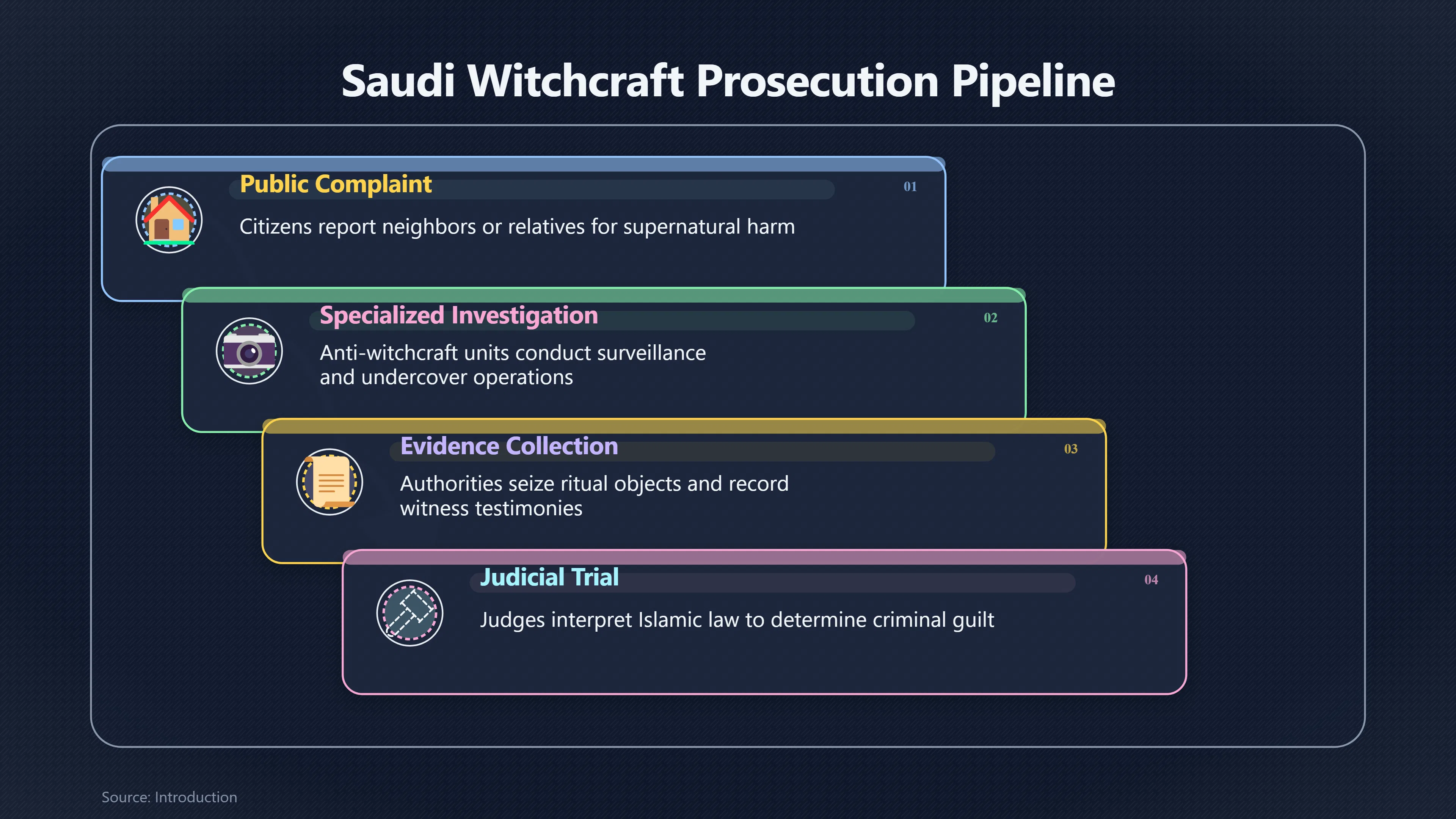
During the 2000s, religious police established specialised anti-witchcraft units and encouraged members of the public to report suspected practitioners. Media reports described dedicated investigators conducting surveillance and undercover operations intended to catch alleged sorcerers offering magical services for payment. Rather than waiting for violent incidents, authorities often initiated prosecutions after receiving complaints from clients, relatives or concerned citizens.[Foreign Policy]foreignpolicy.comOpen source on foreignpolicy.com.
This transformed personal suspicions into formal criminal investigations. A failed marriage, unexplained illness or family conflict could lead complainants to seek official intervention if they believed supernatural forces were responsible. Once authorities accepted the allegation, the investigation entered the ordinary criminal justice process, with arrests, interrogations and trials following procedures used for other offences, despite the unusual nature of the underlying accusation.[Human Rights Watch]hrw.orgHuman Rights WatchSaudi Arabia: Witchcraft and Sorcery Cases on the Rise | Human Rights WatchNovember 24, 2009…
Outsiders, media figures and fear-driven complaints
Many high-profile defendants were people already viewed as socially or culturally distinct from the communities around them.
Foreign workers appeared disproportionately in reported cases. Human Rights Watch noted prosecutions involving migrants from Africa and Asia, while later reporting documented hundreds of sorcery prosecutions over a relatively short period, including cases against foreign domestic workers. Language barriers, limited legal representation and unfamiliarity with Saudi legal procedures could leave such defendants especially vulnerable.[Human Rights Watch]hrw.orgsaudi arabiaHuman Rights WatchWorld Report 2015: World Report 2015: Saudi Arabia | Human Rights Watch…
Media personalities also became targets. Lebanese television presenter Ali Sibat was arrested while on pilgrimage after authorities objected to fortune-telling broadcasts he had made from Lebanon. Although the programmes had been transmitted outside Saudi Arabia, prosecutors argued that his predictions constituted sorcery. His case drew international attention because it illustrated how media activities could become evidence in witchcraft prosecutions when they entered Saudi jurisdiction.[Human Rights Watch]hrw.orgsaudi arabiaHuman Rights WatchWorld Report 2011: World Report 2011: Saudi Arabia | Human Rights Watch…
Another widely discussed prosecution involved Sudanese national Abdul Hamid al-Fakki, who was accused after an undercover operation in which an investigator allegedly requested a spell affecting a family relationship. Amnesty International argued that his subsequent execution demonstrated how allegations of supernatural influence could become capital cases despite the absence of a clearly defined criminal offence.[Amnesty International]amnesty.orgInternational Saudi Arabia executes man convicted of "sorceryAmnesty InternationalSaudi Arabia executes man convicted of "sorcery" - Amnesty International…
Why fear and uncertainty made accusations persuasive
Most accusations reflected everyday anxieties rather than spectacular claims about organised conspiracies.
Complaints commonly centred on:
- unexplained illness;
- infertility or sexual problems;
- broken engagements or marriages;
- financial misfortune;
- sudden changes in behaviour;
- family conflict.
In communities where belief in supernatural influence was religiously meaningful, attributing misfortune to sorcery offered an explanation for otherwise puzzling events. Authorities did not simply create these beliefs; rather, they operated within a social environment in which many complainants sincerely believed they had been harmed through hidden supernatural means. The legal system therefore became a mechanism for responding to fears that already existed in society.[Foreign Policy]foreignpolicy.comOpen source on foreignpolicy.com.
At the same time, historians and legal scholars caution against interpreting every complaint as evidence of widespread social panic. The pattern was typically one of repeated individual accusations processed through state institutions, not a single nationwide outbreak of mass hysteria. The continuity of prosecutions over many years points instead to an enduring interaction between popular belief, religious doctrine and discretionary legal authority.
Why the prosecutions remain significant
Saudi witchcraft prosecutions continue to attract attention because they demonstrate how ambiguous criminal categories can allow personal fears and culturally meaningful beliefs to enter the machinery of the state.
Human rights organisations consistently criticised the absence of clear legal definitions, the reliance on confessions and witness testimony, and procedural shortcomings in several prominent trials. They argued that these features made it difficult for defendants to challenge allegations whose central claims could not be objectively tested.[Human Rights Watch]hrw.orgHuman Rights WatchSaudi Arabia: Witchcraft and Sorcery Cases on the Rise | Human Rights WatchNovember 24, 2009…
For historians of moral panics and collective belief, the Saudi experience illustrates an important distinction. The country’s witchcraft cases were not primarily spontaneous eruptions of public hysteria. Instead, they were recurring state prosecutions in which longstanding beliefs about supernatural harm, combined with broad judicial discretion and institutional enforcement, enabled vague suspicions, unusual objects and fear-driven complaints to become matters for criminal courts.
Amazon book picks
Further Reading
Books and field guides related to How Did Witchcraft Accusations Become State Cases?. Use these as the next step if you want deeper reading beyond the article.


A history of Saudi Arabia
Explains the legal and religious framework behind witchcraft prosecutions.

Endnotes
1.
Source: amnesty.org
Title: International Saudi Arabia executes man convicted of “sorcery”
Link:https://www.amnesty.org/en/latest/news/2011/09/saudi-arabia-executes-man-convicted-sorcery-2/
Source snippet
Amnesty InternationalSaudi Arabia executes man convicted of "sorcery" - Amnesty International...
2.
Source: amnesty.org
Title: Saudi Arabia: Beheading for ‘sorcery’ shocking
Link:https://www.amnesty.org/en/latest/news/2011/12/saudi-arabia-beheading-sorcery-shocking-2/
3.
Source: amnesty.org
Title: Saudi Arabia: Beheading for “sorcery” shocking
Link:https://www.amnesty.org/en/latest/press-release/2011/12/saudi-arabia-beheading-sorcery-shocking/
4.
Source: hrw.org
Link:https://www.hrw.org/news/2009/11/24/saudi-arabia-witchcraft-and-sorcery-cases-rise
Source snippet
Human Rights WatchSaudi Arabia: Witchcraft and Sorcery Cases on the Rise | Human Rights WatchNovember 24, 2009...
Published: November 24, 2009
5.
Source: hrw.org
Link:https://www.hrw.org/news/2008/02/13/saudi-arabia-halt-womans-execution-witchcraft
6.
Source: foreignpolicy.com
Link:https://foreignpolicy.com/2011/12/13/how-do-you-prove-someones-a-witch-in-saudi-arabia/
7.
Source: hrw.org
Title: saudi arabia
Link:https://www.hrw.org/world-report/2015/country-chapters/saudi-arabia
Source snippet
Human Rights WatchWorld Report 2015: World Report 2015: Saudi Arabia | Human Rights Watch...
8.
Source: hrw.org
Title: saudi arabia
Link:https://www.hrw.org/world-report/2011/country-chapters/saudi-arabia
Source snippet
Human Rights WatchWorld Report 2011: World Report 2011: Saudi Arabia | Human Rights Watch...
9.
Source: hrw.org
Link:https://www.hrw.org/news/2008/02/12/letter-hrh-king-abdullah-bin-abd-al-aziz-al-saud-witchcraft-case
10.
Source: hrw.org
Link:https://www.hrw.org/reports/1997/saudi/Saudi-03.htm
Additional References
11.
Source: ukm.my
Title: jcil 2024 92 article 3
Link:https://www.ukm.my/jcil/jcil-2024-92-article-3/
Source snippet
JCIL 2024 9(2) Article 3 | Journal of Contemporary Islamic LawDecember 25, 2024 — 2024 9(2) DECEMBER 2024 Image: Cover JCIL 2024 9(2) PEM...
Published: December 25, 2024
12.
Source: youtube.com
Title: Crazy bans in Saudi Arabia and how they’re changing now
Link:https://www.youtube.com/watch?v=tg7lRBjuECw
Source snippet
Jay-Z, bull-running, magic: Saudi Arabia's entertainment plans for 2019...
13.
Source: ijsu.researchcommons.org
Link:https://ijsu.researchcommons.org/ijsu/vol1/iss1/2/
Source snippet
sorceryJanuary 1, 2021 — CRIMINAL RESPONSIBILITY FOR ACTS OF WITCHCRAFT AND SORCERY * حمود حيدر مبارك العويلي, جامعة الامام جعفر الصادق (...
Published: January 1, 2021
14.
Source: youtube.com
Title: On Patrol with Saudi Arabia’s Religious Police
Link:https://www.youtube.com/watch?v=c2vbs9ZppP4
Source snippet
Crazy bans in Saudi Arabia and how they're changing now...
15.
Source: hse.ru
Link:https://www.hse.ru/en/edu/vkr/833991865
16.
Source: alaw.uomosul.edu.iq
Link:https://alaw.uomosul.edu.iq/index.php/alaw/ar/article/view/48993
17.
Source: saudipedia.com
Link:https://saudipedia.com/en/the-general-presidency-of-the-commission-for-promotion-of-virtue-and-prevention-of-vice
18.
Source: annualreviews.org
Title: The Regulation of Witchcraft and Sorcery Practices and Beliefs | Annual Reviews
Link:https://www.annualreviews.org/content/journals/10.1146/annurev-lawsocsci-110615-084600
19.
Source: rt.com
Title: Saudi religious police hunt down Twitter ‘witchcraft’ accounts — RT World News
Link:https://www.rt.com/news/saudi-twitter-religion-police-828/
20.
Source: investing.com
Title: Lashes for Saudi woman who called morality police liars: newspaper By Reuters
Link:https://www.investing.com/news/economy/article-303856
Topic Tree