Within Botswana Panics
Why Did So Many Pupils Fall Ill Together?
Botswana's school outbreaks show how genuine symptoms can spread through stress and social contact without infection or poisoning.
On this page
- What happened at Lempu school
- How mass psychogenic illness spreads
- Why schools are especially vulnerable
Page outline Jump by section
Introduction
Botswana’s best-documented example of a school-wide illness outbreak is the 2019 episode at Lempu Community Junior Secondary School in Kweneng District. More than a hundred pupils, most of them boarding girls, developed alarming symptoms including difficulty walking, abnormal leg movements, numbness, headaches, hallucinations and temporary visual disturbances. Initial fears naturally centred on poisoning, infection or another environmental hazard. However, medical investigations did not identify an infectious disease or toxic exposure. Instead, health authorities diagnosed the outbreak as mass psychogenic illness (MPI), sometimes called epidemic hysteria or functional mass illness: a phenomenon in which genuine physical symptoms spread through a group without a shared infectious or chemical cause.[PMC]pmc.ncbi.nlm.nih.govMay 30, 2022…
The Lempu outbreak is important because it illustrates how fear, stress and close social contact can produce real illness without implying that pupils were pretending or imagining their symptoms. It also shows why school outbreaks can become part of wider public anxieties, especially where rumours circulate faster than medical explanations.
What happened at Lempu school?
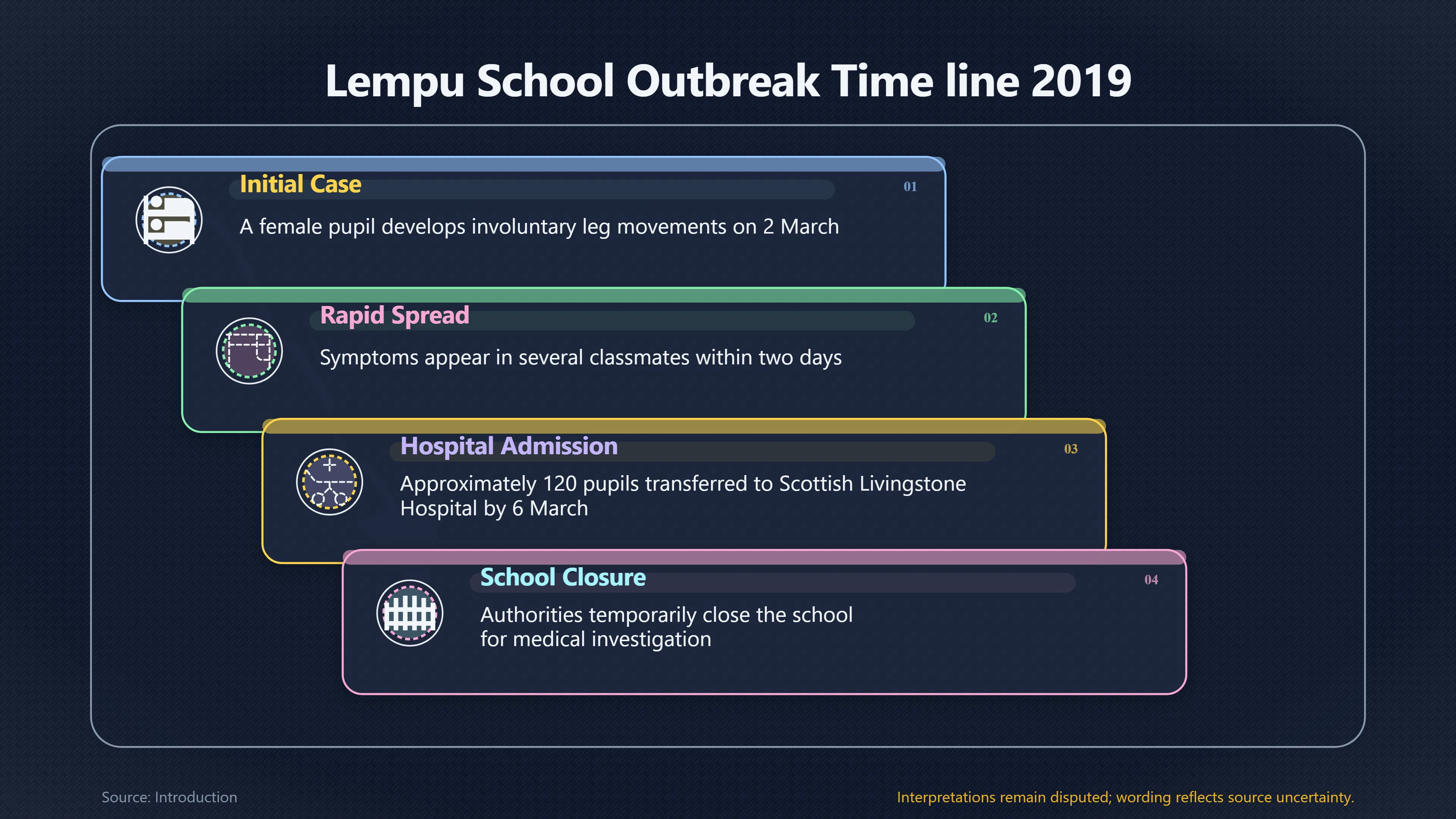
The outbreak began on 2 March 2019 when a female boarding pupil suddenly developed unusual involuntary leg movements and difficulty standing. Within two days several more girls presented with similar symptoms. As classmates observed the illness, the number of affected pupils increased rapidly. By 6 March approximately 120 pupils had been transferred to Scottish Livingstone Hospital, and eventually 133 students were admitted. The school temporarily closed while health officials investigated.[PMC]pmc.ncbi.nlm.nih.govMay 30, 2022…
Symptoms varied between pupils but commonly included:
- difficulty walking or standing;
- involuntary leg movements;
- headaches;
- numbness of the lower limbs;
- temporary visual impairment or perceived blindness;
- hallucinations or unusual perceptions.
Although the symptoms were dramatic, doctors found no evidence of a contagious infection, poisoning or neurological disease affecting the group. The pattern instead matched internationally recognised descriptions of mass psychogenic illness.[PMC]pmc.ncbi.nlm.nih.govMay 30, 2022…
The early uncertainty mattered. Before medical explanations became widely understood, parents and local communities naturally worried that an unknown disease or environmental danger threatened the children. Such uncertainty is common in school outbreaks and can encourage rumours before laboratory investigations are complete.[Daily News]dailynews.gov.bwOpen source on dailynews.gov.bw.
How mass psychogenic illness spreads
Mass psychogenic illness does not mean the symptoms are fake. The pain, weakness, dizziness or movement problems experienced by affected people are real. The defining feature is that they arise through psychological and social mechanisms rather than from a shared biological agent.
The investigation into the Lempu outbreak found several factors associated with becoming ill:
- living in the boarding hostels;
- previous exposure to traumatic experiences;
- previous contact with psychologists or social workers;
- close contact with already affected pupils;
- consultation with spiritual healers;
- concerns about the boarding environment, including perceptions of poor lighting and inadequate security.[PMC]pmc.ncbi.nlm.nih.govMay 30, 2022…
The strongest predictor was residence in the boarding facilities. Boarding pupils shared sleeping spaces, routines and constant social contact, creating ideal conditions for observing classmates’ symptoms and becoming increasingly anxious about developing them themselves. Researchers also found evidence that the illness spread through seeing and interacting with affected pupils rather than through exposure to a physical hazard.[PMC]pmc.ncbi.nlm.nih.govMay 30, 2022…
This pattern fits international research on mass psychogenic illness, where outbreaks often begin with one or a few individuals before spreading through observation, discussion and heightened concern, particularly in cohesive groups.

Why schools are especially vulnerable
Schools combine several conditions that can make psychogenic outbreaks more likely.
First, adolescents experience major emotional and social pressures. Examinations, separation from family, peer relationships and uncertainty about the future all contribute to stress.
Second, boarding schools intensify social interaction. Pupils eat, sleep, study and socialise together, meaning unusual symptoms are quickly noticed and discussed.
Third, uncertainty encourages interpretation. When the first illnesses have no obvious explanation, pupils, parents and staff naturally search for causes. Competing explanations—including environmental hazards, infectious disease or spiritual beliefs—can increase anxiety while investigations are still underway.
Finally, schools are communities built on close observation. When students repeatedly witness classmates collapsing, shaking or struggling to walk, heightened vigilance towards their own bodily sensations can contribute to further cases among susceptible individuals.[PMC]pmc.ncbi.nlm.nih.govMay 30, 2022…
None of these factors imply deliberate behaviour. Rather, they help explain why schools around the world are among the most common settings for documented episodes of mass psychogenic illness.
What the Botswana investigation found
The Lempu outbreak became more than a local news story because it was later investigated scientifically through a case-control study involving affected and unaffected pupils.
The researchers concluded that the outbreak showed the classic features of mass psychogenic illness:
- it predominantly affected adolescent girls;
- nearly all cases involved boarding pupils;
- symptoms spread rapidly over a short period;
- no infectious or toxic cause explained the pattern;
- psychological and environmental factors were stronger predictors than physical exposures.[PMC]pmc.ncbi.nlm.nih.govMay 30, 2022…
Rather than recommending medical treatment alone, the investigators argued for practical changes that reduced stress within the school environment. These included improving boarding conditions, providing continuing psychological support and addressing pupils’ concerns about safety and welfare.[PMC]pmc.ncbi.nlm.nih.govMay 30, 2022…
This approach reflects modern understanding of mass psychogenic illness: removing stressors and reassuring affected communities are often more effective than repeatedly searching for diseases that evidence does not support.

Misunderstanding and rumour
Because the symptoms are genuine and sometimes dramatic, mass psychogenic illness is frequently misunderstood. Community members may suspect poisoning, supernatural forces or hidden environmental dangers, especially during the early stages when no explanation is available.
The Botswana case illustrates why careful communication is essential. Public reassurance cannot simply dismiss symptoms as “imaginary”, because affected pupils are genuinely distressed. Equally, authorities must investigate thoroughly enough to rule out infection or toxic exposure before concluding that psychogenic mechanisms are responsible.[PMC]pmc.ncbi.nlm.nih.govMay 30, 2022…
In Botswana, the later scientific investigation strengthened confidence that the diagnosis rested on evidence rather than assumption. The researchers documented specific social and psychological risk factors instead of treating the outbreak merely as unexplained “mass hysteria”.[PMC]pmc.ncbi.nlm.nih.govMay 30, 2022…
Why the Lempu outbreak matters
Within Botswana’s wider history of collective fears, the Lempu school outbreak represents a different kind of episode from ritual murder rumours or occult scares. The central issue was not a shared belief in a hidden enemy but the rapid spread of real physical symptoms through a vulnerable school community under conditions of stress.
The case has become an important reference point because it provides one of Botswana’s clearest documented examples of mass psychogenic illness investigated with modern epidemiological methods. It demonstrates that collective illness can occur without infection, poisoning or deliberate deception, while also highlighting the importance of school environments, mental wellbeing and effective public communication.
The lasting lesson is that outbreaks like Lempu require both medical investigation and psychological understanding. Only by addressing both can authorities reassure families, reduce unnecessary fear and support pupils experiencing genuine illness.[PMC]pmc.ncbi.nlm.nih.govMay 30, 2022…



Endnotes
1.
Source: pmc.ncbi.nlm.nih.gov
Link:https://pmc.ncbi.nlm.nih.gov/articles/PMC9210177/
Source snippet
May 30, 2022...
Published: May 30, 2022
2.
Source: pubmed.ncbi.nlm.nih.gov
Link:https://pubmed.ncbi.nlm.nih.gov/35747341/
Source snippet
Predictors of mass psychogenic illness in a junior secondary school in rural Botswana: A case control study - PubMed...
3.
Source: dailynews.gov.bw
Link:https://dailynews.gov.bw/news-detail/47826
4.
Source: dailynews.gov.bw
Title: Daily News
Link:https://dailynews.gov.bw/news-detail/48411
Additional References
5.
Source: scielo.org.za
Link:https://scielo.org.za/scielo.php?pid=S2078-67862022000100038&script=sci_arttext
Source snippet
May 30, 2022 — Predictors of mass psychogenic illness in a junior secondary school in rural Botswana: A case control study Keatlaretse Si...
Published: May 30, 2022
6.
Source: sajp.org.za
Link:https://sajp.org.za/index.php/sajp/article/view/1671
Source snippet
ournal of PsychiatryMay 30, 2022 — Affiliation Home ▶ Vol 28 (2022) ▶ Siamisang ORIGINAL RESEARCH PREDICTORS OF MASS PSYCHOGENIC ILLNESS...
Published: May 30, 2022
7.
Source: sajp.org.za
Link:https://sajp.org.za/index.php/sajp/article/view/1671/2648
Source snippet
ournal of Psychiatry...
8.
Source: youtube.com
Title: East African Laughing Epidemic – History Documentary
Link:https://www.youtube.com/watch?v=pGVvD7hlYzI
Source snippet
Episode 71. Frenzy – The Turmoil of Mass Psychogenic Illness...
9.
Source: youtube.com
Title: Episode 71. Frenzy – The Turmoil of Mass Psychogenic Illness
Link:https://www.youtube.com/watch?v=e2AdorYLDF8
Source snippet
Is it PANDAS? Mystery Illness in Leroy, NY...
10.
Source: researchgate.net
Link:https://www.researchgate.net/publication/361074168_Predictors_of_mass_psychogenic_illness_in_a_junior_secondary_school_in_rural_Botswana_A_case_control_study
11.
Source: scielo.org.za
Link:https://www.scielo.org.za/scielo.php?pid=S2078-67862022000100038&script=sci_abstract
12.
Source: journals.co.za
Link:https://journals.co.za/doi/abs/10.4102/sajpsychiatry.v28i0.1671
13.
Source: scielo.org.za
Link:https://scielo.org.za/scielo.php?lng=pt&nrm=iso&pid=S2078-67862022000100038&script=sci_abstract&tlng=en
14.
Source: youtube.com
Title: Teens’ uncontrollable mystery illness
Link:https://www.youtube.com/watch?v=JcKL8ihDL2Y
Source snippet
East African Laughing Epidemic – History Documentary...
Topic Tree