Within Ivory Coast Beliefs
Who Decided Which Ivorian Movements Were Cults?
Colonial officials often treated independent churches and spiritual movements as threats when they challenged European authority.
On this page
- Why colonial authorities distrusted independent churches
- Rumour, urbanisation and political uncertainty
- How modern scholars reassess hostile labels
Page outline Jump by section
Introduction
In colonial Ivory Coast, the question of who counted as a dangerous “cult” was rarely settled by neutral evidence alone. French administrators, European missionaries and African religious leaders often disagreed sharply about which movements represented legitimate Christianity, which were politically troublesome, and which threatened public order. Modern historians argue that many groups labelled as suspicious “sects” or “cults” were in fact African-led Christian movements responding to colonial disruption, rapid social change and local spiritual concerns rather than secretive or inherently dangerous organisations.[mdpi.com]mdpi.comMultilingual Complexities in the Origins and Development of the Harrist Movement and Its Worship Patterns in Ivory CoastSeptember 19…

Understanding these colonial labels matters because they shaped how religious minorities were treated, how rumours spread and how later generations remembered the period. Rather than accepting colonial descriptions at face value, scholars now ask who applied such labels, what political interests they served and how African believers understood their own movements.
Who decided which Ivorian movements were “cults”?
Under French colonial rule, the state claimed authority over public order, while Catholic and Protestant missions sought to define acceptable forms of Christianity. African prophets and independent churches occupied an uncomfortable position between these institutions. They often adopted Christian teachings but rejected European control over worship, leadership and religious authority.
As a result, descriptions such as “sect”, “native cult” or “prophetic cult” frequently reflected colonial anxieties rather than objective assessments of a movement’s behaviour. The same organisation might be celebrated by followers as a Christian revival, viewed cautiously by missionaries as theological competition and regarded by administrators as a possible political risk.[persee.fr]persee.frPerséeProphétismes africains: le Harrisme en Côte-d'Ivoire / African Prophetisms: Harrism in the Ivory Coast - Persée…
The Harrist movement illustrates this tension particularly well. William Wadé Harris preached repentance, baptism and the rejection of many traditional ritual objects while remaining outside European missionary structures. His extraordinary popularity unsettled both colonial officials and established missions because it demonstrated that an African preacher could inspire a mass religious movement without European leadership.[mdpi.com]mdpi.comMultilingual Complexities in the Origins and Development of the Harrist Movement and Its Worship Patterns in Ivory CoastSeptember 19…
Why colonial authorities distrusted independent churches
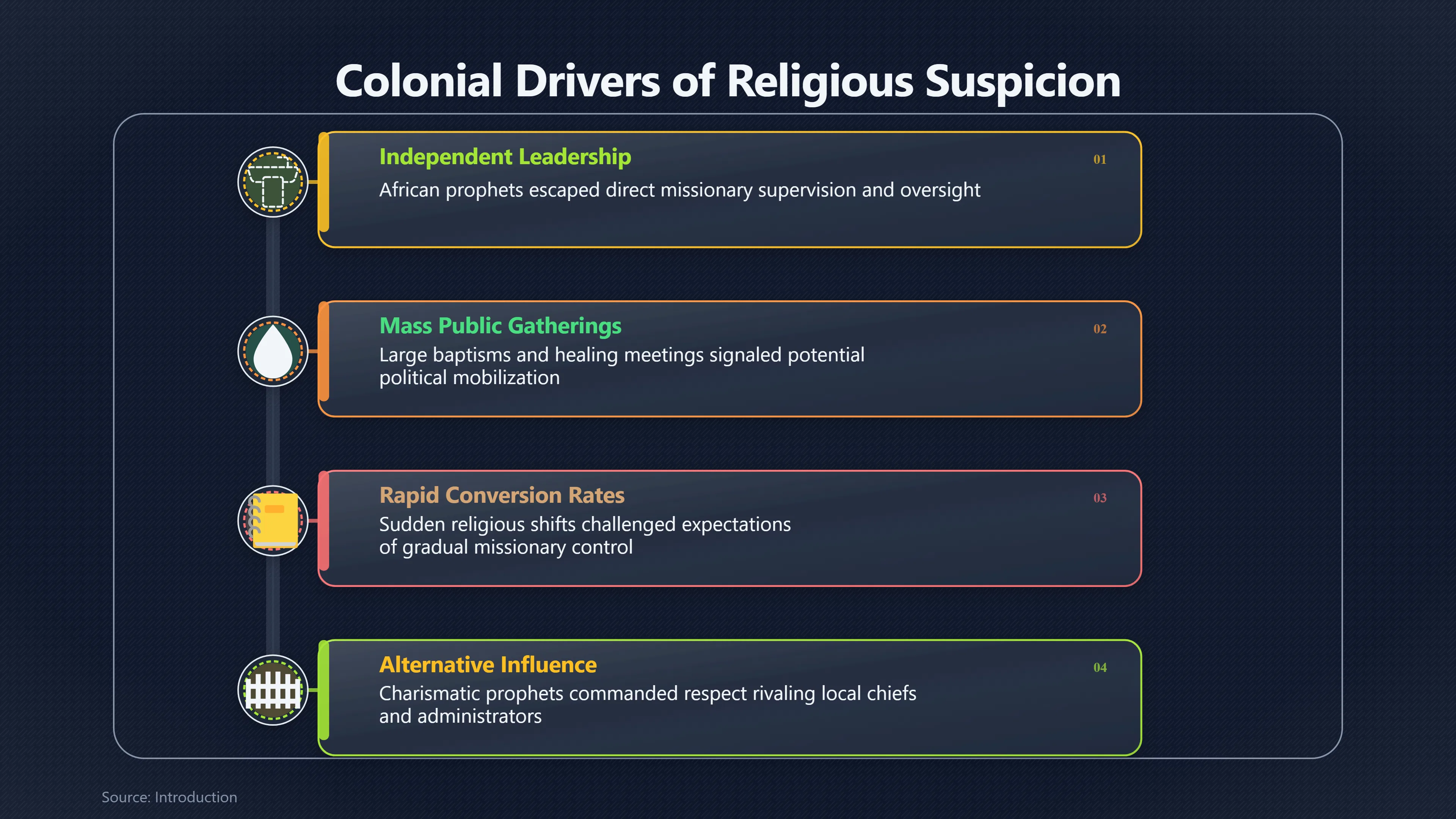
Colonial suspicion usually had less to do with unusual beliefs than with questions of authority.
Several factors repeatedly worried officials:
- Independent leadership. Churches led by African prophets escaped direct missionary supervision.
- Large public gatherings. Mass baptisms, healing meetings and preaching tours could be mistaken for political mobilisation.
- Rapid conversion. Sudden religious change challenged colonial expectations that missions would gradually control Christian education and organisation.
- Alternative sources of influence. Charismatic prophets often commanded respect that rivalled chiefs, missionaries or administrators.
This did not mean every movement was persecuted equally. Colonial responses ranged from observation and regulation to cooperation, depending on whether officials believed a movement encouraged obedience, resisted colonial authority or simply operated outside recognised institutions. Historians therefore caution against assuming that every official description of a “cult” reflected actual danger.[africabib.org]africabib.orgOpen source on africabib.org.
An important irony is that colonial governments themselves sometimes disagreed with missionaries. Relations between French administrators and Catholic missions were not always harmonious, especially during the colony’s early decades, demonstrating that colonial definitions of acceptable religion were themselves politically negotiated rather than fixed.[Brepols Online]brepolsonline.netBrepols OnlineAux prémices de l’Église catholique en Côte d’Ivoire coloniale (1895-1914). Une histoire contrariée | Brepols OnlineJanuary…
Rumour, urbanisation and political uncertainty
Religious suspicion flourished during a period of profound social transformation. Expanding colonial administration, labour migration, new roads, plantation agriculture and growing towns disrupted older social relationships and created uncertainty about identity, authority and moral order.
In this environment, rumours spread easily. A successful prophet could be praised as a divinely inspired reformer in one community while being described elsewhere as a dangerous deceiver or political agitator. These contrasting stories reflected competition over influence as much as disagreements over doctrine.
Urban growth also changed religious life. New migrants encountered unfamiliar churches, healing ministries and prophetic preachers while living alongside people from many ethnic and religious backgrounds. Researchers studying religion in Abidjan found that rapid urbanisation reshaped attitudes towards traditional practices, Christianity and Islam, with religious affiliation becoming intertwined with broader questions about modernity, education and social advancement.[Persée]persee.frPersée Religions dans la ville. Croyances et changements sociaux à AbidjanPerséeReligions dans la ville. Croyances et changements sociaux à Abidjan - Persée…
Rather than producing a single colonial panic, these conditions encouraged recurring episodes of suspicion in which unfamiliar religious movements were interpreted through fears about social change.
Harrism as a case study in hostile labelling
The history of Harrism shows why historians distinguish between colonial labels and later evidence.
During William Wadé Harris’s preaching tour between 1913 and 1915, observers recorded remarkable scenes of mass baptism and the destruction of ritual objects associated with older religious practices. To colonial observers unfamiliar with African prophetic Christianity, such events could appear emotionally charged or socially disruptive.[MDPI]mdpi.comMultilingual Complexities in the Origins and Development of the Harrist Movement and Its Worship Patterns in Ivory CoastSeptember 19…
Yet subsequent history tells a different story. Rather than developing into an isolated or violent organisation, the Harrist movement became one of West Africa’s largest African Independent Churches, establishing clergy, regular worship and enduring institutions. By the mid-twentieth century it had attracted more followers in parts of southern Ivory Coast than some mission churches.[Cambridge University Press & Assessment]cambridge.orgCambridge University Press & AssessmentBref Aperçu sur les principaux Cultes syncrétiques de la basse Côte d'Ivoire | Africa | Cambridge…
Later scholarship has also shown that published missionary accounts sometimes reshaped Harris’s story to fit institutional priorities. Comparisons between original notes and edited publications suggest that aspects of his life and message were modified to make his movement appear more compatible with missionary expectations. This reminds historians that colonial records must be read critically rather than accepted as transparent descriptions of events.[AfricaBib]africabib.orgOpen source on africabib.org.

How modern scholars reassess hostile labels
Contemporary historians, anthropologists and scholars of religion generally avoid calling African Independent Churches “cults” unless they are explicitly analysing historical language.
Instead, they ask different questions:
- Who used the label?
- What political or religious interests did it serve?
- How did members understand their own beliefs?
- Did the movement actually promote coercion, violence or isolation, or was it simply independent of colonial control?
This shift reflects a broader reassessment of colonial archives. Researchers recognise that administrative reports often mixed genuine security concerns with racial assumptions about African leadership and expectations that legitimate religion should resemble European church structures.[Persée]persee.frPersée Espace, savoir, pouvoir: les « prophètes » ivoiriensPerséeEspace, savoir, pouvoir: les « prophètes » ivoiriens - Persée…
The result is a more nuanced picture in which prophetic Christianity is understood as part of African responses to colonialism rather than simply as evidence of irrational collective behaviour.
Why this history still matters
The colonial habit of labelling unfamiliar religious movements as dangerous has had lasting effects on how Ivorian religious history is remembered. It reminds readers that terms such as “cult”, “sect” and “fanatic” are not neutral descriptions but can be tools of power, especially when applied by governments or dominant religious institutions to minority groups.
For Ivory Coast, modern scholarship places less emphasis on sensational stories about supposed colonial “cults” and more on the social struggles beneath them: who controlled religious authority, how communities adapted to colonial rule, and why African-led churches became powerful expressions of both Christian faith and local autonomy. Understanding that distinction helps separate documented episodes of social fear from the more complex historical reality of religious innovation under colonial rule.[mdpi.com]mdpi.comMultilingual Complexities in the Origins and Development of the Harrist Movement and Its Worship Patterns in Ivory CoastSeptember 19…
Amazon book picks
Further Reading
Books and field guides related to Who Decided Which Ivorian Movements Were Cults?. Use these as the next step if you want deeper reading beyond the article.

African religions and philosophy
Explains African religious traditions beyond colonial labels.

African traditional religions in contemporary society
First published 1991. Subjects: Religion, Study and teaching, Congresses, Étude et enseignement, PRO Shaw, Gwendolyn Dubois, 1968- (donor).
Endnotes
1.
Source: mdpi.com
Link:https://www.mdpi.com/2077-1444/15/9/1128
Source snippet
Multilingual Complexities in the Origins and Development of the Harrist Movement and Its Worship Patterns in Ivory CoastSeptember 19...
2.
Source: africabib.org
Link:https://www.africabib.org/rec.php?RID=157260461
3.
Source: africabib.org
Link:https://www.africabib.org/rec.php?RID=833044087
4.
Source: cambridge.org
Link:https://www.cambridge.org/core/journals/africa/article/abs/bref-apercu-sur-les-principaux-cultes-syncretiques-de-la-basse-cote-divoire/6059A0E7680A648260F1F5EA0B351AB5
Source snippet
Cambridge University Press & AssessmentBref Aperçu sur les principaux Cultes syncrétiques de la basse Côte d'Ivoire | Africa | Cambridge...
5.
Source: cambridge.org
Link:https://www.cambridge.org/core/journals/politics-and-religion/article/when-political-crises-result-in-secularization-the-secularist-effects-of-the-crisis-in-cote-divoire/6B8E5EAC5C3544401176BE8759D2DD4E
6.
Source: cambridge.org
Link:https://www.cambridge.org/core/journals/africa/article/islam-in-and-out-cosmopolitan-patriotism-and-xenophobia-among-muslims-in-cote-divoire/57441666A68BD2E37986730EA11AA056
7.
Source: africabib.org
Link:https://www.africabib.org/rec.php?RID=195448952
8.
Source: africabib.org
Link:https://www.africabib.org/rec.php?RID=192829149
9.
Source: africabib.org
Link:https://www.africabib.org/rec.php?DB=p&RID=192829149
10.
Source: africabib.org
Link:https://www.africabib.org/rec.php?RID=192757342
11.
Source: africabib.org
Link:https://www.africabib.org/rec.php?RID=190107502
12.
Source: africabib.org
Link:https://africabib.org/rec.php?DB=p&RID=190107502
13.
Source: persee.fr
Link:https://www.persee.fr/doc/assr_0335-5985_1976_num
Source snippet
PerséeProphétismes africains: le Harrisme en Côte-d'Ivoire / African Prophetisms: Harrism in the Ivory Coast - Persée...
14.
Source: brepolsonline.net
Link:https://www.brepolsonline.net/content/journals/10.1484/J.RHE.5.14275
Source snippet
Brepols OnlineAux prémices de l’Église catholique en Côte d’Ivoire coloniale (1895-1914). Une histoire contrariée | Brepols OnlineJanuary...
15.
Source: persee.fr
Title: Persée Religions dans la ville. Croyances et changements sociaux à Abidjan
Link:https://www.persee.fr/doc/assr_0335-5985_1975_num_40_1_1932_t1
Source snippet
PerséeReligions dans la ville. Croyances et changements sociaux à Abidjan - Persée...
16.
Source: persee.fr
Title: Persée Espace, savoir, pouvoir: les « prophètes » ivoiriens
Link:https://www.persee.fr/doc/gradh_0764-8928_1987_num
Source snippet
PerséeEspace, savoir, pouvoir: les « prophètes » ivoiriens - Persée...
17.
Source: persee.fr
Title: Bureau (René). Le Prophète de la Lagune. Les harristes de Côte d’Ivoire
Link:https://www.persee.fr/doc/assr_0335-5985_1996_num_96_1_1049_t1
18.
Source: countrystudies.us
Title: Ivory Coast
Link:https://countrystudies.us/ivory-coast/28.htm
Additional References
19.
Source: youtube.com
Link:https://www.youtube.com/watch?v=T_aXcZdyNX4
Source snippet
The Night the Angel Gabriel Visited a Liberian Prison | True Story of Faith (William Wadé Harris)...
20.
Source: youtube.com
Link:https://www.youtube.com/watch?v=DkSE3If78io
Source snippet
The Life of William Wadé Harris – God’s Messenger To West Africa...
21.
Source: youtube.com
Title: African Independent Churches (Part 1)
Link:https://www.youtube.com/watch?v=oqEBLNWBIZo
Source snippet
Colonialism and religion ivory coast history Ivory Coast Explained: History, Food, Culture Ivory Coast (Côte d'Ivoire) Opentiera...
22.
Source: youtube.com
Title: The Life of William Wadé Harris – God’s Messenger To West Africa
Link:https://www.youtube.com/watch?v=24sUtK3PSTM
Source snippet
Biography of William Wadé Harris; Early Life, Ministry and Influence, Legacy...
23.
Source: ijrf.org
Link:https://ijrf.org/index.php/home/article/view/194
24.
Source: culanth.org
Link:https://culanth.org/fieldsights/the-roots-of-islamophobia-in-c%C3%B4te-divoire
25.
Source: youtube.com
Title: Biography of William Wadé Harris; Early Life, Ministry and Influence, Legacy
Link:https://www.youtube.com/watch?v=8a8gYpbNE8M
Source snippet
African Independent Churches (Part 1)...
26.
Source: revuehybrides.org
Title: croyances religieuses et societes secretes en pays kode 1740 1890
Link:https://revuehybrides.org/croyances-religieuses-et-societes-secretes-en-pays-kode-1740-1890/
27.
Source: uncpress.org
Title: The Religious Revolution in the Ivory Coast
Link:https://uncpress.org/9780807898055/the-religious-revolution-in-the-ivory-coast/
28.
Source: pctii.org
Title: Churches and Councils
Link:https://www.pctii.org/wcc/churches96.html
Source snippet
Churches and Councils...
Topic Tree