Within Serbian Panics
Was Kosovo's School Illness Poisoning or Panic?
Thousands of Albanian pupils fell ill as poisoning claims, psychogenic explanations and political distrust collided in Kosovo.
On this page
- What pupils reported and how the illness spread
- The poisoning claim and psychogenic explanations
- Why political repression made trust impossible
Page outline Jump by section
Introduction
In the spring of 1990, thousands of ethnic Albanian school pupils in Kosovo suddenly reported headaches, dizziness, breathing difficulties, stomach pain, fainting, eye irritation and convulsions. The illnesses spread rapidly from one school to another, overwhelming clinics and hospitals. Almost immediately, the medical emergency became a political one. Albanian doctors, parents and community leaders argued that the pupils had been deliberately poisoned, while Serbian authorities dismissed the outbreak as mass psychogenic illness—sometimes described as “mass hysteria” or a socially contagious stress reaction.[PubMed]pubmed.ncbi.nlm.nih.govOn the origin of mass casualty incidents in Kosovo, Yugoslavia, in 1990 - PubMed…

More than three decades later, the episode remains deeply contested. The disagreement is not simply about medicine. It reflects a moment when Kosovo’s autonomy was being dismantled, trust between ethnic communities had collapsed, and almost every official statement was viewed through the lens of political conflict. For historians of collective fear and social crises, the 1990 school illness is important precisely because it sits at the intersection of psychology, toxicology, politics and memory.
What pupils reported and how the illness spread
The first cases appeared in March 1990, initially among Albanian secondary school pupils in Podujevo before similar reports emerged across Kosovo. Within days, thousands of young people—mostly teenagers, and particularly girls—had sought medical treatment.
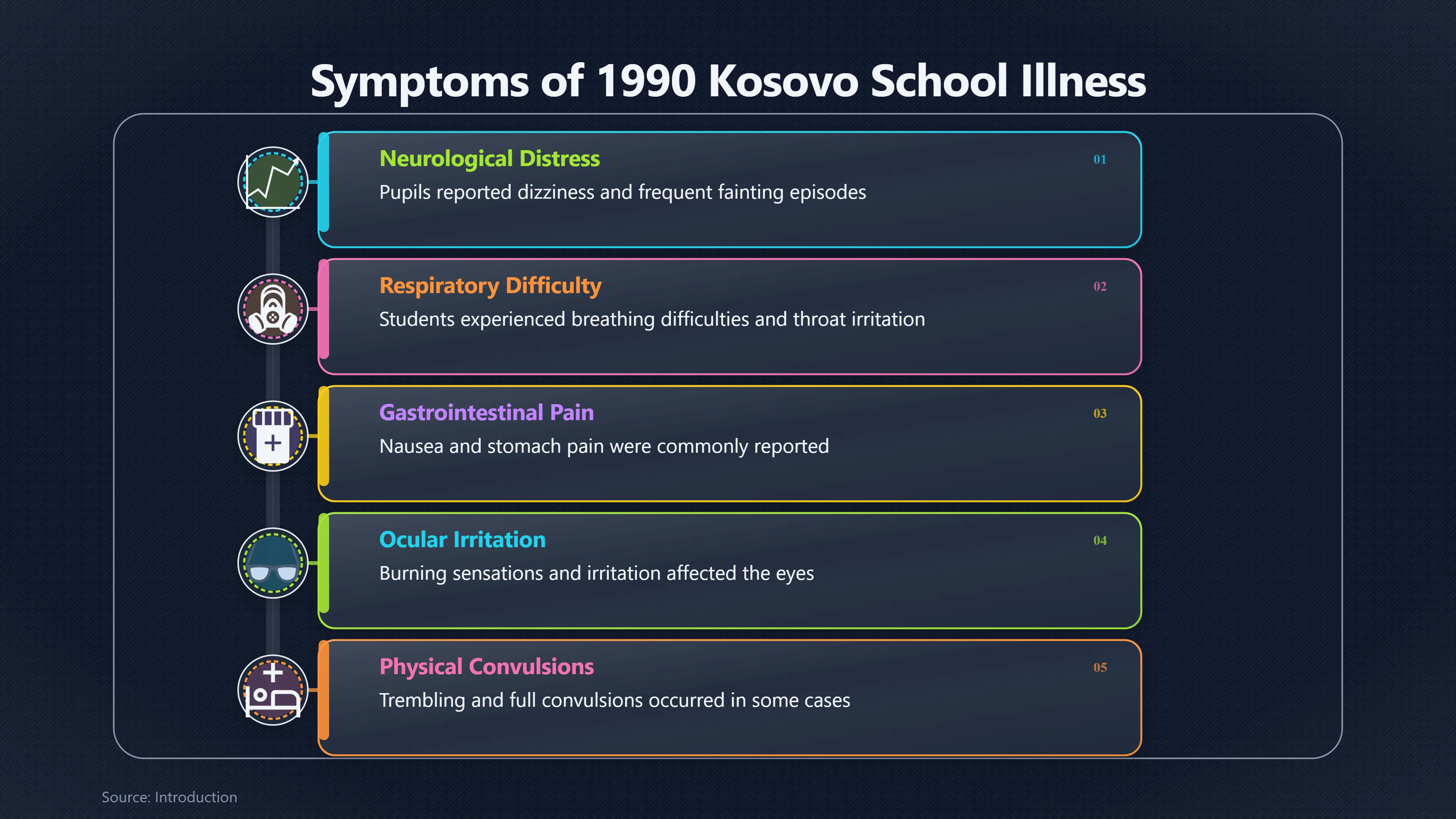
Although accounts vary in detail, the most commonly reported symptoms included:
- dizziness and weakness;
- headaches;
- nausea and stomach pain;
- difficulty breathing;
- burning or irritated eyes and throat;
- trembling or convulsions;
- episodes of fainting.
The scale of the outbreak made it exceptional. Contemporary estimates generally range from roughly 3,000 to more than 7,000 affected pupils, depending on which medical records or later studies are used.[PubMed]pubmed.ncbi.nlm.nih.govOn the origin of mass casualty incidents in Kosovo, Yugoslavia, in 1990 - PubMed…
The illness appeared to spread in waves. In some schools, pupils reportedly became ill after seeing classmates collapse or after hearing rumours that poison had been released. Similar symptoms then appeared in schools many kilometres away. This pattern later became one of the strongest arguments for researchers who favoured a psychogenic explanation, since no single environmental exposure could be identified across all locations.[PubMed]pubmed.ncbi.nlm.nih.govOn the origin of mass casualty incidents in Kosovo, Yugoslavia, in 1990 - PubMed…
At the same time, many Albanian witnesses argued that the geographical spread reflected repeated poisoning events rather than psychological contagion, insisting that the consistency of symptoms pointed to a genuine toxic exposure.
The poisoning claim and psychogenic explanations
The medical debate began almost immediately and has never been fully resolved in public memory.
The poisoning claim
Many Albanian physicians believed they were treating victims of deliberate poisoning. They pointed to the abrupt onset of symptoms, the physical distress they observed and the wider political context. Some later investigators claimed laboratory findings or overseas analyses suggested exposure to toxic chemicals, although these claims have never achieved broad scientific acceptance or independent confirmation.[Human Rights Watch]hrw.orgHuman Rights Watch YUGOHuman Rights Watch YUGO
Human rights organisations also criticised the authorities’ response. Rather than conducting an investigation that all sides regarded as impartial, Serbian officials rejected poisoning allegations early and characterised the episode as politically motivated. This reinforced Albanian suspicions that evidence was being suppressed rather than examined objectively.[Human Rights Watch]hrw.orgHuman Rights Watch YUGOHuman Rights Watch YUGO
The psychogenic explanation
A federal medical commission composed of specialists from several Yugoslav republics concluded in 1990 that neither infectious disease nor poisoning explained the outbreak. Instead, it proposed that the illness consisted of psychogenic reactions—real physical symptoms produced by extreme psychological stress rather than by a chemical agent.[ResearchGate]researchgate.net216715825 On the Origin of Mass Casualty Incidents in Kosovo Yugoslavia in 1990ResearchGate(PDF) On the Origin of Mass Casualty Incidents in Kosovo, Yugoslavia, in 1990February 1, 1996…
The most detailed later defence of this interpretation came from epidemiologist Zoran Radovanović. Reviewing clinical records and investigations, he argued that:
- no consistent toxic substance was identified;
- symptoms varied considerably between patients;
- there was no pattern expected from exposure to a single poison;
- the epidemic spread primarily through social contact and expectation rather than environmental exposure.
He suggested that widespread anxiety, combined with ordinary respiratory infections and intense ethnic tension, could have triggered an unusually large episode of mass sociogenic illness.[PubMed]pubmed.ncbi.nlm.nih.govOn the origin of mass casualty incidents in Kosovo, Yugoslavia, in 1990 - PubMed…
Importantly, advocates of this explanation do not argue that the pupils were pretending. Mass psychogenic illness refers to genuine physical symptoms that spread through groups under conditions of extreme stress and shared expectation.
Why neither explanation convinced everyone
Neither interpretation settled the dispute.
For many Albanians, accepting a psychogenic explanation seemed to imply that thousands of children, parents and doctors had somehow imagined the crisis while living under increasingly repressive political conditions. That conclusion appeared implausible and dismissive.
Conversely, supporters of the poisoning theory struggled to produce reproducible laboratory evidence identifying a specific toxic agent capable of explaining the outbreak across numerous schools. The absence of a confirmed poison has remained the central weakness of that interpretation.[PubMed]pubmed.ncbi.nlm.nih.govOn the origin of mass casualty incidents in Kosovo, Yugoslavia, in 1990 - PubMed…
The result was not merely scientific disagreement but competing understandings of reality itself.
Why political repression made trust impossible
The outbreak cannot be understood apart from Kosovo’s political situation in 1990.
That year marked the rapid dismantling of Kosovo’s autonomy by the Serbian government under Slobodan Milošević. Albanian institutions were increasingly brought under central control, Albanian teachers and public employees faced dismissal, and educational policy became a major source of conflict.[Human Rights Watch]hrw.orgHuman Rights Watch Under Orders War Crimes in Kosovo | HRWHuman Rights Watch Under Orders War Crimes in Kosovo | HRW
Within this atmosphere:
- Albanian communities had little confidence that Serbian authorities would investigate allegations fairly.
- Serbian officials increasingly viewed Albanian protests through the lens of separatist politics.
- Medical findings became entangled with competing national narratives rather than remaining purely scientific.
The illness therefore became symbolic of broader struggles over authority. Every laboratory report, hospital record and public statement was interpreted according to existing political loyalties.
Human rights observers later criticised the state’s handling of the crisis, arguing that dismissing allegations without a transparent investigation further damaged public confidence. At the same time, independent investigators were unable to establish definitive proof of deliberate poisoning.[Human Rights Watch]hrw.orgHuman Rights Watch YUGOHuman Rights Watch YUGO
What the episode tells us about collective illness
The Kosovo school illness is frequently discussed alongside other episodes of mass psychogenic illness around the world because several recognised features were present:
- rapid spread through closely connected social groups;
- predominance among school-age pupils;
- genuine physical symptoms without an established environmental cause;
- emergence during periods of exceptional social stress.
However, Kosovo differs from many textbook examples because the political setting was so extreme. The debate was never confined to medicine. It unfolded amid ethnic conflict, institutional discrimination and collapsing trust between citizens and the state.
As a result, psychologists often see the outbreak as illustrating how severe collective stress can produce widespread physical illness, while many Kosovo Albanian accounts continue to regard poisoning as the most credible explanation. These positions are tied not only to different readings of the medical evidence but also to profoundly different experiences of state power.[nih.gov]pubmed.ncbi.nlm.nih.govOn the origin of mass casualty incidents in Kosovo, Yugoslavia, in 1990 - PubMed…
Why the controversy still matters
The 1990 school illness remains one of the most disputed episodes in the recent history of Kosovo. Unlike many cases labelled “mass hysteria”, the disagreement has never been resolved through a widely accepted independent investigation capable of commanding trust across communities.
For scholars of collective fear, the episode demonstrates an important principle: medical evidence cannot be interpreted in isolation from social conditions. Where institutions lack legitimacy and communities believe authorities may be acting in bad faith, even careful scientific findings may fail to persuade.
The lasting significance of the Kosovo outbreak therefore lies not simply in whether the pupils were poisoned or experienced a mass psychogenic illness. It shows how political repression, ethnic division and institutional distrust can transform a public health emergency into a struggle over whose account of reality will be believed.
Amazon book picks
Further Reading
Books and field guides related to Was Kosovo's School Illness Poisoning or Panic?. Use these as the next step if you want deeper reading beyond the article.
The Body Keeps the Score
Provides accessible background on trauma and stress responses relevant to conflict settings.
Extraordinary Popular Delusions and the Madness of Crowds
Rating: 4.0/5 from 5 Google Books ratings
Provides historical context for collective beliefs, rumours and social contagion.
The Lucifer Effect
Explains how social situations, authority and group processes influence human behaviour during crises.

Mistakes Were Made (But Not by Me)
Examines cognitive dissonance and why conflicting groups maintain incompatible narratives.
Endnotes
1.
Source: pubmed.ncbi.nlm.nih.gov
Link:https://pubmed.ncbi.nlm.nih.gov/8817187/
Source snippet
On the origin of mass casualty incidents in Kosovo, Yugoslavia, in 1990 - PubMed...
2.
Source: hrw.org
Title: Human Rights Watch YUGO
Link:https://www.hrw.org/reports/1992/yugoslavia/
3.
Source: hrw.org
Title: Human Rights Watch Under Orders War Crimes in Kosovo | HRW
Link:https://www.hrw.org/report/2001/10/26/under-orders/war-crimes-kosovo
4.
Source: researchgate.net
Title: 216715825 On the Origin of Mass Casualty Incidents in Kosovo Yugoslavia in 1990
Link:https://www.researchgate.net/publication/216715825_On_the_Origin_of_Mass_Casualty_Incidents_in_Kosovo_Yugoslavia_in_1990
Source snippet
ResearchGate(PDF) On the Origin of Mass Casualty Incidents in Kosovo, Yugoslavia, in 1990February 1, 1996...
Published: February 1, 1996
5.
Source: hrw.org
Title: U N: Compensate Kosovo Lead Poisoning Victims | Human Rights Watch
Link:https://www.hrw.org/news/2017/09/07/un-compensate-kosovo-lead-poisoning-victims
Source snippet
UN: Compensate Kosovo Lead Poisoning Victims | Human Rights WatchSeptember 7, 2017 — UN: COMPENSATE KOSOVO LEAD POISONING VICTIMS Print D...
Published: September 7, 2017
6.
Source: hrw.org
Title: U N Balks at Justice for Kosovo Lead-Poisoning Victims | Human Rights Watch
Link:https://www.hrw.org/news/2017/04/19/un-balks-justice-kosovo-lead-poisoning-victims
7.
Source: pubmed.ncbi.nlm.nih.gov
Link:https://pubmed.ncbi.nlm.nih.gov/9808010/
8.
Source: hrw.org
Link:https://www.hrw.org/reports/2001/kosovo/
9.
Source: hrw.org
Title: Federal Republic Of Yugoslavia: Kosovo
Link:https://www.hrw.org/reports/2000/fry/Kosov003-02.htm
Additional References
10.
Source: cambridge.org
Link:https://www.cambridge.org/core/journals/the-british-journal-of-psychiatry/article/protean-nature-of-mass-sociogenic-illness/2BDC2262E104B8A33F3DD49773DA0D8B
Source snippet
The incident transpired after rumours that students were exposed to poison gas by Russian authorities who had recently used the...
11.
Source: koha.net
Title: helmimet e 1990 s viktimat vuajne pasojat kerkojne pergjegjesi
Link:https://www.koha.net/en/arberi/helmimet-e-1990-s-viktimat-vuajne-pasojat-kerkojne-pergjegjesi
Source snippet
The poisonings of 1990: the victims suffer the consequences, demand responsibility - KOHA.netMarch 20, 2022 — Arberi 1990S POISONINGS: VI...
Published: March 20, 2022
12.
Source: koha.net
Title: rrefimi per helmimin e nxenesve ne pranveren e vitit 90
Link:https://www.koha.net/en/arberi/rrefimi-per-helmimin-e-nxenesve-ne-pranveren-e-vitit-90
Source snippet
The account of the poisoning of students in the spring of 1990 - KOHA.netFebruary 18, 2022 — Arberi THE ACCOUNT OF THE POISONING OF STUDE...
Published: February 18, 2022
13.
Source: publications.parliament.uk
Title: UK Parliament House of Commons
Link:https://publications.parliament.uk/pa/cm199900/cmselect/cmfaff/28/28ap32.htm
Source snippet
UK ParliamentHouse of Commons - Foreign Affairs - Appendices to the Minutes of Evidence...
14.
Source: youtube.com
Link:https://www.youtube.com/watch?v=MRqWkgIfLyU
Source snippet
VOYAGE - What Poisoned Albanian Students in 1990?...
15.
Source: youtube.com
Link:https://www.youtube.com/watch?v=Tij2aoqD4cE
Source snippet
RTS Belgrade Talk Show 'Porota' on the 1990 Kosovo Illness Controversy...
16.
Source: nejm.org
Link:https://www.nejm.org/doi/abs/10.1056/NEJM200001133420206
17.
Source: nejm.org
Link:https://www.nejm.org/doi/full/10.1056/NEJM200001133420206
18.
Source: sciencedirect.com
Link:https://www.sciencedirect.com/science/article/pii/S0140673689919764
19.
Source: youtube.com
Link:https://www.youtube.com/watch?v=a75Bd8kxflU
Source snippet
RTK Documentary: Student Poisonings in 1990...
Topic Tree