Within Belize Belief Scares
Did the Maya Really Predict the End?
The supposed Maya doomsday prophecy was a global media invention that distorted ancient calendars and sidelined living Maya voices.
On this page
- What the Long Count date actually meant
- How films, television and websites spread the scare
- How Maya voices and researchers challenged the myth
Page outline Jump by section
Introduction
In 2012, Belize found itself at the centre of a global story claiming that the ancient Maya had predicted the end of the world on 21 December 2012. The claim became one of the biggest modern apocalyptic scares, but it was not rooted in mainstream Maya belief or in the surviving evidence from ancient inscriptions. Instead, Belize became associated with the scare because it is home to major Maya archaeological sites and living Maya communities. As international media, films, television programmes and websites promoted dramatic doomsday narratives, many Belizean archaeologists, cultural institutions and Maya people worked to explain that the date marked the completion of a calendar cycle rather than a prophecy of global destruction.[Living Maya Time]maya.nmai.si.edu2012 resetting countLiving Maya Time2012: Resetting the Count | Living Maya Time…
The episode is important because it illustrates how a worldwide moral and media panic can grow around a misunderstanding of another culture’s history. For Belize, the real story was not widespread local fear of apocalypse, but the challenge of correcting misinformation while protecting the country’s archaeological heritage and giving greater prominence to living Maya voices.
Did the Maya really predict the end?
The short answer is no. The ancient Maya developed the Long Count calendar, a system that recorded long spans of time by counting days from a traditional creation date. On 21 December 2012, one major cycle—known as the 13th baktun—came to an end. Like the transition from one millennium to another, it marked the completion of a significant period and the beginning of the next, not the destruction of the world.[Living Maya Time]maya.nmai.si.edumeaning of 2012Living Maya TimeThe Meaning of 2012 | Living Maya Time…
Modern archaeologists point out that the handful of ancient inscriptions referring to this date do not describe an apocalypse. The best-known example, Tortuguero Monument 6 from Mexico, contains a damaged reference to a ceremonial event involving a deity. It does not predict earthquakes, floods, planetary collisions or human extinction. Ancient Maya inscriptions also record dates far beyond 2012, demonstrating that Maya scribes expected time to continue.[si.edu]maya.nmai.si.edumeaning of 2012Living Maya TimeThe Meaning of 2012 | Living Maya Time…
For Belize, this distinction mattered because the country preserves many of the most important Maya sites in Central America, including Caracol, Xunantunich, Lamanai and Cahal Pech. The false prophecy risked reducing a sophisticated civilisation to a single fictional prediction.
How films, television and websites spread the scare
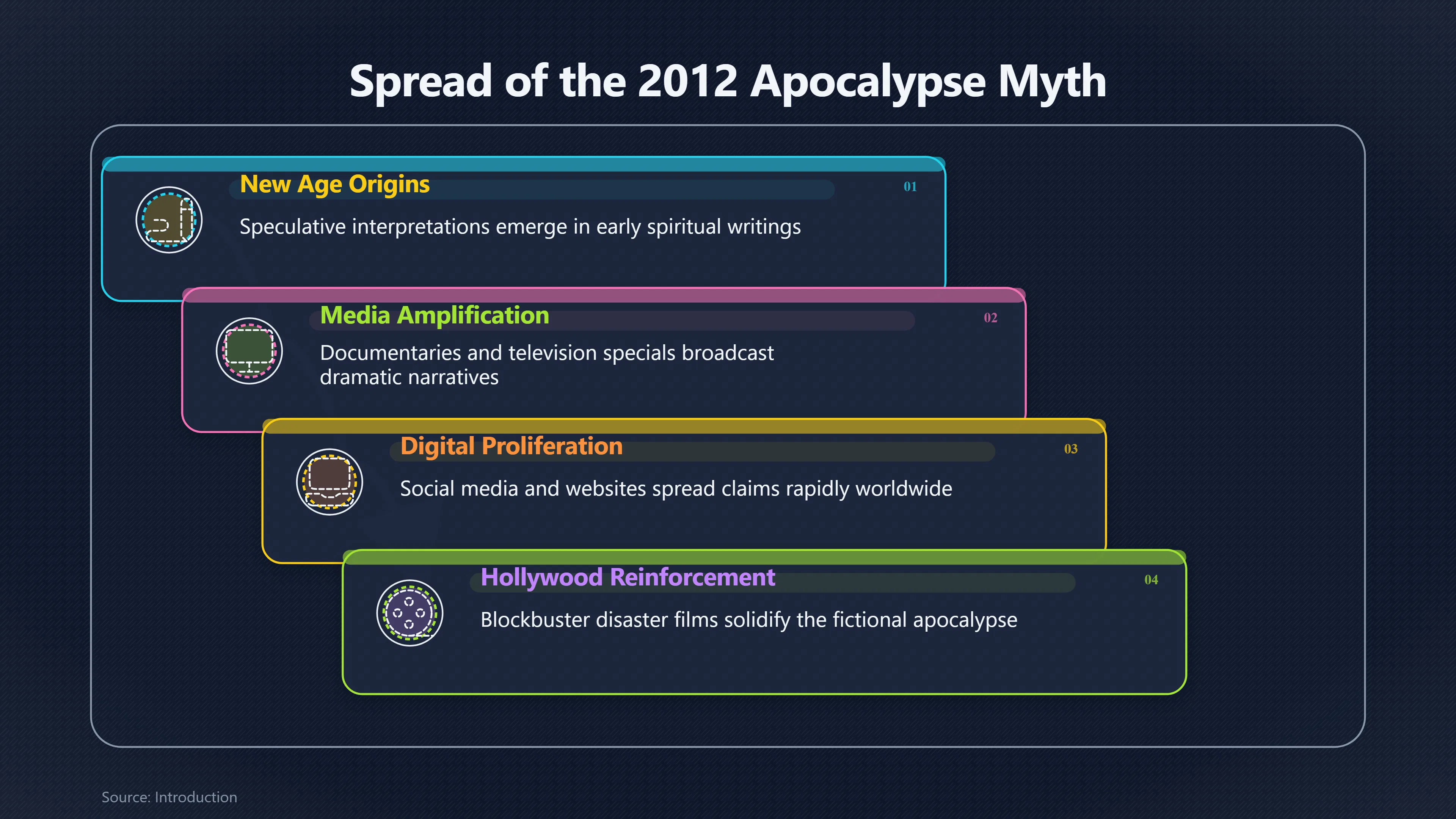
The 2012 scare did not begin in Belize. It emerged gradually through New Age writing, speculative interpretations of Maya inscriptions and popular books before being amplified by documentaries, television specials, internet forums and blockbuster films.
Several features made the story unusually successful:
- It attached a precise calendar date to an apparently ancient prophecy.
- It combined archaeology with modern fears about climate change, solar storms, rogue planets and global catastrophe.
- It spread rapidly through websites and social media, where dramatic claims travelled much faster than careful archaeological explanations.
- Hollywood productions, especially the 2009 disaster film 2012, reinforced the impression that the Maya had predicted a worldwide cataclysm, even though the film was fictional.[cambridge.org]cambridge.orgCambridge University Press & AssessmentThe 2012 phenomenon: Maya calendar, astronomy, and apocalypticism in the worlds of scholarship and…
By late 2012, millions of people around the world had encountered some version of the claim. Surveys and media reports from several countries found that at least some people genuinely worried about the date, bought survival supplies or travelled to locations they believed would be safe. Belize therefore became part of a global media event despite having played no role in creating the myth itself.[Living Maya Time]maya.nmai.si.edu2012 resetting countLiving Maya Time2012: Resetting the Count | Living Maya Time…
Belize’s response: education rather than alarm
Within Belize, officials and archaeologists generally treated the approaching date as an opportunity for public education rather than as a public safety problem.
The country’s archaeological authorities organised educational activities at Maya sites, particularly at Caracol, where visitors could experience the transition to the new calendar cycle while learning about Maya history from professional archaeologists. Rather than encouraging apocalyptic beliefs, these events stressed cultural continuity, archaeology and the achievements of ancient Maya civilisation.[TIME.com]style.time.comend of the world not for the maya of belizeof the World? Not for the Maya of Belize | TIME.comDecember 20, 2012…
This approach contrasted sharply with sensational media coverage elsewhere. Belize promoted its archaeological heritage while attempting to replace myths with evidence-based explanations. Tourism linked to the 2012 date was welcomed, but official messaging consistently rejected claims that the Maya had foretold the world’s end.[TIME.com]style.time.comend of the world not for the maya of belizeof the World? Not for the Maya of Belize | TIME.comDecember 20, 2012…
How Maya voices challenged the myth
One of the most important aspects of the 2012 episode was the response from living Maya communities.
Many Maya people expressed frustration that outsiders were presenting them as the authors of an apocalypse they had never predicted. Educational projects brought together Maya elders, archaeologists and community members to explain that Maya understandings of time are cyclical and emphasise renewal rather than final destruction. The Smithsonian’s National Museum of the American Indian, for example, recorded Maya perspectives specifically to counter misconceptions circulating before December 2012.[Living Maya Time]maya.nmai.si.edu2012 resetting countLiving Maya Time2012: Resetting the Count | Living Maya Time…
For Belize, where Mopan, Q’eqchi’ and Yucatec Maya communities continue to maintain distinct languages and traditions, the episode highlighted an important cultural imbalance. International audiences often showed enormous interest in an imagined ancient prophecy while paying much less attention to the experiences and perspectives of contemporary Maya people.
Many scholars have argued that this imbalance reflected a broader tendency to romanticise or mystify Indigenous cultures while overlooking the realities of living communities.[Cambridge University Press & Assessment]cambridge.orgCambridge University Press & AssessmentThe 2012 phenomenon: Maya calendar, astronomy, and apocalypticism in the worlds of scholarship and…
Why the myth proved so persuasive
The 2012 scare demonstrates several recurring features of collective belief.
First, it drew authority from genuine archaeological discoveries. Because the Maya were renowned astronomers and mathematicians, claims about their calendar appeared plausible to many people unfamiliar with the details.
Second, uncertainty encouraged speculation. Ancient inscriptions are incomplete, and a few damaged texts mentioning the 13th baktun were repeatedly interpreted far beyond what the evidence justified.
Third, the scare emerged during an era of expanding internet communication, allowing unsupported claims to circulate globally with unprecedented speed.
Finally, apocalyptic stories have long attracted attention because they offer apparently simple explanations for complex anxieties about environmental change, economic instability and global uncertainty. Scholars studying the 2012 phenomenon describe it as a modern example of millennial expectation built around misunderstood archaeological evidence rather than around authentic Maya religious teaching.[cambridge.org]cambridge.orgCambridge University Press & AssessmentThe 2012 phenomenon: Maya calendar, astronomy, and apocalypticism in the worlds of scholarship and…
Why the 2012 scare still matters in Belize
The December 2012 date passed without catastrophe, but the episode remains culturally significant.
For Belize, it demonstrated both the opportunities and risks created by global fascination with the ancient Maya. Interest in Maya civilisation brought visitors to archaeological sites and museums, yet it also showed how easily popular culture could overshadow historical evidence and the voices of living Indigenous communities.
The legacy of the scare is therefore less about failed predictions than about historical interpretation. It serves as a reminder that archaeological discoveries can become detached from their original meanings when filtered through commercial entertainment, internet rumours and sensational media coverage. Belize’s experience illustrates that the most effective response to such scares is careful public education grounded in archaeology, history and the perspectives of the people whose culture is being discussed.[time.com]style.time.comend of the world not for the maya of belizeof the World? Not for the Maya of Belize | TIME.comDecember 20, 2012…
Amazon book picks
Further Reading
Books and field guides related to Did the Maya Really Predict the End?. Use these as the next step if you want deeper reading beyond the article.
Endnotes
1.
Source: cambridge.org
Link:https://www.cambridge.org/core/journals/proceedings-of-the-international-astronomical-union/article/2012-phenomenon-maya-calendar-astronomy-and-apocalypticism-in-the-worlds-of-scholarship-and-global-popular-culture/6BC2C7B4652F228D64EB793BDCEC8314
Source snippet
Cambridge University Press & AssessmentThe 2012 phenomenon: Maya calendar, astronomy, and apocalypticism in the worlds of scholarship and...
2.
Source: archive.archaeology.org
Title: Magazine Apocalypse Soon?
Link:https://archive.archaeology.org/0911/2012/
Source snippet
Archaeology MagazineApocalypse Soon? - Archaeology Magazine Archive...
3.
Source: mayan.org
Title: 2012 prophecy
Link:https://mayan.org/mysteries/2012-prophecy/
Source snippet
2012 Maya Prophecy: What Really Happened (And What the Maya Actually Believed) | Mayan.org...
4.
Source: style.time.com
Title: end of the world not for the maya of belize
Link:https://style.time.com/2012/12/20/end-of-the-world-not-for-the-maya-of-belize/
Source snippet
of the World? Not for the Maya of Belize | TIME.comDecember 20, 2012...
Published: December 20, 2012
5.
Source: time.com
Title: end of the world not for the maya of belize
Link:https://time.com/archive/7223873/end-of-the-world-not-for-the-maya-of-belize/
6.
Source: cambridge.org
Link:https://www.cambridge.org/core/journals/proceedings-of-the-international-astronomical-union/article/the-2012-phenomenon-maya-calendar-astronomy-and-apocalypticism-in-the-worlds-of-scholarship-and-global-popular-culture/6BC2C7B4652F228D64EB793BDCEC8314
7.
Source: cambridge.org
Link:https://www.cambridge.org/core/journals/proceedings-of-the-international-astronomical-union/article/2012-mayan-calendar-prophecies-in-the-context-of-the-western-millenarian-tradition/B108098455590097D34859FE0BF5F304
8.
Source: history.com
Title: december 21 2012
Link:https://www.history.com/articles/december
9.
Source: mayan.org
Link:https://www.mayan.org/calendar/long-count/
10.
Source: maya.nmai.si.edu
Title: 2012 resetting count
Link:https://maya.nmai.si.edu/2012-resetting-count
Source snippet
Living Maya Time2012: Resetting the Count | Living Maya Time...
11.
Source: maya.nmai.si.edu
Title: meaning of 2012
Link:https://maya.nmai.si.edu/2012-resetting-count/meaning-of-2012
Source snippet
Living Maya TimeThe Meaning of 2012 | Living Maya Time...
Additional References
12.
Source: bloomsbury.com
Title: 2012 and the end of the world 9781442206113
Link:https://www.bloomsbury.com/uk/2012-and-the-end-of-the-world-9781442206113/
Source snippet
Bloomsbury Publishing2012 and the End of the World: The Western Roots of the Maya Apocalypse: Matthew Restall: Rowman & Littlefield - Blo...
13.
Source: blogs.ucl.ac.uk
Title: apocalypse in 2012 history myth and science
Link:https://blogs.ucl.ac.uk/events/2012/12/21/apocalypse-in-2012-history-myth-and-science/
Source snippet
History, myth and science. | UCL EventsDecember 21, 2012 — APOCALYPSE IN 2012? HISTORY, MYTH AND SCIENCE. By Katherine Aitchison, on 21 D...
Published: December 21, 2012
14.
Source: youtube.com
Link:https://www.youtube.com/watch?v=YRqnB2c8UR8
Source snippet
Why People Thought The World Would End In 2012 - And Why It Didn't...
15.
Source: youtube.com
Link:https://www.youtube.com/watch?v=eeYt-Pq6C7U
Source snippet
Doomsday Delayed? New Maya Calendar Unearthed...
16.
Source: youtube.com
Link:https://www.youtube.com/watch?v=dFYiqOfRvDw
Source snippet
ScienceCasts: Why the World Didn't End Yesterday...
17.
Source: belizenews.com
Link:https://www.belizenews.com/121231.html
Source snippet
Not for the Maya of Belize Much has been made about December 21, 2012 by doomsday prophets, busily proclaiming that the end of the world...
Published: December 21, 2012
18.
Source: youtube.com
Title: Science Casts: Why the World Didn’t End Yesterday
Link:https://www.youtube.com/watch?v=QY_Gc1bF8ds
Source snippet
UK Professor Dispels Myths of Dec. 21, 2012 Doomsday Theory...
19.
Source: bu.edu
Title: B U Archaeologists Discover Oldest Maya Calendars | BU Today | Boston University
Link:https://www.bu.edu/articles/2012/bu-archaeologists-discover-oldest-maya-calendars
20.
Source: nationalgeographic.com
Title: Maya Calendars Actually Predict That Life Goes On | National Geographic
Link:https://www.nationalgeographic.com/culture/article/121207-maya-truly-did-not-predict-doomsday-apocalypse
21.
Source: wbur.org
Title: 5 Things To Know About The Mayan Apocalypse | Here & Now
Link:https://www.wbur.org/hereandnow/2012/12/20/2012-mayan-apocalypse
Topic Tree