Within Austria's Collective Fears
When Did Austria Stop Believing Witch Accusations?
The failed Innsbruck prosecution and Maria Pauer's execution reveal both resistance to witch hunting and its late survival.
On this page
- How Innsbruck challenged Heinrich Kramer
- Maria Pauer and the persistence of prosecution
- What changed in Austrian courts and government
Page outline Jump by section
Introduction
Austria’s history of witch prosecutions did not follow a simple path from superstition to enlightenment. Two episodes, separated by more than 250 years, show a more complicated story. In 1485, an attempted witch prosecution in Innsbruck collapsed after local church authorities and legal experts challenged the methods of the inquisitor Heinrich Kramer. Yet in 1750, Maria Pauer was still executed after being accused of witchcraft in the Prince-Archbishopric of Salzburg, making her the last known person put to death for witchcraft in what is now Austria. Together, these cases reveal both an early resistance to poorly founded accusations and the surprising persistence of witch beliefs long after many European courts had become sceptical. They also illustrate how stronger legal oversight and central government reforms eventually brought Austria’s witch trials to an end.[discover-innsbruck.at]discover-innsbruck.atder innsbrucker hexenprozess von 1485Discover InnsbruckDer Innsbrucker Hexenprozess von 1485 | Historischer Innsbruck Reiseführer…
How Innsbruck challenged Heinrich Kramer
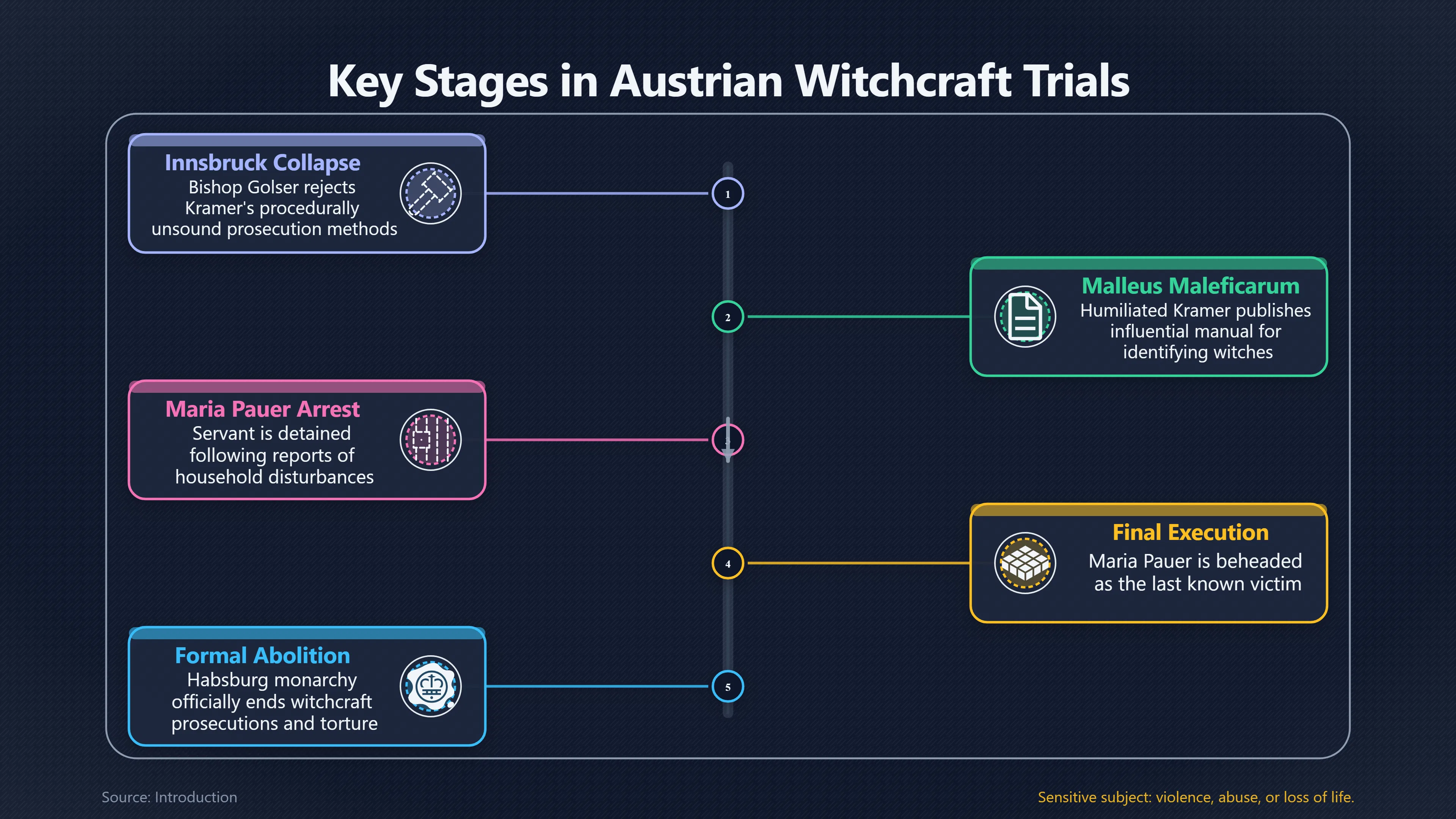
The failed Innsbruck prosecution of 1485 occupies an important place in the history of European witch-hunting because it shows that even at the beginning of the great witch-trial era, influential figures did not automatically accept accusations of witchcraft.
Heinrich Kramer, a Dominican inquisitor, arrived in Innsbruck determined to prosecute several women, including the well-known Helena Scheuberin. Kramer interpreted her refusal to attend his sermons and her outspoken criticism of him as evidence of witchcraft. His investigation relied heavily on assumptions about hidden supernatural crimes rather than demonstrable evidence.[Discover Innsbruck]discover-innsbruck.atder innsbrucker hexenprozess von 1485Discover InnsbruckDer Innsbrucker Hexenprozess von 1485 | Historischer Innsbruck Reiseführer…
Bishop Georg Golser of Brixen became increasingly concerned about Kramer’s conduct. Instead of endorsing the proceedings, he examined whether proper legal standards had been followed. His representatives criticised Kramer’s procedures, a lawyer was appointed to defend the accused women, and the prosecution ultimately collapsed. Golser ordered Kramer to leave Tyrol, commenting that the inquisitor had assumed too much without proof. Rather than confirming widespread belief in witches, the Innsbruck affair demonstrated that legal authorities could reject prosecutions they considered procedurally unsound or driven by personal obsession.[Discover Innsbruck]discover-innsbruck.atder innsbrucker hexenprozess von 1485Discover InnsbruckDer Innsbrucker Hexenprozess von 1485 | Historischer Innsbruck Reiseführer…
Ironically, the failure had consequences far beyond Austria. Feeling publicly humiliated, Kramer soon wrote the Malleus Maleficarum (“Hammer of Witches”), published in 1486. Although never an official law book, it became one of Europe’s most influential manuals for identifying and prosecuting alleged witches, helping to shape later witch-hunting across the Holy Roman Empire. Innsbruck therefore became both an early example of resistance and an indirect starting point for a much wider wave of persecution.[Discover Innsbruck]discover-innsbruck.atder innsbrucker hexenprozess von 1485Discover InnsbruckDer Innsbrucker Hexenprozess von 1485 | Historischer Innsbruck Reiseführer…
Maria Pauer and the persistence of prosecution
The collapse of Kramer’s case did not end Austrian witch prosecutions. During the sixteenth and especially the seventeenth century, local courts across Habsburg territories conducted numerous trials, often under intense religious and social pressures associated with the Counter-Reformation. Although legal standards gradually improved, accusations still occasionally succeeded well into the eighteenth century.[Wikipedia]WikipediaWitch trials in the Holy Roman EmpireWitch trials in the Holy Roman Empire
Maria Pauer’s case illustrates this late survival of witch beliefs. A teenage servant from Mühldorf, then part of the Prince-Archbishopric of Salzburg, she became associated with unexplained disturbances in a household after making a routine visit. Reports described knocking noises and objects moving by themselves, phenomena that contemporaries interpreted as evidence of supernatural activity rather than coincidence or fraud. Suspicion quickly focused on Pauer.[Wikipedia]WikipediaMaria PauerMaria Pauer
After her arrest in 1749, she endured prolonged imprisonment and repeated interrogation. Contemporary records describe her answering an extraordinary catalogue of hundreds of questions. As often happened in witch trials, investigators sought not only a confession but also the names of supposed accomplices. Her mother and another woman were subsequently arrested and executed. Exhausted by imprisonment and questioning, Maria Pauer eventually confessed and was sentenced to death. On 6 October 1750 she was beheaded, after which her body was burned, making her the last known victim executed for witchcraft on the territory of present-day Austria.[Wikipedia]WikipediaMaria PauerMaria Pauer
Modern historians generally see the confession not as reliable evidence of witchcraft but as a product of coercive interrogation, psychological exhaustion and a judicial system that still accepted supernatural explanations despite growing scepticism elsewhere in Europe.[Wikipedia]WikipediaMaria PauerMaria Pauer

What changed in Austrian courts and government?
The contrast between Innsbruck and Maria Pauer’s execution reflects a broader transformation in Austrian justice rather than a sudden disappearance of belief in witches.
Several developments gradually weakened witch prosecutions:
- Greater central oversight: Local courts increasingly came under the supervision of central Habsburg authorities, reducing the freedom of individual judges to pursue large-scale witch trials.
- Higher legal standards: Appeals and closer review made it more difficult to secure convictions based solely on rumour, reputation or forced confessions.
- Changing intellectual attitudes: Enlightenment ideas encouraged officials to seek natural explanations for unusual events and to question claims of supernatural crimes.
- Restrictions on torture: Growing criticism of torture reduced one of the principal mechanisms by which witch-trial confessions had been obtained.[Wikipedia]WikipediaWitch trials in the Holy Roman EmpireWitch trials in the Holy Roman Empire
These changes did not eliminate popular belief in magic or harmful supernatural forces overnight. Villagers continued to attribute illness, misfortune or strange events to suspected witches in some regions. What changed was the willingness of higher courts and governments to transform those suspicions into capital prosecutions.
Under Empress Maria Theresa, central reforms increasingly discouraged witch trials, and in 1768 witchcraft prosecutions and judicial torture were formally abolished within the Habsburg monarchy. By then, Maria Pauer’s execution already appeared to many officials as an embarrassing relic of an older legal culture.[Wikipedia]WikipediaWitch trials in the Holy Roman EmpireWitch trials in the Holy Roman Empire
Why these two cases still matter
Taken together, the Innsbruck proceedings and Maria Pauer’s execution show that Austria’s history was neither one of uninterrupted credulity nor one of steady progress.
The Innsbruck case demonstrates that scepticism existed remarkably early. Church leaders and legal professionals were capable of challenging unsupported accusations, criticising flawed procedures and insisting that extraordinary claims required stronger evidence. At the same time, Maria Pauer’s fate reminds us that legal resistance was uneven. Local fears, institutional habits and deeply rooted supernatural beliefs could still overcome growing intellectual scepticism centuries later.
For historians of collective belief, these episodes highlight an important distinction. Witch accusations spread because communities interpreted misfortune through a shared supernatural framework, but whether those accusations resulted in executions depended increasingly on legal institutions. Austria’s experience therefore illustrates not simply the decline of belief in witches, but the growing determination of courts and governments to require evidence rather than fear before imposing the law’s most severe punishment.[discover-innsbruck.at]discover-innsbruck.atder innsbrucker hexenprozess von 1485Discover InnsbruckDer Innsbrucker Hexenprozess von 1485 | Historischer Innsbruck Reiseführer…



Endnotes
1.
Source: discover-innsbruck.at
Title: der innsbrucker hexenprozess von 1485
Link:https://www.discover-innsbruck.at/en/der-innsbrucker-hexenprozess-von-1485/
Source snippet
Discover InnsbruckDer Innsbrucker Hexenprozess von 1485 | Historischer Innsbruck Reiseführer...
2.
Source: Wikipedia
Title: Maria Pauer
Link:https://en.wikipedia.org/wiki/Maria_Pauer
3.
Source: Wikipedia
Title: Witch trials in the Holy Roman Empire
Link:https://en.wikipedia.org/wiki/Witch_trials_in_the_Holy_Roman_Empire
4.
Source: discover-innsbruck.at
Link:https://www.discover-innsbruck.at/en/maria-theresia-landesmutter-und-reformatorin/
5.
Source: discover-innsbruck.at
Link:https://www.discover-innsbruck.at/en/?p=54722
6.
Source: discover-innsbruck.at
Title: der innsbrucker hexenprozess von 1485
Link:https://www.discover-innsbruck.at/der-innsbrucker-hexenprozess-von-1485/
7.
Source: youtube.com
Title: Salem in Context: Europe’s Witch Trials
Link:https://www.youtube.com/watch?v=_jAwbX5avI8
Source snippet
Witchcraft - Malleus Maleficarum - The Hammer of Witches...
8.
Source: youtube.com
Link:https://www.youtube.com/watch?v=uIdcjeeYjaE
Source snippet
The Witch-Hunt from a Feminist Perspective...
9.
Source: wiki.sn.at
Title: Maria Pauer
Link:https://wiki.sn.at/wiki/index.php/Maria_Pauer
Source snippet
Oktober 1750 in der Stadt Salzburg) war eine Dienstmagd in Mühldorf am Inn und die letzte hingerichtete Hexe. LEBEN...
10.
Source: zenodo.org
Link:https://zenodo.org/records/3533617
11.
Source: executedtoday.com
Link:https://www.executedtoday.com/category/where/austria/
12.
Source: executedtoday.com
Link:https://www.executedtoday.com/category/witchcraft/
Additional References
13.
Source: innsbruck-erinnert.at
Title: Aberglaube und Zauberei in Innsbruck – Innsbruck erinnert sich
Link:https://innsbruck-erinnert.at/aberglaube-und-zauberei-in-innsbruck/
Source snippet
Juni 2023 * Team Stadtarchiv * Allgemein * 0 Kommentare Auf der Suche nach einem neuen & spannenden Beitrag b...
14.
Source: innsbruck-erinnert.at
Title: Nobody expects the Tyrolean Inquisition!
Link:https://innsbruck-erinnert.at/nobody-expects-the-tyrolean-inquisition/
Source snippet
Innsbruck erinnert sichSeptember 19, 2023 — Image: Nobody Expects The Tyrolean Inquisition! NOBODY EXPECTS THE TYROLEAN INQUISITION! *...
Published: September 19, 2023
15.
Source: wikidata.org
Title: Witch Trial of Innsbruck
Link:https://www.wikidata.org/wiki/Q104518284
Source snippet
October 15, 2024 — WITCH TRIAL OF INNSBRUCK (Q104518284) * Item * Discussion [Input] English * Read * View history [Input] Tools...
Published: October 15, 2024
16.
Source: wiki.sn.at
Link:https://wiki.sn.at/wiki/Hexenprozesse
Source snippet
SALZBURGWIKIAugust 27, 2024 — HEXENPROZESS (Weitergeleitet von Hexenprozesse) Zur Navigation springen Zur Suche springen Unter Fürsterz...
Published: August 27, 2024
17.
Source: youtube.com
Title: Witch-Hunting in European and World History
Link:https://www.youtube.com/watch?v=snAicO9WHGY
Source snippet
The Dark History of Austria's Witch Castle...
18.
Source: cambridge.org
Link:https://www.cambridge.org/core/journals/austrian-history-yearbook/article/abs/an-end-to-witch-trials-in-austria-reconsidering-the-enlightened-state/92DA384B3EE7A60D470EB2706A05529C
19.
Source: sn.at
Link:https://www.sn.at/wiki/Hexenprozess
20.
Source: habsburger.net
Link:https://www.habsburger.net/en/chapter/league-devil
21.
Source: presse.innsbruck.gv.at
Title: innsbruck.gv.at Die „Hexensach“ des Sebastian Auracher
Link:https://presse.innsbruck.gv.at/news-die-hexensach-des-sebastian-auracher?id=235576&l=deutsch&menueid=0
22.
Source: executedtoday.com
Title: 1750 maria pauer the last witch executed in austria
Link:https://www.executedtoday.com/2019/10/06/1750-maria-pauer-the-last-witch-executed-in-austria/
Topic Tree