When Rumour and Belief Reshaped Montenegro
Montenegro does not have a well-documented national equivalent of the Salem witch trials, a medieval dance plague or a famous outbreak of mass psychogenic illness.
Page outline Jump by section
Introduction
The clearest historical case is the rise of Šćepan Mali, who ruled Montenegro from 1767 to 1773 after many inhabitants became convinced that he was Peter III of Russia, supposedly returned from the dead. Later evidence shows a different pattern around witchcraft: supernatural beliefs could produce accusations and persecution, but Montenegrin religious leaders sometimes tried to stop them. In the present day, collective anxiety is more likely to travel through television, news portals and social media than through village storytelling. The recurring mechanism is not simple “mass hysteria”, but a mixture of uncertainty, hope, political rivalry, religious authority and rumours that fit what communities already fear or wish to believe.[cambridge.org]cambridge.orgPavićević, “Lažni car šćepan Mali u svjetlosti istorije i narodne tradicije,” V jesnik Etnograftkog Muzeja u Zagrebu, IV (1938), 72-73…
The stranger who became a tsar
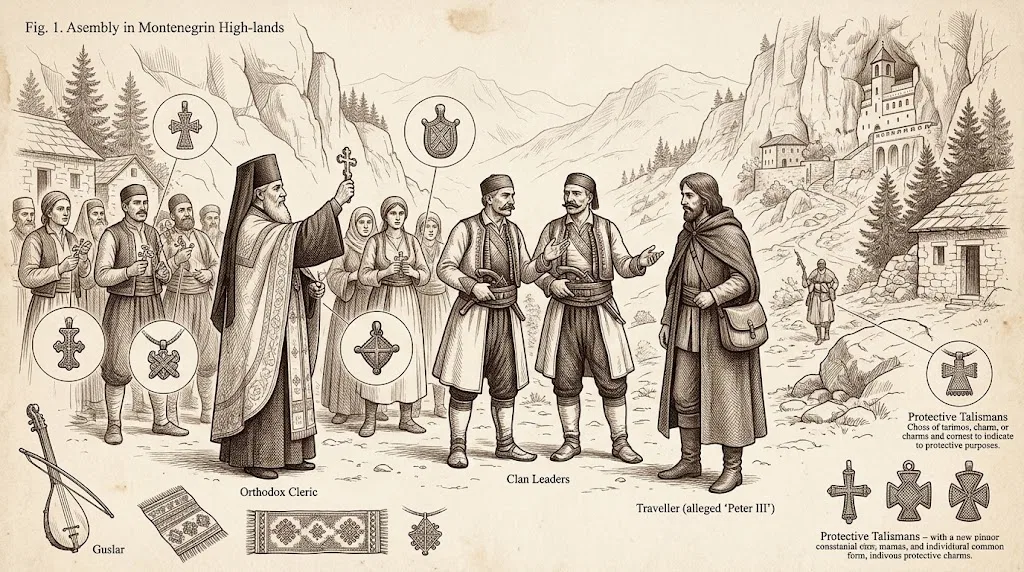
In the autumn of 1766, an obscure man appeared in Maine, near Budva, then under Venetian control. He practised medicine and attracted the attention of local monks and community leaders. Before long, a rumour spread that he was not an ordinary traveller but Peter III, the Russian emperor who had been deposed and killed in 1762. The stranger called himself Šćepan Mali, roughly “Stephen the Little”, but neither clearly confirmed nor firmly denied the imperial identity attributed to him.[Cambridge University Press & Assessment]cambridge.orgPavićević, “Lažni car šćepan Mali u svjetlosti istorije i narodne tradicije,” V jesnik Etnograftkog Muzeja u Zagrebu, IV (1938), 72-73…
The claim was implausible but emotionally powerful. Russia occupied an exceptional place in the imagination of Orthodox Montenegrins, who hoped that the empire might protect Balkan Christians and help free them from Ottoman pressure. Peter III’s sudden overthrow had also generated rumours elsewhere that he had survived. Šćepan’s evasive remarks, solemn behaviour and apparent knowledge of politics allowed supporters to interpret ordinary gestures as signs of concealed royalty.[Cambridge University Press & Assessment]cambridge.orgPavićević, “Lažni car šćepan Mali u svjetlosti istorije i narodne tradicije,” V jesnik Etnograftkog Muzeja u Zagrebu, IV (1938), 72-73…
By the autumn of 1767, clan leaders were paying homage to him. A public assembly formally recognised him as Peter III, and he was soon exercising power over much of Montenegro. Prince-Bishop Sava, the existing ruler, initially entertained the possibility but later received confirmation from Russian diplomats that Peter was dead. When Sava attempted to expose the newcomer, many Montenegrins preferred the hopeful story. He was pushed aside and confined to his monastery while Šćepan assumed secular authority.[Cambridge University Press & Assessment]cambridge.orgPavićević, “Lažni car šćepan Mali u svjetlosti istorije i narodne tradicije,” V jesnik Etnograftkog Muzeja u Zagrebu, IV (1938), 72-73…
Why the belief survived contradiction
Šćepan’s success cannot be explained simply by saying that an isolated population was gullible. The rumour met several practical and psychological needs at once.
It offered powerful protection. A Russian emperor living among the Montenegrins implied that a great Orthodox state might intervene on their behalf.
It promised unity. Montenegro was divided among clans whose feuds weakened collective government. A supposedly imperial outsider could claim authority above local rivalries.
Ambiguity protected the story. Šćepan rarely made a straightforward claim that could be tested. Supporters supplied much of the narrative themselves, turning hints and silences into proof.
His rule produced visible results. He compelled clans to accept truces, strengthened judicial arrangements and imposed greater central discipline. Even people who doubted his identity could value the order he created.[Cambridge University Press & Assessment]cambridge.orgPavićević, “Lažni car šćepan Mali u svjetlosti istorije i narodne tradicije,” V jesnik Etnograftkog Muzeja u Zagrebu, IV (1938), 72-73…
This makes the episode more complicated than either a confidence trick or a spontaneous delusion. Some followers probably believed sincerely that Peter III had returned. Others may have suspended disbelief because Šćepan was useful. Local elites could support the story because it strengthened government, while ordinary people could treat his apparent success as confirmation of his identity. Belief, political convenience and performance reinforced one another.
Russia rejected him, Venice watched him cautiously, and Ottoman authorities regarded his regime as a threat. Yet external denials did not immediately destroy his authority. He continued to rule until 1773, when a servant bribed by an Ottoman official murdered him. His reign lasted long enough to demonstrate that a collectively sustained political fiction could become a functioning government.[Cambridge University Press & Assessment]cambridge.orgPavićević, “Lažni car šćepan Mali u svjetlosti istorije i narodne tradicije,” V jesnik Etnograftkog Muzeja u Zagrebu, IV (1938), 72-73…
From impostor to cultural symbol
Šćepan Mali remained prominent in Montenegrin literature, drama and film because his story raises uncomfortable questions about legitimate rule. Was he merely a fraud, or did his ability to govern give him a different kind of legitimacy? Were the Montenegrins deceived, or did they knowingly accept a useful fiction?
Petar II Petrović-Njegoš, Montenegro’s celebrated nineteenth-century ruler and poet, made the false tsar the subject of a historical drama. Later writers portrayed Šćepan variously as manipulator, reformer, idealist and victim. The 1955 film The Fake Tsar, the first Montenegrin feature film, presented him sympathetically and used the story to explore authority, sovereignty and relations with Russia. His cultural afterlife has therefore softened the sharp distinction between deception and belief: the impostor is remembered not only for what people falsely thought he was, but for what his reign briefly made possible.[Wikipedia]WikipediaŠćepan MaliŠćepan Mali
Witches, revenants and the limits of persecution
Montenegrin folklore contained witches, vampires, werewolf-like beings and people believed capable of fighting supernatural battles while asleep. Such traditions belonged to the wider South Slavic world, but they were adapted to local concerns about illness, failed crops, storms, livestock and unexplained death.
One important figure was the supernatural protector sometimes imagined as leaving the body during sleep to fight hostile spirits responsible for bad weather. A person credited with such powers might be respected as a guardian of the community, yet a similar figure could also be suspected of working with the Devil or becoming a vampire after death. These categories were fluid: healer, protector, witch and revenant were not always sharply separated.[Wikipedia]WikipediaOpen source on wikipedia.org.
Reports collected by ethnographers describe precautions taken against the dead. A person feared as a harmful supernatural being might have thorns driven beneath the fingernails or tendons cut so that the corpse could not leave the grave. Such actions show that belief could affect the treatment of bodies and families, although surviving accounts do not justify speaking of a nationwide “vampire panic” in Montenegro. Most evidence is folkloric or ethnographic rather than a record of sustained judicial campaigns.[Wikipedia]WikipediaOpen source on wikipedia.org.
The distinction matters because dramatic stories about Balkan superstition were often exaggerated by foreign travellers and later Gothic culture. Montenegro belonged to a region associated in Western imagination with blood feuds, vampires and primitive violence. That image can obscure the difference between a tale told by an ethnographer, an occasional act against a corpse and an organised persecution supported by courts or government.
A ruler against witch accusations
The strongest evidence of social harm appears in the efforts of Petar I Petrović-Njegoš, prince-bishop from 1784 to 1830, to suppress accusations of witchcraft. He condemned denunciations and attacks on women alleged to possess supernatural powers. In an 1830 epistle written after an incident in southern Montenegro, he insisted that witches and similar beings did not exist and rebuked people for preferring lies to Christian teaching.[Wikipedia]WikipediaOpen source on wikipedia.org.
This intervention reveals that accusations were serious enough to require political and religious action. They were not merely entertaining legends. In small communities facing illness, bereavement or crop failure, suspicion could settle on socially vulnerable people, particularly women. Labelling misfortune as witchcraft supplied an apparent cause and a human target.
Petar I’s response also shows that official religion did not automatically intensify supernatural fear. Although he was both a church leader and a temporal ruler, he treated witch persecution as ignorance rather than piety. His letters attempted to replace communal accusation with clerical authority, legal order and a more disciplined version of Christian belief.
Montenegro therefore fits poorly into the familiar model of early modern Europe, where specialised courts, demonological manuals and central institutions sometimes drove large witch hunts. Its evidence points instead towards scattered local accusations, customary violence and elite attempts to contain them. Claims that Montenegro experienced extensive witch trials or mass burnings should be treated cautiously unless supported by specific archival records.
Miracles without a miracle panic
Miracle belief remains an important part of Montenegro’s religious culture, especially around Ostrog Monastery, the dramatic seventeenth-century Orthodox shrine built into a cliff above the Zeta valley. Pilgrims from different religious backgrounds visit the monastery and venerate Saint Basil of Ostrog. Testimonies commonly describe healing, answered prayers, dreams and personal transformation.[Visit Montenegro]visit-montenegro.comOpen source on visit-montenegro.com.
These traditions belong within the history of contagious belief because stories of cures encourage further pilgrimage. A person hears that someone recovered after visiting Ostrog, travels there in hope, interprets a later improvement as intervention and passes the account to others. Physical setting, ritual, expectation and testimony combine to make the shrine’s reputation self-reinforcing.
Yet calling this a “miracle panic” would be misleading. There is no strong evidence of a sudden Montenegrin outbreak in which crowds overwhelmed authorities because of a new apparition or extraordinary claim. Ostrog represents durable pilgrimage culture rather than a short-lived collective scare. Many visitors approach it as an expression of ordinary faith, not as membership of a separate movement.
The same caution applies to the word “cult”. Devotion to Saint Basil is embedded in mainstream Orthodox practice. Accounts of healing may be accepted, doubted or interpreted symbolically, but their existence does not by itself establish manipulation, coercion or a dangerous organisation. The historically useful question is how testimony creates sacred reputation, not whether pilgrims can be dismissed as irrational.
Religion became an existential political scare
The most important recent episode began with Montenegro’s 2019 Law on Freedom of Religion or Belief. Provisions concerning religious property were understood by the Serbian Orthodox Church as enabling the state to claim churches and monasteries whose pre-1918 ownership could not be demonstrated. The government said the law established proper legal regulation; church leaders described it as confiscation directed against their institution.[State Department]state.govState Department2020 Report on International Religious FreedomAccording to media reports, SOC leaders decried the religious freedom law a…
Large religious processions and protest walks followed across the country. They were overwhelmingly peaceful, but the dispute quickly exceeded the technical question of property documentation. For many Serbian Orthodox believers, the law seemed to threaten their churches, historical continuity and collective identity. Government supporters, meanwhile, presented parts of the protest movement as an attempt by Serbian political and religious forces to undermine Montenegrin sovereignty.[State Department]state.govState Department2020 Report on International Religious FreedomAccording to media reports, SOC leaders decried the religious freedom law a…
Both frames transformed a legal conflict into an emergency of national survival. One side feared that sacred buildings would be seized and an inherited identity erased. The other feared that a neighbouring state and its allies were using the Church to reverse Montenegro’s independence. These anxieties drew strength from the unresolved relationship between Serbian and Montenegrin identities, memories of Yugoslavia, the status of the Serbian Orthodox Church and political competition following Montenegro’s 2006 independence.
Official and independent reporting identified coordinated propaganda, false reports and inflammatory online content surrounding the protests. Montenegro’s government accused Serbian and Russian-linked media of spreading fabricated stories, while critics argued that the government itself exaggerated threats and used the language of disinformation to discredit legitimate opposition. The United States’ religious-freedom report described an apparent campaign of propaganda and provocation intended to deepen ethnonational divisions, while also noting that the property law had generated genuine religious-freedom concerns.[state.gov]state.govState Department2020 Report on International Religious FreedomAccording to media reports, SOC leaders decried the religious freedom law a…
That combination is crucial. A moral panic does not require the underlying issue to be imaginary. The law was real, its ownership provisions were disputed, and religious communities had understandable concerns. The panic-like element lay in the rapid multiplication of worst-case narratives: imminent confiscation, destruction of the Church, national betrayal, foreign takeover or impending civil conflict.
The controversy helped mobilise voters before the August 2020 parliamentary election, which ended three decades of rule by the Democratic Party of Socialists. Amendments were later passed removing or changing the most contested provisions. The episode demonstrates how religious ritual can become a mass political communication system: processions offered a repeated public display of numbers, solidarity and moral purpose, while phones and online media carried emotionally charged interpretations far beyond the streets.[State Department]state.govState Department2020 Report on International Religious FreedomAccording to media reports, SOC leaders decried the religious freedom law a…
When authorities police “panic”
Montenegrin law and official rhetoric have sometimes treated the spreading of panic or false news as a public-order problem. During the highly polarised atmosphere of 2020, journalists and social-media users faced arrests or investigations over allegedly false reports, including claims linked to public safety and political unrest. Later media-freedom assessments noted that journalists prosecuted in such cases were acquitted.[SafeJournalists]safejournalists.netSafe Journalists The Western Balkans Journalists' Safety IndexSafe Journalists The Western Balkans Journalists' Safety Index
This creates a difficult balance. Fabricated warnings can inflame ethnic or religious tension, particularly in a small country where competing media systems from neighbouring states circulate widely. But vague accusations of “spreading panic” can also become a way to punish embarrassing reporting or suppress legitimate uncertainty.
A responsible assessment therefore requires three separate questions:
- Was the claim factually false or merely unconfirmed at the time?
- Did the person spreading it knowingly manipulate the audience, or repeat information believed to be true?
- Was the state responding to demonstrable harm, or protecting itself from criticism?
Combining these questions under the single label of fake news risks reproducing the very panic logic authorities claim to oppose. It converts disagreement into danger and critics into suspected agents.

Pandemic rumours and imported conspiracies
COVID-19 brought Montenegro into a global information crisis involving rumours about vaccines, government restrictions, secret plots and hostile foreign influence. United Nations and civil-society monitoring found that pandemic misinformation in Montenegro frequently appeared alongside hate speech and political polarisation. Religious and national divisions provided established channels through which new fears could be interpreted and shared.[Reporting Diversity Network]reportingdiversity.orgOpen source on reportingdiversity.org.
Not every false pandemic belief formed a distinct Montenegrin movement. Many narratives were imported through regional media and international social platforms: claims about hidden vaccine dangers, fabricated death figures, population control or shadowy elites circulated across borders. Montenegro’s linguistic and media connections with Serbia, Bosnia and Herzegovina, Croatia and the wider online world made it difficult to separate domestic scares from regional ones.
This is a modern counterpart to the Šćepan Mali story. A rumour spreads most effectively when it joins an existing structure of expectation. In the eighteenth century, hope for Russian protection made a returned tsar believable. During the pandemic, distrust of institutions and rival geopolitical loyalties made some audiences more receptive to claims that official health information concealed a political agenda.
The comparison should not be pushed too far. The false tsar became a ruler through face-to-face recognition and clan assemblies; pandemic conspiracies travel through fragmented online communities. But both show that corrective facts alone may fail when a story offers identity, moral certainty and an explanation of who is responsible.
What Montenegro’s record does not show
Montenegro is frequently absorbed into broad stories about “Balkan superstition”, but the available evidence does not support several tempting claims.
There is no securely documented Montenegrin dance plague, nationwide school fainting epidemic or classic outbreak of mass psychogenic illness comparable with better-known cases elsewhere. There is also little basis for describing the country as a major centre of organised Satanism or for claiming that a North American-style satanic ritual-abuse panic produced large numbers of Montenegrin prosecutions.
Vampire and witch traditions are real parts of regional folklore, and some accusations caused harm. But folklore should not automatically be treated as a record of mass panic. A supernatural story may express attitudes towards death, weather or social outsiders without prompting collective violence. Conversely, a single documented persecution may matter greatly even when it never became a national movement.
Modern religious mobilisation must also be described with care. The Serbian Orthodox Church is a large historic institution, not a marginal “cult”. Calling its followers cult members would obscure the political and legal questions involved in the 2019–20 dispute. At the same time, the mainstream status of an institution does not prevent leaders, governments or media allies from using emotionally charged narratives.
Why these episodes matter
Montenegro’s history suggests that collective belief becomes most powerful when it offers an answer to a crisis of authority. Šćepan Mali appeared when divided clans wanted unity and Orthodox communities hoped for Russian rescue. Witch accusations assigned personal responsibility for disasters that were otherwise difficult to explain. Miracle stories made suffering meaningful and offered the possibility of healing. Modern disinformation campaigns convert complicated disputes over law, identity and sovereignty into struggles between sacred survival and national betrayal.
None of these cases is adequately explained by calling an entire population hysterical. People act within inherited stories, unequal institutions and real political pressures. Some sincerely believe; some remain uncertain; some exploit the belief; and many participate because the movement provides community or practical hope.
The most useful lesson from Montenegro is therefore not that crowds are easily fooled. It is that a story becomes socially effective when it joins desire, fear and organisation. A rumour needs people who repeat it, authorities who oppose or endorse it, rituals that make it visible and circumstances that make it feel plausible. Once those elements align, even a dead emperor can return, a neighbour can become a witch, or a property law can be experienced as the possible end of a nation.
Amazon book picks
Further Reading
Books and field guides related to When Rumour and Belief Reshaped Montenegro. Use these as the next step if you want deeper reading beyond the article.
Extraordinary Popular Delusions and the Madness of Crowds
Rating: 4.0/5 from 5 Google Books ratings
Useful framework for examining collective belief.
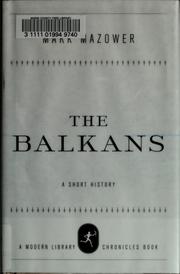
The Balkans: Nationalism, War, and the Great Powers,
Places Montenegro within broader regional developments.

Montenegro: A Modern History
Covers the political and cultural background for major belief episodes.
Endnotes
1.
Source: cambridge.org
Link:https://www.cambridge.org/core/journals/american-slavic-and-east-european-review/article/catherine-ii-and-a-false-peter-iii-in-montenegro/FC8FC66AD4E24B597D3475F6E51D8CF7
Source snippet
Pavićević, “Lažni car šćepan Mali u svjetlosti istorije i narodne tradicije,” V jesnik Etnograftkog Muzeja u Zagrebu, IV (1938), 72-73...
2.
Source: state.gov
Link:https://www.state.gov/reports/2020-report-on-international-religious-freedom/montenegro
Source snippet
State Department2020 Report on International Religious FreedomAccording to media reports, SOC leaders decried the religious freedom law a...
3.
Source: Wikipedia
Title: Šćepan Mali
Link:https://en.wikipedia.org/wiki/%C5%A0%C4%87epan_Mali
4.
Source: Wikipedia
Link:https://en.wikipedia.org/wiki/Zduha%C4%87
5.
Source: visit-montenegro.com
Link:https://www.visit-montenegro.com/monastery-ostrog/stories/
6.
Source: Wikipedia
Title: 2019–2020 clerical protests in Montenegro
Link:https://en.wikipedia.org/wiki/2019%E2%80%932020_clerical_protests_in_Montenegro
7.
Source: safejournalists.net
Title: Safe Journalists The Western Balkans Journalists’ Safety Index
Link:https://safejournalists.net/wp-content/uploads/2023/11/MNE-ENG-Index-za-2022.pdf
8.
Source: Wikipedia
Title: Satanic panic
Link:https://en.wikipedia.org/wiki/Satanic_panic
9.
Source: Wikipedia
Title: List of mass panic cases
Link:https://en.wikipedia.org/wiki/List_of_mass_panic_cases
10.
Source: Wikipedia
Title: Our Lady of Medjugorje
Link:https://en.wikipedia.org/wiki/Our_Lady_of_Medjugorje
11.
Source: Wikipedia
Title: Mass psychogenic illness
Link:https://en.wikipedia.org/wiki/Mass_psychogenic_illness
12.
Source: Wikipedia
Title: Witch trials in the early modern period
Link:https://en.wikipedia.org/wiki/Witch_trials_in_the_early_modern_period
13.
Source: Wikipedia
Title: History of Montenegro
Link:https://en.wikipedia.org/wiki/History_of_Montenegro
14.
Source: Wikipedia
Title: Šćepan Mali
Link:https://de.wikipedia.org/wiki/%C5%A0%C4%87epan_Mali
15.
Source: cambridge.org
Link:https://www.cambridge.org/core/journals/nationalities-papers/article/remembering-the-causes-of-collective-violence-and-the-role-of-propaganda-in-the-yugoslav-wars/DA8EFC29DFC55A45A91B293062BA1474
16.
Source: cambridge.org
Link:https://www.cambridge.org/core/services/aop-cambridge-core/content/view/DA8EFC29DFC55A45A91B293062BA1474/S0090599222000538a.pdf/remembering_the_causes_of_collective_violence_and_the_role_of_propaganda_in_the_yugoslav_wars.pdf
17.
Source: cambridge.org
Link:https://www.cambridge.org/core/books/cambridge-encyclopedia-of-stage-directors/m/49DC07053D7E5C818C3E09097072FFCA
18.
Source: history.com
Title: what was satanic panic 1980s
Link:https://www.history.com/articles/what-was-satanic-panic-1980s
19.
Source: 2021-2025.state.gov
Link:https://2021-2025.state.gov/reports/2019-report-on-international-religious-freedom/montenegro/
20.
Source: sigedon.com
Title: peter iii of russia
Link:https://sigedon.com/peter-iii-of-russia/
Source snippet
The Curious Case of Peter III of Russia2 Jul 2025 — This belief created fertile ground for false tsars, individuals who claimed to...
21.
Source: gov.me
Link:https://www.gov.me/en/article/219509–ministry-of-culture-montenegro-exposed-to-unprecedented-disinformation-campaign
22.
Source: reportingdiversity.org
Link:https://www.reportingdiversity.org/wp-content/uploads/2022/07/MRHS_Montenegro-FINAL.pdf
23.
Source: theins.press
Link:https://theins.press/en/politics/281101
24.
Source: ebsco.com
Link:https://www.ebsco.com/research-starters/social-sciences-and-humanities/mass-hysteria
Additional References
25.
Source: labrujulaverde.com
Link:https://www.labrujulaverde.com/en/2024/08/scepan-mali-the-first-and-only-tsar-of-montenegro-who-pretended-to-be-the-russian-peter-iii/
Source snippet
La Brújula VerdeŠcepan Mali, the first and only tsar of Montenegro, who...20 Aug 2024 — Everyone knew that Šćepan was an impostor, but h...
26.
Source: youtube.com
Title: THE FAKE RUSSIAN TSAR WHO RULED MONTENEGRO? The story of a fake tsar Šćepan mali
Link:https://www.youtube.com/watch?v=CTHZl0vPLSs
Source snippet
Montenegro adopts law on religion amid protests by pro-Serbs...
27.
Source: youtube.com
Title: Montenegro protesters, police clash over church head inauguration
Link:https://www.youtube.com/watch?v=IOWzACMogAk
Source snippet
Inside Ostrog Monastery, Montenegro The Serbian-Orthodox Church in the Balkans...
28.
Source: books.google.com
Title: Лажни цар Шћепан Мали: Писма · Peter II (Prince-Bishop of Montenegro)Read more
Link:https://books.google.com/books/about/%D0%9B%D0%B0%D0%B6%D0%BD%D0%B8%D1%86%D0%B0%D1%80%D0%A8%D1%9B%D0%B5%D0%BF%D0%B0%D0%BD_%D0%9C%D0%B0%D0%BB%D0%B8.html?id=-NBGAAAAMAAJ
Source snippet
Google BooksЛажни цар Шћепан Мали - Peter II (Prince-Bishop...Lažni car Šćepan Mali: Pisma · Peter II (Prince-Bishop of Montenegro) Snip...
29.
Source: govinfo.gov
Link:https://www.govinfo.gov/content/pkg/CPRT-108JPRT20429/html/CPRT-108JPRT20429.htm
30.
Source: youtube.com
Title: Montenegro Protests Flare as New Church Head Is Installed
Link:https://www.youtube.com/watch?v=FwycH6pVOyA
Source snippet
Montenegro protesters, police clash over church head inauguration...
31.
Source: youtube.com
Title: Montenegro adopts law on religion amid protests by pro-Serbs
Link:https://www.youtube.com/watch?v=XPLSZr3_krE
Source snippet
Montenegro Protests Flare as New Church Head Is Installed...
32.
Source: balkaninsight.com
Title: montenegro politics and society
Link:https://balkaninsight.com/2021/09/13/montenegro-is-turning-a-blind-eye-to-the-disinformation-war/bi/montenegro/montenegro-politics-and-society/
Source snippet
Montenegro is vulnerable to these trends, as...Read more...
33.
Source: academia.edu
Link:https://www.academia.edu/28591164/Brainwashing_Theories_in_European_Parliamentary_and_Administrative_Reports_on_Cults_and_Sects
34.
Source: researchgate.net
Link:https://www.researchgate.net/publication/379664445THE_VAMPIRE_AS_THE_MYTHOLOGICAL_CREATURE_IN_THE_CINEMATOGRAPHY_OF_SOUTH_SLAVIC_COUNTRIES_VAMPIRE_IN_FILMS_LEPTIRICA_AND_HOLY_PLACE-FOLKLORIC_JUXTAPOSITION
Topic Tree
Follow this branch
Related pages 192
- Antigua and Barbuda
- Argentina Belief Scares
- Azerbaijan Belief
- Bahrain Beliefs
- North Korea
- +187 more in sidebar