What Has Monaco Believed, Feared and Misremembered?
Monaco does not have a well-documented history of witch-hunting, mass psychogenic illness, apocalyptic sects or satanic panic comparable with cases found elsewhere in Europe. That absence is the most important finding.
Page outline Jump by section
Introduction
What Monaco does offer is a more subtle history of collective belief and fear. Its national identity is closely tied to the protective legend of Saint Devote; the devastating Riviera earthquake of 1887 caused genuine public panic; and modern concern about exploitative spiritual movements has entered Monaco largely through French-speaking Catholic and European debates about “sectarian abuses”. These subjects must be kept separate. A religious tradition is not a delusion, fear during a real earthquake is not “mass hysteria”, and an unconventional spiritual association is not automatically a dangerous cult.
Why Monaco has so few recorded panic episodes
Monaco’s exceptional size shapes its historical record. It is a very small sovereign state whose population has long been socially, economically and culturally intertwined with neighbouring France and Italy. Religious movements, rumours and public scares therefore tend to belong to the wider Riviera rather than remaining confined within Monegasque borders.
The principality also lacks the sort of surviving local judicial archive that has allowed historians to reconstruct witch prosecutions village by village elsewhere. The available evidence does not support claims of a distinctive Monegasque witch panic, satanic conspiracy scare or epidemic of unexplained group illness. This does not prove that no rumour, accusation or unusual belief ever circulated. It means that such incidents should not be promoted into historical “cases” without records showing who was involved, what was alleged and how officials responded.
Monaco’s political and religious structure may also have reduced some conditions associated with major early-modern panics. Catholicism retained an unusually continuous public and ceremonial role, while political authority remained highly concentrated. The present constitution still identifies Roman Catholicism as the religion of the state, although it also protects freedom of conscience, religious practice and public worship.[LégiMonaco]legimonaco.mcLégiMonacoConstitution du 17 décembre 1962 de la PrincipautéLa Principauté de Monaco est un État souverain et indépendant dans le cadre d…
This combination does not make a society immune to collective fear. It does, however, differ from places where competing courts, confessional conflict, village feuds and zealous local prosecutors allowed accusations of witchcraft or heresy to multiply.
Saint Devote: shared legend, not mass delusion
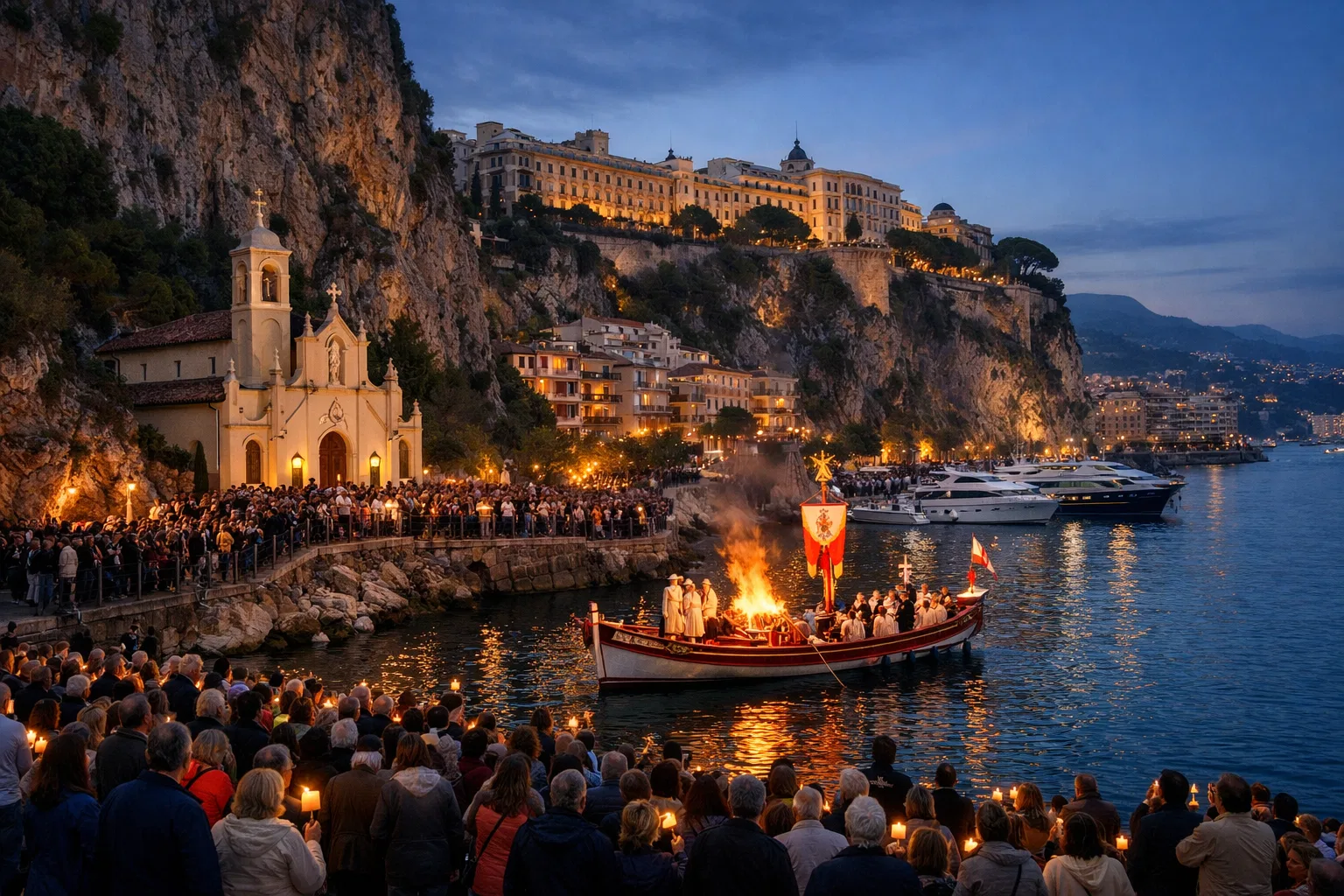
The most important collective supernatural belief in Monaco is the tradition of Saint Devote, the principality’s patron saint. According to the medieval legend, Devote was a Christian woman martyred in Corsica during the persecutions associated with the emperors Diocletian and Maximian. Her body was placed in a boat and carried across the sea to the site that became Monaco. A dove was said to have guided the vessel.
Another part of the story tells of a thief who attempted to steal the saint’s relics. Fishermen caught him, and his boat was burnt on the shore. Monaco’s annual ceremony now includes the symbolic burning of a boat on 26 January, followed by religious and state observances. The Monegasque government explicitly presents the account as legend and tradition rather than as verified documentary history.[Government of Monaco]gouv.mcGovernment of MonacoSainte Dévote: the spread of ChristianityAccording to legend, a group of fishermen caught the thief's boat, which was…
Later tradition credited Saint Devote with protecting Monaco during the Genoese siege of 1506–07. One version says that she appeared to defenders and promised victory before the besieging force withdrew. The belief became associated with the ruling family, national survival and Monegasque identity. Images of the saint appear in churches, art, literature, coins and official celebrations.[Sainte Dévote Monaco |]saintedevotemonaco.comSainte Dévote Monaco |Patron saint of MonacoHer cult in connection with Monaco and its Princes can officially be seen in every…Read more…
It would be misleading to call this “mass hysteria”. The tradition is better understood as a civic sacred narrative: a story through which a small community explains its endurance and expresses continuity between religion, dynasty and nation. Whether every detail is historically demonstrable is less important to its social function than the fact that generations of Monegasques have publicly commemorated it.
The case also shows why the word “cult” requires care. In traditional Christian usage, the “cult of a saint” means an organised pattern of veneration, ceremonies and devotional practices. It does not imply coercive leadership, manipulation or the modern popular image of a dangerous cult.
The 1887 earthquake and a real panic
On 23 February 1887, a powerful earthquake struck the Ligurian coast and the western Riviera. It caused severe destruction in parts of Italy, was felt across southern France and produced a small tsunami. Contemporary reports described violent shocks in Monaco and Monte Carlo.[ResearchGate]researchgate.netConsequences of the 1887 February 23, earthquake…Early in the morning, of February 23, 1887 a major damaging earthquake hi…
People throughout the affected region fled buildings, gathered in open spaces and feared further shocks. Accounts from nearby Riviera communities describe residents sleeping outside or sheltering in temporary camps. This behaviour was not evidence of irrational contagion. Buildings had collapsed elsewhere, hundreds of people had been killed across the wider disaster zone, and aftershocks posed a credible danger.
The episode belongs in Monaco’s history of collective fear because earthquakes create conditions in which information is scarce, danger is invisible and rumours travel rapidly. People cannot easily tell whether the next tremor will be weaker or catastrophic. Hotels, churches and densely occupied buildings can empty almost at once as one person’s flight alerts others.
Yet the distinction between panic and mass psychogenic illness remains crucial. Mass psychogenic illness usually refers to real physical symptoms spreading through a group when investigators find no adequate toxic, infectious or environmental cause. Typical outbreaks may involve fainting, dizziness, nausea, breathing difficulties or unusual movements. Researchers warn that authorities must first exclude genuine hazards before applying such an explanation.[Society of Apothecaries]apothecaries.orgSociety of Apothecaries Mass-psychogenic-illness-and-how-to-respondSociety of Apothecaries Mass-psychogenic-illness-and-how-to-respond
In Monaco in 1887, the hazard was unquestionably real. Fear may have spread socially, but it was rooted in an actual natural disaster. Describing the reaction as “hysteria” would trivialise both the danger and the understandable behaviour of those affected.
Modern concern about “sectarian abuses”
There is little evidence that Monaco developed an independent anti-cult panic. Modern discussion instead reflects the influence of France and the wider French-speaking Catholic world, where the word “sect” has often been used for organisations accused of psychological control, financial exploitation, abusive healing practices or isolation of members.
A revealing Monegasque example came in January 2019, when a diocesan venue advertised a public conference on alternative therapies and “sectarian abuses”. The speakers included a priest described as a specialist in sects and a former national coordinator of a Catholic pastoral service concerned with new beliefs. The event suggests preventive concern about manipulation in loosely regulated therapeutic or spiritual settings, not evidence that Monaco itself was experiencing an organised cult emergency.[Journal de Monaco]journaldemonaco.gouv.mcLa Semaine en PrincipauteLa Semaine en Principaute
This language can serve a legitimate purpose when it directs attention to concrete harms: taking money through deception, pressuring patients to abandon medical care, coercing members or exploiting vulnerable people. It becomes less reliable when it treats religious unfamiliarity as proof of danger.
Monaco’s own public record illustrates the need for that distinction. The official journal shows that a local association connected with the Ancient Mystical Order Rosae Crucis, commonly known as AMORC, received formal authorisation in 1968 and continued to appear in later administrative notices. Its existence demonstrates that esoteric organisations have operated openly within Monaco’s association system. The available records do not, by themselves, establish abuse, criminality or a public panic surrounding the group.[Journal de Monaco]journaldemonaco.gouv.mcOpen source on gouv.mc.
Administrative recognition does not prove that every practice of an organisation is harmless. Equally, esoteric teaching, secrecy, ritual or unconventional belief does not prove coercion. A sound assessment asks about conduct: whether members can leave, whether leaders control money and relationships, whether medical claims are deceptive, and whether abuse is concealed.
Religion, minority groups and the risk of hostile labelling
Roman Catholicism remains Monaco’s state religion, but the country is also home to Protestant, Orthodox, Jewish, Muslim and other communities. Estimates vary because Monaco does not routinely publish comprehensive religious census data, although available reports consistently describe Catholics as the large majority. The constitution extends religious freedom to citizens and non-citizen residents.[state.gov]2021-2025.state.govOpen source on state.gov.
The legal and social position of minority faiths matters to any discussion of cult scares. Hostile labelling often begins when a small or unfamiliar community is treated as suspicious simply because its practices differ from those of the majority. Across Europe, terms such as “sect”, “heresy” and “superstition” have never been neutral descriptions; they have frequently reflected the authority of the speaker and the social status of the group being described.[OAPEN]library.oapen.orgSectes » et « hérésies »Sectes » et « hérésies »
Recent reporting indicates that Monaco generally respects freedom of worship. Freedom House noted that the government officially recognised Jehovah’s Witnesses in late 2022, a development that complicates any simple picture of a Catholic state resisting minority religions.[Freedom House]freedomhouse.orgfreedom worldfreedom world
For historians of moral panic, this is an important safeguard. Concern should be tied to demonstrable actions rather than theology, unusual clothing, missionary activity or claims of spiritual truth. Otherwise, “cult protection” can become a respectable language for discrimination.

How rumours would spread in a microstate
Although Monaco lacks a famous historical panic, its social structure offers a useful case for thinking about how one might spread. The principality is geographically compact, highly urbanised and closely observed by international media. Residents, commuters, tourists, luxury businesses and state institutions operate in a very small physical space.
In such an environment, an alarming claim could travel rapidly through personal contact, local news, messaging apps and French or Italian media. A suspicious smell, an unexplained illness in a school, a claim about contaminated food or an allegation against a religious group might quickly appear to affect the whole country even when the original event involved only a small number of people.
That does not mean Monaco is unusually gullible. It means that scale alters perception. In a large country, an incident involving one building may remain local. In Monaco, the same event may occur within walking distance of government offices, major hotels, schools and international broadcasters.
Modern research on mass psychogenic illness also suggests that crowded settings, anxiety, visible symptoms and repeated media exposure can amplify a scare. Symptoms are genuine rather than consciously invented, but belief about the source of danger can influence how they are noticed and transmitted.[PMC]pmc.ncbi.nlm.nih.govOpen source on nih.gov.
A responsible official response would therefore investigate physical causes first, communicate clearly, avoid speculative labels and correct false claims without ridiculing affected people.
What can safely be concluded
Monaco’s place in the history of cults and collective panic is defined more by careful distinctions than by a single dramatic episode.
The legend of Saint Devote is a long-lived religious and national tradition, not evidence of social pathology. The fear caused by the 1887 earthquake was a rational response to a genuine disaster, even though alarm spread collectively. Modern warnings about “sectarian abuses” show that Monaco participates in wider European concern about manipulative spiritual and therapeutic organisations, but they do not establish that the principality has undergone a major cult panic.
The sparse record is itself instructive. Small countries are easily drawn into stories created elsewhere, while ordinary religious diversity can be misrepresented as menace. Monaco’s evidence supports a restrained approach: document harm precisely, distinguish legend from history, separate real danger from rumour, and never use “cult” or “mass hysteria” as a substitute for explanation.
Amazon book picks
Further Reading
Books and field guides related to What Has Monaco Believed, Feared and Misremembered?. Use these as the next step if you want deeper reading beyond the article.
The Oxford illustrated history of Christianity
Helps explain the development of Christian traditions, saints and collective religious belief.

The witch
Explains how societies have interpreted fear, superstition and accusations across Europe.

A little history of religion
Places Monaco's religious traditions within the wider history of belief and culture.
Monaco: Business and Pleasure on the Riviera
Provides broad historical and cultural context for Monaco's identity, traditions and public memory.
Endnotes
1.
Source: researchgate.net
Link:https://www.researchgate.net/figure/Consequences-of-the-1887-February-23-earthquake-observed-along-the-coast-from-Marseille_fig13_258620677
Source snippet
Consequences of the 1887 February 23, earthquake...Early in the morning, of February 23, 1887 a major damaging earthquake hi...
Published: February 23, 1887
2.
Source: apothecaries.org
Title: Society of Apothecaries Mass-psychogenic-illness-and-how-to-respond
Link:https://www.apothecaries.org/wp-content/uploads/2019/06/Mass-psychogenic-illness-and-how-to-respond.pdf
3.
Source: pmc.ncbi.nlm.nih.gov
Link:https://pmc.ncbi.nlm.nih.gov/articles/PMC4884863/
4.
Source: 2021-2025.state.gov
Link:https://2021-2025.state.gov/reports/2023-report-on-international-religious-freedom/monaco/
5.
Source: thearda.com
Link:https://www.thearda.com/world-religion/national-profiles?u=152c
6.
Source: library.oapen.org
Title: Sectes » et « hérésies »
Link:https://library.oapen.org/bitstream/20.500.12657/24512/4/9782800413013.pdf
7.
Source: history.com
Title: salem witch trials hysteria factors
Link:https://www.history.com/articles/salem-witch-trials-hysteria-factors
8.
Source: 2009-2017.state.gov
Link:https://2009-2017.state.gov/j/drl/rls/irf/2008/108461.htm
9.
Source: 2021-2025.state.gov
Link:https://2021-2025.state.gov/reports/2022-report-on-international-religious-freedom/monaco/
10.
Source: researchgate.net
Link:https://www.researchgate.net/publication/248584398_The_geographical_spread_of_cholera_in_the_Crimean_War_epidemic_transmission_in_the_camp_systems_of_the_British_Army_of_the_East
11.
Source: legimonaco.mc
Link:https://legimonaco.mc/constitution
Source snippet
LégiMonacoConstitution du 17 décembre 1962 de la PrincipautéLa Principauté de Monaco est un État souverain et indépendant dans le cadre d...
12.
Source: gouv.mc
Link:https://www.gouv.mc/en/government-institutions/history-and-heritage/periods/an-ancient-history-prehistory-and-antiquity/sainte-devote-the-spread-of-christianity
Source snippet
Government of MonacoSainte Dévote: the spread of ChristianityAccording to legend, a group of fishermen caught the thief's boat, which was...
13.
Source: saintedevotemonaco.com
Title: Sainte Dévote Monaco |Patron saint of Monaco
Link:https://www.saintedevotemonaco.com/en/saint-devote-patron-saint-of-monaco/
Source snippet
Her cult in connection with Monaco and its Princes can officially be seen in every...Read more...
14.
Source: journaldemonaco.gouv.mc
Title: La Semaine en Principaute
Link:https://journaldemonaco.gouv.mc/Journaux/2019/Journal-8416/La-Semaine-en-Principaute
15.
Source: journaldemonaco.gouv.mc
Title: La Semaine en Principaute
Link:https://journaldemonaco.gouv.mc/en/Journaux/2019/Journal-8418/La-Semaine-en-Principaute
16.
Source: journaldemonaco.gouv.mc
Link:https://journaldemonaco.gouv.mc/en/Journaux/1968/Journal-5786/Arrete-Ministeriel-n-68-264-portant-autorisation-et-approbation-des-statuts-d-une-association-denommee-A.M.O.R.C.-Pronaos-Heracles
17.
Source: journaldemonaco.gouv.mc
Link:https://journaldemonaco.gouv.mc/en/Journaux/1990/Journal-6945/Arrete-Ministeriel-n-90-534-du-24-octobre-1990-approuvant-le-changement-de-denomination-et-les-nouveaux-statuts-de-l-association-denommee-A.M.O.R.C.-Pronaos-Heracles
18.
Source: journaldemonaco.gouv.mc
Title: AMORC MONOECIS
Link:https://journaldemonaco.gouv.mc/Journaux/2014/Journal-8187/AMORC-MONOECIS
19.
Source: freedomhouse.org
Title: freedom world
Link:https://freedomhouse.org/country/monaco/freedom-world/2024
20.
Source: Wikipedia
Title: Mass psychogenic illness
Link:https://en.wikipedia.org/wiki/Mass_psychogenic_illness
21.
Source: Wikipedia
Title: Moral panic
Link:https://en.wikipedia.org/wiki/Moral_panic
22.
Source: Wikipedia
Link:https://en.wikipedia.org/wiki/Monaco
23.
Source: journaldemonaco.gouv.mc
Title: Journal 1506
Link:https://journaldemonaco.gouv.mc/en/Journaux/1887/Journal-1506
24.
Source: journaldemonaco.gouv.mc
Title: Journal 1512
Link:https://journaldemonaco.gouv.mc/en/Journaux/1887/Journal-1512
25.
Source: journaldemonaco.gouv.mc
Title: AMORC MONOECIS
Link:https://journaldemonaco.gouv.mc/fr/Journaux/2016/Journal-8284/AMORC-MONOECIS
26.
Source: journaldemonaco.gouv.mc
Title: AMORC MONOECIS
Link:https://journaldemonaco.gouv.mc/switchlanguage/to/jdm_eng/Journaux/2016/Journal-8284/AMORC-MONOECIS
27.
Source: journaldemonaco.gouv.mc
Title: mc Recherche
Link:https://journaldemonaco.gouv.mc/fr/content/search/%28offset%29/1305?SearchText=&filter%5B%5D=attr_category_s%3A%22Insertions+l%C3%A9gales+et+Annonces%22&filter%5B%5D=attr_theme_s%3A%22Association%2FFondation%22&page_limit=15&sort=score_desc
28.
Source: journaldemonaco.gouv.mc
Title: Journal 6945
Link:https://journaldemonaco.gouv.mc/Journaux/1990/Journal-6945
29.
Source: journaldemonaco.gouv.mc
Title: mc Recherche
Link:https://journaldemonaco.gouv.mc/fr/content/search/%28offset%29/1335?SearchText=&filter%5B%5D=attr_theme_s%3A%22Association%2FFondation%22&page_limit=15&sort=score_desc
30.
Source: journaldemonaco.gouv.mc
Link:https://journaldemonaco.gouv.mc/fr/content/search/%28offset%29/1605?SearchText=&activeFacets%5Barticle_jdm%2Fcategory%3ACat%C3%A9gories%5D=Arr%C3%AAt%C3%A9s+Minist%C3%A9riels&activeFacets%5Barticle_jdm%2Ftheme%3AThemes%5D=Association%2FFondation&activeFacets%5Battr_category_s%3ACat%C3%A9gories%5D=Arr%C3%AAt%C3%A9s+Minist%C3%A9riels&filter%5B%5D=attr_theme_s%3A%22Association%2FFondation%22&page_limit=15&sort=published_desc
31.
Source: journaldemonaco.gouv.mc
Title: mc Recherche
Link:https://journaldemonaco.gouv.mc/fr/content/search/%28offset%29/810?SearchText=&filter%5B%5D=attr_theme_s%3A%22Association%2FFondation%22&page_limit=15&sort=score_desc
32.
Source: legimonaco.mc
Link:https://legimonaco.mc/tnc/ordonnance/2003/02-07-15.655
33.
Source: legimonaco.mc
Link:https://legimonaco.mc/projet/1.084
34.
Source: legimonaco.mc
Link:https://legimonaco.mc/tai/convention/1950/11-04-tai1l010454%402021.08.01
35.
Source: legimonaco.mc
Link:https://legimonaco.mc/tai/convention/1951/07-28-tai1l000781%401954.08.16
36.
Source: legimonaco.mc
Link:https://legimonaco.mc/code/code-penal
37.
Source: legimonaco.mc
Link:https://legimonaco.mc/tai/arrangement/1957/11-23-tai1l000129%401962.01.17
38.
Source: legimonaco.mc
Link:https://legimonaco.mc/projet/912
39.
Source: legimonaco.mc
Link:https://legimonaco.mc/tnc/ordonnance/2002/04-08-15.320%402021.11.13
40.
Source: legimonaco.mc
Link:https://legimonaco.mc/tai/convention/1977/01-27-tai1l016204%402008.01.01
41.
Source: trove.nla.gov.au
Link:https://trove.nla.gov.au/newspaper/article/3466382
42.
Source: pmc.ncbi.nlm.nih.gov
Link:https://pmc.ncbi.nlm.nih.gov/articles/PMC7582136/
43.
Source: pmc.ncbi.nlm.nih.gov
Link:https://pmc.ncbi.nlm.nih.gov/articles/PMC10058923/
44.
Source: end-blasphemy-laws.org
Link:https://end-blasphemy-laws.org/countries/europe/monaco/
45.
Source: ebsco.com
Link:https://www.ebsco.com/research-starters/social-sciences-and-humanities/mass-hysteria
46.
Source: healthline.com
Title: mass hysteria
Link:https://www.healthline.com/health/mental-health/mass-hysteria
Additional References
47.
Source: monaco-tribune.com
Link:https://www.monaco-tribune.com/en/listing/feast-of-sainte-devote/
Source snippet
Monaco TribuneThe celebration of Sainte DévoteLegend has it that (Dévote), a young Christian native of Corsica was martyred by the prefec...
48.
Source: pewresearch.org
Title: many countries favor specific religions officially or unofficially
Link:https://www.pewresearch.org/religion/2017/10/03/many-countries-favor-specific-religions-officially-or-unofficially/
Source snippet
Pew Research CenterMany Countries Favor Specific Religions, Officially or...3 Oct 2017 — Monaco, for example, designates Roman Catholici...
49.
Source: monacoembassy.orderofmalta.int
Title: feast of sainte devote patron of the principality of monaco
Link:https://monacoembassy.orderofmalta.int/en/news/feast-of-sainte-devote-patron-of-the-principality-of-monaco/
Source snippet
Feast of Sainte Dévote: Patron of the Principality of Monaco28 Jan 2025 — According to tradition, in the 16th century, during a war again...
50.
Source: youtube.com
Title: Monaco traditions: Saint Devote celebration
Link:https://www.youtube.com/watch?v=OKDwIPdg1dQ
Source snippet
Saint Devote 2026: Relive the traditional Monegasque ceremony with the Princely Family...
51.
Source: youtube.com
Link:https://www.youtube.com/watch?v=eAGaMQAULxc
Source snippet
Monaco: Europe's Strangest Microstate...
52.
Source: academia.edu
Link:https://www.academia.edu/4593752/Of_Women_and_Witches_A_Case_Study_in_Moral_Panics
53.
Source: facebook.com
Link:https://www.facebook.com/ExploreScienceFR/posts/3-personnes-qui-ont-surv%C3%A9cu-%C3%A0-limpossible-/1361646615995313/
54.
Source: facebook.com
Link:https://www.facebook.com/61555950827446/posts/germanys-witch-trials-the-forgotten-mass-hysteriabefore-salem-there-was-bamberg-/122222958440198360/
55.
Source: facebook.com
Link:https://www.facebook.com/groups/355712515374599/posts/1712345833044587/
56.
Source: facebook.com
Link:https://www.facebook.com/www.defimedia.info/posts/la-situation-sest-intensifi%C3%A9e-avec-la-diffusion-sur-les-r%C3%A9seaux-sociaux-dun-enre/1209075214578104/
Topic Tree
Follow this branch
Related pages 192
- Antigua and Barbuda
- Argentina Belief Scares
- Azerbaijan Belief
- Bahrain Beliefs
- North Korea
- +187 more in sidebar