How Fear Spread Through Modern Jordan
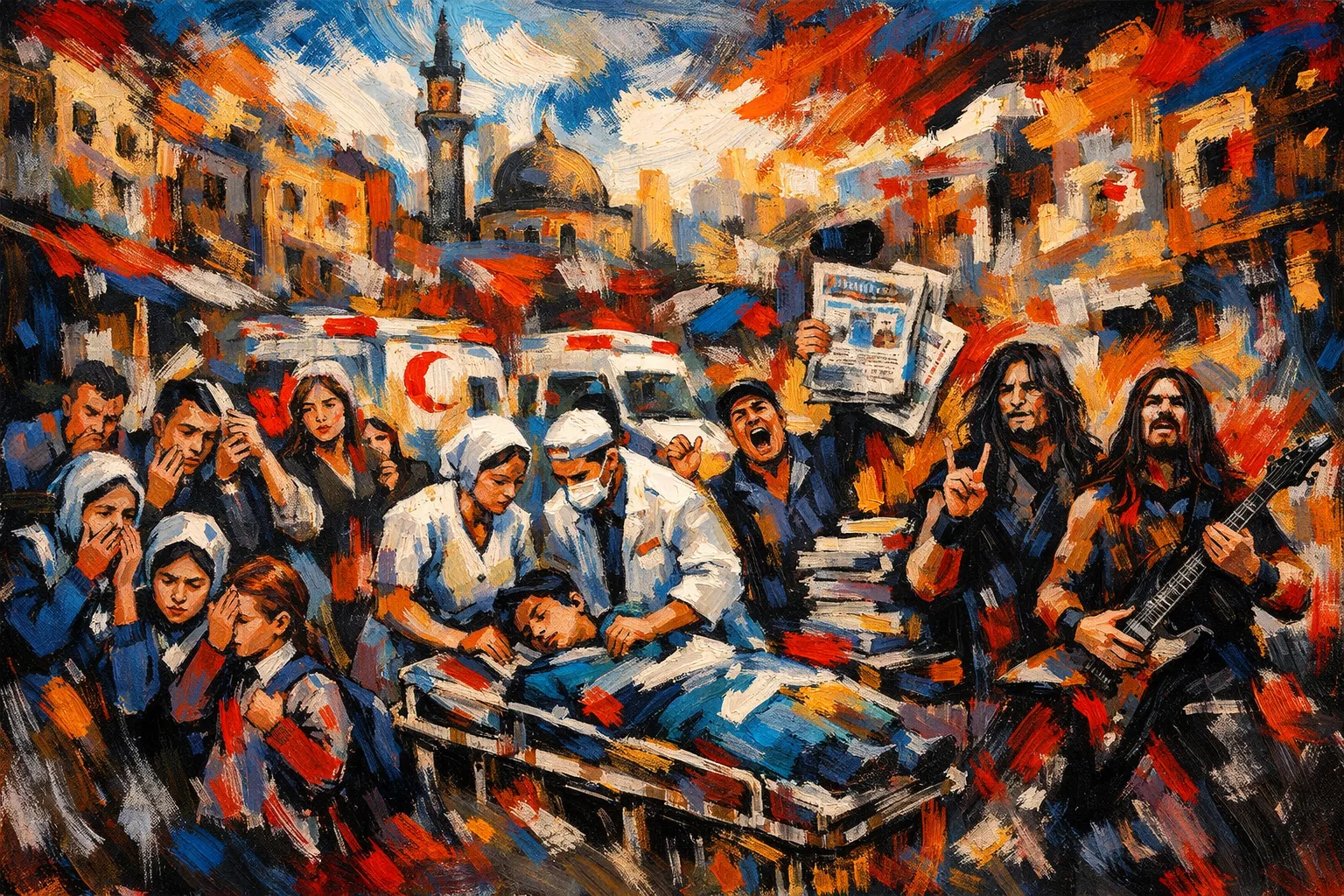
Jordan’s documented history of collective fear is not dominated by famous witch trials or a single notorious apocalyptic sect. Its clearest cases are more modern and reveal how ordinary institutions—schools, hospitals, newspapers, concert venues and government ministries—can become channels for contagious belief.
Page outline Jump by section
Introduction
A second, less precisely documented pattern involved recurring claims that Jordanian heavy-metal musicians and fans were devil worshippers. Rumours about blood drinking, occult rituals and supernatural musical powers helped restrict concerts and record shops, despite little evidence of organised Satanism. Together, these cases show that Jordan’s most revealing “panic” history concerns social contagion, mistrust and the policing of unfamiliar youth culture—not proven secret cults.
The 1998 school vaccination scare
In September 1998, Jordan began administering a combined tetanus and diphtheria booster to school pupils. The programme was medically routine, but reports of adverse reactions rapidly turned it into a national health alarm. The sequence began with a comparatively small number of pupils who felt unwell. News then travelled through schools, families, emergency services, hospitals and the press. Eventually, 806 pupils sought medical advice and 122 were admitted to hospital.[ResearchGate]researchgate.netResearch Gate Mass psychogenic illness following tetanus-diphtheriaMass psychogenic illness following tetanus-diphtheria…February 1, 2001 — 17 Mar 2026 — In September 1998, more than 800 yo…
Reported symptoms included headache, dizziness, nausea, weakness, feverishness and general malaise. Such complaints are physically real and can be frightening, but they are also common responses to anxiety, pain, hyperventilation and the sight of other people becoming distressed. Investigators found that most cases could not be explained by vaccine toxicity, contamination or a defective production batch. The epidemiological pattern instead supported a diagnosis of mass psychogenic illness, now also described as an immunisation stress-related response when it occurs around vaccination.[scielosp.org]scielosp.orgdiphtheria toxoid vaccination in Jordanby S Kharabsheh · 2001 · Cited by 72 — 61.5% of all students identified throughout the country suf…
That diagnosis does not mean the pupils invented their symptoms. Mass psychogenic illness occurs when distress produces genuine bodily effects that spread through observation, expectation and social communication. One person faints or becomes dizzy; nearby people become alert to similar sensations; alarming interpretations circulate; and ordinary physical feelings acquire a threatening meaning. Group vaccination can create ideal conditions because recipients are close together, are watching one another and may already expect pain or side effects.[PubMed]pubmed.ncbi.nlm.nih.govMass psychogenic illness after vaccinationby CJ Clements · 2003 · Cited by 118 — When vaccines are administered to groups, the phys…
The Jordanian episode illustrates this ripple effect unusually well. A later medical review represented its growth as a chain running from roughly 20 initial cases to about 80 at the first school, then to hospital admissions, hundreds seeking medical attention and a much wider concerned public. Information passed among pupils, parents, teachers, health workers, Civil Defence personnel, officials and journalists. The feared danger therefore travelled more efficiently than any suspected contaminant.[seccm.org.tw]seccm.org.twMass Psychogenic Illness After Vaccinationby CJ Clements · 2003 · Cited by 118 — Ripple effect on an outbreak of 'mass psychogenic illnes…

Why the alarm travelled so far
The scare did not spread simply because teenagers were suggestible. It grew because the first symptoms appeared in a setting where uncertainty carried serious consequences. Parents had entrusted a state programme with their children’s safety. Doctors and officials could not dismiss complaints before conducting proper examinations. Hospitals admitted pupils as a precaution, while ambulances and emergency responses made the event more visible. Each sensible protective action could also be interpreted by observers as proof that something dangerous had happened.
Early media reports were especially important. Later public-health guidance described a background of poorly informed reporting that quickly suggested Jordan had used a “bad vaccine”. This explanation was vivid, understandable and emotionally powerful. A detailed account of stress reactions, by contrast, required medical investigation and sounded less convincing to families watching pupils being taken to hospital.[ECDC]ecdc.europa.euECDCCommunication on immunisation – Building trustECDCCommunication on immunisation – Building trust
The incident therefore fits the pattern of a health scare as well as that of mass psychogenic illness. The outbreak consisted of bodily symptoms, but its national significance came from the belief attached to them: that an official intervention intended to protect children might instead have poisoned them. Once this interpretation circulated, every new report seemed to confirm it.
Researchers also found that not every complaint had to share one cause. Vaccination can produce ordinary local pain, mild fever or fainting in a small proportion of recipients. An initial genuine reaction may then become the focus of anxiety and trigger many more cases. This mixed explanation is more realistic than choosing between “everyone was poisoned” and “nothing happened”.[scielosp.org]scielosp.orgdiphtheria toxoid vaccination in Jordanby S Kharabsheh · 2001 · Cited by 72 — 61.5% of all students identified throughout the country suf…
How the authorities responded
Jordanian health authorities faced two duties that could pull in opposite directions. They had to investigate the possibility of a faulty vaccine, while avoiding actions or statements that would deepen an unsupported fear. The programme was interrupted during the inquiry, and vaccine lots, clinical findings and the geographical pattern of cases were examined. Investigators concluded that the vaccine itself did not explain the scale and distribution of the outbreak.[PMC]pmc.ncbi.nlm.nih.govOpen source on nih.gov.
The vaccination campaign was subsequently reinstated. Restoring it required more than announcing that laboratory tests were satisfactory: the Ministry of Health had to spend time and resources rebuilding public confidence. European public-health guidance later used Jordan as a cautionary example of how communication failures can turn anxiety-related events into a threat to an entire immunisation programme.[ECDC]ecdc.europa.euECDCCommunication on immunisation – Building trustECDCCommunication on immunisation – Building trust
The practical lesson is not that officials should immediately describe unexplained illness as psychological. Doing so before excluding infection, contamination or environmental exposure can be medically dangerous and socially insulting. The stronger approach is to investigate rapidly, communicate what is known and unknown, treat affected people respectfully and explain that stress-related symptoms are genuine but not evidence of poisoning. Contemporary vaccine-safety literature treats these events as predictable risks that can be reduced through preparation, calm clinical management and credible public communication.[PMC]pmc.ncbi.nlm.nih.gov806 reported symptoms; 110 were first graders and… Mass psychogenic illness following tetanus-diphtheria toxoid vaccination in Jordan…
The Jordanian case remains important internationally because it demonstrates how a relatively safe intervention can become associated with danger through social amplification. It has subsequently appeared in medical reviews, World Health Organization materials and immunisation-communication guidance as one of the best-known outbreaks of mass psychogenic illness following vaccination.[IRIS]iris.who.intOpen source on who.int.
Heavy metal and Jordan’s devil-worship scare
Jordan’s heavy-metal panic was less concentrated than the vaccine episode. It did not unfold as one national emergency with a definitive investigation. Instead, musicians described recurring periods in which concerts were tolerated and then prohibited, venues became reluctant to host bands, and shops selling metal recordings or merchandise closed or changed business. Academic fieldwork likewise found that government policy could alternate between allowing and preventing performances.[The World from PRX]theworld.orgThe World from PRXRock and a hard placeThe World from PRXRock and a hard place
At the centre of the scare was a claim that heavy metal was not merely loud, foreign or offensive but a form of Satanic worship. Jordanian musicians reported rumours that fans drank cats’ blood or injected a mysterious green substance that gave them the ability to play guitar. Major newspapers were said to have repeated some of these stories. No substantial evidence emerged of an organised Jordanian movement carrying out the alleged rituals.[The World from PRX]theworld.orgThe World from PRXRock and a hard placeThe World from PRXRock and a hard place
The people targeted by the stereotype did not neatly match the image of a dangerous underground. Journalistic accounts described many musicians as educated and from middle- or upper-income families, with ordinary employment and family responsibilities. Bands said their lyrics dealt with war, emotion, regional mythology and historical themes rather than devil worship. Tyrant Throne, for example, drew on Mesopotamian and Nabataean legends, while Bilocate’s members described music as an outlet for anger and difficult human experience.[The World from PRX]theworld.orgThe World from PRXRock and a hard placeThe World from PRXRock and a hard place
One account published in 2009 reported that fear spreading from the much-publicised 1997 arrests of alleged Satanists in Egypt had affected attitudes in Jordan. Jordanian musicians recalled that the limited number of specialist metal shops disappeared or changed direction between about 2002 and 2005. Long hair, black clothing, unfamiliar symbols and aggressive musical sounds became convenient signs through which outsiders imagined a hidden religious threat.[The National]thenationalnews.comThe National Heavy metal band on the run in JordanThe National Heavy metal band on the run in Jordan
This was a moral panic rather than mass psychogenic illness. There was no contagious outbreak of symptoms. Instead, a youth subculture was represented as a danger to religion, morality and public order. Rumour transformed aesthetic differences into evidence of secret conduct, while restrictions on performance gave the accusations institutional consequences.
Why young musicians became believable villains
Heavy metal offered unusually fertile material for hostile interpretation. Its imagery often includes death, darkness, war, mythology and religious symbolism. Its vocal style and distorted sound can appear aggressive to listeners unfamiliar with the genre. Some international bands deliberately use occult imagery, but that does not establish that listeners belong to an organised religion or practise criminal rituals.
In Jordan, these features intersected with wider concern about imported culture and youthful nonconformity. Metal fans could be presented simultaneously as Westernised, morally rebellious and spiritually dangerous. Their clothing and music made them visible, while the alleged activities attached to them—secret ceremonies, animal blood and supernatural initiation—were difficult to disprove to an audience already inclined to suspect hidden behaviour.
The panic also formed part of a regional pattern. During the late 1990s and early 2000s, alleged devil worshippers were pursued or publicly denounced in Egypt, Lebanon and Morocco. Police and newspapers sometimes treated black shirts, compact discs, tattoos or long hair as clues to Satanism. The Jordanian experience was generally less dramatic than Egypt’s mass arrests or Morocco’s prosecutions, but neighbouring scares helped make the same story plausible.[The Guardian]theguardian.comThe Guardian Highway to hell | World news | The GuardianThe Guardian Highway to hell | World news | The Guardian
Political and social interpretations go beyond religion alone. Critics of regional crackdowns have argued that controlling conspicuous youth culture can divert attention from unemployment, corruption and limited political participation. That argument should not be treated as a proven motive in every Jordanian decision. It does, however, explain why a small music scene might attract a level of official and journalistic attention out of proportion to any demonstrated harm.[The Guardian]theguardian.comThe Guardian Highway to hell | World news | The GuardianThe Guardian Highway to hell | World news | The Guardian

Cults, rumours and contested labels
Neither of Jordan’s strongest cases is best understood as the history of an actual “cult”. The pupils affected in 1998 did not form a belief movement or follow a charismatic leader. Their symptoms arose within a temporary network of fear and communication. Heavy-metal fans constituted a music scene, not a unified religious organisation, and the “Satanist” label was largely imposed by worried outsiders.
This distinction matters because the word “cult” can make unverified accusations sound established. A coercive religious group should be assessed through evidence of leadership control, exploitation, isolation, abuse or organised illegal conduct. Unusual beliefs, private rituals or unpopular music are not enough. In the Jordanian metal scare, the allegations most often described by musicians and journalists were folkloric claims without documented proof.
Belief in spiritual healing, sorcery or supernatural harm also exists in Jordan, as it does in many societies, but individual belief should not automatically be called mass hysteria. A recent Jordanian television investigation, for example, reported a commercial fraud network selling supposed spiritual and magical services through social media. The alleged harm in that case concerned deception and exploitation, not a spontaneous nationwide witch panic.[Roya News]en.royanews.tvRoya investigation exposes scam witchcraft ring in JordanRoya investigation exposes scam witchcraft ring in Jordan
The useful question is therefore not whether Jordanians “believe in” supernatural forces as a single category. It is how a particular claim moves from private belief to public alarm, who benefits from its circulation, what evidence is demanded and whether authorities respond to demonstrable harm or merely to social difference.
What the Jordanian cases teach
Jordan’s vaccination scare and metal panic appear very different, yet both depended on rapid interpretation under uncertainty. In the first case, bodily sensations were read as proof of a dangerous medical product. In the second, unfamiliar music and appearance were read as signs of a secret anti-religious movement. Once the threatening explanation became established, visible responses—hospital admissions, cancelled concerts, closed shops or newspaper coverage—could be mistaken for independent confirmation.
Both episodes also show that institutions do not merely suppress or correct panics. They can unintentionally amplify them. Emergency precautions may make an uncertain health event look catastrophic. Sensational reporting can convert rumour into apparent fact. Restrictions justified as responses to public anxiety can persuade the public that the suspected danger was genuine.
The comparison should not erase their differences. The 1998 outbreak was a well-investigated case of mass psychogenic illness involving real physical distress and a measurable public-health impact. The heavy-metal controversy was a recurring moral and cultural scare whose extent is reconstructed mainly from musicians’ testimony, journalism and regional research. Claims about its scale should therefore remain more cautious.
Jordan’s record is culturally important precisely because it resists the familiar catalogue of spectacular cult disasters. Its best evidence points instead to quieter mechanisms: fear passing between classmates, mistrust accumulating around a state programme, newspaper stories turning clothing into incriminating evidence, and authorities struggling to distinguish precaution from amplification. These episodes show how collective belief can cause disruption and stigma even when there is no hidden sect, poisoned vaccine or organised Satanic conspiracy behind it.
Amazon book picks
Further Reading
Books and field guides related to How Fear Spread Through Modern Jordan. Use these as the next step if you want deeper reading beyond the article.
Extraordinary Popular Delusions and the Madness of Crowds
Rating: 4.0/5 from 5 Google Books ratings
Provides foundational context for collective fear and social contagion.

The Righteous Mind
Helps explain why communities respond differently to perceived threats.

The Psychology of Pandemics
Explains how fear, rumours and risk perception spread through societies.

Mistakes Were Made (But Not by Me)
Explores self-justification, belief persistence and public misunderstanding.
Endnotes
1.
Source: researchgate.net
Title: Research Gate Mass psychogenic illness following tetanus-diphtheria
Link:https://www.researchgate.net/publication/11801887_Mass_psychogenic_illness_following_tetanus-diphtheria_toxoid_vaccination_in_Jordan
Source snippet
Mass psychogenic illness following tetanus-diphtheria...February 1, 2001 — 17 Mar 2026 — In September 1998, more than 800 yo...
Published: February 1, 2001
2.
Source: seccm.org.tw
Link:https://www.seccm.org.tw/files/orgNews/gov_20100126_H1N120100127enclosure2.pdf
Source snippet
Mass Psychogenic Illness After Vaccinationby CJ Clements · 2003 · Cited by 118 — Ripple effect on an outbreak of 'mass psychogenic illnes...
3.
Source: scielosp.org
Link:https://www.scielosp.org/pdf/bwho/2001.v79n8/764-770
Source snippet
diphtheria toxoid vaccination in Jordanby S Kharabsheh · 2001 · Cited by 72 — 61.5% of all students identified throughout the country suf...
4.
Source: pmc.ncbi.nlm.nih.gov
Link:https://pmc.ncbi.nlm.nih.gov/articles/PMC10874769/
Source snippet
806 reported symptoms; 110 were first graders and... Mass psychogenic illness following tetanus-diphtheria toxoid vaccination in Jordan...
5.
Source: pmc.ncbi.nlm.nih.gov
Title: PMCMass sociogenic illness
Link:https://pmc.ncbi.nlm.nih.gov/articles/PMC543940/
Source snippet
NIHby E Weir · 2005 · Cited by 63 — September 1998 involved 800 children in Jordan who believed they had suffered from the side eff...
Published: September 1998
6.
Source: ecdc.europa.eu
Title: ECDCCommunication on immunisation – Building trust
Link:https://www.ecdc.europa.eu/sites/default/files/media/en/publications/Publications/TER-Immunisation-and-trust.pdf
7.
Source: pmc.ncbi.nlm.nih.gov
Link:https://pmc.ncbi.nlm.nih.gov/articles/PMC4884863/
8.
Source: pmc.ncbi.nlm.nih.gov
Link:https://pmc.ncbi.nlm.nih.gov/articles/PMC2566491/
9.
Source: researchgate.net
Link:https://www.researchgate.net/figure/Number-of-vaccinated-students-affected-by-district-and-vaccine-lot-29-September-5_tbl3_11801887
10.
Source: iris.who.int
Link:https://iris.who.int/bitstreams/88d3e61d-63e5-458c-8880-893f713226d1/download
11.
Source: iris.who.int
Title: IRISCausality assessment of an adverse event following
Link:https://iris.who.int/bitstreams/2a09fc09-127c-47e7-b289-e20523ded26b/download
12.
Source: theworld.org
Title: The World from PRXRock and a hard place
Link:https://theworld.org/stories/2017/03/10/rock-and-hard-place
13.
Source: iris.who.int
Title: int Index
Link:https://iris.who.int/bitstreams/03475692-7441-41d2-bbf8-7f46622483c5/download
14.
Source: terrance.who.int
Title: SAGE Yellow Book Oct2015
Link:https://terrance.who.int/mediacentre/data/sage/SAGE_Docs_Ppt_Oct2015/SAGE_Yellow_Book_Oct2015.pdf
15.
Source: iris.who.int
Link:https://iris.who.int/bitstream/handle/10665/264552/PMC2491115.pdf
16.
Source: afro.who.int
Link:https://www.afro.who.int/sites/default/files/2017-06/IDSR-Technical-Guidelines_Final_2010_0.pdf
17.
Source: terrance.who.int
Title: SAGE Yellow Book april 2017
Link:https://terrance.who.int/mediacentre/data/sage/SAGE_Docs_Ppt_Apr2017/SAGE_Yellow_Book_april_2017.pdf
Published: april 2017
18.
Source: afro.who.int
Title: 2 Uganda 3rd IDSR Tech Guideline PrintVersion 10Sep2021
Link:https://www.afro.who.int/sites/default/files/2021-09/2_Uganda%203rd%20IDSR%20Tech%20Guideline_PrintVersion_10Sep2021.pdf
19.
Source: ojs-dev.wpro.who.int
Link:https://ojs-dev.wpro.who.int/ojs/index.php/wpsar/article/view/538/860
20.
Source: terrance.who.int
Title: SAGE Yellow Book Oct2016
Link:https://terrance.who.int/mediacentre/data/sage/SAGE_Docs_Ppt_Oct2016/SAGE_Yellow_Book_Oct2016.pdf
21.
Source: ojs.wpro.who.int
Title: int I N THIS ISSUE
Link:https://ojs.wpro.who.int/ojs/public/journals/1/pdf/wpsar.2018.9.4.pdf
22.
Source: researchgate.net
Link:https://www.researchgate.net/publication/14044086_Adverse_events_after_school_leavers_received_combined_tetanus_and_low_dose_diphtheria_vaccine
23.
Source: researchgate.net
Title: 365923857 Witchcraft Acts Condemnation of Sorcery in the Codes of Law
Link:https://www.researchgate.net/publication/365923857_Witchcraft_Acts_Condemnation_of_Sorcery_in_the_Codes_of_Law
24.
Source: researchgate.net
Link:https://www.researchgate.net/publication/249727744_Doing_the_Devil%27s_Work_Heavy_Metal_and_the_Threat_to_Public_Order_in_the_Muslim_World
25.
Source: researchgate.net
Link:https://www.researchgate.net/publication/6951268_Mass_Psychogenic_Illness_After_Vaccination
26.
Source: researchgate.net
Link:https://www.researchgate.net/profile/Nora-Dellepiane
27.
Source: researchgate.net
Title: (PDF) Gardasil™ and mass psychogenic illness [4]View. Show
Link:https://www.researchgate.net/publication/6115317_Gardasil_and_mass_psychogenic_illness_4
28.
Source: researchgate.net
Link:https://www.researchgate.net/profile/Najwa-Khuri-Bulos/2
29.
Source: researchgate.net
Link:https://www.researchgate.net/figure/mmunity-to-tetanus-and-diphtheria-in-adolescents-as-a-function-of-vaccination-status_fig1_6530326
30.
Source: scielosp.org
Link:https://www.scielosp.org/article/bwho/2001.v79n8/764-770/
31.
Source: health.mil
Title: MSMR Tetanus and Diphtheria
Link:https://www.health.mil/News/Articles/2025/08/01/MSMR-Tetanus-and-Diphtheria
32.
Source: history.com
Title: vaccine trials schools
Link:https://www.history.com/articles/vaccine-trials-schools
33.
Source: youtube.com
Title: The nocebo effect – Helen Pilcher – Nothing event
Link:https://www.youtube.com/watch?v=wQ1QCbnUjPE
Source snippet
Mass hysteria...
34.
Source: youtube.com
Title: Mass hysteria
Link:https://www.youtube.com/watch?v=3xqikn0pFrA
35.
Source: pubmed.ncbi.nlm.nih.gov
Link:https://pubmed.ncbi.nlm.nih.gov/11545334/
Source snippet
In September 1998, more than 800 young people in Jordan believed they had suffered from the side-effects of tetanus-diphtheria toxoid vac...
Published: September 1998
36.
Source: pubmed.ncbi.nlm.nih.gov
Link:https://pubmed.ncbi.nlm.nih.gov/12814329/
Source snippet
Mass psychogenic illness after vaccinationby CJ Clements · 2003 · Cited by 118 — When vaccines are administered to groups, the phys...
37.
Source: thenationalnews.com
Title: The National Heavy metal band on the run in Jordan
Link:https://www.thenationalnews.com/world/mena/heavy-metal-band-on-the-run-in-jordan-1.501056
38.
Source: theguardian.com
Title: The Guardian Highway to hell | World news | The Guardian
Link:https://www.theguardian.com/world/2003/jun/02/worlddispatch.brianwhitaker
39.
Source: en.royanews.tv
Title: Roya investigation exposes scam witchcraft ring in Jordan
Link:https://en.royanews.tv/news/64234/Roya-investigation-exposes-scam-witchcraft-ring-in-Jordan
40.
Source: Wikipedia
Title: Moral panic
Link:https://en.wikipedia.org/wiki/Moral_panic
41.
Source: pmc.ncbi.nlm.nih.gov
Link:https://pmc.ncbi.nlm.nih.gov/articles/PMC7201200/
42.
Source: pmc.ncbi.nlm.nih.gov
Link:https://pmc.ncbi.nlm.nih.gov/articles/PMC6363158/
43.
Source: ebsco.com
Link:https://www.ebsco.com/research-starters/social-sciences-and-humanities/moral-panic
44.
Source: ebsco.com
Link:https://www.ebsco.com/research-starters/social-sciences-and-humanities/mass-hysteria
45.
Source: en.royanews.tv
Title: Digital sorcerer sparks controversy on social media in Jordan
Link:https://en.royanews.tv/news/52536/Digital-sorcerer-sparks-controversy-on-social-media-in-Jordan
46.
Source: en.royanews.tv
Title: Thirteen students hospitalized after gas leak at school in Amman
Link:https://en.royanews.tv/news/59067/Thirteen-students-hospitalized-after-gas-leak-at-school-in-Amman
47.
Source: theguardian.com
Link:https://www.theguardian.com/world/2018/nov/17/an-apocalyptic-cult-900-dead-remembering-the-jonestown-massacre-40-years-on
48.
Source: healthline.com
Title: mass hysteria
Link:https://www.healthline.com/health/mental-health/mass-hysteria
49.
Source: youtube.com
Link:https://www.youtube.com/watch?v=tiluGfZ_AtU
Additional References
50.
Source: ojp.gov
Link:https://www.ojp.gov/pdffiles1/Digitization/136592NCJRS.pdf
51.
Source: youtube.com
Title: The Salem Witch Trials
Link:https://www.youtube.com/watch?v=JaB3kfqyG1E
Source snippet
The nocebo effect -- Helen Pilcher -- Nothing event...
52.
Source: youtube.com
Title: Was ‘Havana Syndrome’ a case of mass hysteria?
Link:https://www.youtube.com/watch?v=ljf1TVWTSlQ
Source snippet
The Salem Witch Trials - History Simplified and Explained...
53.
Source: academia.edu
Link:https://www.academia.edu/1644589/Taking_a_Trip_to_the_Middle_Eastern_Metal_Scene
54.
Source: sciencedirect.com
Link:https://www.sciencedirect.com/science/chapter/edited-volume/pii/B978012802655700006X
55.
Source: pbs.org
Link:https://www.pbs.org/wgbh/pages/frontline/shows/apocalypse/explanation/cults.html
56.
Source: ebsco.com
Link:https://www.ebsco.com/research-starters/history/david-berg
57.
Source: facebook.com
Link:https://www.facebook.com/groups/aotearoanzhistory/posts/1201382481684112/
58.
Source: reddit.com
Link:https://www.reddit.com/r/exjw/comments/1j12yzm/doomsday_cults_through_the_centuries/
59.
Source: study.com
Link:https://study.com/learn/lesson/mass-hysteria-moral-panic.html
Topic Tree
Follow this branch
Related pages 192
- Antigua and Barbuda
- Argentina Belief Scares
- Azerbaijan Belief
- Bahrain Beliefs
- North Korea
- +187 more in sidebar