Within Lithuania
Why Did the Siluva Apparition Endure?
Reported visions at Siluva show how pilgrimage, religious rivalry and institutional approval can turn a local claim into a national tradition.
On this page
- The reported vision and its historical setting
- How pilgrimage and church recognition shaped belief
- What evidence can and cannot establish
Page outline Jump by section
Introduction
The reported apparition at Šiluva occupies a distinctive place in Lithuania’s religious history because it became far more than a local miracle story. According to Catholic tradition, the Virgin Mary appeared to shepherd children in 1608 near the site of a destroyed Catholic church, at a time when the surrounding area had become predominantly Calvinist during the Reformation. Whether viewed as a genuine miracle, a powerful religious tradition or a product of its historical moment, the story helped transform Šiluva into one of Lithuania’s leading pilgrimage centres. It also illustrates how reported supernatural experiences can gain lasting influence when they become intertwined with religious rivalry, legal disputes, institutional recognition and national identity rather than remaining isolated personal experiences.
Why did the reported vision happen when it did?
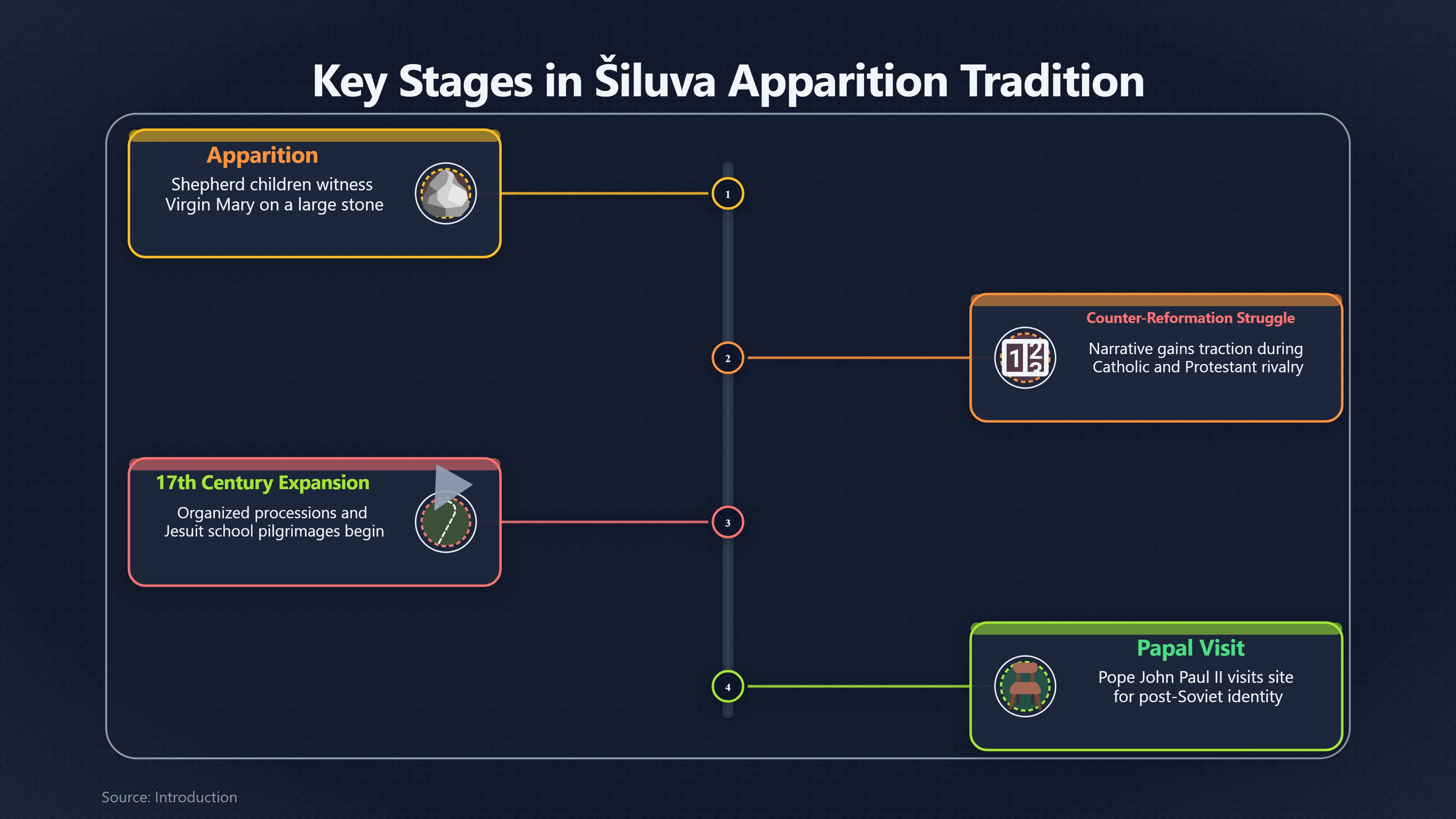
The traditional account places the apparition in 1608. Shepherd children grazing animals reportedly saw a sorrowful woman holding the infant Jesus standing on a large stone. According to later accounts, she lamented that a place where her Son had once been worshipped had become ploughed farmland. The story quickly spread beyond the children themselves when adults, including members of the local Protestant community, reportedly witnessed the same figure.[siluva.lt]siluva.ltApsireiškimas Šiluvoje – ŠiluvaApsireiškimas Šiluvoje – Šiluva
The setting mattered enormously. During the sixteenth century, much of the local nobility had embraced Calvinism. The Catholic church at Šiluva had disappeared, its property had become the subject of dispute, and Catholic influence in the area had weakened dramatically. According to Catholic tradition, important church documents proving ownership of the land had previously been hidden for safekeeping. The apparition narrative became closely linked with the later recovery of these documents and the successful legal restoration of Catholic property.[siluva.lt]siluva.ltApsireiškimas Šiluvoje – ŠiluvaApsireiškimas Šiluvoje – Šiluva
Historians therefore see the apparition not simply as an isolated visionary experience but as part of the wider struggle between Catholicism and Protestantism during the Counter-Reformation. The story answered an immediate religious question: why should Catholic worship return to a place that had largely passed into Protestant hands?
How pilgrimage and church recognition shaped belief
Unlike many local miracle stories that faded within a generation, the Šiluva tradition became institutionalised.
Catholic authorities gradually incorporated the reported apparition into devotional life rather than treating it merely as popular folklore. Pilgrimages expanded throughout the seventeenth century, with organised processions documented from Jesuit schools and neighbouring communities. Reports of healings associated with the shrine encouraged further visits, while annual feast days created repeated opportunities for the tradition to be renewed across generations.[siluva.lt]siluva.ltIstorija – ŠiluvaIstorija – Šiluva
This process illustrates an important feature of enduring miracle traditions. Belief was reinforced through several overlapping mechanisms:
- recurring pilgrimages that brought new witnesses into contact with the tradition;
- churches, chapels and devotional images that gave the story a permanent physical setting;
- clergy who incorporated the event into preaching and local religious practice;
- legal and ecclesiastical recognition that distinguished the tradition from countless unrecorded visionary claims.
Rather than remaining dependent on the original witnesses, the apparition became embedded within Lithuania’s religious calendar and collective memory.
By the eighteenth century the shrine had acquired wider recognition within the Catholic Church, and later papal attention further strengthened its standing. Pope John Paul II visited Šiluva during his 1993 journey to Lithuania, reinforcing its importance for post-Soviet Catholic identity.[siluva.lt]siluva.ltIstorija – ŠiluvaIstorija – Šiluva
What evidence can—and cannot—establish
The historical evidence differs depending on the question being asked.
If the question is whether a Marian apparition objectively occurred, historians cannot answer it using historical methods. Miraculous events lie outside what documentary evidence alone can prove or disprove.
If the question is whether people believed such an event occurred and acted upon that belief, the evidence is much stronger.
Researchers point out several important limitations:
- no contemporary eyewitness account from 1608 survives;
- the earliest surviving narratives were written later and reflect Catholic religious interpretation;
- later retellings often became more detailed than the earliest versions;
- the development of the tradition cannot be separated from the Counter-Reformation context.[Lituanistika]lituanistika.ltLituanistika | Dievo Motinos apsireiškimas Šiluvoje: istorinis, teologinis, etnologinis aspektai…
This does not mean the tradition is simply fictional. Rather, historians distinguish between the historical existence of a belief community and the supernatural claim itself. The growth of pilgrimage, church construction, legal disputes over land and devotional practices are all historically well documented even if the apparition itself remains beyond historical verification.
The Catholic Church similarly applies a narrower standard than historical proof. Ecclesiastical recognition does not claim that a miracle can be demonstrated scientifically. Instead, it judges whether devotion associated with a reported apparition is consistent with Catholic teaching and whether there is sufficient reason to permit or encourage public veneration.[zurnalai.vu.lt]zurnalai.vu.ltOpen source on vu.lt.
Why the tradition endured
Many reported visions disappear because they remain confined to a single village or family. Šiluva followed a different path because several historical forces reinforced one another.
First, the apparition offered a compelling explanation for the return of Catholic worship during an era of religious competition. The story functioned not only as a miracle narrative but also as a statement about the legitimacy of Catholic continuity in the region.
Second, pilgrimage continually recreated the tradition. Every generation encountered not merely a written story but a living ritual landscape consisting of the basilica, the apparition chapel, processions and annual festivals.
Third, Lithuania’s later political history strengthened rather than weakened the shrine’s symbolic importance. During periods of foreign domination, particularly under Soviet rule, Catholic pilgrimage became intertwined with expressions of national and religious identity. Visiting Šiluva therefore carried meanings beyond private devotion alone.[vu.lt]zurnalai.vu.ltOpen source on vu.lt.
Sociological research suggests that Marian apparition sites often become especially significant where communities perceive threats to religious identity or rapid social change. From this perspective, Šiluva illustrates how sacred places are continually reinterpreted as societies face new political and cultural circumstances.[zurnalai.vu.lt]zurnalai.vu.ltOpen source on vu.lt.
What Šiluva reveals about collective belief
The Šiluva tradition is best understood neither as a simple case of mass hysteria nor as merely an unquestioned miracle story. Instead, it demonstrates how collective belief develops through interaction between personal testimony, religious institutions and historical events.
The original reported vision involved only a small number of witnesses. What transformed it into a national tradition was not the initial claim alone but the way it became connected to legal disputes, Catholic renewal, organised pilgrimage and centuries of continued devotional practice.
For historians of collective belief, Šiluva provides an example of how institutional approval can stabilise and preserve a local visionary tradition. For believers, it remains a place associated with divine intervention and healing. Both perspectives agree on one point: the reported apparition profoundly shaped Lithuania’s religious landscape, making Šiluva one of the country’s enduring centres of pilgrimage and one of Europe’s oldest continuously venerated Marian apparition traditions.

Amazon book picks
Further Reading
Books and field guides related to Why Did the Siluva Apparition Endure?. Use these as the next step if you want deeper reading beyond the article.



Endnotes
1.
Source: siluva.lt
Title: Apsireiškimas Šiluvoje – Šiluva
Link:https://siluva.lt/en/apsireiskimas-siluvoje/
2.
Source: lithuania.travel
Title: Travel Pilgrimage of St. John Paul II in Lithuania | Lithuania Travel
Link:https://lithuania.travel/en/what-to-do/history-culture-art/lithuania-for-spiritual-travelers-sacred-places-and-piligrimage-experiences/pilgrimage-of-st-john-paul-ii-in-lithuania
Source snippet
Pilgrimage of St. John Paul II in Lithuania | Lithuania Travel...
3.
Source: lituanistika.lt
Link:https://www.lituanistika.lt/content/62201
Source snippet
Lituanistika | Dievo Motinos apsireiškimas Šiluvoje: istorinis, teologinis, etnologinis aspektai...
4.
Source: siluva.lt
Title: Istorija – Šiluva
Link:https://siluva.lt/en/page_category/istorija/
5.
Source: zurnalai.vu.lt
Link:https://www.zurnalai.vu.lt/sociologija-mintis-ir-veiksmas/en/article/view/15806
6.
Source: siluva.lt
Title: pastarojo amziaus ivykiai
Link:https://siluva.lt/en/pastarojo-amziaus-ivykiai/
7.
Source: siluva.lt
Link:https://siluva.lt/en/siluva-atsikuria/
8.
Source: lituanistika.lt
Link:https://www.lituanistika.lt/content/22392
9.
Source: lituanistika.lt
Link:https://www.lituanistika.lt/content/106805
10.
Source: piligrimai.lt
Title: Šiluva | Lietuvos piligrimų bendrijaŠILUVA Image Raseinių rajone esanti Šiluva
Link:https://www.piligrimai.lt/siluva/
11.
Source: immaculateconceptioncenter.org
Link:https://www.immaculateconceptioncenter.org/About
Additional References
12.
Source: researchgate.net
Link:https://www.researchgate.net/publication/398261709_Images_of_eschatology_of_Antanas_Vivulskis%27_1877-1919_Saint_Mary_Apparition_Chapel_in_Siluva
Source snippet
(PDF) Images of eschatology of Antanas Vivulskis’ (1877-1919) Saint Mary Apparition Chapel in ŠiluvaNovember 1, 2025 — denomination stren...
Published: November 1, 2025
13.
Source: mfa.lt
Link:https://mfa.lt/en/news/928/healing-is-possible-lithuania-in-the-world-vol.-16-september-october-2008-p.-11-15%3A28433
Source snippet
URM | Užsienio reikalų ministerijaHEALING IS POSSIBLE (Lithuania in the World, Vol. 16 September – October 2008, p. 11-15) | Ministry of...
Published: october 2008
14.
Source: cambridge.org
Title: Etymologically, the English word “testimony” derives fro
Link:https://www.cambridge.org/core/elements/testimony-and-historical-knowledge/5A0CD4DB5C838E2DF7CA4761EA3976E9
Source snippet
Testimony and Historical KnowledgeJuly 29, 2025 — 2 FROM AUTHORITY TO EVIDENCE The concept of testimony has many different layers of mean...
Published: July 29, 2025
15.
Source: youtube.com
Title: Marian Apparitions: Miraculous Medal and Siluva
Link:https://www.youtube.com/watch?v=ls8IisrT-Rs
Source snippet
provides crucial historical context regarding the 1608 Marian apparition in Šiluva, Lithuania, detailing how the event directly impacted...
16.
Source: nationalshrine.org
Title: Dating back to the 15^{th} century, this Marian d
Link:https://www.nationalshrine.org/blog/virtually-tour-the-our-lady-of-siluva-chapel/
Source snippet
Virtually Tour the Our Lady of Šiluva Chapel - National Shrine of the Immaculate ConceptionAugust 31, 2022 — VIRTUALLY TOUR THE OUR LADY...
Published: August 31, 2022
17.
Source: youtube.com
Title: This is the Message that Our Lady of Siluva wants us to hear
Link:https://www.youtube.com/watch?v=RdkF10Cg0sU
Source snippet
Our Lady of the Pines (Also known as Our Lady as Siluva)...
18.
Source: mdpi.com
Title: 2073 445X
Link:https://www.mdpi.com/2073-445X/11/1/47
Source snippet
Narrative-Based Nature of Heritage: Between Myth and Discourses: Case of Šiluva Place-Making in Progress | MDPIDecember 29, 2021 — 29 Dec...
Published: December 29, 2021
19.
Source: tartle.lt
Link:https://www.tartle.lt/en/collection/the_apparition_of_the_blessed_virgin_mary_in_siluva.html
20.
Source: vdu.lt
Link:https://www.vdu.lt/cris/entities/publication/262ba8a1-b0f5-4942-9a10-3b933a70727c
21.
Source: knightsoflithuania.org
Link:https://www.knightsoflithuania.org/ols-churches
Topic Tree