When Fear Gripped Colonial Lesotho
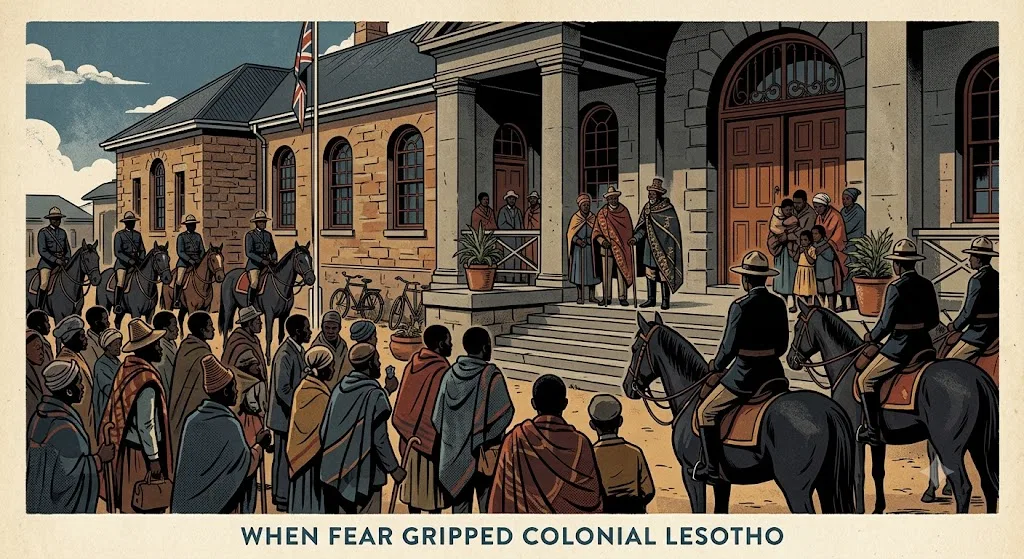
Lesotho’s clearest and best-documented episode of collective fear was the “medicine murder panic” that gripped Basutoland, as the country was then known, during the late 1940s and 1950s.
Page outline Jump by section
Introduction
The episode therefore cannot be dismissed as imaginary “mass hysteria”. People were murdered, senior chiefs were convicted and several defendants were executed. At the same time, historians describe a genuine moral panic in which uncertainty about how many killings had taken place, who directed them and whether the government was concealing evidence became politically explosive. The panic exposed the weakness of British colonial rule, damaged the legitimacy of the chieftainship and helped early nationalist politics to grow.[cambridge.org]cambridge.orgRitual Child Homicide in Contemporary Africa: A Systematic Review of the Empirical Literature.Read more…
What were “medicine murders”?
The expression referred to killings in which human tissue was taken for incorporation into powerful “medicine”. The English word can be misleading: this was not ordinary healthcare, nor should it be confused with the broad and generally non-violent work of traditional healers. It described a criminal practice in which a victim’s body was treated as a source of supposed supernatural power.
The belief behind the murders was that substances containing selected human parts could increase fertility, prosperity, protection, political influence or the strength of a community. Some accounts alleged that the victim had to be alive when mutilated because terror, pain or vitality were thought to intensify the substance. Historians Colin Murray and Peter Sanders stress that these acts were secret, exceptional and condemned by the wider population; they were not an accepted feature of everyday Basotho religion or healing.[phambo.wiser.org.za]phambo.wiser.org.zaMedicine Murder in Colonial Lesotho:March 28, 2004 — The cases of Chiefs Bereng and Gabashane drew the attention of the world to…
This distinction matters. Colonial writing sometimes presented the murders as evidence of a primitive society ruled by superstition. That framing obscured both their rarity and the political circumstances in which they occurred. It also encouraged outsiders to treat all African spiritual practice as suspect. Modern research on traditional healers in Lesotho instead describes a varied field of therapeutic, social and environmental knowledge that cannot responsibly be reduced to criminal ritual.[ATPSNET]atpsnet.orgAnalysis of Traditional Healers in Lesotholandscape and practices of traditional healers…. They avoid harvesting young plants a…
Why fear surged after 1945
Reports of such murders existed before the Second World War, but they were sporadic. The situation changed dramatically in the mid-1940s. A succession of mutilated bodies, disappearances, arrests and trials persuaded many Basotho that the country faced an epidemic. Contemporary figures must be treated carefully because suspected cases were not always proven, but one scholarly review reports 20 cases in 1948 and more than ten reported cases annually during much of the 1950s.[OUP Academic]academic.oup.comIt is with analysing the context of this upsurge in medicine murders in late colonial Basutoland…Read more…
Several pressures made the rumours believable.
Political authority was being disrupted. British reforms were reducing the income and independence of chiefs. The Basutoland National Treasury, opened in 1946, redirected revenue that had previously supported chiefly power. Some historians argue that medicine murders were associated with attempts by insecure office-holders to preserve status or strengthen their authority during this upheaval.[Cambridge University Press & Assessment]cambridge.orgCambridge University Press & AssessmentThe Basutoland National Treasury African Place-namesApril 12, 2022 — by A Place-names — During 194…
Ordinary people distrusted both chiefs and colonial officials. Chiefs were expected to protect communities, yet some of the accused belonged to the highest ranks of the chieftainship. Colonial administrators, meanwhile, depended upon those same chiefs to govern. This created a damaging suspicion: if powerful chiefs were implicated, could the British investigate them honestly without undermining their own system?
Secrecy encouraged expanding rumours. Missing people, unexplained deaths and mutilated remains were interpreted through an existing fear of hidden ritual crime. Once several cases reached court, almost any suspicious disappearance could appear to confirm the existence of a wider conspiracy.
The justice process generated further uncertainty. Cases often depended on accomplice testimony, confessions, disputed witnesses and claims about secret orders. A conviction might demonstrate that a particular murder occurred without proving the existence of the vast network imagined in popular rumour.
The panic was therefore built from an unstable mixture of fact and inference. There were actual victims and perpetrators, but the scale and organisation of the supposed conspiracy remained uncertain.
The trials that transformed the crisis
The cases involving Chiefs Bereng Griffith Lerotholi and Gabasheane Masupha gave the panic its greatest force. Both were senior figures, not marginal village suspects. They and several followers were convicted in connection with murders that prosecutors said had been committed to obtain human material for medicine.
Their trials attracted international attention because they appeared to show that the practice reached the summit of Basutoland’s political order. The two chiefs and some of their associates were hanged in Maseru on 3 August 1949. The executions were intended to demonstrate that status would not protect anyone convicted of murder.[africabib.org]africabib.orgOpen source on africabib.org.
Instead of ending public anxiety, the cases intensified it. If two principal chiefs could be guilty, many people reasoned, how many other chiefs might also be involved? Conversely, supporters of the condemned men questioned the evidence and suspected political motives. The trials thus supported two competing stories: one about a hidden murderous elite, and another about a colonial government using uncertain prosecutions to discipline troublesome African leaders.
Neither story fully explains every case. Historians generally accept that the murders examined in the major trials were real, while also questioning whether colonial courts, investigators and later commentators always distinguished proven facts from rumour, coerced participation and political interpretation.[cambridge.org]cambridge.orgRitual Child Homicide in Contemporary Africa: A Systematic Review of the Empirical Literature.Read more…
The Jones inquiry and the problem of official truth
The British government commissioned anthropologist G. I. Jones to investigate. His 103-page report, Basutoland Medicine Murder: A Report on the Recent Outbreak of “Diretlo” Murders in Basutoland, appeared in 1951 and became the principal official account of the crisis.[De Gruyter Brill]degruyterbrill.comOpen source on degruyterbrill.com.
Jones tried to explain why reported murders had increased so sharply. His interpretation connected the killings to political rivalry, weakened customary restraints, changing chiefly authority and the social disruptions of colonial rule. The report rejected the idea that the crimes were simply timeless African tradition. In that respect, it was more careful than much contemporary newspaper coverage.
Nevertheless, the inquiry did not settle the controversy. Later allegations claimed that British officials suppressed evidence implicating Regent ’Mantšebo in order to protect the stability of the colonial administration. Murray and Sanders found the documentary record more complicated than a simple cover-up narrative. The published report did refer to popular suspicions surrounding the regent and to alleged struggles between powerful chiefs, although officials were plainly concerned about the political consequences of accusations against the royal leadership.[phambo.wiser.org.za]phambo.wiser.org.zaMedicine Murder in Colonial Lesotho:March 28, 2004 — The cases of Chiefs Bereng and Gabashane drew the attention of the world to…
This disagreement is central to understanding the panic. Official investigation was expected to restore trust, but colonial rule itself was one of the institutions under suspicion. Even a substantial inquiry could not persuade everyone that the authorities had revealed all they knew.
A moral panic, but not an invented crime wave
Calling the episode a moral panic does not mean that the murders were fictional. A moral panic occurs when a real or alleged threat becomes a symbol of deeper social anxieties, producing public alarm, demands for action and an expanded sense that society itself is under attack.
That description fits Basutoland because the fear of medicine murder came to represent several crises at once:
- the possibility that chiefs were exploiting rather than protecting their subjects;
- the inability of the colonial state to guarantee safety;
- anxiety about political change and declining traditional authority;
- conflict between Christian, colonial and indigenous explanations of power;
- and suspicion that courts and officials served elite interests.
The panic was “contagious” mainly through testimony, local conversation, political meetings and press coverage, not because everyone shared a single delusion. Each arrest or discovery made older stories seem more credible. Each official denial could be interpreted as evidence of concealment. In this respect, the crisis resembled later rumour panics in which a small number of verified crimes sustains much larger claims about secret networks.
The most responsible conclusion is therefore double-sided. Medicine murders were documented crimes, sometimes involving influential people. Claims that every unexplained death formed part of one coordinated system were far less securely established.
How the panic fed nationalism
The crisis weakened the political arrangement through which Britain governed Basutoland. Colonial officials relied on chiefs, but prosecuting senior chiefs exposed corruption and coercion within that system. Protecting chiefs from investigation would have appeared complicit; prosecuting them damaged the very hierarchy on which indirect rule depended.
Political activists could therefore present medicine murder as evidence that colonial government had failed morally as well as administratively. The authorities appeared unable to prevent killings, reluctant to expose the most powerful suspects and dependent on institutions that many Basotho no longer trusted. Research on the period argues that the panic contributed to an atmosphere in which nationalist organisations could claim that Basotho society required accountable political representation rather than paternal colonial supervision.[QMRO]qmro.qmul.ac.ukThe Medicine Murder Panic: Colonial Weakness and the…That enquiry was the 1951 'Jones Report,' officially titled 'Basutoland Medic…
Medicine murder was not the sole cause of Lesotho’s independence movement. Labour migration, land pressure, education, regional politics and opposition to white minority rule in neighbouring South Africa were also crucial. Yet the panic gave political discontent a vivid human form: murdered bodies, accused chiefs and officials who seemed unable to provide a convincing account.
Witchcraft accusations and later killings
Lesotho’s history of collective fear did not end with the colonial panic. Later reports describe people being attacked or killed after accusations of witchcraft, alongside occasional murders alleged to have been committed for body parts or supernatural medicine. These are related but distinct phenomena.
A witchcraft killing generally targets someone believed to have caused illness, death or misfortune through hidden power. A medicine murder targets a person in order to obtain material believed to confer power. One is framed by perpetrators as retaliation or defence; the other as acquisition. In practice, reports, court cases and public discussion may blur the categories.
Reliable statistics are scarce. A 2022 investigation reported that Lesotho’s police records generally classified these deaths simply as murders, without consistently distinguishing alleged medicine murder, witchcraft accusation or gang-related homicide. This makes claims about rising or falling numbers difficult to verify.[Africa Press English]africa-press.netAfrica Press English The curse of ritual murdersAfrica Press English The curse of ritual murders
A 2015 educational study argued that witchcraft-related killings and ritual murders had received too little public and academic attention since the late 1990s. Its proposed solution was not the suppression of traditional religion, but better teaching about Basotho belief, ethics and the difference between cultural ideas and violence committed in their name. The study is useful evidence of continuing concern, although its assertion of an increase relies on a limited set of reported cases rather than a comprehensive national database.[Net Journals]netjournals.orgOpen source on netjournals.org.
Modern court reporting also confirms that murders described by prosecutors as intended to produce wealth or supernatural benefit have continued to occur. Such cases show persistence, not necessarily a nationwide wave. Without consistent classification and transparent data, individual convictions should not be turned into claims of an epidemic.[Newsdayonline]newsdayonline.co.lsNewsdayonline Father convicted of ritual murders of family membersNewsdayonline Father convicted of ritual murders of family members
Why “cult” and “mass hysteria” are poor labels here
There is little strong evidence that Lesotho’s central historical episode involved a clearly bounded sect with a recognised founder, membership system and shared doctrine. The participants accused in the colonial cases were chiefly households, intermediaries and hired accomplices rather than members of a distinct new religious movement. Calling them a cult would therefore imply an organisation that the evidence does not establish.
“Mass hysteria” is equally inadequate. The term can suggest that frightened people merely imagined danger. In Basutoland, bodies were found, defendants were convicted and some perpetrators confessed or gave evidence. Public fear was amplified and sometimes indiscriminate, but it was not detached from real violence.
More precise language produces a clearer picture:
- medicine murder for the documented criminal practice;[books.google.com]books.google.comBasutoland Medicine MurderBasutoland Medicine Murder
- witchcraft accusation for claims that a person caused harm supernaturally;
- rumour panic for rapidly spreading, weakly verified allegations;
- moral panic for the widening belief that hidden crime revealed the corruption of the whole political order;
- colonial political crisis for the struggle over chiefs, courts and official credibility.
These categories can overlap without being treated as identical.

What historians think happened
The strongest historical interpretations reject both of the simplest explanations. The murders were neither a fictional invention of colonial racism nor an unchanged survival from an ancient past.
Instead, scholars place them within the political economy of late colonial Basutoland. Chiefs faced reforms that reduced their revenues and authority. Competition for office intensified. Ordinary people faced poverty, migration and limited protection from the state. Beliefs about concentrated spiritual power offered a language through which ambition, insecurity and violence could be understood. In some cases, perpetrators seem to have acted on those beliefs. In others, accusations may have been used to settle political disputes or explain disturbing deaths.
The colonial government’s response also shaped the panic. Trials and executions demonstrated that crimes had occurred, but publicity magnified the impression of a country-wide conspiracy. Investigations exposed wrongdoing while leaving unresolved questions about elite protection and official censorship. The state was simultaneously prosecutor, political stakeholder and judge of its own credibility.[cambridge.org]cambridge.orgRitual Child Homicide in Contemporary Africa: A Systematic Review of the Empirical Literature.Read more…
The episode is therefore best understood as a convergence of lethal belief, political coercion and contagious suspicion. It was not merely a story about supernatural ideas. It was a struggle over who possessed power, who could safely accuse the powerful and whether colonial justice could be trusted.
Why the episode still matters
The medicine murder panic remains culturally important because it reveals how fear grows when genuine violence meets weak institutions and secrecy. A murder can support justified alarm; uncertainty about its perpetrators can generate rumours; official evasiveness can turn rumour into political conviction.
It also warns against two forms of prejudice. The first is the sensational claim that violent ritual represents Basotho culture as a whole. The second is the dismissive assumption that belief-linked crimes are only folklore and that victims or frightened communities are irrational. Both positions erase the central evidence: the killings were exceptional and widely condemned, but some were real.
For modern Lesotho, the practical legacy is a need for clearer crime classification, careful investigation, protection for people accused of witchcraft and public education that respects religious and cultural belief while drawing an unambiguous boundary around coercion and violence. The historical lesson is not that belief automatically produces panic. It is that fear becomes socially contagious when authority is distrusted, facts are scarce and every new case appears to confirm a hidden system no institution can convincingly explain.
Amazon book picks
Further Reading
Books and field guides related to When Fear Gripped Colonial Lesotho. Use these as the next step if you want deeper reading beyond the article.
Witchcraft, Oracles and Magic Among the Azande
Helps explain belief systems without sensationalism.
Endnotes
1.
Source: cambridge.org
Link:https://www.cambridge.org/core/journals/africa/article/medicine-murder-in-basutoland-colonial-rule-and-moral-crisis/D29C9ED05F553C9CFAA53C5C203BF46B
Source snippet
Ritual Child Homicide in Contemporary Africa: A Systematic Review of the Empirical Literature.Read more...
2.
Source: academic.oup.com
Link:https://academic.oup.com/shm/article/19/1/175/2259072
Source snippet
It is with analysing the context of this upsurge in medicine murders in late colonial Basutoland...Read more...
3.
Source: qmro.qmul.ac.uk
Link:https://qmro.qmul.ac.uk/xmlui/bitstream/handle/123456789/90439/The%20Medicine%20Murder%20Panic%20Colonial%20Weakness%20and%20the%20Emergence%20of%20Nationalism%20in%20Basutoland%201945-60.pdf?isAllowed=y&sequence=6
Source snippet
The Medicine Murder Panic: Colonial Weakness and the...That enquiry was the 1951 'Jones Report,' officially titled 'Basutoland Medic...
4.
Source: phambo.wiser.org.za
Link:https://phambo.wiser.org.za/files/seminars/Murray2004.pdf
Source snippet
Medicine Murder in Colonial Lesotho:March 28, 2004 — The cases of Chiefs Bereng and Gabashane drew the attention of the world to...
Published: March 28, 2004
5.
Source: atpsnet.org
Link:https://atpsnet.org/wp-content/uploads/2017/05/wps68.pdf
Source snippet
Analysis of Traditional Healers in Lesotholandscape and practices of traditional healers.... They avoid harvesting young plants a...
6.
Source: cambridge.org
Link:https://www.cambridge.org/core/services/aop-cambridge-core/content/view/006003BCF6109FBA9E6F389FE05695D2/S0001972000023202a.pdf/the-basutoland-national-treasury.pdf
Source snippet
Cambridge University Press & AssessmentThe Basutoland National Treasury African Place-namesApril 12, 2022 — by A Place-names — During 194...
Published: April 12, 2022
7.
Source: africabib.org
Link:https://www.africabib.org/rec.php?RID=200800280
8.
Source: jstor.org
Link:https://www.jstor.org/stable/1581529
9.
Source: qmro.qmul.ac.uk
Link:https://qmro.qmul.ac.uk/xmlui/handle/123456789/90439
10.
Source: africa-press.net
Title: Africa Press English The curse of ritual murders
Link:https://www.africa-press.net/lesotho/all-news/the-curse-of-ritual-murders
11.
Source: jstor.org
Link:https://www.jstor.org/stable/2637211
12.
Source: jstor.org
Link:https://www.jstor.org/stable/25065187
13.
Source: jstor.org
Link:https://www.jstor.org/stable/26158059
14.
Source: jstor.org
Link:https://www.jstor.org/stable/4133907
15.
Source: cambridge.org
Title: Changing Landscapes of Power (Chapter 5)
Link:https://www.cambridge.org/core/books/slavery-and-emancipation-in-islamic-east-africa/changing-landscapes-of-power/F6D64B2779DF234D20FDE4DE1EE7285F
16.
Source: resolve.cambridge.org
Link:https://resolve.cambridge.org/core/services/aop-cambridge-core/content/view/7ED6F3121EDD29277404379EB5C539F1/9780511642173c4_p105-145_CBO.pdf/facts-metaphysics-and-mysticism-magical-powers-and-the-law.pdf
17.
Source: cambridge.org
Link:https://www.cambridge.org/core/journals/africa/article/forgetting-apartheid-history-culture-and-the-body-of-a-nun/4B7A826C33DCE0EB593D8D00B74FCBC4
18.
Source: resolve.cambridge.org
Title: politics of improvement 19471960
Link:https://resolve.cambridge.org/core/services/aop-cambridge-core/content/view/FB3DC39E520D3BD034C8401BCE58152E/9780748631001c8_p311-338_CBO.pdf/politics_of_improvement_19471960.pdf
19.
Source: cambridge.org
Link:https://www.cambridge.org/core/journals/international-annals-of-criminology/article/superstition-that-dismembers-the-african-child-an-exploration-of-the-scale-and-features-of-jujudriven-paedicide-in-ghana/57D052C7608EC50D223151505559EEB3
20.
Source: cambridge.org
Link:https://www.cambridge.org/core/journals/journal-of-global-history/article/historical-globalization-and-colonial-legal-culture-african-assessors-customary-law-and-criminal-justice-in-british-africa/499F7FB6135ED7E1F1CF47C547AD68DC
21.
Source: cambridge.org
Link:https://www.cambridge.org/core/books/reluctant-abolitionists/vast-and-extended-web/CB00BFA0F0E09A38E2BFDFE219A22B69
22.
Source: assets.cambridge.org
Link:https://assets.cambridge.org/97805218/17219/sample/9780521817219ws.pdf
23.
Source: history.com
Title: mysterious illnesses mass hysteria
Link:https://www.history.com/articles/mysterious-illnesses-mass-hysteria
24.
Source: youtube.com
Link:https://www.youtube.com/watch?v=FLOVbEyb8d8
Source snippet
Mourns A Chief (1939)...
25.
Source: degruyterbrill.com
Link:https://www.degruyterbrill.com/document/doi/10.1515/9781474471220-027/pdf?licenseType=restricted&srsltid=AfmBOoqAZxLEchVpLtH7f3rrU3cGZ5pAPdiVNli_JgwKlF3itvJzyPar
26.
Source: netjournals.org
Link:https://www.netjournals.org/pdf/AERJ/2015/4/15-054.pdf
27.
Source: newsdayonline.co.ls
Title: Newsdayonline Father convicted of ritual murders of family members
Link:https://newsdayonline.co.ls/news-9/
28.
Source: Wikipedia
Title: Moral panic
Link:https://en.wikipedia.org/wiki/Moral_panic
29.
Source: books.google.com
Title: Basutoland Medicine Murder
Link:https://books.google.com/books/about/Basutoland_Medicine_Murder.html?id=ZFjDPQAACAAJ
30.
Source: qmro.qmul.ac.uk
Title: qmul.ac.uk Browsing by Title
Link:https://qmro.qmul.ac.uk/jspui/browse?etal=10&offset=30719&order=ASC&rpp=20&sort_by=1&type=title
31.
Source: qmul.ac.uk
Title: Dr Reuben Loffman
Link:https://www.qmul.ac.uk/history/staff/profile/5481-dr-reuben-loffman
32.
Source: sajp.org.za
Link:https://sajp.org.za/index.php/sajp/article/view/1671/0
33.
Source: sajp.org.za
Link:https://sajp.org.za/index.php/sajp/article/view/1671/2648
34.
Source: ritualkillinginafrica.org
Link:https://www.ritualkillinginafrica.org/category/lesotho/
35.
Source: x.com
Link:https://x.com/archeohistories/status/2037119801110434158
36.
Source: ebsco.com
Link:https://www.ebsco.com/research-starters/social-sciences-and-humanities/mass-hysteria
Additional References
37.
Source: dokumen.pub
Link:https://dokumen.pub/medicine-murder-in-colonial-lesotho-the-anatomy-of-a-moral-crisis-9781474471220.html
Source snippet
hey were still alive, to be used for theRead more...
38.
Source: researchgate.net
Link:https://www.researchgate.net/publication/236695018_Witch_Craze_Beyond_the_Legends_of_Panic
39.
Source: researchgate.net
Link:https://www.researchgate.net/publication/361074168_Predictors_of_mass_psychogenic_illness_in_a_junior_secondary_school_in_rural_Botswana_A_case_control_study
40.
Source: facebook.com
Link:https://www.facebook.com/dw.africa/videos/the-rise-of-africas-prophets/3428834150709520/
41.
Source: facebook.com
Link:https://www.facebook.com/100068860614629/posts/poor-and-vulnerable-botswanas-ritual-killings-expose-deep-seated-social-illin-bo/1248782817427060/
42.
Source: reddit.com
Link:https://www.reddit.com/r/exjw/comments/1j12yzm/doomsday_cults_through_the_centuries/
43.
Source: askanwi.com
Link:https://www.askanwi.com/feature-publications/fact-sheet-the-dilemma-of-witchcraft-accusations-in-africa
44.
Source: academia.edu
Link:https://www.academia.edu/62744924/A_sustainable_educational_response_to_the_recent_increased_witch_killing_and_ritual_murder_Liretlo_in_Lesotho_Introducing_Basotho_Traditional_Religion_in_Lesotho_schools
45.
Source: facebook.com
Link:https://www.facebook.com/BotswanaGovernment/posts/mass-hysteria-continues-to-affect-studentsthe-mass-psychogenic-illness-affecting/2337390149676963/
46.
Source: researchgate.net
Link:https://www.researchgate.net/publication/290076238_Medicine_Murder_in_Basutoland_Colonial_Rule_and_Moral_Crisis
Topic Tree
Follow this branch
Related pages 192
- Antigua and Barbuda
- Argentina Belief Scares
- Azerbaijan Belief
- Bahrain Beliefs
- North Korea
- +187 more in sidebar