When Collective Belief Turns Dangerous in Burundi
Burundi’s best-documented history of contagious belief and collective fear is not a catalogue of classic “mass hysteria” outbreaks.
Page outline Jump by section
Introduction
The evidence also demands careful language. The Businde pilgrims were members of a contested religious movement, not people shown to be mentally ill. Those accused of witchcraft were victims of persecution, not proven practitioners of harmful magic. People with albinism were targeted by organised criminal markets as well as supernatural claims. Burundi therefore offers a particularly stark lesson: collective belief becomes most dangerous when rumour, spiritual authority, commercial incentive and coercive power reinforce one another.
Businde: visions, pilgrimage and a fatal confrontation
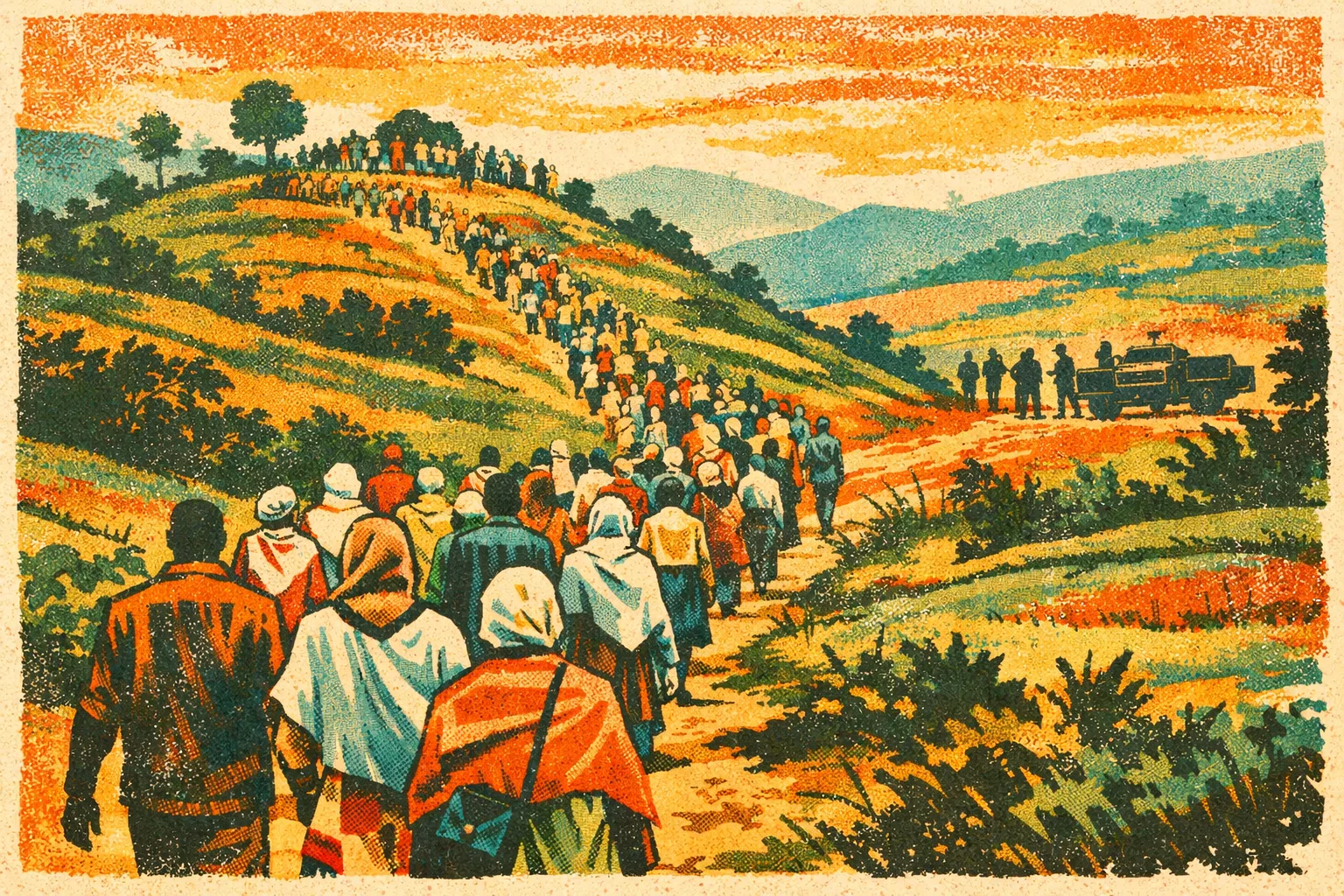
The clearest Burundian case of a disputed visionary movement developed around Zebiya Ngendakumana, a young woman who said that she received messages or visions from the Virgin Mary. Her followers made regular pilgrimages to Businde in Kayanza province, treating the site as a place of prayer and revelation. The movement drew heavily on Catholic imagery, but it operated outside the authority of Burundi’s Roman Catholic hierarchy. Church leaders did not authenticate the claimed apparitions, while public officials increasingly described the gatherings as an issue of order and security.[ucanews.com]ucanews.comSix dead as police storm site of Marian apparitionMarch 13, 2013 — 13 Mar 2013 — Burundi police clashed Tuesday with Catholic followers of a woman who claims to see visions of the Virgin…
That distinction matters. Marian devotion itself is firmly established in Burundi: thousands of Catholics attend the recognised shrine at Mugera, where pilgrimage occurs within an authorised church framework. Businde was different because the claimed messages centred on a living visionary and continued despite opposition from both church and state authorities. The controversy was therefore not a simple conflict between religion and secular government. It was also a struggle over who had the right to declare a revelation genuine, organise pilgrims and speak with sacred authority.[Africanews]africanews.comburundi thousands of pilgrims gather at mugera marian shrineBurundi: Thousands of Pilgrims Gather at Mugera Marian Shrine17 Aug 2024 — In Burundi, thousands of Christians flocked on Thurs…
On 12 March 2013, police attempted to prevent hundreds of worshippers from reaching or remaining at the Businde prayer site. The confrontation ended with at least six people dead and dozens wounded. Human Rights Watch reported that officers used live ammunition and subsequently beat worshippers, including children and people who had already been injured. Authorities maintained that members of the crowd had resisted police and attacked officers, but the organisation concluded that the use of lethal force and the subsequent beatings required an independent investigation.[ucanews.com]ucanews.comSix dead as police storm site of Marian apparitionMarch 13, 2013 — 13 Mar 2013 — Burundi police clashed Tuesday with Catholic followers of a woman who claims to see visions of the Virgin…
Calling the episode a “cult panic” would conceal more than it explains. Some contemporary reports used the word cult, and the government portrayed the movement as a threat to public order. Yet that label bundled together several separate questions: whether the visions were genuine, whether the gatherings were legally authorised, whether followers disobeyed police and whether the state’s response was proportionate. None of those questions proves that the believers had surrendered independent judgement or were preparing collective violence.
The episode is better understood as a collision between charismatic revelation and institutions determined to control it. Followers accepted the visionary’s spiritual claims strongly enough to continue travelling despite official warnings. The Catholic hierarchy sought to distinguish approved devotion from unauthorised apparition claims. The state treated a persistent, self-organising crowd as a security problem. When these forms of authority met at Businde, a dispute over belief became a crisis of policing.
The persecution hidden inside witchcraft accusations
Belief in harmful supernatural action has remained capable of provoking real-world violence in Burundi. In June 2025, six people accused of witchcraft were reportedly killed in a series of attacks in the country’s north-west. Victims were burned, stoned or beaten, according to reports citing a local administrator. The alleged assailants were identified as members of a ruling-party youth organisation, although the available public reporting does not establish that the killings were formally ordered by the movement’s leadership.[genocidewatch]genocidewatch.comSix Killed in Burundi Over Witchcraft AccusationsSix Killed in Burundi Over Witchcraft AccusationsJuly 3, 2025 — 2 Jul 2025 — Six ix individuals accused of practising witchc…
This was not a “witch trial” in the formal historical sense. There was no reliable judicial process for testing evidence, protecting defendants or distinguishing an allegation from a crime. The accusation itself appears to have acted as permission for punishment. That pattern is familiar in research on witchcraft-related persecution: unexplained illness, death or misfortune is attributed to a person within the community, after which suspicion can harden through repetition, coerced confession or collective endorsement. Human-rights research stresses that accusations are often imposed upon victims rather than openly claimed by them.[UNHCR]unhcr.orgWitchcraft allegations, refugee protection and human rightsWitchcraft allegations, refugee protection and human rights
The term “mass hysteria” is especially unhelpful here. It can make violence sound like a spontaneous emotional storm when accusations often follow social fault lines. Across documented cases, supposed witches tend to be people who are already vulnerable, isolated or inconvenient: older adults, widows, children, people with disabilities, outsiders or individuals involved in family and property disputes. Researchers also associate waves of accusation with rapid social change, economic pressure, political conflict and weakened trust in courts or public services.[unicef.org]unicef.orgChildren Accused of WitchcraftChildren Accused of Witchcraft
A witchcraft allegation can perform several social functions at once. It gives a name to frightening events that otherwise seem random. It concentrates diffuse anxiety upon a visible suspect. It may legitimise revenge or the seizure of property. In politicised settings, it can also disguise intimidation as community protection. For that reason, an accusation should be investigated not only as a belief but as an action: who made it, who repeated it, who benefited and which institutions failed to protect the accused.
The 2025 killings are culturally important precisely because they were not survivals from a sealed-off “traditional” past. They occurred in a modern state with political parties, administrators, police and national media. Supernatural explanation and contemporary power structures can coexist, and each may intensify the other.
Why people with albinism became targets
The most organised form of magical violence associated with Burundi emerged in the late 2000s, when people with albinism were murdered and dismembered. Reports described a cross-border trade in which body parts were taken towards Tanzania for use in ritual preparations advertised as bringing wealth, success or good fortune. By 2009, published accounts placed the Burundian death toll at about a dozen, concentrated largely in eastern provinces near the Tanzanian frontier.[reliefweb.int]reliefweb.intRelief Web East Africa's albino underworldRelief Web East Africa's albino underworld
Albinism is a genetic condition affecting the production of melanin. It does not grant supernatural properties, and the victims were not killed because of anything they had done. They were targeted because myths transformed visible bodily difference into imagined magical value. Those stories then became part of a criminal market involving killers, intermediaries and clients willing to pay for human remains.
This distinguishes the attacks from a conventional rumour panic. Fear and folklore mattered, but so did profit. A belief that a victim’s body possessed unusual power created demand; poverty and porous borders helped suppliers act upon it; limited policing increased the chance of impunity. The resulting trade turned human beings into commodities. Contemporary reporting described families hiding children, moving into protected accommodation or living under constant fear of abduction.[ReliefWeb]reliefweb.intRelief Web East Africa's albino underworldRelief Web East Africa's albino underworld
The regional dimension is essential. The killing wave was most heavily associated with Tanzania, but it crossed into Burundi through shared markets, migration routes and cultural networks. Burundi’s eastern provinces were therefore not merely experiencing an independent local scare. They had been pulled into a wider system in which claims circulated across borders alongside buyers, brokers and body parts. International human-rights work has since treated ritual attacks connected with albinism as a distinct problem requiring criminal investigation, victim protection, public education and action against those who commission offences.[OHCHR]ohchr.orgAlbinism Worldwide Report 2021 ENAlbinism Worldwide Report 2021 EN
Public awareness and government pressure produced some protective measures, including demands for greater security and prosecution. Yet protection alone could not address every source of danger. Safe accommodation may prevent an immediate kidnapping while also separating people with albinism from ordinary family and community life. Effective reform therefore requires both enforcement against criminal networks and the dismantling of beliefs that portray a person’s body as an instrument for someone else’s advancement.
Belief, tradition and the danger of careless labels
Burundi’s religious landscape has long included Catholic and Protestant Christianity alongside older systems of healing, spirit mediation and ritual practice. One important historical complex centres on Kiranga and forms of spirit possession and initiation found more widely across the Great Lakes region. These traditions should not be collapsed into accusations of murderous witchcraft. A community ritual, a healer’s practice, a visionary pilgrimage and a mob attack are different social phenomena even when outsiders describe all of them as “superstition”.[sheppartoninterfaith.org.au]sheppartoninterfaith.org.auOpen source on sheppartoninterfaith.org.au.
Colonial rule and Christian missionisation changed the boundaries between accepted religion and condemned practice. Mission churches did not merely introduce new beliefs; they also classified existing practices, sometimes treating local spiritual authority as error, fraud or demonic influence. Burundians nevertheless combined, adapted or moved between different systems of explanation. Someone might seek biomedical treatment, Christian prayer and a traditional healer without experiencing those choices as mutually exclusive.
This background helps explain why labels carry power. Calling Businde’s followers a “cult” could support restrictions on their gatherings. Calling a neighbour a witch could remove the ordinary protections owed to them. Describing a healer as a criminal without evidence could stigmatise legitimate cultural practice, while romanticising every ritual specialist could obscure fraud or abuse. The useful question is not whether a belief appears strange to an outsider, but what people are being asked to do because of it.
Several distinctions keep the history clear:
- A religious movement consists of shared teachings and practices; it is not inherently coercive or dangerous.
- A contested apparition is a claimed supernatural encounter that religious authorities have not accepted as authentic.
- A moral panic magnifies a perceived threat and identifies a group as a danger to society.
- A witchcraft accusation assigns supernatural blame to an individual and may become a tool of persecution.
- Mass psychogenic illness concerns the spread of genuine physical symptoms without an identified toxic or infectious cause; strong published evidence for a major Burundian school outbreak of this kind is presently lacking.
- Organised ritual violence may use supernatural claims, but it also involves material incentives, planning and criminal networks.
These categories can overlap, but they should not be treated as interchangeable. Doing so risks turning victims into curiosities and replacing explanation with spectacle.
Why fear and revelation gained force
Burundi’s episodes of contagious belief developed within a society marked by civil war, displacement, political repression, economic hardship and repeated failures of public institutions. Such conditions do not automatically create witchcraft accusations or visionary movements. They do, however, increase the appeal of explanations that promise hidden knowledge, moral clarity or direct access to protective power.
A revelation can offer meaning when official institutions appear remote or compromised. A witchcraft accusation can make illness or sudden death feel intentional rather than random. A magical commodity can appear to offer control over an uncertain economic future. Rumours spread most effectively when they fit existing expectations and when trustworthy sources of correction are weak.
Authorities can then worsen the situation by treating every unconventional belief as a security conspiracy. At Businde, force did not resolve the theological dispute; it produced deaths and reinforced the sense that followers were a persecuted community. In witchcraft cases, failure to intervene quickly allows an allegation to acquire the appearance of communal consensus. In attacks on people with albinism, arresting only the immediate killer leaves clients and intermediaries untouched.
The media faces a similar dilemma. Reporting can expose abuse and mobilise protection, as coverage of the albinism killings did. It can also repeat lurid claims so vividly that the myth is advertised rather than challenged. Responsible coverage identifies alleged supernatural powers as claims, centres the person harmed and follows the practical chain from rumour to organiser, buyer, official response and legal outcome.

What Burundi’s cases actually show
Burundi does not offer strong evidence for a famous nationwide episode of mass psychogenic illness, a dance plague or a UFO religion. Its more substantial record concerns collective beliefs that became entangled with persecution and state power. The Businde movement shows how unauthorised revelation can mobilise a devoted community and alarm both church and government. Witchcraft killings show how supernatural blame can strip accused people of legal and social protection. Attacks on people with albinism show how myth can be commercialised into a cross-border market for murder.
The connecting mechanism is not simple credulity. Each episode required a social structure that carried belief into action: pilgrimage networks, neighbourhood accusation, political groups, ritual specialists, brokers, clients or armed police. Beliefs became dangerous when those structures made violence appear justified, profitable or administratively convenient.
That is why Burundi’s history belongs within the study of cult scares, witch panics and contagious belief, but not as a collection of exotic curiosities. Its central questions are questions of authority. Who is permitted to declare a miracle? Who can identify an alleged witch? Whose account of danger is believed? Which bodies receive protection, and which are treated as expendable? The answers reveal how collective fear operates not outside ordinary society, but through its churches, political organisations, markets, borders and institutions.
Amazon book picks
Further Reading
Books and field guides related to When Collective Belief Turns Dangerous in Burundi. Use these as the next step if you want deeper reading beyond the article.

The Spirit Catches You and You Fall Down
Shows how cultural belief systems shape responses to crisis.
We wish to inform you that tomorrow we will be killed with ou...
Explores mass violence and the power of collective belief in the Great Lakes region.
African religions and philosophy
Provides context for religion, belief and social practice across Africa.

The Penguin book of witches
Offers historical comparisons for persecution driven by supernatural claims.
Endnotes
1.
Source: ucanews.com
Title: Six dead as police storm site of Marian apparition
Link:https://www.ucanews.com/news/six-dead-as-police-storm-site-of-marian-apparition/67700
Source snippet
March 13, 2013 — 13 Mar 2013 — Burundi police clashed Tuesday with Catholic followers of a woman who claims to see visions of the Virgin...
Published: March 13, 2013
2.
Source: africanews.com
Title: burundi thousands of pilgrims gather at mugera marian shrine
Link:https://www.africanews.com/2024/08/17/burundi-thousands-of-pilgrims-gather-at-mugera-marian-shrine/
Source snippet
Burundi: Thousands of Pilgrims Gather at Mugera Marian Shrine17 Aug 2024 — In Burundi, thousands of Christians flocked on Thurs...
3.
Source: reliefweb.int
Title: Relief Web Shot, Beaten Near Prayer Site
Link:https://reliefweb.int/report/burundi/shot-beaten-near-prayer-site?lang=fr
Source snippet
Shot, Beaten Near Prayer Site - Burundi26 Jul 2013 — On the morning of March 12, 2013, police fired live ammunition into a crowd...
Published: March 12, 2013
4.
Source: genocidewatch.com
Title: Six Killed in Burundi Over Witchcraft Accusations
Link:https://www.genocidewatch.com/single-post/six-killed-in-burundi-over-witchcraft-accusations
Source snippet
Six Killed in Burundi Over Witchcraft AccusationsJuly 3, 2025 — 2 Jul 2025 — Six ix individuals accused of practising witchc...
Published: July 3, 2025
5.
Source: unhcr.org
Title: Witchcraft allegations, refugee protection and human rights
Link:https://www.unhcr.org/au/sites/en-au/files/legacy-pdf/4981ca712.pdf
6.
Source: ohchr.org
Link:https://www.ohchr.org/en/special-procedures/ie-albinism/witchcraft-and-human-rights
7.
Source: unicef.org
Title: Children Accused of Witchcraft
Link:https://www.unicef.org/nigeria/media/1326/file/%20Children-accused-of-witchcraft-in-Africa.pdf.pdf
8.
Source: unhcr.org
Link:https://www.unhcr.org/in/sites/en-in/files/legacy-pdf/4d346eab9.pdf
9.
Source: reliefweb.int
Title: Relief Web East Africa’s albino underworld
Link:https://reliefweb.int/report/burundi/east-africas-albino-underworld
10.
Source: bnub.unmissions.org
Link:https://bnub.unmissions.org/en/news/burundi-pressured-security-albinos
11.
Source: ohchr.org
Title: Albinism Worldwide Report 2021 EN
Link:https://www.ohchr.org/sites/default/files/2022-12/Albinism-Worldwide-Report-2021-EN.pdf
12.
Source: sheppartoninterfaith.org.au
Link:https://sheppartoninterfaith.org.au/?p=11604
13.
Source: state.gov
Link:https://www.state.gov/report/custom/1948f83df1
14.
Source: state.gov
Title: BURUNDI 2020 HUMAN RIGHTS REPORT
Link:https://www.state.gov/wp-content/uploads/2021/10/BURUNDI-2020-HUMAN-RIGHTS-REPORT.pdf
15.
Source: hrw.org
Title: burundi shot beaten near prayer site
Link:https://www.hrw.org/news/2013/07/26/burundi-shot-beaten-near-prayer-site
Source snippet
Human Rights WatchBurundi: Shot, Beaten Near Prayer Site26 Jul 2013 — On the morning of March 12, 2013, police fired live ammunition into...
Published: March 12, 2013
16.
Source: Wikipedia
Title: Mass psychogenic illness
Link:https://en.wikipedia.org/wiki/Mass_psychogenic_illness
17.
Source: ebsco.com
Link:https://www.ebsco.com/research-starters/social-sciences-and-humanities/mass-hysteria
Additional References
18.
Source: vaticannews.va
Title: vatican secretary of state visits burundi
Link:https://www.vaticannews.va/en/vatican-city/news/2025-08/vatican-secretary-of-state-visits-burundi.html
Source snippet
Vatican NewsParolin in Burundi: For the common good, so everyone...16 Aug 2025 — Pilgrims travel to Mugera in search of hope and to pray...
19.
Source: youtube.com
Title: ZEBIYA SECTE OU PROBLEME DE LIBERTE DE CULTE?
Link:https://www.youtube.com/watch?v=75cqoPqb4Is
Source snippet
Plus de 1600 adeptes d'Euzebie (Zebiya) ont été acceuillis à la frontière avec la RDC de Gatumba...
20.
Source: govinfo.gov
Link:https://www.govinfo.gov/content/pkg/CPRT-108JPRT20429/html/CPRT-108JPRT20429.htm
21.
Source: youtube.com
Link:https://www.youtube.com/watch?v=Da2HbACl3mc
Source snippet
Albino body organs sold for witchcraft...
22.
Source: youtube.com
Title: Zeru Zeru The Ghosts
Link:https://www.youtube.com/watch?v=Psc9Wi4rrq8
Source snippet
White Berry (2022) Trailer | Latifa Mwazi | Emmanuel Ohene Boafo | Joyeuse Musabimana...
23.
Source: academia.edu
Link:https://www.academia.edu/5368224/Apocalyptic_and_Millenarian_Movements
24.
Source: researchgate.net
Link:https://www.researchgate.net/publication/361074168_Predictors_of_mass_psychogenic_illness_in_a_junior_secondary_school_in_rural_Botswana_A_case_control_study
25.
Source: africaalbinismnetwork.org
Link:https://africaalbinismnetwork.org/wp-content/uploads/2022/09/1532538047872yn2bimyf2vn3zo050jbw97ldi-1.pdf
26.
Source: reddit.com
Link:https://www.reddit.com/r/exjw/comments/1j12yzm/doomsday_cults_through_the_centuries/
27.
Source: smallarmssurvey.org
Link:https://www.smallarmssurvey.org/sites/default/files/resources/Geneva-Declaration-Armed-Violence-Burundi-EN.pdf
Topic Tree
Follow this branch
Related pages 192
- Antigua and Barbuda
- Argentina Belief Scares
- Azerbaijan Belief
- Bahrain Beliefs
- North Korea
- +187 more in sidebar