Within Guinea
Why Ebola Teams Were Feared as a Threat
A real epidemic became harder to control when frightening medical procedures were interpreted through memories of neglect and coercion.
On this page
- How emergency medicine looked from outside
- Funerals, isolation and hidden treatment spaces
- How trust building changed the response
Page outline Jump by section
Introduction
During the 2014–16 Ebola epidemic, Guinea faced two emergencies at once. The first was the Ebola virus itself. The second was a collapse of trust that allowed rumours to spread faster than official information. Many communities did not simply reject medical advice because they were uninformed. Instead, frightening emergency measures—patients disappearing behind fences, homes sprayed with chlorine, loved ones taken away by strangers in protective suits, and traditional funerals being prohibited—were interpreted through long-standing experiences of neglect, political suspicion and weak public services. In that environment, rumours that Ebola treatment centres were killing patients, that burial teams were stealing organs, or that the disease had been invented became believable to many people, with deadly consequences for outbreak control.[World Health Organization]who.intWorld Health Organization Factors that contributed to undetected spreadWorld Health OrganizationFactors that contributed to undetected spreadJanuary 1, 2015…
Understanding these rumours is important because they reveal how trust shapes public health. The epidemic showed that controlling a dangerous disease requires more than medicines and protective equipment. It also requires people to believe that authorities are acting in their interests.
How emergency medicine looked from outside
From the perspective of international health organisations, emergency measures such as isolation wards, disinfectant spraying, contact tracing and safe burials were essential to stop Ebola transmission. From the perspective of many villagers encountering Ebola for the first time, however, these interventions often appeared frightening and inexplicable.
Treatment centres were surrounded by fences, staff wore full-body protective clothing, and relatives were frequently unable to visit patients. Many people entered these centres gravely ill and never returned because Ebola’s fatality rate was so high during the early stages of the epidemic. To observers, the pattern could appear to confirm the rumour that treatment centres themselves were places where people were taken to die rather than to recover. The World Health Organization later acknowledged that some facilities resembled prisons more than hospitals and that this appearance reinforced fear and delayed care-seeking.[World Health Organization]who.intWorld Health Organization Factors that contributed to undetected spreadWorld Health OrganizationFactors that contributed to undetected spreadJanuary 1, 2015…
Practical failures strengthened suspicion. In remote parts of Guinea, ambulances sometimes took many hours to reach treatment centres over poor roads. Families could wait days for burial teams, while bodies remained in villages. Some patients died during exhausting journeys. These experiences made official advice difficult to trust even when the scientific guidance was correct.[World Health Organization]who.intWorld Health Organization Guinea- The Ebola virus shows its tenacityWorld Health Organization Guinea- The Ebola virus shows its tenacity
The result was a feedback loop. Fear encouraged families to hide sick relatives, avoid treatment centres or seek traditional care first. Delayed diagnosis allowed the virus to spread further, apparently confirming that outsiders had failed to control the disease.
Funerals, isolation and hidden treatment spaces
Funeral practices became one of the most sensitive points of conflict because they combined infection risk with deeply held social and religious obligations.
Safe burial teams removed bodies quickly and prevented relatives from washing, dressing or touching the deceased, practices that had long been important expressions of respect and mourning. Families often could not witness the burial directly and sometimes received little explanation about what had happened to their relatives. Under these conditions, rumours circulated that burial teams were harvesting organs, replacing bodies or secretly spreading Ebola themselves. While there is no evidence that such claims were true, they reflected profound uncertainty created by opaque emergency procedures rather than simple irrationality.[World Health Organization]who.intWorld Health Organization Factors that contributed to undetected spreadWorld Health OrganizationFactors that contributed to undetected spreadJanuary 1, 2015…
Isolation created similar misunderstandings. Contact tracing required health workers to identify everyone who had been near an infected person. Houses were disinfected with chlorine, and neighbours sometimes saw entire families taken away by teams dressed in unfamiliar protective equipment. Without trusted local intermediaries explaining these actions, emergency medicine could resemble forced removal or punishment.
The rumours had measurable consequences. Some communities concealed patients, resisted surveillance or continued unsafe funerals despite the risks. In September 2014, distrust culminated in the killing of an Ebola education team and accompanying officials in the village of Wome, illustrating how fear of responders had become a security crisis as well as a public health problem.[World Health Organization]who.intWorld Health Organization Factors that contributed to undetected spreadWorld Health OrganizationFactors that contributed to undetected spreadJanuary 1, 2015…
Why rumours became believable
The persistence of Ebola rumours cannot be explained simply by a lack of scientific knowledge.
Medical anthropologists studying Guinea argued that rumours gained strength because they matched existing experiences of government failure and unequal treatment. Many rural communities had long received little reliable healthcare. Suddenly, enormous international attention and resources arrived for a disease that many people had never previously encountered. Some residents questioned why governments and foreign organisations seemed willing to invest so heavily in Ebola while longstanding local health needs had gone unmet.
The unfamiliar nature of Ebola also mattered. Earlier generations had hunted in the same forests without recognising the disease. To many people, the sudden appearance of an invisible illness accompanied by foreign medical teams, military checkpoints and strict controls seemed difficult to reconcile with everyday experience. The rumours therefore attached themselves to existing political and social distrust rather than emerging in isolation.[World Health Organization]who.intWorld Health Organization Factors that contributed to undetected spreadWorld Health OrganizationFactors that contributed to undetected spreadJanuary 1, 2015…
This distinction is important. Explaining why rumours spread does not mean accepting them as accurate. Instead, it shows that false beliefs often flourish where institutions have not previously earned public confidence.
How trust-building changed the response
As the epidemic continued, responders increasingly recognised that technical expertise alone could not end the outbreak.
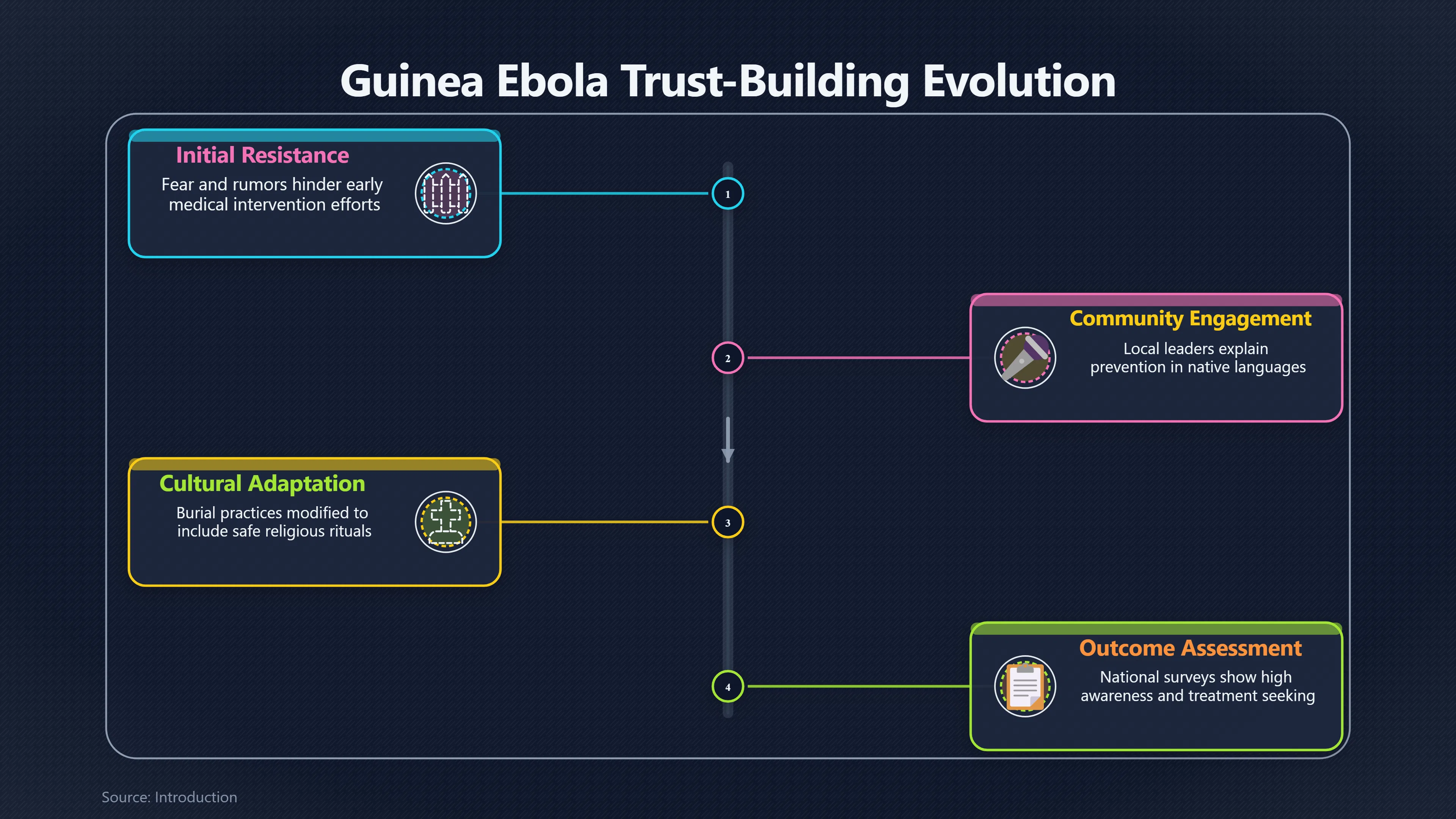
Communication strategies shifted away from one-way public messaging towards community engagement. Local religious leaders, traditional healers, women’s organisations, youth groups and village representatives became involved in explaining Ebola prevention in local languages and adapting public health measures to local customs where possible. Rather than treating resistance as ignorance, many programmes began asking communities what frightened them and addressing specific concerns.[UNICEF Hong Kong]unicef.org.hkUNICEF Hong KongIn Guinea, reaching out to root out Ebola | Latest News | News | Hong Kong Committee for UNICEF | For every childMay 19…
Burial practices were modified to become both safe and more culturally acceptable. Families were increasingly allowed to observe ceremonies from a safe distance, religious rituals were incorporated where feasible, and greater efforts were made to explain what burial teams were doing. These changes helped reduce suspicion while maintaining infection control.[UNICEF Hong Kong]unicef.org.hkUNICEF Hong KongIn Guinea, reaching out to root out Ebola | Latest News | News | Hong Kong Committee for UNICEF | For every childMay 19…
Evidence collected near the end of Guinea’s epidemic suggests that these efforts had an effect. National surveys found high awareness of Ebola prevention, widespread willingness to seek specialised treatment, and broad acceptance of specialised burial teams, although misconceptions about transmission still remained and attitudes varied between regions.[CDC]cdc.govKnowledge, Attitudes, and Practices Related to Ebola Virus Disease at the End of a National Epidemic — Guinea, August 2015 | MMWR…

Why the episode remains important
Guinea’s Ebola rumours are now widely studied as an example of how public trust becomes a critical part of epidemic control.
The episode demonstrated that rumours are not merely false stories competing with accurate information. They are often attempts to explain frightening events in situations where institutions appear unfamiliar, inconsistent or unresponsive. Public health measures that seem self-evidently necessary to experts may look coercive or threatening to communities that lack reasons to trust those implementing them.
The lessons from Guinea have influenced later outbreak responses beyond West Africa. International organisations now place much greater emphasis on community engagement, transparent communication, locally trusted messengers and safe but culturally respectful practices. The central lesson is not simply that misinformation is dangerous, but that trust must be built before accurate information can persuade people to act on it.[unicef.org]unicef.orgEbola emergency: Protecting children and families | UNICEFEbola emergency: Protecting children and families | UNICEF
Amazon book picks
Further Reading
Books and field guides related to Why Ebola Teams Were Feared as a Threat. Use these as the next step if you want deeper reading beyond the article.


Ebola: The Natural and Human History of a Deadly Virus
Directly explains Ebola outbreaks and public responses.
Endnotes
1.
Source: who.int
Title: World Health Organization Factors that contributed to undetected spread
Link:https://www.who.int/news-room/spotlight/one-year-into-the-ebola-epidemic/factors-that-contributed-to-undetected-spread-of-the-ebola-virus-and-impeded-rapid-containment
Source snippet
World Health OrganizationFactors that contributed to undetected spreadJanuary 1, 2015...
Published: January 1, 2015
2.
Source: who.int
Title: World Health Organization Guinea- The Ebola virus shows its tenacity
Link:https://www.who.int/news-room/spotlight/one-year-into-the-ebola-epidemic/guinea-the-ebola-virus-shows-its-tenacity
3.
Source: unicef.ie
Link:https://www.unicef.ie/pr-news/life-saving-information-helps-reduce-spread-of-ebola-across-west-africa/
Source snippet
UNICEF IrelandLife-saving information helps reduce spread of Ebola across West Africa | UNICEF Ireland...
4.
Source: cdc.gov
Link:https://www.cdc.gov/mmwr/volumes/66/wr/mm6641a4.htm
Source snippet
Knowledge, Attitudes, and Practices Related to Ebola Virus Disease at the End of a National Epidemic — Guinea, August 2015 | MMWR...
Published: August 2015
5.
Source: unicef.org
Title: Ebola emergency: Protecting children and families | UNICEF
Link:https://www.unicef.org/emergencies/ebola-emergency
6.
Source: unicef.org
Title: UNICE F Congratulates Guinea on Ending Ebola Virus Transmission
Link:https://www.unicef.org/wca/press-releases/unicef-congratulates-guinea-ending-ebola-virus-transmission
7.
Source: unicef.org
Title: L’UNICEF félicite la Guinée pour avoir mis fin à la transmission du virus Ebola
Link:https://www.unicef.org/guinea/communiqu%C3%A9s-de-presse/lunicef-f%C3%A9licite-la-guin%C3%A9e-pour-avoir-mis-fin-%C3%A0-la-transmission-du-virus
8.
Source: unicef.ca
Title: Fighting Ebola in West Africa
Link:https://www.unicef.ca/en/blog/fighting-ebola-in-west-africa
9.
Source: afro.who.int
Link:https://www.afro.who.int/news/busting-myths-about-ebola-crucial-stop-transmission-disease-guinea
10.
Source: unicef.org
Link:https://www.unicef.org/esa/documents/managing-rumours-guidance-country-offices
11.
Source: unicef.org.hk
Link:https://www.unicef.org.hk/en/news/latest_news/in-guinea-reaching-out-to-root-out-ebola/
Source snippet
UNICEF Hong KongIn Guinea, reaching out to root out Ebola | Latest News | News | Hong Kong Committee for UNICEF | For every childMay 19...
12.
Source: ebolaresponse.un.org
Link:https://ebolaresponse.un.org/en/guinea
Source snippet
ebolaresponseMay 26, 2026 — UPDATE ON THE OPERATIONAL ACTIVITIES CARRIED OUT BY THE UN SYSTEM THROUGH THE MISSION AND ITS PARTNERS The...
Published: May 26, 2026
13.
Source: GOV.UK
Title: www.gov.uk Understanding social resistance to Ebola response in Guinea
Link:https://www.gov.uk/research-for-development-outputs/understanding-social-resistance-to-ebola-response-in-guinea
Additional References
14.
Source: youtube.com
Link:https://www.youtube.com/watch?v=S5zSAaW_uVY
Source snippet
Guinea: Mistrust thwarts Ebola vaccination effort...
15.
Source: youtube.com
Title: Health workers in Congo race to gain people’s trust as Ebola virus spreads
Link:https://www.youtube.com/watch?v=7h-QR9b-i8o
Source snippet
Community volunteers join fight against Ebola in Bunia...
16.
Source: pmc.ncbi.nlm.nih.gov
Link:https://pmc.ncbi.nlm.nih.gov/articles/PMC5689093/
Source snippet
Knowledge, Attitudes, and Practices Related to Ebola Virus Disease at the End of a National Epidemic — Guinea, August 2015 - PMC...
Published: August 2015
17.
Source: journals.plos.org
Link:https://journals.plos.org/plosntds/article?id=10.1371%2Fjournal.pntd.0009487
Source snippet
2021 Ebola virus outbreak in Guinea: Mistrust and the shortcomings of outbreak surveillance | PLOS Neglected Tropical DiseasesJune 24, 20...
18.
Source: youtube.com
Title: Deadly attack in Guinea on Ebola team
Link:https://www.youtube.com/watch?v=KjmdSwYMyM0
Source snippet
Health workers in Congo race to gain people's trust as Ebola virus spreads...
19.
Source: bmj.com
Link:https://www.bmj.com/content/393/bmj-2026-721038/rr
Source snippet
When communities resist: rethinking Ebola response through risk communication and community engagement | The BMJJune 14, 2026 — DRC HAS S...
Published: June 14, 2026
20.
Source: archive.ids.ac.uk
Link:https://archive.ids.ac.uk/erap/evidence/1269/
21.
Source: research.wur.nl
Link:https://research.wur.nl/en/publications/trust-and-distrust-of-ebola-treatment-centers-a-case-study-from-s/
22.
Source: nejm.org
Title: Community Trust and the Ebola Endgame | New England Journal of Medicine
Link:https://www.nejm.org/doi/full/10.1056/NEJMp1508413
23.
Source: youtube.com
Title: Guinea: Mistrust thwarts Ebola vaccination effort
Link:https://www.youtube.com/watch?v=57konljP5RI
Source snippet
Deadly attack in Guinea on Ebola team...
Topic Tree