Within New Zealand Belief
How Can Real Abuse Be Separated from Moral Panic?
Some New Zealand controversies reflected imported panic, while others exposed documented coercion and abuse.
On this page
- The satanic ritual abuse scare
- The Christchurch Civic Creche case
- Centrepoint, Gloriavale and evidence of coercion
Page outline Jump by section
Introduction
New Zealand’s experience shows why it is dangerous to treat every allegation involving an unusual religious community as either a baseless “cult scare” or as proof that all accusations are true. The country has experienced both imported moral panics, particularly around supposed satanic ritual abuse in the late twentieth century, and well-documented cases in which isolated communities concealed genuine coercion, sexual abuse and exploitation. The crucial distinction has never been whether a group appeared unconventional. It has been whether allegations could be supported by reliable evidence, independently investigated and tested in court.
This contrast is especially clear when comparing the Christchurch Civic Crèche case, which became entangled with international fears about satanic ritual abuse, with later investigations into communities such as Centrepoint and Gloriavale, where extensive criminal investigations, civil litigation and official inquiries documented real patterns of abuse. Together these cases illustrate why evidence matters more than labels.
The satanic ritual abuse scare
During the 1980s and early 1990s, many English-speaking countries experienced what became known as the satanic ritual abuse (SRA) panic. Claims spread that organised networks of satanists were systematically abusing children in secret ceremonies, often in day-care centres. Police investigations, academic reviews and later judicial examinations in several countries failed to uncover evidence supporting the existence of the vast conspiracies that had been alleged.
New Zealand did not experience the same scale of panic as the United States or Britain, but the international climate shaped local expectations. Training materials, media reporting and some interviewing practices reflected a growing belief that children might repress memories of elaborate ritual abuse and require repeated questioning before revealing them. As later reviews showed, these assumptions risked encouraging interviewers to treat increasingly extraordinary claims as corroboration rather than as signals that interview methods required closer scrutiny.[RNZ]rnz.co.nzRNZPeter Ellis and the Christchurch creche case | RNZ NewsAugust 2, 2019…
The lesson is not that child sexual abuse was imaginary. Child abuse was, and remains, a serious social problem. Rather, the specific claims about hidden satanic networks lacked reliable supporting evidence despite extensive investigations in multiple countries.
The Christchurch Civic Crèche case
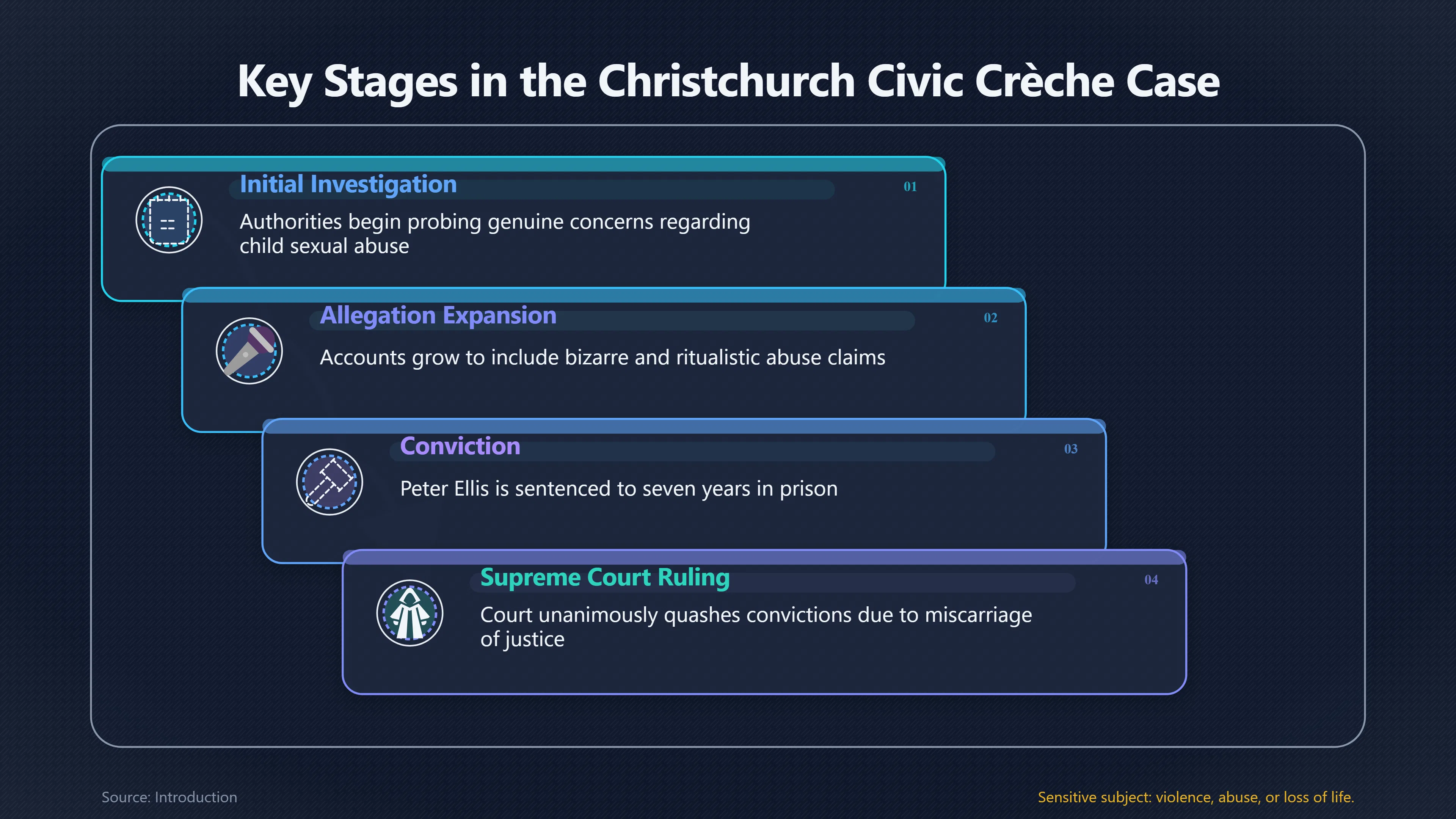
The Christchurch Civic Crèche investigation began with genuine concerns about possible child sexual abuse. As more children were interviewed, however, the allegations expanded dramatically. Some accounts included claims associated with the wider international satanic panic, including bizarre stories that became increasingly difficult to reconcile with physical evidence or independent corroboration.[RNZ]rnz.co.nzRNZPeter Ellis and the Christchurch creche case | RNZ NewsAugust 2, 2019…
Peter Ellis, a childcare worker, was convicted in 1993 on multiple sexual abuse charges and served seven years in prison while consistently maintaining his innocence. His case divided New Zealand for decades.
Why the case became so controversial
The controversy did not arise because people believed child abuse was impossible. Instead, critics increasingly questioned:
- whether repeated interviews influenced children’s recollections;
- whether interviewers relied too heavily on assumptions that abuse must have occurred;
- whether extraordinary claims were adequately tested against objective evidence;
- whether the broader international panic about ritual abuse shaped professional judgement.
Successive appeals kept the debate alive, and the case became one of New Zealand’s most examined criminal prosecutions. In 2022 the Supreme Court unanimously quashed Ellis’s convictions, concluding that a substantial miscarriage of justice had occurred. The Court’s decision did not declare that no child had ever experienced abuse, but it found that the convictions themselves could no longer safely stand.[News]1news.co.nz1News Peter Ellis case: Supreme Court quashes child abuse convictionsPeter Ellis case: Supreme Court quashes child abuse convictionsOctober 8, 2022…
The Christchurch case is therefore best understood as a warning about the interaction between sincere concern for children, flawed investigative practices and an international moral panic. It demonstrates how genuine anxiety about protecting vulnerable people can coexist with unreliable evidence and ultimately produce injustice.
When investigations uncovered genuine coercion
Unlike the Christchurch Civic Crèche case, some New Zealand communities later became the focus of investigations that uncovered substantial independent evidence of abuse.

Centrepoint
Centrepoint, founded by Bert Potter near Auckland in the 1970s, promoted communal living, psychotherapy and beliefs about sexual liberation. Supporters described it as an alternative community, but former members reported extensive exploitation.
Over time, criminal investigations established that Potter had sexually abused children living within the community. He was convicted in 1992 on numerous sexual offences involving minors. Former residents also described manipulation, pressure to conform, blurred boundaries between adults and children, and the concentration of authority in charismatic leadership.
The significance of Centrepoint is that the findings did not depend upon rumours of secret satanic conspiracies. They rested on identifiable victims, police investigations, criminal trials and judicial findings.
Gloriavale
Gloriavale Christian Community presents a different pattern. It is not associated with satanic panic, but with longstanding allegations of coercive control within a highly isolated religious community.
Over many years, former members, journalists, employment authorities, family courts and police investigations documented concerns including:
- exploitative labour arrangements;
- severe restrictions on personal freedom;
- authoritarian leadership;
- sexual offending by some members;
- barriers to reporting abuse;
- pressure discouraging departure from the community.
Not every allegation has resulted in criminal conviction, and the community continues to reject many criticisms. Nevertheless, multiple courts and official bodies have recognised patterns of exploitation and coercive practices extending well beyond isolated incidents. These findings emerged through extensive evidence gathered across many years rather than through a sudden public panic.
What separates moral panic from genuine abuse?
The New Zealand experience suggests several practical questions that help distinguish evidence-based concern from collective fear.
Is there independent evidence? Genuine abuse cases are normally supported by multiple forms of evidence, including witness testimony, forensic material, documentary records or consistent corroboration. Moral panics often depend primarily upon rumours or increasingly elaborate allegations that cannot be independently verified.
Do allegations become more extraordinary over time? In panic-driven cases, stories sometimes grow more dramatic through repeated interviewing or media attention. Genuine investigations may uncover additional victims, but they do not usually require increasingly implausible explanations to sustain the central claim.
Can claims survive critical testing? Reliable investigations actively search for contradictory evidence rather than assuming allegations are true. Courts, appeals and independent reviews are essential safeguards precisely because sincere investigators can still make mistakes.
Is the focus on behaviour rather than beliefs? Unusual religious doctrines or communal lifestyles are not themselves evidence of abuse. Authorities should investigate criminal conduct—such as assault, exploitation or coercive control—rather than unconventional beliefs alone.

Why the distinction still matters
The Christchurch Civic Crèche case and communities such as Centrepoint and Gloriavale are sometimes discussed together because they all involve public concern about vulnerable people in unusual settings. Yet they point in opposite directions.
The Civic Crèche controversy illustrates how imported narratives about hidden satanic conspiracies, combined with flawed interviewing methods and intense public anxiety, can contribute to miscarriages of justice. Centrepoint and Gloriavale show that isolated or charismatic communities can also become places where genuine abuse flourishes if leaders exercise unchecked power and victims struggle to seek outside help.
Confusing these two patterns creates risks in both directions. Treating every unusual religious community as inherently dangerous encourages prejudice and investigative error. Dismissing allegations simply because previous moral panics proved unfounded can leave real victims without protection.
New Zealand’s experience therefore supports an evidence-led approach. Authorities, journalists and the public are best served by resisting sensational labels, testing claims rigorously and concentrating on verifiable conduct rather than fear, ideology or appearance.
Amazon book picks
Further Reading
Books and field guides related to How Can Real Abuse Be Separated from Moral Panic?. Use these as the next step if you want deeper reading beyond the article.

Mistakes Were Made (But Not by Me)
Explains confirmation bias and persistence of false beliefs.
Endnotes
1.
Source: rnz.co.nz
Title: RNZPeter Ellis and the Christchurch creche case | RNZ News
Link:https://www.rnz.co.nz/news/thedetail/551938/peter-ellis-and-the-christchurch-creche-case
Source snippet
August 2, 2019...
Published: August 2, 2019
2.
Source: rnz.co.nz
Title: RNZE03: The Perfect Storm | RNZ
Link:https://www.rnz.co.nz/programmes/conviction-the-christchurch-civic-creche-case/story/2018904775/e03-the-perfect-storm
Source snippet
E03: The Perfect Storm | RNZSeptember 29, 2023 — 29 Sep 2023 E03: THE PERFECT STORM From Conviction, 5:02 am on 29 September 2023 As in s...
Published: September 29, 2023
3.
Source: 1news.co.nz
Title: 1News Peter Ellis case: Supreme Court quashes child abuse convictions
Link:https://www.1news.co.nz/2022/10/08/peter-ellis-case-supreme-court-quashes-child-abuse-convictions/
Source snippet
Peter Ellis case: Supreme Court quashes child abuse convictionsOctober 8, 2022...
Published: October 8, 2022
4.
Source: rnz.co.nz
Title: ‘No evidence of lying’
Link:https://www.rnz.co.nz/programmes/conviction-the-christchurch-civic-creche-case/story/2018910666/no-evidence-of-lying-peter-ellis-parole-officer-speaks-for-first-time
Source snippet
Peter Ellis’ parole officer speaks for first time | RNZOctober 12, 2023 — 12 Oct 2023 ‘NO EVIDENCE OF LYING’ - PETER ELLIS’ PAROLE OFFICE...
Published: October 12, 2023
Additional References
5.
Source: thespinoff.co.nz
Link:https://thespinoff.co.nz/society/07-10-2022/peter-ellis-has-name-cleared-child-abuse-convictions-posthumously-quashed
Source snippet
October 7, 2022 — Image: Peter Ellis ((Photo: Paddy Dillon/Getty Images, additional design Archi Banal) Peter Ellis ((Photo: Paddy Dillon...
Published: October 7, 2022
6.
Source: nzherald.co.nz
Title: The twists and turns of Peter Ellis’ Christchurch Civic Creche sex abuse case
Link:https://www.nzherald.co.nz/nz/the-twists-and-turns-of-peter-ellis-christchurch-civic-creche-sex-abuse-case/C4WP7PXYSPCVUD32SLMZ5N7PVQ/
Source snippet
NZ HeraldOctober 7, 2022 — Home / New Zealand THE TWISTS AND TURNS OF PETER ELLIS' CHRISTCHURCH CIVIC CRECHE SEX ABUSE CASE Image: Meliss...
Published: October 7, 2022
7.
Source: ero.govt.nz
Title: Gloriavale Christian Preschool | Education Review Office
Link:https://www.ero.govt.nz/institution/70555/gloriavale-christian-preschool
Source snippet
July 2, 2025 — GLORIAVALE CHRISTIAN PRESCHOOL Education institution number: 70555 Service type: Education & Care Service Definition: Non...
Published: July 2, 2025
8.
Source: youtube.com
Title: Introducing: Conviction: The Christchurch Civic Creche Case | Motive
Link:https://www.youtube.com/watch?v=rB6PehM0PTc
Source snippet
The Commune Episode 5: Invaders | Podcast Stuff | Stuff.co.nz...
9.
Source: youtube.com
Title: The Commune Episode 5: Invaders | Podcast Stuff | Stuff.co.nz
Link:https://www.youtube.com/watch?v=iyq4y4J09HI
Source snippet
Devotion: Obedience or Betrayal | Paramount+ Official Trailer...
10.
Source: natlib.govt.nz
Link:https://natlib.govt.nz/records/45982891?search%5Bi%5D%5Bsubject%5D%5B%5D=Child+sexual+abuse&search%5Bi%5D%5Bsubject%5D%5B%5D=Male+teachers&search%5Bpath%5D=items
11.
Source: menz.org.nz
Link:https://menz.org.nz/cosa/peter-ellis-christchurch-creche/
12.
Source: teara.govt.nz
Link:https://teara.govt.nz/en/video/30538/christchurch-civic-creche
13.
Source: newstalkzb.co.nz
Link:https://www.newstalkzb.co.nz/news/crime/the-twists-and-turns-of-peter-ellis-christchurch-civic-creche-sex-abuse-case/
14.
Source: ombudsman.parliament.nz
Title: Request for information relating to Civic Creche Inquiry | Ombudsman New Zealand
Link:https://www.ombudsman.parliament.nz/resources/request-information-relating-civic-creche-inquiry
Topic Tree