Within Peru Beliefs
Why Peru Feared the Fat Stealing Stranger
Stories of fat-stealing outsiders transformed inequality, violence and state distrust into one of Peru's most enduring fear traditions.
On this page
- How the pishtaco legend changed over time
- Why conflict made the rumour persuasive
- How the 2009 police scare collapsed
Page outline Jump by section
Introduction
Stories about the pishtaco—a mysterious stranger who murders people to steal their body fat—have circulated in Peru for centuries. At first glance they resemble a supernatural folk tale, but historians and anthropologists argue that the legend is better understood as a recurring expression of political distrust. Whenever Peruvians, especially Indigenous communities, have experienced exploitation, violence or state neglect, rumours about fat-stealing outsiders have often returned in new forms. Rather than reflecting a single episode of collective panic, pishtaco stories have repeatedly adapted to changing fears about colonialism, capitalism, civil war, corruption and unequal power.
The endurance of the rumour reveals an important social mechanism. The figure of the fat-stealing stranger changes with each generation, but the underlying suspicion remains remarkably consistent: powerful outsiders profit by extracting value from Indigenous bodies while authorities either cannot or will not provide protection.
How the pishtaco legend changed over time
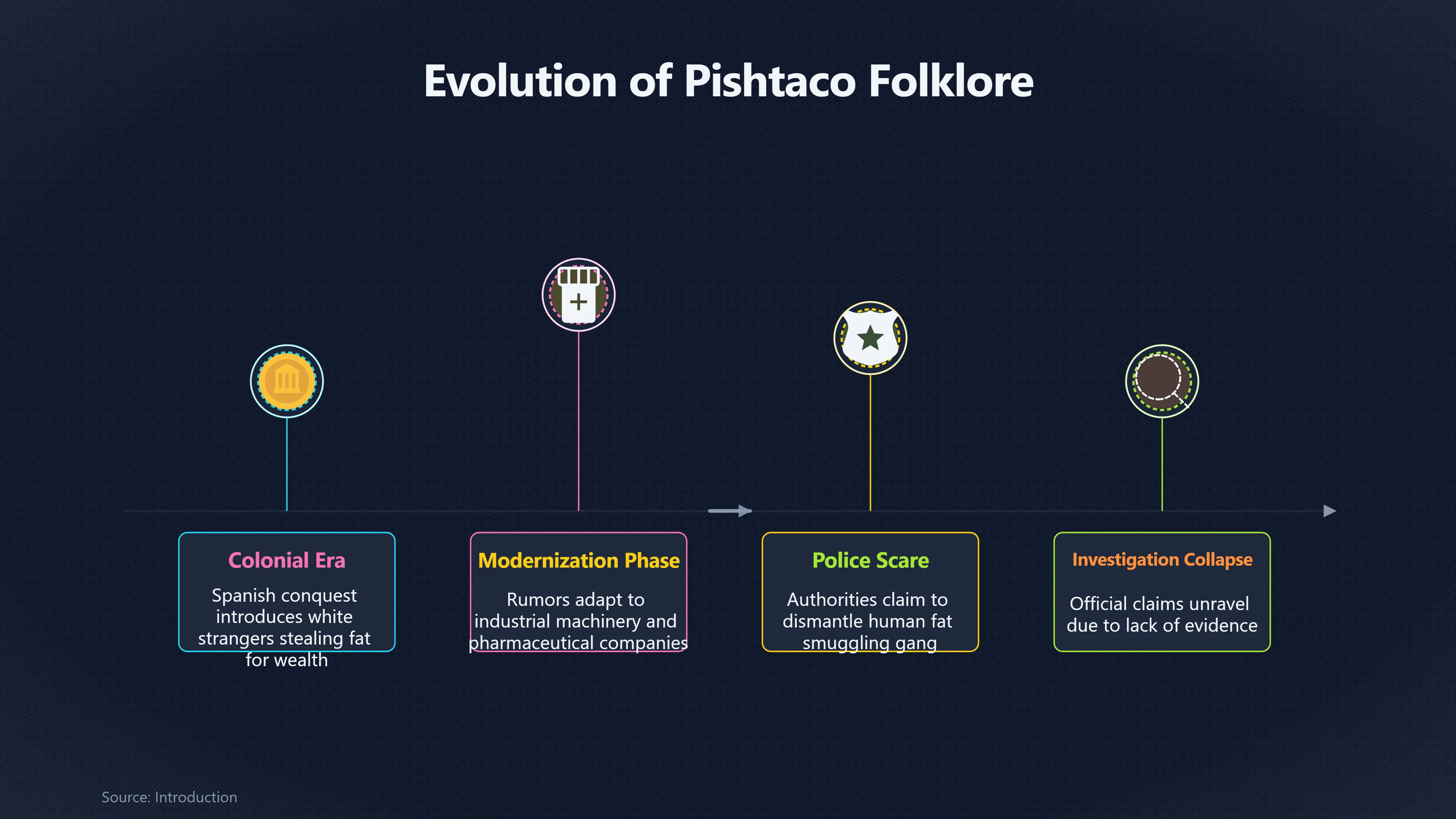
The earliest versions of the legend emerged during the colonial period, when Spanish conquest radically transformed Andean society. In many accounts the pishtaco appeared as a white or foreign-looking man who ambushed travellers, killed them and removed their fat. The precise purpose of the stolen fat shifted over time, but the basic idea remained that outsiders literally enriched themselves through Indigenous bodies.[Wikipedia]WikipediaOpen source on wikipedia.org.
Anthropologists caution against treating the story as a simple fantasy. Instead, they note that rumours reflected historical experiences of extraction. Colonial labour systems, forced tribute, missionary campaigns and racial hierarchy all created a world in which Indigenous communities saw wealth flowing away while they bore the costs. Stories about bodily extraction became an unusually vivid way of describing economic exploitation.
As Peru modernised, the legend modernised with it. Instead of serving kings or churches, later pishtacos supposedly supplied industrial machinery, hospitals, pharmaceutical companies or international cosmetic firms. These changing details mirrored contemporary technologies and markets while preserving the older narrative that distant elites prospered at the expense of ordinary people. Scholars have also noted that the rumour drew credibility from the historical importance of animal fats and tallow in industry, making the idea less implausible to earlier generations than it may appear today.[Wikipedia]WikipediaOpen source on wikipedia.org.
The legend therefore survived not because people consistently believed the same factual claims, but because it offered a flexible language for expressing unequal relationships between powerful outsiders and marginalised communities.
Why conflict made the rumour persuasive
The pishtaco tradition became especially influential during periods of insecurity. Peru’s internal armed conflict between the early 1980s and 2000 left tens of thousands dead, with rural Indigenous populations suffering disproportionately. The violence involved guerrilla organisations, state security forces and local militias, producing widespread disappearances, massacres and deep mistrust of official institutions.[arXiv]arxiv.orgEstimating the Number of Fatal Victims of the Peruvian Internal Armed Conflict, 1980-2000: an application of modern multi-list Captu…
In that environment, rumours travelled easily because many people had genuine reasons to fear strangers and armed men. Communities already accustomed to disappearances could find stories about mysterious killers emotionally plausible even without direct evidence. Anthropologists studying rumour have argued that the pishtaco became a symbolic explanation for broader experiences of extraction and vulnerability rather than merely a supernatural monster.
Several factors reinforced the rumour’s credibility:
- Historical memory of exploitation. Colonial and republican experiences had long associated outsiders with forced labour, resource extraction and unequal treatment.
- Weak state presence. Remote communities often had limited confidence that police or courts could investigate disappearances or protect vulnerable populations.
- Political violence. Years of civil conflict blurred the distinction between criminals, insurgents and state agents, making unfamiliar travellers appear especially threatening.
- Economic inequality. Expanding mining, logging and commercial development sometimes intensified local fears that outside interests profited while Indigenous communities bore the risks.
These conditions did not produce uniform belief across Peru. Rather, they created circumstances in which rumours could spread rapidly because they fitted existing expectations about power and injustice.
Why body fat became such a powerful symbol
To outsiders the focus on body fat can seem bizarre, yet anthropologists argue that fat carried unusually rich symbolic meanings.
Body fat represented life, health, labour and vitality. Stealing it therefore implied taking more than flesh: it meant extracting a person’s strength, prosperity and future. In communities whose labour had historically enriched others, the metaphor resonated with everyday experience.
The rumour also expressed a broader moral economy. Instead of imagining wealth as something created fairly, pishtaco stories portrayed riches as originating in hidden violence against vulnerable people. Modern versions involving multinational companies or foreign buyers simply updated that underlying logic.
This symbolic dimension helps explain why the rumour has survived technological change. The exact commodity changes—from church rituals to machinery to cosmetics—but the deeper accusation remains that powerful people become wealthy through concealed exploitation.

How the 2009 police scare collapsed
The most famous modern pishtaco episode began in late 2009 when Peruvian police announced that they had dismantled a gang supposedly murdering people to harvest human fat. Investigators claimed the fat was being sold through intermediaries for use by European cosmetic companies, and dramatic press conferences displayed bottles of alleged human fat and gruesome photographs. International media rapidly reported the extraordinary claims.[theguardian.com]theguardian.comThe Guardian Gang 'killed victims to extract their fat' | Peru | The GuardianThe GuardianGang 'killed victims to extract their fat' | Peru | The GuardianNovember 20, 2009…
The announcement appeared to confirm one of Peru’s oldest legends. Yet the story quickly began to unravel.
Medical specialists questioned the alleged commercial motive, pointing out that cosmetic and medical industries already had lawful and inexpensive sources of human fat, making an illicit international market highly implausible. Regional officials also disputed key elements of the investigation, saying they knew of no evidence supporting the sweeping claims about dozens of victims.[The Guardian]theguardian.comThe GuardianPeruvian officials express doubt over alleged fat smuggling gang | Peru | The GuardianDecember 1, 2009…
Within weeks Peru’s national police leadership publicly distanced itself from the investigation. Senior officers were suspended or reassigned, and officials acknowledged that many of the original claims could not be substantiated. Reports that up to sixty people had been murdered were abandoned, and the alleged international fat-trafficking operation effectively collapsed under scrutiny.[theguardian.com]theguardian.comThe GuardianPeruvian officials express doubt over alleged fat smuggling gang | Peru | The GuardianDecember 1, 2009…
The affair became notable not because it proved the legend, but because official authorities briefly amplified it before evidence failed to support their narrative.

What the 2009 episode revealed about mistrust
The failed investigation illustrated several overlapping forms of mistrust.
First, many Peruvians were willing to consider the allegations believable because the pishtaco legend already occupied a familiar place in cultural memory. The police narrative echoed long-standing fears rather than inventing entirely new ones.
Second, the rapid collapse damaged confidence in official institutions. Critics questioned why dramatic accusations had been presented publicly before rigorous evidence had been established. The controversy demonstrated how state institutions can unintentionally reinforce rumours instead of dispelling them.[The Guardian]theguardian.comThe GuardianPeruvian officials express doubt over alleged fat smuggling gang | Peru | The GuardianDecember 1, 2009…
Third, the episode highlighted the dangers of confirmation bias. Once investigators interpreted evidence through the lens of the pishtaco legend, ordinary criminal investigations risked becoming entangled with culturally powerful expectations.
For scholars of rumour, the incident serves as an example of how folklore and official authority can briefly reinforce one another, even when subsequent investigation undermines the original claims.
Why the pishtaco still matters
The pishtaco remains culturally significant because it captures enduring anxieties about unequal power rather than merely preserving an old folk monster.
Modern versions continue to appear whenever communities fear exploitation by mining companies, criminal organisations, corrupt officials or mysterious outsiders. The specific villains change, but the narrative still asks who benefits when vulnerable people lose control over their bodies, land or livelihoods.
For historians and sociologists, the legend offers a reminder that rumours often communicate genuine social concerns even when their literal claims are false. They reveal where trust has broken down, which institutions people fear, and how historical memories shape interpretations of present-day events.
Seen in this light, the pishtaco is less a supernatural killer than a recurring political symbol. Its persistence reflects centuries of unequal relationships between Indigenous communities and centres of power. Understanding why the rumour survives therefore requires understanding not only folklore, but also Peru’s long history of conquest, violence, exclusion and contested authority.
Amazon book picks
Further Reading
Books and field guides related to Why Peru Feared the Fat Stealing Stranger. Use these as the next step if you want deeper reading beyond the article.

The Art of Not Being Governed
First published 2009. Subjects: Politics and government, Rural conditions, Peasantry, Ethnology, Political activity.
Endnotes
1.
Source: Wikipedia
Link:https://en.wikipedia.org/wiki/Pishtaco
2.
Source: arxiv.org
Link:https://arxiv.org/abs/1906.04763
Source snippet
Estimating the Number of Fatal Victims of the Peruvian Internal Armed Conflict, 1980-2000: an application of modern multi-list Captu...
3.
Source: www1.rfi.fr
Title: article 6053.asp
Link:https://www1.rfi.fr/actuen/articles/120/article_6053.asp
Source snippet
RFI - Fat extraction gang a myth, say police...
4.
Source: time.com
Title: Peru’s Fat-Stealing Gang: Crime or Cover-Up?
Link:https://time.com/archive/6948763/perus-fat-stealing-gang-crime-or-cover-up/
5.
Source: theguardian.com
Title: The Guardian Gang ‘killed victims to extract their fat’ | Peru | The Guardian
Link:https://www.theguardian.com/world/2009/nov/20/peru-gang-killing-human-fat
Source snippet
The GuardianGang 'killed victims to extract their fat' | Peru | The GuardianNovember 20, 2009...
Published: November 20, 2009
6.
Source: aljazeera.com
Title: Al Jazeera Peru police hold ‘fat gang’ killers | News | Al Jazeera
Link:https://www.aljazeera.com/news/2009/11/20/peru-police-hold-fat-gang-killers/
7.
Source: theguardian.com
Link:https://www.theguardian.com/world/2009/dec/01/peru-human-fat-smuggling
Source snippet
The GuardianPeruvian officials express doubt over alleged fat smuggling gang | Peru | The GuardianDecember 1, 2009...
Published: December 1, 2009
Additional References
8.
Source: iberoamericana.se
Link:https://iberoamericana.se/en/articles/10.16993/iberoamericana.579
Source snippet
Conflict Resolution through Force: The Case of Peru, 1980–1993 | Iberoamericana – Nordic Journal of Latin American and Caribbean StudiesJ...
9.
Source: sciencedirect.com
Title: Friends or foes?
Link:https://www.sciencedirect.com/science/article/abs/pii/S0305750X25003444
Source snippet
The insurgent’s dilemma of seeking legitimacy while keeping secrets - ScienceDirectMarch 1, 2026 — Regular Research Article Friends or fo...
Published: March 1, 2026
10.
Source: researchgate.net
Link:https://www.researchgate.net/publication/330854315_Pishtacos_Human_Fat_Murderers_Structural_Inequalities_and_Resistances_in_Peru
11.
Source: elpais.com
Link:https://elpais.com/internacional/2009/11/20/actualidad/1258671611_850215.html
12.
Source: cambridge.org
Link:https://www.cambridge.org/core/journals/journal-of-latin-american-studies/article/abs/maoism-in-the-andes-the-communist-party-of-perushining-path-and-the-refusal-of-history/89D6FE39EE3672C50ACED3708B31FB54
13.
Source: andina.pe
Link:https://andina.pe/agencia/noticia.aspx?id=267061
14.
Source: cambridge.org
Link:https://www.cambridge.org/core/journals/world-politics/article/abs/why-peasants-rebel-the-case-of-perus-sendero-luminoso/527340A396825D04110C54360728DCB3
15.
Source: news24.com
Title: Fat-stealing gang ‘a hoax’ | News24
Link:https://www.news24.com/fat-stealing-gang-a-hoax-20091202
Source snippet
Fat-stealing gang 'a hoax' | News24...
16.
Source: faculty.up.edu.pe
Title: up.edu.pe Politics after violence: Legacies of the shining path conflict in Peru
Link:https://faculty.up.edu.pe/en/publications/politics-after-violence-legacies-of-the-shining-path-conflict-in-/
17.
Source: faculty.up.edu.pe
Title: up.edu.pe Politics after violence: Legacies of the shining path conflict in Peru
Link:https://faculty.up.edu.pe/es/publications/politics-after-violence-legacies-of-the-shining-path-conflict-in-/
Topic Tree