Within Solomon Islands Belief
How the Moro Movement Rebuilt Isatabu Identity
Pelise Moro's movement joined communal living, ancestral history, Christianity and self-government without sharing one fixed millenarian creed.
On this page
- Pelise Moro and communal organisation
- Christianity, sacred objects and ancestral authority
- Cargo rumours, independence and the legacy of Isatabu
Page outline Jump by section
Introduction
The Moro Movement was one of the most distinctive Indigenous movements in the modern history of the Solomon Islands. Founded by Pelise Moro on Guadalcanal in the late 1950s, it was neither simply a religious revival nor merely a political protest. Instead, it sought to rebuild Guadalcanal society by combining customary authority, communal organisation, Christian belief and economic self-help. Although colonial officials and some outside observers occasionally grouped it with so-called “cargo cults”, that label obscures its wider aims. Miraculous expectations and rumours appeared on the margins, but the movement’s central purpose was to restore Indigenous control over land, identity and governance under the name of Isatabu—the movement’s preferred name for Guadalcanal.[Solomon Islands Encyclopaedia]solomonencyclopaedia.netSolomon Islands Encyclopaedia Moro MovementSolomon Islands EncyclopaediaMoro Movement - Party - Solomon Islands Encyclopaedia, 1893-1978…
Rather than waiting for supernatural transformation, Moro’s followers built villages, organised councils, collected contributions, preserved oral history and promoted a vision of self-government rooted in ancestral tradition. The movement became an enduring cultural force whose influence extended well beyond the colonial era and helped shape later debates over Guadalcanal identity and political rights.[Solomon Islands Encyclopaedia]solomonencyclopaedia.netSolomon Islands Encyclopaedia Moro MovementSolomon Islands EncyclopaediaMoro Movement - Party - Solomon Islands Encyclopaedia, 1893-1978…
Pelise Moro and communal organisation
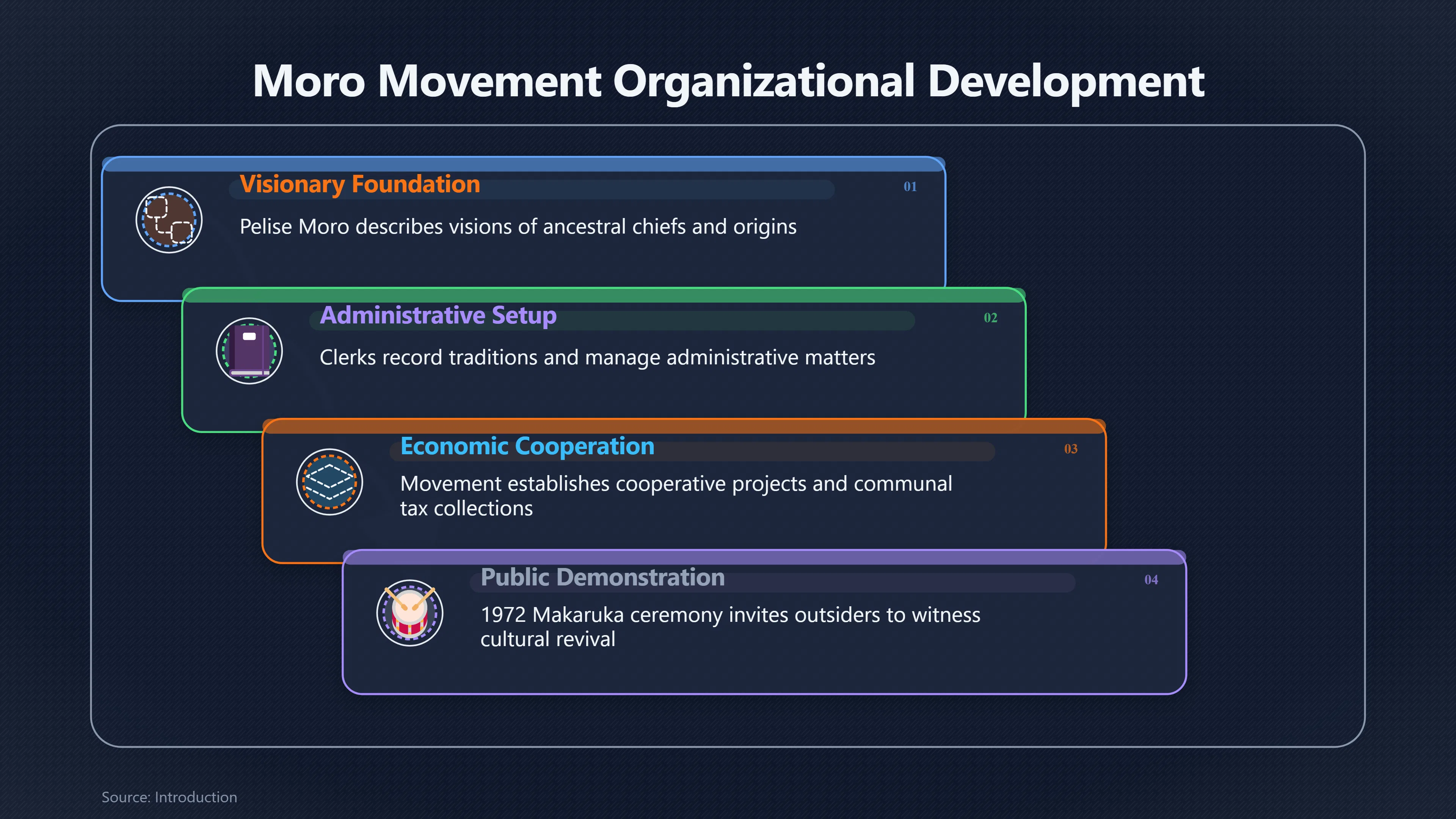
Pelise Moro emerged from the isolated Weathercoast of Guadalcanal, an area long neglected by the colonial administration. Baptised as a Catholic but raised within local customary traditions, he experienced wartime employment with American forces after the Second World War and later worked on plantations and government projects. Around 1956–57, following a serious illness, he began describing visions concerning the origins of Guadalcanal, the authority of its ancestral chiefs and the future of its people. These experiences became the foundation of the Moro Movement.[Solomon Islands Encyclopaedia]solomonencyclopaedia.netSolomon Islands Encyclopaedia Moro, PeliseSolomon Islands EncyclopaediaMoro, Pelise - Biographical entry - Solomon Islands Encyclopaedia, 1893-1978…
Moro claimed that he inherited the authority of ancient paramount chiefs and argued that Guadalcanal’s customary political order had survived beneath colonial rule. His movement therefore focused less on creating an entirely new religion than on restoring what followers believed had always been the island’s rightful social order. He referred to Guadalcanal as Isatabu, reinforcing the idea that colonial place names and institutions had obscured Indigenous history.[Solomon Islands Encyclopaedia]solomonencyclopaedia.netSolomon Islands Encyclopaedia Moro, PeliseSolomon Islands EncyclopaediaMoro, Pelise - Biographical entry - Solomon Islands Encyclopaedia, 1893-1978…
The movement developed a surprisingly elaborate organisation. It established:
- councils of advisers and local leaders;
- clerks who recorded traditions and administrative matters;
- communal tax collections;
- cooperative economic projects;
- village-level organisation centred on customary leadership.
This structure resembled aspects of the earlier Maasina Rule movement while remaining rooted in Guadalcanal rather than spreading across the Solomon Islands. At its height during the 1960s, the movement attracted an estimated 3,000–4,000 followers across roughly half of Guadalcanal’s Indigenous population.[Solomon Islands Encyclopaedia]solomonencyclopaedia.netSolomon Islands Encyclopaedia Moro MovementSolomon Islands EncyclopaediaMoro Movement - Party - Solomon Islands Encyclopaedia, 1893-1978…
The practical emphasis distinguished the movement from stereotypes of passive millenarian expectation. Followers invested in agriculture, community organisation and local governance while resisting colonial assumptions that government alone possessed legitimate authority.
Christianity, sacred objects and ancestral authority
The Moro Movement did not reject Christianity outright. Instead, it blended Christian belief with Indigenous understandings of ancestry, sacred history and chiefly authority. This combination reflected broader Melanesian patterns in which Christianity was adapted to local cultural frameworks rather than simply replacing them.[Solomon Islands Encyclopaedia]solomonencyclopaedia.netSolomon Islands Encyclopaedia Moro MovementSolomon Islands EncyclopaediaMoro Movement - Party - Solomon Islands Encyclopaedia, 1893-1978…
Moro dictated extensive accounts of the origins of Isatabu, the succession of ancestral chiefs and the boundaries of customary lands. Because he was unable to write himself, educated supporters recorded these narratives. The resulting documents became political as well as spiritual statements. They argued that ancestral authority defined legitimate ownership of land and that colonial concepts such as “vacant” or “waste” land ignored long-established customary relationships.[Solomon Islands Encyclopaedia]solomonencyclopaedia.netSolomon Islands Encyclopaedia Moro, PeliseSolomon Islands EncyclopaediaMoro, Pelise - Biographical entry - Solomon Islands Encyclopaedia, 1893-1978…
The movement also created symbolic institutions that reinforced this historical vision. Its headquarters included a Custom House or House of Antiquities, where important ritual objects and historical knowledge were preserved. Visitors who attended major ceremonies were expected to wear customary clothing before entering sacred spaces, demonstrating that participation required respect for Indigenous tradition rather than simple curiosity.[Solomon Islands Encyclopaedia]solomonencyclopaedia.netSolomon Islands Encyclopaedia Moro MovementSolomon Islands EncyclopaediaMoro Movement - Party - Solomon Islands Encyclopaedia, 1893-1978…
These practices were not attempts to recreate a frozen pre-colonial society. Instead, Moro presented custom as a living source of authority capable of guiding economic development, political organisation and cultural renewal in the modern world.
Cargo rumours, independence and the legacy of Isatabu
Because the movement contained visionary elements, some observers associated it with the wider category of Melanesian “cargo cults”. Stories occasionally circulated that Americans would return with wealth or that dramatic transformations would occur. However, historians who have studied the movement closely argue that these rumours remained peripheral rather than defining its programme. Moro himself consistently emphasised community organisation, customary law, land rights and economic improvement over miraculous expectations.[Solomon Islands Encyclopaedia]solomonencyclopaedia.netSolomon Islands Encyclopaedia Moro MovementSolomon Islands EncyclopaediaMoro Movement - Party - Solomon Islands Encyclopaedia, 1893-1978…
Colonial authorities nevertheless regarded the movement cautiously. Followers refused to cooperate with some government initiatives, including the 1959 census and mapping projects, while maintaining their own systems of taxation and leadership. Officials responded with a mixture of repression and accommodation. Moro himself was briefly imprisoned in the movement’s early years, but the administration also attempted to reduce tensions by expanding health, agricultural and infrastructure projects on the neglected Weathercoast.[Solomon Islands Encyclopaedia]solomonencyclopaedia.netSolomon Islands Encyclopaedia Moro MovementSolomon Islands EncyclopaediaMoro Movement - Party - Solomon Islands Encyclopaedia, 1893-1978…
One of the movement’s most remarkable public moments came in 1972, when more than a thousand visitors gathered at Makaruka for a large ceremonial celebration. Journalists, researchers and government officials attended after Moro explicitly invited outsiders to demonstrate that his organisation was not an irrational cult but a coherent social movement grounded in Guadalcanal history and custom. Ceremonies, dances, displays of shell wealth and access to the movement’s houses of memory illustrated its commitment to cultural revival rather than secrecy.[Solomon Islands Encyclopaedia]solomonencyclopaedia.netSolomon Islands Encyclopaedia Moro MovementSolomon Islands EncyclopaediaMoro Movement - Party - Solomon Islands Encyclopaedia, 1893-1978…
When the Solomon Islands achieved independence in 1978, Moro and his followers participated in national cultural celebrations. Although the movement had passed its peak, it continued into the following decades and remained an important reference point for Guadalcanal identity. Its emphasis on Isatabu, customary land ownership and Indigenous political authority influenced later debates during periods of ethnic tension, although historians distinguish the Moro Movement’s programme from the more militant actions of the later Isatabu Freedom Movement. The earlier movement provided an enduring language of cultural revival and Indigenous rights rather than a blueprint for armed conflict.[Solomon Islands Encyclopaedia]solomonencyclopaedia.netSolomon Islands Encyclopaedia Moro MovementSolomon Islands EncyclopaediaMoro Movement - Party - Solomon Islands Encyclopaedia, 1893-1978…
Why the Moro Movement remains significant
The Moro Movement illustrates why simple labels such as “cargo cult” can misrepresent complex Indigenous movements. While visions, sacred narratives and occasional rumours of miraculous change formed part of its history, these beliefs existed within a broader project of social reconstruction.
Its lasting contributions include:
- preserving Guadalcanal oral history and customary law;
- promoting the name Isatabu as an expression of Indigenous identity;
- strengthening communal organisation through councils and cooperative activity;
- linking Christianity with ancestral traditions instead of treating them as opposites;
- demonstrating that cultural revival could also function as a programme for political and economic self-determination.
For historians of the Solomon Islands, the movement is therefore better understood as a cultural and political renaissance rooted in local concepts of land, ancestry and authority than as an example of irrational collective belief. It shows how religious symbolism, historical memory and practical community organisation could combine to challenge colonial power while creating a durable sense of Indigenous identity.[Solomon Islands Encyclopaedia]solomonencyclopaedia.netSolomon Islands Encyclopaedia Moro MovementSolomon Islands EncyclopaediaMoro Movement - Party - Solomon Islands Encyclopaedia, 1893-1978…

Amazon book picks
Further Reading
Books and field guides related to How the Moro Movement Rebuilt Isatabu Identity. Use these as the next step if you want deeper reading beyond the article.

The Cambridge history of the Pacific Islanders
Explains colonial and postcolonial Pacific history.
Social Change in Melanesia
First published 2000. Subjects: Melanesia, Social conditions, History, Conditions sociales, Histoire.
Endnotes
1.
Source: solomonencyclopaedia.net
Title: Solomon Islands Encyclopaedia Moro Movement
Link:https://www.solomonencyclopaedia.net/biogs/E000207b.htm
Source snippet
Solomon Islands EncyclopaediaMoro Movement - Party - Solomon Islands Encyclopaedia, 1893-1978...
2.
Source: solomonencyclopaedia.net
Title: Solomon Islands Encyclopaedia Moro, Pelise
Link:https://www.solomonencyclopaedia.net/biogs/E000605b.htm
Source snippet
Solomon Islands EncyclopaediaMoro, Pelise - Biographical entry - Solomon Islands Encyclopaedia, 1893-1978...
3.
Source: solomonencyclopaedia-net.paulturnbull.org
Title: Solomon Islands Encyclopaedia Guadalcanal Island
Link:https://www.solomonencyclopaedia-net.paulturnbull.org/biogs/E000124b.htm
Source snippet
Solomon Islands EncyclopaediaGuadalcanal Island - Place - Solomon Islands Encyclopaedia, 1893-1978...
4.
Source: paulturnbull.org
Link:https://paulturnbull.org/solomonencyclopaedia/introduction.html
5.
Source: solomonencyclopaedia.net
Title: Home Page
Link:https://www.solomonencyclopaedia.net/
6.
Source: solomonencyclopaedia.net
Link:https://www.solomonencyclopaedia.net/biogs/E000150b.htm
7.
Source: solomonencyclopaedia.net
Link:https://www.solomonencyclopaedia.net/biogs/E000133b.htm
8.
Source: solomonencyclopaedia.net
Title: Rennell and Bellona Islands
Link:https://www.solomonencyclopaedia.net/biogs/E000248b.htm
9.
Source: youtube.com
Title: Moro Movement
Link:https://www.youtube.com/watch?v=aT5yr2xHcP8
10.
Source: youtube.com
Title: Moro Movement
Link:https://www.youtube.com/watch?v=YtcBsHabX3Y
Source snippet
Ben Bohane Evening Presentation – Foundry Photojournalism Workshop 2018...
11.
Source: youtube.com
Link:https://www.youtube.com/watch?v=L-Y2ix6D4NA
Source snippet
Solomon Islands - Harold Keke: Rebel or Raskol...
12.
Source: youtube.com
Title: Solomon Islands
Link:https://www.youtube.com/watch?v=w5suNrKdBNs
Source snippet
The Build Up to the Solomon Islands Coup (2000)...
Additional References
13.
Source: da.lib.kobe-u.ac.jp
Title: kobe-u.ac.jp民族性から土着性へ: ソロモン諸島紛争におけるイサタンブ解放運動の一側面 | 神戸大学学術成果リポジトリ Kernel
Link:https://da.lib.kobe-u.ac.jp/da/kernel/81011955/
Source snippet
February 12, 2020 — [https://doi.org/10.24546/81011955](https://doi.org/10.24546/81011955) このアイテムのアクセス数:65件(2026-03-16 17:29 集計) 閲覧可能ファイル ファイル | フォーマット | サイズ | 閲覧回数 | 説明...
Published: March 16, 2026
14.
Source: researchgate.net
Title: Among the multiplexity of identities that matter in the Solomon
Link:https://www.researchgate.net/publication/353866430_Pillars_and_Shadows_Statebuilding_as_peacebuilding_in_Solomon_Islands
Source snippet
(PDF) Pillars and Shadows: Statebuilding as peacebuilding in Solomon IslandsJanuary 1, 2010 — discourses purely for personal, political a...
Published: January 1, 2010
15.
Source: academic.oup.com
Title: reference article
Link:https://academic.oup.com/reference/62334/reference-article-abstract/554061984?login=false
Source snippet
Introduction 2. General Overviews 3. Essential Cargo Ethnographies 4. Anthologies 5. Bibliographies 6. Film 7. Journal Special Issues 8...
16.
Source: academic.oup.com
Link:https://academic.oup.com/hawaii-scholarship-online/book/20137/chapter-abstract/179136562
Source snippet
oup.comGuadalcanal: The Contested Motherland | Greed and Grievance: Ex-Militants' Perspectives on the Conflict in Solomon Islands, 1998-2...
17.
Source: cap-press.com
Link:https://cap-press.com/books/isbn/9781531022419/Moro-and-the-Weather-Coast
Source snippet
Authors: Gülbün Çoker O'Connor. Carolina Academic PressJanuary 1, 2022 — MORO AND THE WEATHER COAST A REVITALIZATION MOVEMENT IN THE SOLO...
Published: January 1, 2022
18.
Source: awm.gov.au
Link:https://www.awm.gov.au/collection/C1084820
19.
Source: awm.gov.au
Link:https://www.awm.gov.au/collection/C1085225
20.
Source: britishempire.co.uk
Link:https://www.britishempire.co.uk/article/lettersfromthesolomonislands.htm
21.
Source: en-academic.com
Link:https://en-academic.com/dic.nsf/enwiki/5057758/
22.
Source: jstor.org
Link:https://www.jstor.org/stable/j.ctt24hf05
Topic Tree