Within Micronesian Beliefs
When Spirits Spoke Through Family Conflict
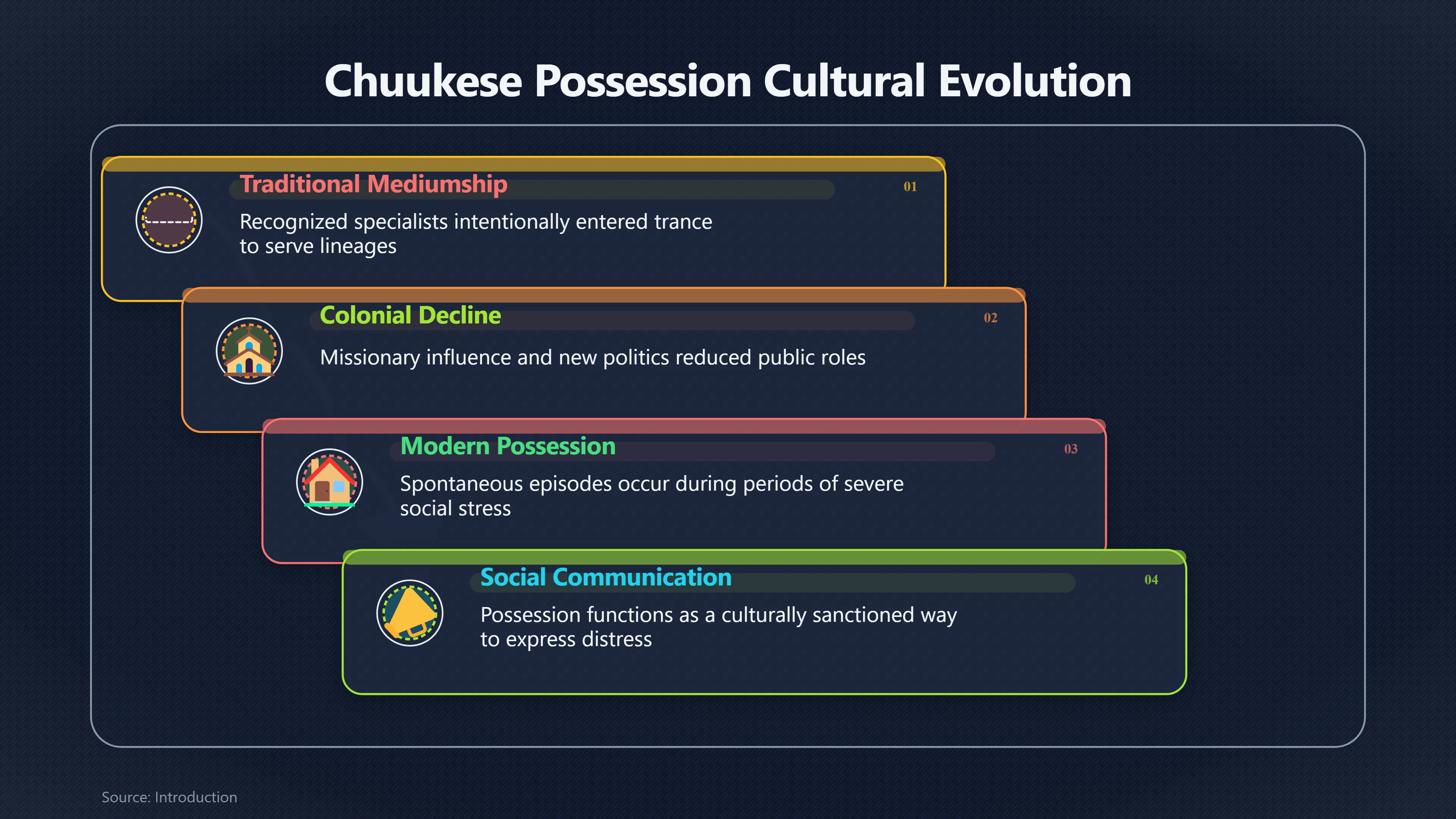
Chuukese possession traditions shifted from recognised mediumship towards involuntary episodes shaped by family conflict and social pressure.
On this page
- Traditional mediums and ancestral authority
- Why possession increasingly affected women
- Distress, dissociation and social communication
Page outline Jump by section
Introduction
Spirit possession in Chuuk, one of the four states of the Federated States of Micronesia, is best understood neither as simple superstition nor as evidence of collective hysteria. Anthropologists who documented dozens of cases found that possession traditions changed dramatically during the twentieth century. Older forms of possession centred on recognised spirit mediums who deliberately entered trance to communicate with ancestors on behalf of their communities. More recent cases, by contrast, usually involved spontaneous episodes experienced by young women during periods of family conflict, bereavement or other severe social stress. Rather than dismissing these experiences as fraud or mental illness, many researchers argue that they became a culturally recognised way of expressing distress and forcing families to confront otherwise unspoken problems.[micsem.org]micsem.orgPossession and Trance in Chuuk – Micronesian SeminarPossession and Trance in Chuuk – Micronesian Seminar
This transformation makes Chuuk an important case in the study of collective belief. It illustrates how an established religious tradition can survive profound social change while acquiring new social functions, allowing emotional suffering and family tensions to be communicated through a language that remained meaningful within Chuukese society.
Traditional mediums and ancestral authority
Early descriptions of Chuukese religion describe recognised spirit mediums who served lineages and communities. These specialists intentionally entered trance, summoned ancestral spirits and delivered advice concerning illness, disputes, ritual obligations or other important matters. Their role carried recognised social authority rather than suspicion. Both men and women could act as mediums, although historical accounts often describe male specialists more frequently.[micsem.org]micsem.orgPossession and Trance in Chuuk – Micronesian SeminarPossession and Trance in Chuuk – Micronesian Seminar
Researchers Francis X. Hezel and Jay Dobbin argue that this institutional role gradually declined during the colonial and missionary periods. Christianity, changing political authority and new social institutions reduced the public role of traditional mediums. Yet the underlying belief that ancestors could communicate through the living did not disappear. Instead, it survived in a different form.
Modern possession episodes still involve many recognisable elements from older traditions:
- altered voice or speech identified with a deceased relative;
- shaking, collapse or trance-like behaviour;
- messages believed to come from ancestral spirits;
- family gatherings to hear and interpret what the spirit was saying.
The continuity is important. Modern possession was not simply invented as a new behaviour but developed from older religious practices that retained cultural legitimacy even after formal mediumship had largely faded.[micsem.org]micsem.orgPossession and Trance in Chuuk – Micronesian SeminarPossession and Trance in Chuuk – Micronesian Seminar
Why possession increasingly affected women
One of the most striking changes documented by researchers is the shift in who experienced possession.
Where earlier mediumship included both sexes, twentieth-century possession became overwhelmingly associated with women, especially teenagers and women in their twenties. Hezel and Dobbin’s collection of more than forty possession cases found that almost all involved female subjects, despite recognising that interview methods could have produced some bias. Even allowing for that limitation, both researchers and Chuukese informants regarded female predominance as unmistakable.[micsem.org]micsem.orgOpen source on micsem.org.
Researchers explored several explanations for this shift.
First, young women often occupied a socially difficult position within extended families. Expectations of respect, emotional restraint and obedience limited opportunities to voice anger or criticise relatives openly. During possession, however, these ordinary restrictions temporarily disappeared.
Second, many documented episodes followed intense personal pressures, including:
- disputes over land or family obligations;
- domestic conflict;
- bereavement, particularly after unexpected deaths or suicides;
- anxiety surrounding pregnancy;
- prolonged interpersonal tension within the household.
In these situations, possession frequently occurred immediately after emotionally charged events rather than appearing randomly.[micsem.org]micsem.orgOpen source on micsem.org.
Researchers therefore interpreted possession less as evidence that women were uniquely vulnerable than as evidence that women had inherited a culturally recognised role through which otherwise forbidden feelings could be expressed.
When spirits spoke through family conflict
Perhaps the most distinctive feature of contemporary Chuukese possession is that the “voice of the spirit” often communicated precisely the issues that families were reluctant to discuss openly.
During possession episodes, women might:
- accuse relatives of neglect or unfair treatment;
- reveal hidden disputes;
- expose clandestine relationships;
- warn of future misfortune;
- demand changes in family behaviour.
Witnesses frequently described dramatic changes in speech, posture and personality, with the possessed woman speaking in the mannerisms and voice of a deceased parent or other ancestor. Family members interpreted these performances not simply as emotional outbursts but as communications requiring serious attention because they appeared to come from respected ancestors rather than from the individual herself.[micsem.org]micsem.orgOpen source on micsem.org.
Anthropologists argue that this created an unusual social mechanism. Complaints that would normally be considered disrespectful became difficult to dismiss when attributed to an ancestral spirit. The possession therefore shifted responsibility away from the individual woman while compelling relatives to address underlying tensions.
For this reason, Hezel and Dobbin described modern possession as a form of culturally sanctioned communication. They even suggested that, in some cases, it functioned similarly to family therapy by bringing hidden conflicts into the open through accepted cultural symbols rather than direct confrontation.[micsem.org]micsem.orgPossession and Trance in Chuuk – Micronesian SeminarPossession and Trance in Chuuk – Micronesian Seminar
Distress, dissociation and social communication
Modern anthropology generally distinguishes between the observed behaviour and the cultural explanation attached to it.
Researchers describe the shaking, altered consciousness and changes in voice as forms of trance or dissociation—temporary alterations in awareness that occur in many societies under conditions of intense stress. The interpretation that ancestors are speaking belongs to Chuukese religious understanding rather than to psychology itself. Both perspectives can coexist without one automatically disproving the other.[micsem.org]micsem.orgPossession and Trance in Chuuk – Micronesian SeminarPossession and Trance in Chuuk – Micronesian Seminar
This distinction helps explain why scholars avoid retrospective medical diagnosis. The available evidence comes largely from interviews and ethnographic observation rather than clinical assessment. Instead of asking whether the women were “really possessed”, most contemporary researchers ask different questions:
- What circumstances preceded the episodes?
- Why were possession experiences socially recognised?
- What practical effects did they have on families?
- Why did similar behaviours become associated primarily with young women?
These questions shift attention from supernatural claims to the social functions of possession while respecting the cultural framework within which participants understood their experiences.

Protest without organised rebellion
Although possession was not an organised political movement, several scholars have interpreted it as a subtle form of protest.
The protest was rarely directed against colonial governments or churches. Instead, it challenged inequalities and tensions within everyday family life. A possessed woman could publicly express resentment, grief or frustration without openly claiming personal responsibility for the accusations. The ancestral spirit became the authorised speaker.
This did not necessarily produce lasting social reform, nor were all possession episodes conscious acts of resistance. Researchers emphasise that the experiences appear to have been genuine episodes of distress for those involved. Nevertheless, because possession temporarily suspended ordinary social rules, it allowed grievances to be voiced that might otherwise have remained permanently suppressed.[micsem.org]micsem.orgPossession and Trance in Chuuk – Micronesian SeminarPossession and Trance in Chuuk – Micronesian Seminar
The interpretation therefore combines psychological and social dimensions. Personal suffering and family politics reinforced one another rather than existing as separate explanations.
Why Chuuk remains the best-documented Micronesian example
Possession traditions exist elsewhere in Micronesia, including Pohnpei, Yap and Palau, but Hezel and Dobbin conclude that Chuuk provides by far the strongest documented evidence for the transition from institutional mediumship to involuntary possession linked with personal stress. Comparable patterns appear elsewhere in the region, particularly the growing concentration among young women and the association with family conflict, but the Chuukese case has the richest collection of historical records and modern case histories.[micsem.org]micsem.orgDistribution of Spirit Possession and Trance in Micronesia – Micronesian SeminarDistribution of Spirit Possession and Trance in Micronesia – Micronesian Seminar
For historians of collective belief, Chuuk demonstrates that religious traditions do not simply disappear under colonialism or Christianisation. They may instead acquire new meanings that reflect changing social realities. Spirit possession continued to speak the language of ancestors, but increasingly it also became a language through which emotional distress, domestic conflict and otherwise silenced grievances could be heard.
Amazon book picks
Further Reading
Books and field guides related to When Spirits Spoke Through Family Conflict. Use these as the next step if you want deeper reading beyond the article.
Coming of age in Samoa
First published 1928. Subjects: Adolescence, Children, Children in the Samoan Islands, Girls, Psychology.
The Elementary Forms Of Religious Life
First published 2008. Subjects: Sociology, philosophy, Religion and sociology, Sociology, Philosophy, Long Now Manual for Civilization.
Interpretation of Cultures
First published 1973. Subjects: Culturele antropologie, Culture, Ethnology, Ethnologie, Ethnolo.

Shamans, nostalgias, and the IMF
First published 2009. Subjects: Religion, Shamanism, Civilization, Shamanistic influences, Schamanin.
Endnotes
1.
Source: micsem.org
Title: Possession and Trance in Chuuk – Micronesian Seminar
Link:https://micsem.org/article/possession-and-trance-in-chuuk/
2.
Source: micsem.org
Title: Distribution of Spirit Possession and Trance in Micronesia – Micronesian Seminar
Link:https://micsem.org/article/distribution-of-spirit-possession-and-trance-in-micronesia/
3.
Source: micsem.org
Link:https://micsem.org/article/spirit-possession-in-chuuk-a-socio-cultural-interpretation/
4.
Source: micsem.org
Link:https://micsem.org/article/
5.
Source: micsem.org
Link:https://micsem.org/micronesian-counselo/spirit-possession-in-chuuk-socio-cultural-interpretation/?id=1983&type=micronesian-counselo
6.
Source: micsem.org
Link:https://micsem.org/category/social-issues/?type=micronesian-counselo
7.
Source: micsem.org
Link:https://micsem.org/article/american-anthropologys-contribution-to-social-problems-research-in-micronesia/
8.
Source: micsem.org
Link:https://www.micsem.org/pubs/articles.htm
9.
Source: micsem.org
Link:https://micsem.org/article/congeries-of-spirits/?id=2065&type=article%3Fid%3D2055%3Fid%3D2088%3Fid%3D2052%3Fid%3D285264%3Fid%3D2072%3Fid%3D2088%3Fid%3D221716%3Fid%3D192290%3Fid%3D2052%3Fid%3D190729%3Fid%3D1999%3Fid%3D1999%3Fid%3D1999%3Fid%3D2032%3Fid%3D2087%3Fid%3D2032%3Fid%3D2087%3Fid%3D2021%3Fid%3D2060%3Fid%3D2065
10.
Source: micsem.org
Link:https://micsem.org/category/social-issues/?type=article
11.
Source: slife.org
Title: Spirit Possession
Link:https://slife.org/spirit-possession/
Additional References
12.
Source: pacificislandtimes.com
Link:https://www.pacificislandtimes.com/post/spiritualism-and-superstitions-the-chuukese-journey-to-the-underworld-and-afterlife
Source snippet
They also believe in love potions to win the affection of people they are attracted to. Belief in spirit possession is another aspect o...
13.
Source: researchgate.net
Title: (PDF) Correlative Thinking in Pacific Island (Micronesian) Cultural Philosophies
Link:https://www.researchgate.net/publication/350275549_Correlative_Thinking_in_Pacific_Island_Micronesian_Cultural_Philosophies
Source snippet
An afterlife in paradise was lived either in the sky-world, among the clouds and stars, in the vault of...
14.
Source: academic.oup.com
Link:https://academic.oup.com/book/58134/chapter-abstract/480190450
Source snippet
and Postcolonial Spirits: States of Possession and Culture History in Polynesia and Micronesia | Ideas of Possession: Interdisciplinary a...
15.
Source: youtube.com
Title: What Is It: Fairy Tales or History? | Francis Hezel | TEDx Hagatna
Link:https://www.youtube.com/watch?v=APZeKS3FE8Y
Source snippet
History of Micronesia Part I: Early Encounters...
16.
Source: habeleinstitute.org
Title: Chuuk State
Link:https://habeleinstitute.org/wiki/Chuuk_State
Source snippet
Murdock and Ward H. Goodenough explained in Social Organization of Truk (1947), "[traditional] political structure in Micronesia is in ge...
17.
Source: academic.oup.com
Link:https://academic.oup.com/book/58134/chapter/480190450
Source snippet
and Postcolonial Spirits: States of Possession and Culture History in Polynesia and Micronesia | Ideas of Possession: Interdisciplinary a...
18.
Source: digitalpasifik.org
Link:https://digitalpasifik.org/items/491278
19.
Source: digitalpasifik.org
Link:https://digitalpasifik.org/items/491414
20.
Source: youtube.com
Title: History of Micronesia Part I: Early Encounters
Link:https://www.youtube.com/watch?v=qKe-X1OtrXQ
Source snippet
Micronesia Episode 1: Faith & Spirituality in Action...
21.
Source: sciencedirect.com
Link:https://www.sciencedirect.com/science/article/abs/pii/0277539582900036
Topic Tree