When Belief Became a Public Force in Argentina
Argentina’s history of contagious belief is not dominated by one great witch craze or a single notorious apocalyptic sect.
Page outline Jump by section
Introduction
These cases are not all examples of “mass hysteria”. Some involved genuine crimes; others were moral panics in which journalists and campaigners treated unfamiliar religions as inherently dangerous. Still others were devotional movements or local legends that spread without producing widespread disorder. The important question is therefore not simply whether Argentines believed something strange, but how uncertainty, economic crisis, religious change, media competition and distrust of institutions turned particular claims into shared fears or powerful collective narratives.[aacademica.org]aacademica.orgEl boom de las sectas en la Argentina de los '90by O Ferretti · 2017 — Según la explicación que daban los movimientos anticultos a los me…
Why Argentina became fertile ground for scares and alternative belief
Argentina has long been culturally Catholic, but its religious life has never been as uniform as that label suggests. Evangelical churches, popular saints, spiritual healing, astrology, UFO belief and other forms of personal spirituality have grown alongside declining attachment to institutional Catholicism. Researchers describe a landscape in which people may leave formal religion without abandoning belief in sacred forces, miracles or supernatural intervention.[CONICET]conicet.gov.arThe challenge of integrating beliefs, cults and practices in…In this interview, Flores explains the complexity of the Argentine…
This mixture became especially visible after the restoration of democracy in 1983. New religious movements, alternative therapies and imported spiritual practices appeared in a public sphere newly freed from dictatorship-era controls. Television programmes and popular magazines also expanded their coverage of the paranormal. During the economic and political instability of the late 1980s and 1990s, these movements could be presented in two very different ways: as sources of meaning in an uncertain society, or as secretive organisations exploiting vulnerable people.
The word “sect” became an elastic media category. It might refer to a small religious community, an apocalyptic movement, a therapeutic school, a UFO group or an organisation accused of criminal abuse. Argentine scholarship on the period argues that anti-sect activists commonly explained membership through ideas such as “brainwashing”, “coercive persuasion” and total psychological control. These concepts gave worried relatives a simple answer to a painful question—why a loved one had adopted an unfamiliar identity—but they could also remove the individual’s agency and encourage the assumption that every unconventional group was dangerous.[aacademica.org]aacademica.orgEl boom de las sectas en la Argentina de los '90by O Ferretti · 2017 — Según la explicación que daban los movimientos anticultos a los me…
The 1990s “sect boom” and the making of a moral panic
The Argentine “sect boom” was partly a real social development and partly a media construction. Alternative religious and spiritual organisations were becoming more visible, but newspapers and television frequently grouped very different movements together under an image of hidden leaders, hypnotised followers, sexual exploitation and impending ritual violence.
The fear drew strength from events abroad. The deaths associated with Peoples Temple in Guyana in 1978, the Branch Davidian siege in the United States in 1993 and the Order of the Solar Temple in Europe and Canada from 1994 gave journalists dramatic templates through which to interpret obscure local groups. In this atmosphere, eccentric doctrine or communal living could be treated as warning signs of mass suicide even when no evidence of such plans existed.
The Guaratuba murder and the “satanic sect” frame
One of the clearest studies of this process concerns the 1992 murder of a six-year-old boy in Guaratuba, Brazil. The case involved allegations of ritual killing and drew intense coverage in both Brazil and Argentina. Suspicion eventually extended to a UFO-oriented movement led by Brazilian and Argentine figures, allowing newspapers to combine several powerful fears: child sacrifice, Afro-Brazilian religion, satanism and secretive flying-saucer believers.
Anthropologists Alejandro Frigerio and Ari Pedro Oro found that the reporting did more than describe a criminal investigation. It constructed religious deviance by selecting which beliefs appeared sinister and by distributing blame according to national stereotypes. Practices associated with minority religions were treated as evidence of dangerous irrationality, while the distinction between an accusation, a proven act and mere association was often blurred.[scispace.com]scispace.comsectas satanicas en el mercosur un estudio de la 2dgwkzqk35SciSpace“sectas satánicas” en el mercosur: un estudio de“SECTAS SATÁNICAS” en 1992 tuvo amplia repercusión en los medios de comunicación…
The case demonstrates why “satanic panic” should be used carefully in Argentina. There was no exact national replica of the enormous North American panic over supposed networks of ritual abusers. Instead, satanic language circulated through particular murder investigations, rumours and television narratives. It supplied a ready-made explanation whenever violence, alternative religion and children appeared in the same story.

Why the panic was persuasive
The panic worked because it joined several genuine anxieties. Families feared losing young adults to charismatic leaders. Argentina’s institutions were still recovering from a dictatorship in which people had really been abducted and hidden by organised networks. Economic insecurity made stories of financial exploitation plausible. Meanwhile, sensational reporting rewarded witnesses and campaigners who offered the most alarming interpretation.
None of this means that coercive organisations did not exist. The problem was indiscriminate labelling. A useful distinction is between:
- Unpopular belief, which may be eccentric but lawful.
- High-demand organisation, involving strict discipline or intense commitment without necessarily committing crimes.
- Coercive control, in which leaders use isolation, threats, dependency or humiliation to restrict a person’s choices.
- Criminal exploitation, such as trafficking, forced labour, sexual abuse, fraud or unlawful confinement.
The 1990s panic often collapsed these categories into one frightening word.
San Nicolás: when an apparition becomes public devotion
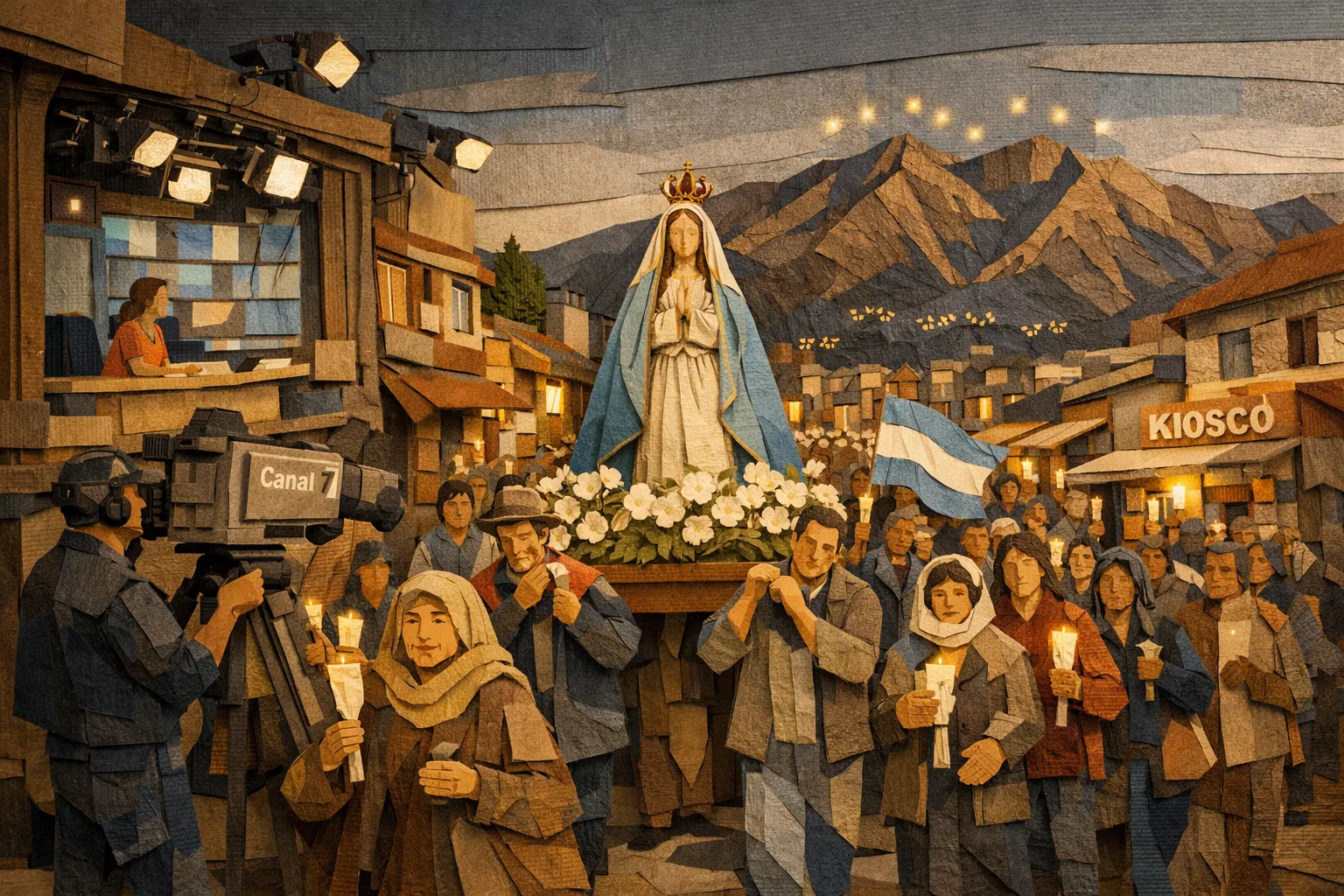
In September 1983, Gladys Quiroga de Motta, a housewife in San Nicolás de los Arroyos, said she began receiving appearances and messages from the Virgin Mary. Reports of unusually illuminated rosaries circulated locally, and an old statue of the Virgin was brought back into public devotion. The messages emphasised prayer, repentance, scripture and the construction of a sanctuary near the Paraná River.
The claims spread through personal testimony, printed messages, clergy involvement and repeated pilgrimage. Rather than suppressing the devotion, the local Catholic hierarchy supervised it. A large sanctuary was constructed, and San Nicolás became one of Argentina’s major Marian pilgrimage centres. In May 2016, Bishop Héctor Cardelli declared the reported apparitions “worthy of belief” and supernatural in character after a lengthy diocesan examination. This was a local ecclesiastical judgement: Catholic recognition permits devotion but does not require every Catholic to accept a private revelation as an article of faith.[ewtnnews.com]ewtnnews.comEWTN News A Marian apparition has been approved in ArgentinaEWTN News A Marian apparition has been approved in Argentina
San Nicolás is therefore not best described as a panic. It is a case of contagious religious enthusiasm becoming institutionalised. Yet it belongs within the history of collective belief because it shows how an extraordinary claim can move from one person’s testimony to a city-wide movement, alter the built environment and attract generations of pilgrims.
Its growth also reveals the importance of authority. Church supervision gave the devotion a framework, controlled publication of messages and distinguished approved material from later claims. This contrasts with rumours that circulate without a trusted institution capable of investigating or limiting them.
Cerro Uritorco: UFO belief, spiritual tourism and apocalypse
Cerro Uritorco, near Capilla del Monte in Córdoba province, has become Argentina’s best-known landscape of UFO and New Age belief. From the 1980s onwards, alleged sightings, mysterious lights and stories of an underground city called Erks attracted contactees, meditation groups, healers and curious tourists.
A central figure in the development of the Erks story was Ángel Cristo Acoglanis, who claimed contact with advanced beings and conducted nocturnal ceremonies in which lights were interpreted as signals from the hidden city. Later investigators proposed ordinary geographical or artificial explanations for some of the lights, but the narrative had already escaped any single witness. It became part of the cultural identity and tourist economy of Capilla del Monte.[Academia]academia.eduOpen source on academia.edu.
The town’s spiritual scene is diverse. Some visitors expect spacecraft; others speak of energy, meditation, nature or personal transformation. Many do not belong to a formal UFO religion at all. The belief system works less like a church with fixed doctrine and more like a shared imaginative landscape into which people place different hopes.
This is important because the label “UFO cult” can mislead. There have been organised groups with charismatic teachers, but much of the Uritorco phenomenon consists of tourism, informal spirituality and folklore. Its persistence does not depend on proof of extraterrestrial visitors. It survives because the mountain provides a place in which disillusionment with conventional religion, environmental feeling and the search for personal meaning can be combined.[AP News]apnews.comFormer Catholics like Pablo Robles, who turned away from the church after feeling disillusioned by its opulence and hypocrisy, now seek s…
The 2012 mass-suicide scare
The darker side of Uritorco’s reputation appeared in December 2012, amid worldwide rumours that the completion of a cycle in the Maya calendar predicted the end of civilisation. An anonymous Facebook invitation proposed a “spiritual” mass suicide on the mountain on 21 December. Around 150 people reportedly indicated interest online.
Local authorities and the mountain’s operators closed access for the date. No collective suicide occurred, and there was little evidence that the online respondents represented a committed group preparing to die. Nevertheless, the threat could not responsibly be ignored.[worldcrunch.com]worldcrunch.comOpen source on worldcrunch.com.
The episode illustrates a modern panic mechanism. An ambiguous online post generated visible numbers through Facebook responses; journalists publicised those numbers; authorities acted against a low-probability but potentially catastrophic risk; and the closure itself made the threat appear more credible. The official response was understandable, but the resulting attention may have enlarged what could otherwise have remained a marginal provocation.
It was therefore both a precaution and a scare. Calling it an attempted mass suicide would overstate the evidence. Calling it meaningless internet humour would understate the danger authorities had to assess.
The 2002 cattle mutilations and the chupacabra scare
During the first half of 2002, farmers across parts of the Pampas and surrounding provinces reported cattle found dead with missing tissue, especially around the mouth, eyes and reproductive organs. Stories quickly attributed the deaths to extraterrestrials, satanic rituals or the chupacabra, the livestock-killing creature already popular in Latin American folklore.
The timing mattered. Argentina was living through the aftermath of its 2001 economic collapse. Public trust in political and financial institutions was exceptionally low, and rural communities were confronting financial hardship. A mysterious threat attacking cattle—the basis of many livelihoods—offered a vivid symbol of insecurity.
Nearly 100 suspected mutilation cases were reported in La Pampa and Buenos Aires provinces between May and August, according to a later investigation. Argentina’s animal-health service concluded that scavenging animals, including foxes and small rodents, could account for the apparently precise removal of soft tissue from carcasses. Decomposition, drying and selective feeding can create wounds that look surgical to an observer who encounters the animal only after death.[amazonaws.com]centerforinquiry.s3.amazonaws.comOpen source on amazonaws.com.
The explanation did not satisfy everyone. Disputes over which scavenger species lived in particular locations, along with claims that carcasses lacked blood or decomposed unusually slowly, kept the story alive. Those details were readily incorporated into the extraterrestrial interpretation rather than treated as questions for veterinary examination.
The episode followed a familiar scare cycle:
- A genuinely unusual discovery was reported.
- Similar discoveries received heightened attention.
- Journalists linked separate cases into a national pattern.
- Familiar folklore supplied an agent—the chupacabra.
- Official explanations were interpreted through existing distrust.
- The reports declined once the media cycle moved on.
The cattle were real and the losses mattered. What remains unsupported is the leap from unusual carcass damage to a single hidden predator, satanic network or extraterrestrial operation.
When “sect” allegations concern documented harm
Moral panics should not be confused with investigations supported by testimony, financial records and evidence of specific offences. Argentina’s recent legal history includes organisations accused not merely of possessing unusual beliefs but of trafficking, exploitation or forced labour.
The Buenos Aires Yoga School
The Buenos Aires Yoga School operated for decades as a philosophical and spiritual organisation. In 2022, federal authorities carried out extensive raids and arrested members whom prosecutors accused of belonging to a criminal structure that used the school as a front. The prosecution alleged sexual exploitation, money laundering and an internal hierarchy centred on founder Juan Percowicz. Cash, property and documentary material were seized.[fiscales.gob.ar]fiscales.gob.arSecta de yoga de Villa Crespo: el secuestro de los bienesSecta de yoga de Villa Crespo: el secuestro de los bienes
The defendants and their supporters have disputed the accusations and argued that consenting adults and an unconventional community were being reinterpreted through anti-sect prejudice. The proceedings have also faced procedural disputes. In April 2026, the Federal Court of Cassation removed Judge Ariel Lijo from the case following challenges concerning impartiality, and a new judicial decision in May 2026 ordered the prosecution of three central defendants on trafficking allegations. The litigation therefore remains a developing criminal case rather than a settled historical verdict.[LA NACION]lanacion.com.arLA NACIONTrata: apartaron al juez Ariel Lijo de la causa de la EscuelaLA NACIONTrata: apartaron al juez Ariel Lijo de la causa de la Escuela
The case shows why precise language matters. “Yoga sect” is a media description, not a criminal charge. The relevant legal questions concern identifiable acts: whether people were recruited or maintained through coercion, whether exploitation occurred, how money moved and whether the alleged victims could exercise meaningful choice.
Opus Dei and allegations of domestic servitude
Argentine prosecutors have also investigated allegations by former female auxiliary numeraries of Opus Dei. The women said they were recruited as adolescents, often from poorer families, with promises of education and training, but were instead made to perform unpaid domestic work under strict religious discipline.
In 2024 prosecutors accused former regional authorities of trafficking and reduction to servitude; in 2025 the investigation was extended to Mariano Fazio, a senior international Opus Dei figure. Opus Dei has rejected the accusations and described the dispute as involving false claims and labour grievances. As with the Yoga School, these remain allegations to be determined through legal proceedings.[El País]elpais.comOpen source on elpais.com.
The significance of the case lies partly in its challenge to the popular image of a dangerous “cult” as necessarily small, exotic or outside mainstream religion. Coercion, when it occurs, is defined by conduct rather than theology or institutional size.
Why criminal law is safer than belief policing
Córdoba’s provincial Law 9891 created a programme for people affected by groups using psychological manipulation. National legislators have introduced similar proposals referring to coercive persuasion and group dependency. Such measures reflect legitimate concern for people emerging from controlling organisations.[cba.gov.ar]web2.cba.gov.arLegislación Provincial de Córdoba: Ley Número 9891ARTÍCULO 1º.- Créase el “Programa Provincial de Prevención y Asistencia a las Víctimas…
They also create a risk. Terms such as “psychological manipulation” can be difficult to define objectively and may be applied selectively to minority religions, political organisations or intense therapeutic communities. A more reliable approach is to focus on demonstrable harm: threats, fraud, sexual violence, confiscation of identity documents, forced labour, unlawful medication, confinement and financial exploitation.
Argentina’s Public Defender’s Office has increasingly discussed coercive organisations through the framework of trafficking and victim reparation. This moves attention away from whether beliefs seem bizarre and towards whether a person’s rights were violated.[Ministerio Público de la Defensa]mpd.gov.arreparacion en casos de sectas y trata de personasreparacion en casos de sectas y trata de personas

What these episodes have in common
Argentina’s apparition movements, UFO traditions, satanic scares and coercive-group investigations are not one phenomenon. Their shared feature is the social management of uncertainty.
A memorable story arrives before complete evidence. A mutilated animal, a visionary’s message or an anonymous Facebook invitation offers an immediate narrative while investigation moves slowly.
Existing fears shape interpretation. Economic collapse made mysterious livestock deaths more threatening. The global cult disasters of the late twentieth century made every closed spiritual group look potentially suicidal. Concern for children intensified claims involving satanism or ritual violence.
Media attention creates apparent frequency. Once journalists identify a pattern, previously isolated events are reported as connected examples. This does not require deliberate fabrication; heightened attention alone can create the impression of an expanding crisis.
Authority can calm or amplify belief. The Catholic Church absorbed the San Nicolás apparition into a controlled process of investigation and devotion. By contrast, dramatic police terminology or television coverage can make an alleged secret network appear proven before trial.
Real harm and exaggerated fear can coexist. A moral panic may unfairly stigmatise minority believers while genuine abuse occurs in some organisations. Recognising one possibility does not require denying the other.
How to read Argentine “cult” and panic stories critically
The most useful question is not whether a report sounds strange, but what kind of claim it makes.
A documented criminal case requires evidence of conduct and should be judged through records, testimony and due process. A reported miracle belongs to religious interpretation and cannot be established merely by the number of pilgrims. A mass psychogenic illness requires medical investigation that first excludes environmental or biological causes. A moral panic is identified not because every concern is imaginary, but because the public response becomes disproportionate, indiscriminate or organised around a stereotyped enemy.
Several warning signs deserve attention:
- Allegations are treated as established facts before charges or trial.
- Many unrelated groups are placed under one label.
- Belief itself is presented as proof of coercion.
- Anonymous testimony is repeated without corroboration.
- Ordinary explanations are dismissed because they appear insufficiently dramatic.
- Every contradiction becomes evidence that the conspiracy is more powerful.
- Children, sexuality or satanism are invoked to make doubt seem immoral.
Argentina’s experience suggests that neither automatic belief nor automatic scepticism is adequate. The cattle deaths of 2002 deserved veterinary investigation even though the chupacabra explanation lacked evidence. The Uritorco suicide post required precaution even though no organised death movement was demonstrated. Allegations against spiritual organisations deserve serious legal scrutiny without allowing the word “sect” to substitute for proof.
Why the stories still matter
These episodes reveal a country repeatedly negotiating the boundaries between inherited Catholic culture, expanding spiritual choice and fear of manipulation. San Nicolás shows how an extraordinary private claim can gain institutional legitimacy. Uritorco shows how folklore, commerce and personal spiritual search can sustain a belief without a central church. The 1990s sect scare and the chupacabra wave show how media narratives turn scattered events into an apparent national emergency.
The recent trafficking cases add a harder lesson. Public scepticism towards sensational “cult” stories should never become indifference to people describing coercion or exploitation. At the same time, concern for victims should not justify treating every unconventional religion as a criminal conspiracy.
Argentina’s most revealing collective-belief stories therefore sit in the uncomfortable space between credulity and dismissal. They endure because they are not merely tales of irrational people. They are accounts of how ordinary people seek meaning, explain danger, protect relatives, distrust authorities and decide whom to believe when the evidence is incomplete.
Amazon book picks
Further Reading
Books and field guides related to When Belief Became a Public Force in Argentina. Use these as the next step if you want deeper reading beyond the article.
The Demon-Haunted World
Explores why unusual beliefs and moral panics spread in modern societies.
Extraordinary Popular Delusions and the Madness of Crowds
Rating: 4.0/5 from 5 Google Books ratings
Provides historical context for collective belief and social contagion.

Combating cult mind control
Useful background for pages discussing sect scares and coercive groups.

Religion Explained
Helps explain the persistence of supernatural belief across cultures.
Endnotes
1.
Source: aacademica.org
Link:https://www.aacademica.org/of/9.pdf
Source snippet
El boom de las sectas en la Argentina de los '90by O Ferretti · 2017 — Según la explicación que daban los movimientos anticultos a los me...
2.
Source: scielo.br
Title: Sociedad y Religión, n. el debate sobre nuevos
Link:https://www.scielo.br/j/ha/a/TCLqPHknPdDc9HV66HrPG4t/?format=pdf&lang=es
Source snippet
SciELO“sectas satánicas” en el mercosur: un estudio deby A Frigerio · 1998 · Cited by 44 — “SECTAS SATÁNICAS” en 1992 tuvo amplia repercu...
3.
Source: conicet.gov.ar
Link:https://www.conicet.gov.ar/the-challenge-of-integrating-beliefs-cults-and-practices-in-argentina/
Source snippet
The challenge of integrating beliefs, cults and practices in...In this interview, Flores explains the complexity of the Argentine...
4.
Source: diputados.gov.ar
Link:https://www.diputados.gov.ar/comisiones/permanentes/cjusticia/proyecto.html?exp=6811-D-2014
Source snippet
proyecto de leyARTICULO 1°: Créase el PROGRAMA NACIONAL DE ASISTENCIA A VÍCTIMAS DE GRUPO-DEPENDENCIA, Y LÍDERES GRUPALES O UNIP...
5.
Source: web2.cba.gov.ar
Link:https://web2.cba.gov.ar/web/leyes.nsf/85a69a561f9ea43d03257234006a8594/b998b958247d2b4503257845004c2883
Source snippet
Legislación Provincial de Córdoba: Ley Número 9891ARTÍCULO 1º.- Créase el “Programa Provincial de Prevención y Asistencia a las Víctimas...
6.
Source: scispace.com
Title: sectas satanicas en el mercosur un estudio de la 2dgwkzqk35
Link:https://scispace.com/pdf/sectas-satanicas-en-el-mercosur-un-estudio-de-la-2dgwkzqk35.pdf
Source snippet
SciSpace“sectas satánicas” en el mercosur: un estudio de“SECTAS SATÁNICAS” en 1992 tuvo amplia repercusión en los medios de comunicación...
7.
Source: Wikipedia
Title: Our Lady of the Rosary of San Nicolás
Link:https://en.wikipedia.org/wiki/Our_Lady_of_the_Rosary_of_San_Nicol%C3%A1s
8.
Source: academia.edu
Link:https://www.academia.edu/99223999/A_Unique_Argentinian_Ufological_Guru_of_the_1980s_The_Case_of_%C3%81ngel_Cristo_Acoglanis_Mount_Uritorco_and_the_Underground_City_of_Erks
9.
Source: worldcrunch.com
Link:https://worldcrunch.com/culture-society/facebook-doomsday-suicide-group-raises-alarms-on-argentina039s-mystical-mountain/
10.
Source: centerforinquiry.s3.amazonaws.com
Link:https://centerforinquiry.s3.amazonaws.com/wp-content/uploads/sites/29/2006/03/22164613/p19.pdf
11.
Source: Wikipedia
Link:https://en.wikipedia.org/wiki/Chupacabra
12.
Source: fiscales.gob.ar
Title: Secta de yoga de Villa Crespo: el secuestro de los bienes
Link:https://www.fiscales.gob.ar/trata/secta-de-yoga-de-villa-crespo-el-secuestro-de-los-bienes-y-las-sumas-millonarias-incautadas-en-los-allanamientos/
13.
Source: mpf.gob.ar
Link:https://www.mpf.gob.ar/protex/envian-a-juicio-oral-a-17-personas-acusadas-de-asociacion-ilicita-trata-de-personas-y-lavado-de-activos-desde-la-escuela-de-yoga-de-buenos-aires/
14.
Source: lanacion.com.ar
Title: LA NACIONTrata: apartaron al juez Ariel Lijo de la causa de la Escuela
Link:https://www.lanacion.com.ar/seguridad/trata-apartaron-al-juez-ariel-lijo-de-la-causa-de-la-escuela-de-yoga-de-buenos-aires-nid16042026/
15.
Source: senado.gob.ar
Link:https://www.senado.gob.ar/parlamentario/parlamentaria/305776/downloadPdf
16.
Source: mpd.gov.ar
Title: reparacion en casos de sectas y trata de personas
Link:https://www.mpd.gov.ar/index.php/noticias-h/reparacion-en-casos-de-sectas-y-trata-de-personas
17.
Source: Wikipedia
Title: List of mass panic cases
Link:https://en.wikipedia.org/wiki/List_of_mass_panic_cases
18.
Source: Wikipedia
Title: Satanic panic
Link:https://en.wikipedia.org/wiki/Satanic_panic
19.
Source: Wikipedia
Title: List of moral panics
Link:https://en.wikipedia.org/wiki/List_of_moral_panics
20.
Source: Wikipedia
Link:https://en.wikipedia.org/wiki/Uritorco
21.
Source: Wikipedia
Title: Witchcraft in Latin America
Link:https://en.wikipedia.org/wiki/Witchcraft_in_Latin_America
22.
Source: Wikipedia
Title: UFO sightings in Argentina
Link:https://en.wikipedia.org/wiki/UFO_sightings_in_Argentina
23.
Source: Wikipedia
Title: 2012 phenomenon
Link:https://en.wikipedia.org/wiki/2012_phenomenon
24.
Source: academia.edu
Title: Pentecostalism Globalisation and Society in Contemporary Argentina
Link:https://www.academia.edu/6277464/Pentecostalism_Globalisation_and_Society_in_Contemporary_Argentina
25.
Source: academia.edu
Link:https://www.academia.edu/143851811/The_Witch_as_Indigenous_Race_and_Colonialism_in_the_Green_Tide_Feminist_Spirituality
26.
Source: academia.edu
Link:https://www.academia.edu/36287154/Alien_Sightings_and_OVNI_Culture_in_Argentina
27.
Source: history.com
Title: what was satanic panic 1980s
Link:https://www.history.com/articles/what-was-satanic-panic-1980s
28.
Source: intranet.hcdiputados-ba.gov.ar
Title: hcdiputados-ba.gov.ar Proyecto de Ley
Link:https://intranet.hcdiputados-ba.gov.ar/proyectos/12-13D3532012018-10-2310-27-00.pdf
29.
Source: facebook.com
Title: the satanic panic of the 1980s still echoes in the modern day which makes unders
Link:https://www.facebook.com/hotdocscinema/posts/the-satanic-panic-of-the-1980s-still-echoes-in-the-modern-day-which-makes-unders/705496991623254/
30.
Source: facebook.com
Link:https://www.facebook.com/SaintsOfToday.PH/posts/my-faith-news-pope-francis-recognizes-miracle-that-paves-way-for-first-argentini/645594437750771/
31.
Source: facebook.com
Title: in 1983 something extraordinary happened in the small city of san nicolás de los
Link:https://www.facebook.com/totustuusglobal/posts/in-1983-something-extraordinary-happened-in-the-small-city-of-san-nicol%C3%A1s-de-los/991424543261333/
32.
Source: facebook.com
Link:https://www.facebook.com/todonoticias/posts/las-organizaciones-coercitivas-se-extienden-cada-vez-m%C3%A1s-y-no-s%C3%B3lo-se-limitan-a-/1238372144316658/
33.
Source: apnews.com
Link:https://apnews.com/article/41f515711006553a12d57e8c64b4beac
Source snippet
Former Catholics like Pablo Robles, who turned away from the church after feeling disillusioned by its opulence and hypocrisy, now seek s...
34.
Source: ewtnnews.com
Title: EWTN News A Marian apparition has been approved in Argentina
Link:https://www.ewtnnews.com/world/americas/a-marian-apparition-has-been-approved-in-argentina-and-its-a-big-deal
35.
Source: telegraph.co.uk
Title: Mayan apocalypse Argentina closes mountain over mass suicide risk
Link:https://www.telegraph.co.uk/news/worldnews/southamerica/argentina/9756327/Mayan-apocalypse-Argentina-closes-mountain-over-mass-suicide-risk.html
36.
Source: skepticalinquirer.org
Link:https://skepticalinquirer.org/wp-content/uploads/sites/29/2019/03/SI-MA-06.pdf
37.
Source: elpais.com
Link:https://elpais.com/argentina/2025-07-03/la-justicia-argentina-acusa-al-vicario-auxiliar-del-opus-dei-de-trata-de-personas-y-reduccion-a-la-servidumbre.html
38.
Source: scielo.org.mx
Link:https://www.scielo.org.mx/scielo.php?pid=S1665-11462023000500320&script=sci_arttext
39.
Source: ebsco.com
Title: mass hysteria
Link:https://www.ebsco.com/research-starters/social-sciences-and-humanities/mass-hysteria
40.
Source: ufologie.patrickgross.org
Link:https://ufologie.patrickgross.org/htm/newspapers.htm
41.
Source: portal.amelica.org
Link:https://portal.amelica.org/ameli/journal/739/7394979004/html/
Additional References
42.
Source: youtube.com
Title: Capilla del Monte: The Argentine village that believes in UFOs
Link:https://www.youtube.com/watch?v=zq8On3H94xc
Source snippet
Leader of sect in Argentina serves house detention...
43.
Source: researchgate.net
Link:https://www.researchgate.net/publication/334156484The_geopolitics_of_moral_panic_The_influence_of_Argentinian_neo-conservatism_in_the_genesis_of_the_discourse_of%27gender_ideology%27
44.
Source: reddit.com
Link:https://www.reddit.com/r/argentina/comments/1i8mych/hay_ovnis_en_el_cerro_uritorco_%C3%B3_son_s%C3%B3lo/?tl=en
45.
Source: inexplicata.blogspot.com
Link:https://inexplicata.blogspot.com/2014/09/cattle-mutilations-i-see-dead-cows.html
46.
Source: reuters.com
Link:https://www.reuters.com/article/lifestyle/celebrations-in-mexico-as-world-survives-maya-end-of-days-idUSBRE8BJ164/
47.
Source: inexplicata.blogspot.com
Link:https://inexplicata.blogspot.com/2014/07/cryptozoology-megatherium-theory.html
48.
Source: reddit.com
Link:https://www.reddit.com/r/asklatinamerica/comments/131fwpc/did_your_country_experienced_the_satanic_panic/
49.
Source: instagram.com
Link:https://www.instagram.com/p/DN_YRt9EgAD/
50.
Source: instagram.com
Link:https://www.instagram.com/reel/DUECvOzD8wr/
51.
Source: fieldepidemiology.org
Link:https://fieldepidemiology.org/index.php/ajfe/article/download/7807/6435/21437
Topic Tree
Follow this branch
Related pages 192
- Antigua and Barbuda
- Azerbaijan Belief
- Bahrain Beliefs
- North Korea
- Bosnia and Herzegovina
- +187 more in sidebar