Within Palau Beliefs
What Did Modekngei Followers Actually Believe?
Modekngei blended Christian ideas with Palauan spiritual traditions and preserved its teachings through sacred songs and communal worship.
On this page
- Revelation and the movement's founders
- Sacred songs, healing and divine beings
- Why religious blending mattered under colonial rule
Page outline Jump by section
Introduction
Modekngei emerged on Babeldaob around 1914, just as Palau entered a new phase of Japanese colonial rule. Although outsiders often described it as a political movement or an anti-colonial sect, its followers understood it first and foremost as a religion. Its distinctive feature was the way it combined Christian teaching with long-established Palauan ideas about spiritual beings, healing, ritual authority and community life. Rather than abandoning older traditions, Modekngei reinterpreted them through a new religious framework centred on revelation, sacred songs and inspired leaders. This blending allowed Palauans to preserve spiritual knowledge during a period of rapid cultural change while presenting it in a form that many believers saw as compatible with Christianity. Modern scholarship increasingly emphasises this religious dimension rather than reducing the movement to political protest alone.[researchgate.net]researchgate.netResearch Gate Modekngei: A New Religion in Belau, Micronesia (reviewModekngei: A New Religion in Belau, Micronesia (review)September 1, 2003…
What did Modekngei followers actually believe?
Revelation and the movement’s founders
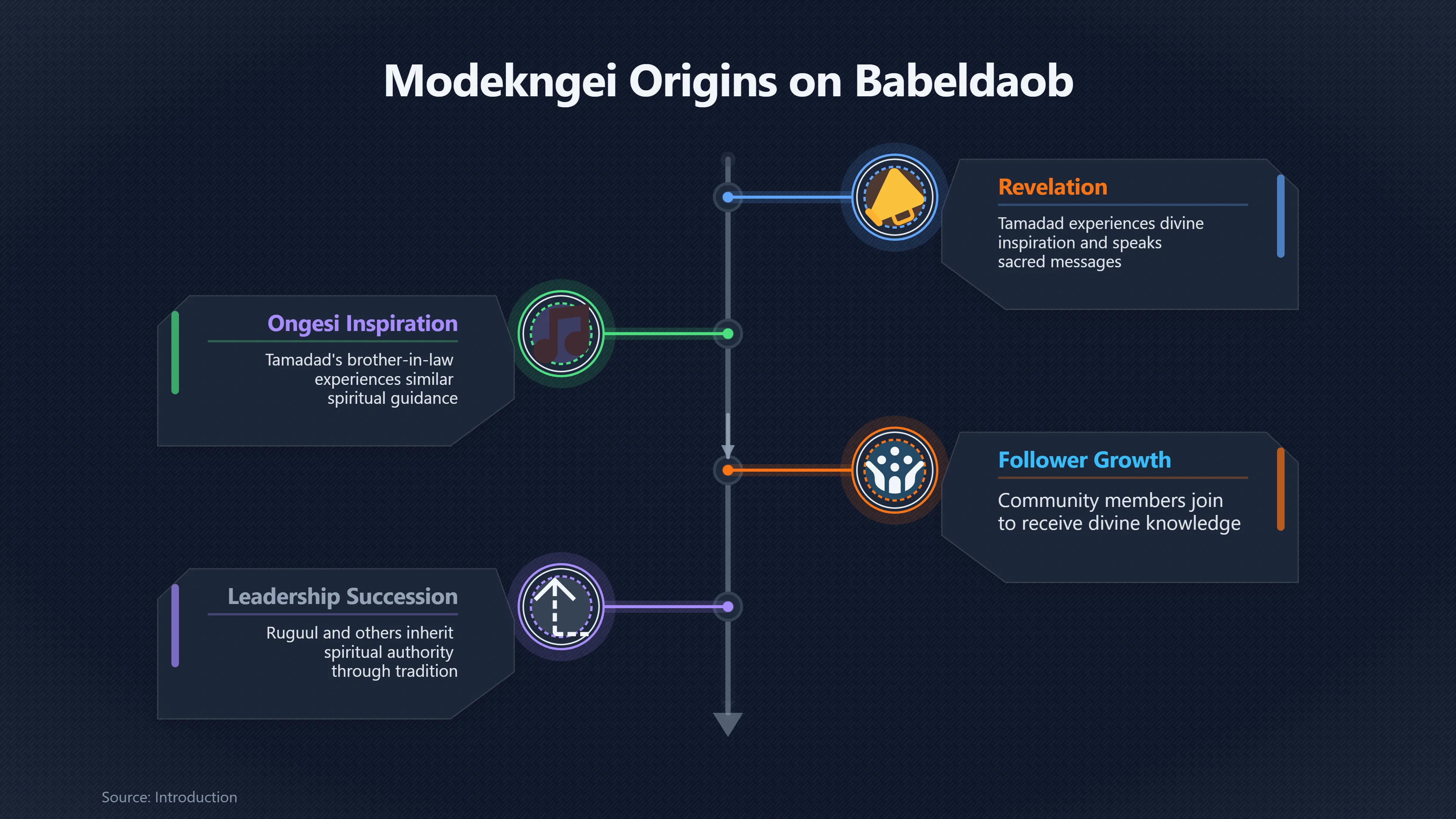
According to Modekngei tradition, the movement began when Tamadad, a ritual specialist from Chol on Babeldaob, experienced a divine revelation in 1914. Contemporary ethnographic accounts describe him entering inspired states in which he spoke loudly, sang religious songs and delivered messages believed to come from a supernatural source. Within a short time his brother-in-law Ongesi experienced similar inspiration, and together they attracted followers who regarded them as people chosen to communicate divine knowledge. Later leaders, including Ruguul, inherited spiritual authority through the movement’s traditions rather than through a formal priesthood.[nii.ac.jp]minpaku.repo.nii.ac.jpMinpaku Repository SER no.087;Minpaku RepositorySER no.087; IntroductionJune 2, 2026…
Their authority rested on more than personal charisma. Followers believed that inspired individuals could receive guidance about illness, moral conduct and the future. Healing with medicinal plants, identifying spiritual causes of misfortune and declaring temporary food taboos all formed part of this authority. Such practices drew on older Palauan understandings of ritual specialists while placing them within a new religious vision that also acknowledged the Christian God and Jesus Christ.[nii.ac.jp]minpaku.repo.nii.ac.jpMinpaku Repository SER no.087;Minpaku RepositorySER no.087; IntroductionJune 2, 2026…
Modern researchers caution against viewing these revelations simply as evidence of irrational belief or mass enthusiasm. Machiko Aoyagi’s long-term fieldwork suggests that followers developed a coherent theology that explained divine beings, morality and healing, rather than merely reacting emotionally to colonial disruption.[ResearchGate]researchgate.netResearch Gate Modekngei: A New Religion in Belau, Micronesia (reviewModekngei: A New Religion in Belau, Micronesia (review)September 1, 2003…
How did sacred songs preserve religious teaching?
Unlike many Christian churches, early Modekngei relied far less on written scripture than on an extensive tradition of sacred songs, known as kesekes. These hymns became the movement’s principal way of preserving religious knowledge. They were performed collectively during worship, allowing teachings to be remembered, transmitted and interpreted within the community rather than through printed texts.[researchgate.net]researchgate.netResearch Gate Modekngei: A New Religion in Belau, Micronesia (reviewModekngei: A New Religion in Belau, Micronesia (review)September 1, 2003…
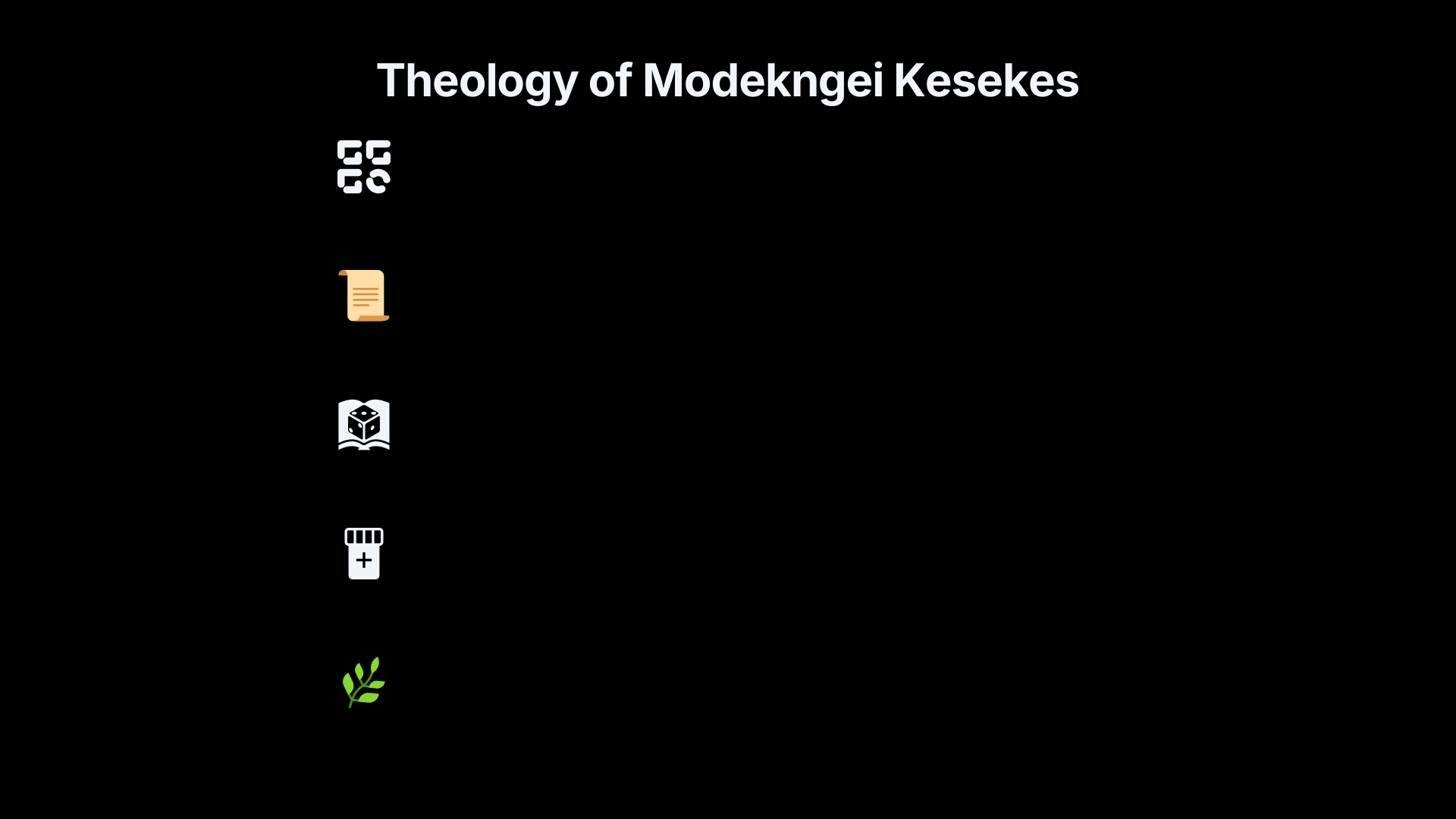
Aoyagi’s analysis of 128 surviving songs demonstrates that they contain far more than simple devotional lyrics. Together they present a complex religious world including:
- the Christian God and Jesus alongside indigenous spiritual beings;
- accounts of revelation received by the founders;
- moral instruction about proper conduct;
- prayers for healing and protection;
- explanations of illness and spiritual power; and
- descriptions of relationships between humans and numerous divine beings.[ResearchGate]researchgate.netResearch Gate Modekngei: A New Religion in Belau, Micronesia (reviewModekngei: A New Religion in Belau, Micronesia (review)September 1, 2003…
Because these teachings were sung rather than written, they remained flexible enough to incorporate older Palauan traditions while also absorbing Christian language introduced by missionaries. The songs therefore acted as both worship and an oral theological library, preserving beliefs that might otherwise have disappeared during colonial rule. Scholars regard this oral tradition as one of the richest surviving sources for understanding Modekngei’s cosmology and religious ideas.[ResearchGate]researchgate.netResearch Gate Modekngei: A New Religion in Belau, Micronesia (reviewModekngei: A New Religion in Belau, Micronesia (review)September 1, 2003…
How did healing and spiritual authority work?
Healing occupied a central place in Modekngei religious life. Followers believed that physical illness, spiritual imbalance and moral behaviour were interconnected. Religious leaders used traditional herbal medicine alongside prayer, ritual and inspired guidance, reflecting the belief that divine beings could reveal both the causes of sickness and appropriate remedies.[Minpaku Repository]minpaku.repo.nii.ac.jpMinpaku Repository SER no.087;Minpaku RepositorySER no.087; IntroductionJune 2, 2026…
Stories of successful healing strengthened confidence in the movement’s leaders. Such accounts circulated within communities as evidence that divine authority continued to operate through inspired individuals. Although these testimonies cannot be verified in the way modern clinical medicine would require, they played an important role in establishing religious legitimacy among believers. Researchers therefore treat them primarily as evidence of how authority functioned inside the movement rather than as proof of supernatural intervention.[Kagoshima University Repository]ir.kagoshima-u.ac.jpKagoshima University RepositoryKagoshima Univ. Res. Center S. Pac, Occasional Papers, No. 30, 137-138, 1996…
Modekngei authority also depended on communal participation. Worship, singing, ritual observance and respect for elders reinforced the idea that revelation belonged to the religious community rather than to isolated individuals. Spiritual leadership therefore combined inherited Palauan concepts of respected ritual specialists with newer forms of organised congregational worship.[Wikipedia]WikipediaOpen source on wikipedia.org.
Why did religious blending matter under colonial rule?
The blending of Christian and indigenous beliefs was not simply a theological compromise. It offered many Palauans a way to remain culturally Palauan while living under successive colonial administrations that introduced new religions, schools and social expectations. Instead of rejecting Christianity outright, Modekngei incorporated Christian figures into an existing spiritual landscape, allowing continuity with ancestral traditions while adapting to a changing world.[researchgate.net]researchgate.netResearch Gate Modekngei: A New Religion in Belau, Micronesia (reviewModekngei: A New Religion in Belau, Micronesia (review)September 1, 2003…
This syncretic approach also explains why outside observers often misunderstood the movement. Colonial officials tended to focus on its independent leadership and growing influence, while missionaries sometimes viewed its retention of indigenous spiritual beings as incompatible with orthodox Christianity. More recent scholarship argues that these outside interpretations overlooked the movement’s internally consistent theology and exaggerated its political character during its earliest years.[researchgate.net]researchgate.netResearch Gate Modekngei: A New Religion in Belau, Micronesia (reviewModekngei: A New Religion in Belau, Micronesia (review)September 1, 2003…
Why Modekngei remains culturally important
Modekngei endures because its religious life has always been rooted in more than doctrine alone. Sacred songs, healing practices, communal worship and respect for inspired leaders created a living tradition that linked faith with Palauan identity. The movement’s continued presence in villages such as Ibobang, together with institutions established to pass its teachings to younger generations, reflects an enduring effort to preserve indigenous culture alongside Christian belief rather than choosing between them.[wikipedia.org]WikipediaOpen source on wikipedia.org.
For historians of religion, Modekngei illustrates how new religious movements can emerge through cultural adaptation rather than rejection. Its songs, theology and forms of spiritual authority demonstrate that colonial-era religious change in Palau was not simply a replacement of one belief system by another, but an ongoing process of reinterpretation in which local traditions remained active participants in shaping religious life.[researchgate.net]researchgate.netResearch Gate Modekngei: A New Religion in Belau, Micronesia (reviewModekngei: A New Religion in Belau, Micronesia (review)September 1, 2003…

Amazon book picks
Further Reading
Books and field guides related to What Did Modekngei Followers Actually Believe?. Use these as the next step if you want deeper reading beyond the article.
The Demon-Haunted World
Provides an evidence-focused perspective on extraordinary beliefs.
The Varieties of Religious Experience
Explores revelation, belief and spiritual experience.

The anthropology of religion, magic, and witchcraft
Directly supports understanding of syncretic religious belief.
Endnotes
1.
Source: researchgate.net
Title: Research Gate Modekngei: A New Religion in Belau, Micronesia (review)
Link:https://www.researchgate.net/publication/247827772_Modekngei_A_New_Religion_in_Belau_Micronesia_review
Source snippet
Modekngei: A New Religion in Belau, Micronesia (review)September 1, 2003...
Published: September 1, 2003
2.
Source: Wikipedia
Link:https://en.wikipedia.org/wiki/Modekngei
3.
Source: proquest.com
Title: Pro Quest Modekngei: A New Religion in Belau, Micronesia
Link:https://www.proquest.com/scholarly-journals/modekngei-new-religion-belau-micronesia/docview/201679283/se-2
Source snippet
Modekngei: A New Religion in Belau, Micronesia - ProQuest...
4.
Source: worldatlas.com
Title: World Atlas Religious Beliefs In Palau
Link:https://www.worldatlas.com/articles/religious-beliefs-in-palau.html
5.
Source: researchgate.net
Link:https://www.researchgate.net/publication/329104946_Globalization_and_Tradition_in_Palau_Case_Study_of_the_Syncretic_Omengat_First_Child_Birth_and_Ngasech_Ceremonies
6.
Source: youtube.com
Link:https://www.youtube.com/watch?v=XJSbtydSiAo
Source snippet
Modekngei | Wikipedia audio article...
7.
Source: youtube.com
Title: Modekngei | Wikipedia audio article
Link:https://www.youtube.com/watch?v=SG6YRFc_dWw
Source snippet
Belau Modekngei School - Talk Show (6/19/17)...
8.
Source: minpaku.repo.nii.ac.jp
Title: Minpaku Repository国立民族学博物館学術情報リポジトリ(みんぱくリポジトリ)
Link:https://minpaku.repo.nii.ac.jp/records/3266
9.
Source: minpaku.repo.nii.ac.jp
Title: Minpaku Repository SER no.087;
Link:https://minpaku.repo.nii.ac.jp/record/1115/files/SER87_001.pdf
Source snippet
Minpaku RepositorySER no.087; IntroductionJune 2, 2026...
Published: June 2, 2026
10.
Source: ir.kagoshima-u.ac.jp
Link:https://ir.kagoshima-u.ac.jp/record/8314/files/AN1013531X_v30_p137-138.pdf
Source snippet
Kagoshima University RepositoryKagoshima Univ. Res. Center S. Pac, Occasional Papers, No. 30, 137-138, 1996...
11.
Source: encyclopedia.com
Title: Palau | Encyclopedia.com
Link:https://www.encyclopedia.com/places/australia-and-oceania/pacific-islands-political-geography/palau
12.
Source: worlddata.info
Link:https://www.worlddata.info/religions/modekngei.php
13.
Source: religion.fandom.com
Link:https://religion.fandom.com/wiki/Modekngei
Additional References
14.
Source: jarniascyril.com
Title: Understanding Religious Practices in Palau for Expats: Integration and Respect
Link:https://www.jarniascyril.com/expatriation/moving-to-palau-as-an-expat-complete-guide/religious-practices-palau-expats-guide-integration/
Source snippet
April 23, 2026 — LIVING YOUR FAITH FAR FROM HOME: UNDERSTANDING LOCAL RELIGIOUS PRACTICES WHEN SETTLING IN PALAU Image: Living Your Faith...
Published: April 23, 2026
15.
Source: handwiki.org
Link:https://handwiki.org/wiki/Religion%3AModekngei
Source snippet
February 19, 2026 — RELIGION:MODEKNGEI From HandWiki [Input] Modekngei, or Ngara Modekngei (English: United Sect), is a monotheis...
Published: February 19, 2026
16.
Source: pulotu.com
Link:https://pulotu.com/culture/palau
17.
Source: theworldofinfo.com
Link:https://theworldofinfo.com/palau/religion/
18.
Source: oocities.org
Link:https://www.oocities.org/southbeach/palms/6757/modekngei.html
19.
Source: youtube.com
Title: Belau Modekngei School
Link:https://www.youtube.com/watch?v=QjNpWL2oNvA
Source snippet
50th Anniversary Celebration...
20.
Source: youtube.com
Link:https://www.youtube.com/watch?v=EV-CwZsRUTU
Source snippet
Vitarelli - Modekngei (Part 3)...
21.
Source: irci.jp
Link:https://www.irci.jp/rdb/ich/item?Search=&property%5B0%5D%5Bproperty%5D=817&property%5B0%5D%5Btext%5D=Aoyagi%2C+Machiko&property%5B0%5D%5Btype%5D=eq
22.
Source: irci.jp
Link:https://www.irci.jp/rdb/item?page=19&property%5B0%5D%5Bjoiner%5D=and&property%5B0%5D%5Bproperty%5D=1640&property%5B0%5D%5Btext%5D=Identification&property%5B0%5D%5Btype%5D=eq&sort_by=created&sort_order=desc
23.
Source: studyguides.com
Link:https://studyguides.com/study-methods/study-guide/cmkyhty2im23301d5tghydtow
Topic Tree