Within South Africa
Why Satanism Became a National Moral Panic
South Africa's Satanic panic linked youth culture and crime to imagined occult networks during the upheaval of political transition.
On this page
- The rise of the Satanism scare
- Churches, newspapers and police
- Political transition and the policing of youth
Page outline Jump by section
Introduction
During the final years of apartheid, South Africa experienced a distinctive form of the international Satanic panic. Between the late 1980s and the mid-1990s, fears about Satanism, hidden cults and ritual crime spread through conservative churches, sections of the media and parts of the police. Real anxieties about rising crime, family change and political uncertainty were increasingly interpreted through a supernatural lens. Ordinary youth culture—from heavy metal music to role-playing games and black clothing—could be presented as evidence of recruitment into organised Satanic networks, while some violent crimes were publicly framed as signs of occult conspiracies before conventional criminal investigations were complete.[Wikipedia]WikipediaSatanic panic (South AfricaSatanic panic (South Africa
Unlike in many other countries, these fears became partly institutionalised through the creation of a specialised police unit devoted to occult-related crime. Historians and media scholars now generally interpret the episode as a moral panic: a period in which genuine social anxieties were channelled into exaggerated beliefs about an organised Satanic threat, despite the lack of evidence for nationwide conspiracies.[wikipedia.org]WikipediaSatanic panic (South AfricaSatanic panic (South Africa
Why Satanism Became a National Moral Panic
South Africa’s Satanic panic cannot be understood simply as an imported American phenomenon. It arrived during a period when apartheid was collapsing, political violence was widespread and many white South Africans felt that the social order they had known was disintegrating. Conservative Christian churches, already influential within many Afrikaans communities, often interpreted these rapid changes as evidence of a wider spiritual battle between Christianity and evil.[Polity.org.za]polity.org.zaWorrier State: Risk, anxiety and moral panic in South Africa – Nicky FalkofWorrier State: Risk, anxiety and moral panic in South Africa – Nicky Falkof
The panic therefore attached itself to existing fears:
- growing violent crime and sensational murders;
- uncertainty over political transition;
- concerns about changing youth culture;
- the spread of international popular culture through music, films and games;
- evangelical teachings that stressed literal spiritual warfare against Satan.
Rather than seeing these developments as separate social problems, many campaigners argued that they formed parts of a coordinated Satanic campaign aimed at corrupting young people and weakening Christian society. Scholars note that this narrative offered a simple explanation for a much more complicated period of national upheaval.[polity.org.za]polity.org.zaWorrier State: Risk, anxiety and moral panic in South Africa – Nicky FalkofWorrier State: Risk, anxiety and moral panic in South Africa – Nicky Falkof
The Rise of the Satanism Scare
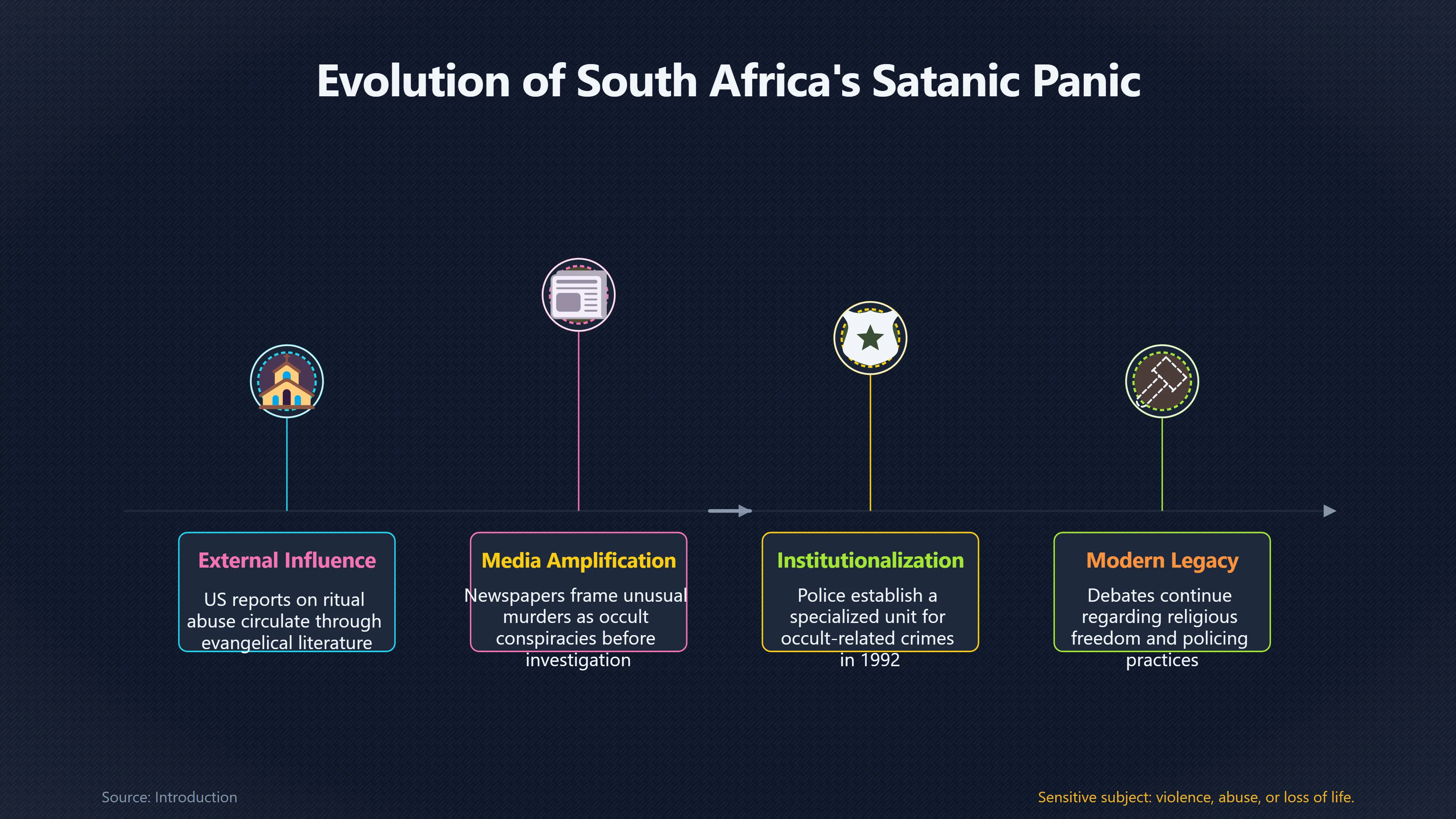
Although isolated fears about occult practices had appeared earlier, concern accelerated during the late 1980s. Reports from the United States about alleged Satanic ritual abuse, recovered memories and secret cults circulated widely through evangelical literature and conferences. These ideas blended with local religious traditions and media reporting, creating a distinctly South African version of the panic.[Wikipedia]WikipediaSatanic panic (South AfricaSatanic panic (South Africa
Common warning signs promoted by churches and campaigners included:
- heavy metal music and certain rock performers;
- fantasy role-playing games such as Dungeons & Dragons;
- horror films and occult fiction;
- black clothing, unusual jewellery and inverted crosses;
- experimentation with alternative spiritual beliefs.
Many of these supposed indicators had little or no proven connection with organised criminal activity. Nevertheless, they became familiar themes in church seminars, newspaper reports and educational talks aimed at parents and schools. Later commentators have noted that ordinary adolescent experimentation was often interpreted through a framework that assumed hidden Satanic influence.[wikipedia.org]WikipediaSatanic panic (South AfricaSatanic panic (South Africa
Churches, Newspapers and Police
Religious organisations played a central role in spreading concern. Evangelical speakers organised public lectures on Satanism, pastors warned congregations about hidden occult symbols, and Christian publications circulated lists of supposedly dangerous cultural products. The language of spiritual warfare resonated with communities already anxious about violence and uncertainty.[Polity.org.za]polity.org.zaWorrier State: Risk, anxiety and moral panic in South Africa – Nicky FalkofWorrier State: Risk, anxiety and moral panic in South Africa – Nicky Falkof
Some newspapers amplified these fears by treating unusual murders or youth subcultures as evidence of organised Satanic activity. Sensational headlines often appeared before investigators had established ordinary criminal motives, reinforcing the impression that occult crime was becoming widespread. Later academic work argues that media coverage helped transform isolated incidents into proof of a much larger imagined conspiracy.[Polity.org.za]polity.org.zaWorrier State: Risk, anxiety and moral panic in South Africa – Nicky FalkofWorrier State: Risk, anxiety and moral panic in South Africa – Nicky Falkof
The most unusual institutional response came from the state. In 1992, during apartheid’s final years, the South African Police established the Occult Related Crimes Unit under detective Kobus Jonker, with the support of Law and Order Minister Adriaan Vlok. The unit investigated crimes believed to have occult elements and became internationally known because few other police services maintained a comparable specialist organisation.[wikipedia.org]WikipediaSatanic panic (South AfricaSatanic panic (South Africa
Political Transition and the Policing of Youth
The timing of the panic was significant. South Africa was not merely experiencing a change in popular culture but undergoing one of the largest political transformations in its history. As apartheid weakened, traditional sources of authority—government, churches, schools and families—were themselves under strain.
Within this atmosphere, concerns about teenagers often became symbolic concerns about society as a whole. Youth who adopted alternative fashions or musical tastes could be portrayed as rejecting Christian civilisation rather than simply participating in global cultural trends. Scholars argue that fears about Satanism frequently became a way of expressing broader anxieties about losing social control during political transition.[Polity.org.za]polity.org.zaWorrier State: Risk, anxiety and moral panic in South Africa – Nicky FalkofWorrier State: Risk, anxiety and moral panic in South Africa – Nicky Falkof
This dynamic particularly affected white middle-class communities. While political negotiations, sanctions, economic uncertainty and violence dominated national life, the Satanism narrative redirected attention towards hidden internal enemies rather than structural social change. Instead of explaining crime through poverty, political conflict or ordinary criminal behaviour, some commentators attributed it to organised occult forces.[Polity.org.za]polity.org.zaWorrier State: Risk, anxiety and moral panic in South Africa – Nicky FalkofWorrier State: Risk, anxiety and moral panic in South Africa – Nicky Falkof
Did the Evidence Match the Claims?
Subsequent research has found little evidence for the vast, organised Satanic networks that many campaigners described. Individual offenders occasionally adopted Satanic imagery or claimed occult motivations, but this differed sharply from allegations of coordinated nationwide conspiracies involving ritual murder or systematic recruitment of children.[Wikipedia]WikipediaSatanic panic (South AfricaSatanic panic (South Africa
This distinction is important. South Africa has experienced genuine violent crimes involving religious symbolism, occult beliefs or ritual practices, just as many countries have. Those cases should not be confused with the broader moral panic, in which isolated incidents were interpreted as proof of a hidden nationwide movement.
Anthropologists and criminologists have also stressed the need to distinguish between:
- crimes committed for conventional motives but later described as “Satanic”;
- genuine religious movements, including minority faiths such as modern Paganism or contemporary Satanism, whose beliefs are not inherently criminal;
- beliefs about witchcraft in different South African cultural traditions;
- unsupported claims about secret conspiracies controlling society.[Wikipedia]WikipediaSatanic panic (South AfricaSatanic panic (South Africa
Why the Panic Still Matters
Although the most intense period passed after the mid-1990s, elements of the panic continued into democratic South Africa. Public debates periodically revived claims about Satanic influence in schools, music, gaming and violent crime, while the legacy of the Occult Related Crimes Unit remained controversial among legal scholars, anthropologists and advocates for religious freedom.[Wikipedia]WikipediaSatanic panic (South AfricaSatanic panic (South Africa
For historians of South Africa, the episode illustrates how moral panics flourish during periods of profound uncertainty. The fears surrounding Satanism reflected genuine concerns about crime, family life and rapid political transformation, but they channelled those concerns into narratives that greatly exaggerated the scale of organised occult activity.
The Satanic panic therefore stands as an important example of how collective fear can reshape public debate, influence policing and affect minority religious groups even when the central conspiracy claims remain unsupported. It also reminds readers that societies undergoing rapid political change often seek simple explanations for complex and unsettling realities.[polity.org.za]polity.org.zaWorrier State: Risk, anxiety and moral panic in South Africa – Nicky FalkofWorrier State: Risk, anxiety and moral panic in South Africa – Nicky Falkof
Amazon book picks
Further Reading
Books and field guides related to Why Satanism Became a National Moral Panic. Use these as the next step if you want deeper reading beyond the article.
The Demon-Haunted World
Offers a broader framework for understanding how unsupported conspiracy claims and supernatural fears gain public traction.
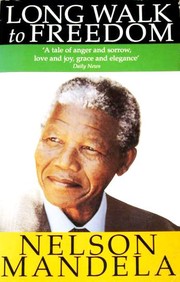
Long Walk to Freedom
Helps readers understand the political transformation during which the moral panic developed.
Satanic panic
Explains the wider international Satanic panic that influenced South African fears.
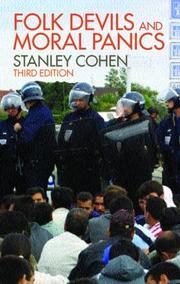
Folk devils and moral panics
The foundational work for understanding moral panics, the main interpretive framework for this topic.
Endnotes
1.
Source: Wikipedia
Title: Satanic panic (South Africa)
Link:https://en.wikipedia.org/wiki/Satanic_panic_%28South_Africa%29
2.
Source: polity.org.za
Title: Worrier State: Risk, anxiety and moral panic in South Africa – Nicky Falkof
Link:https://www.polity.org.za/article/worrier-state-risk-anxiety-and-moral-panic-in-south-africa-nicky-falkof
3.
Source: researchgate.net
Link:https://www.researchgate.net/publication/378739628_South_Africa%27s_Occult_Crimes_Unit_How_Apartheid_shaped_South_African_attitudes_toward_Paganism_and_the_Occult
4.
Source: vice.com
Title: The Rise, Fall, and Resurrection of South Africa’s Anti-Occult Police Unit
Link:https://www.vice.com/en/article/satanic-panic-the-history-of-south-africas-specialised-anti-occult-police-unit-394/
Source snippet
The Rise, Fall, and Resurrection of South Africa's Anti-Occult Police Unit...
5.
Source: polity.org.za
Link:https://www.polity.org.za/article/the-devil-made-me-do-it-understanding-occult-crime-in-south-africa-nicky-falkof
Source snippet
September 29, 2025 — THE DEVIL MADE ME DO IT: UNDERSTANDING OCCULT CRIME IN SOUTH AFRICA – NICKY FALKOF Image To play this media please e...
Published: September 29, 2025
6.
Source: polity.org.za
Title: The Devil Made Me Do It
Link:https://polity.org.za/article/extract-the-devil-made-me-do-it-by-nicky-falkof
Source snippet
When we talk about occult crime, are we speaking about crimes perpetrated by people who believe they are under the influence o...
7.
Source: researchgate.net
Link:https://www.researchgate.net/publication/390261335_Petrus-Roelofse-Phillips-Maritz_Acta_Criminologica_Southern_African_Journal_of_Criminology_3122018_168_RETHINKING_OCCULTISM_AND_CRIME_SATANISM_THE_OCCULT_AND_YOUTH_GANG_SUBCULTURES_IN_THE_GLOBAL_AND_S
8.
Source: vice.com
Title: Satanic Panic: The History of South Africa’s Specialised Anti-Occult Police Unit
Link:https://www.vice.com/da/article/satanic-panic-the-history-of-south-africas-specialised-anti-occult-police-unit-394/
9.
Source: researchgate.net
Title: (PDF) ‘Satan has come to Rietfontein’: Race in South Africa’s Satanic Panic
Link:https://www.researchgate.net/publication/262961669_%27Satan_has_come_to_Rietfontein%27_Race_in_South_Africa%27s_Satanic_Panic
10.
Source: researchgate.net
Link:https://www.researchgate.net/publication/260097720_%27No_less_a_foe_than_Satan_himself%27_The_Devil_Transition_and_Moral_Panic_in_White_South_Africa
11.
Source: researchgate.net
Link:https://www.researchgate.net/publication/404729130_Apartheid%27s_demons_Satanism_and_moral_panic_in_South_Africa
Additional References
12.
Source: ucl.ac.uk
Link:https://www.ucl.ac.uk/institute-of-advanced-studies/events/2026/apr/devil-made-me-do-it-understanding-occult-crime-south-africa
Source snippet
University College LondonApril 20, 2026 — * * * * # The Devil Made Me Do It: Understanding Occult Crime in South Africa 20 April 20...
Published: April 20, 2026
13.
Source: themediaonline.co.za
Title: Satanic panic: 5 ‘occult’ crimes that gripped South Africa’s imagination
Link:https://themediaonline.co.za/2025/10/satanic-panic-5-occult-crimes-that-gripped-south-africas-imagination/
Source snippet
THE MISSING MURDERED BABIES (1991) In the early 1990s, during the last years of apartheid’s white-minority rule, white South African soci...
14.
Source: ewn.co.za
Title: Satanic panic: 5 ‘occult’ crimes that gripped South Africa’s imagination
Link:https://www.ewn.co.za/2025/09/15/satanic-panic-5-occult-crimes-that-gripped-south-africa-s-imagination
Source snippet
September 15, 2025 — SATANIC PANIC: 5 ‘OCCULT’ CRIMES THAT GRIPPED SOUTH AFRICA’S IMAGINATION Topic Timeline CM Celeste Martin 15 Septemb...
Published: September 15, 2025
15.
Source: youtube.com
Title: Devilsdorp | Official Trailer | Showmax Local True-Crime Documentary
Link:https://www.youtube.com/watch?v=MJRwOVAuXoU
Source snippet
A Book Discussion on Worrier State: Risk, Anxiety and Moral Panic in South Africa with Nicky Falkof This video is highly relevant because...
16.
Source: youtube.com
Title: Johan de Beer unpacks the satanism issue in SA schools
Link:https://www.youtube.com/watch?v=W4jdWlGAEdA
Source snippet
Devilsdorp | Official Trailer | Showmax Local True-Crime Documentary...
17.
Source: youtube.com
Link:https://www.youtube.com/watch?v=U8nH-qnczQA
Source snippet
Occult and satanic practices...
18.
Source: africabib.org
Link:https://africabib.org/rec.php?DB=p&RID=369414675
19.
Source: brill.com
Link:https://brill.com/display/book/edcoll/9789004382022/BP000009.pdf
20.
Source: cambridge.org
Link:https://www.cambridge.org/core/journals/comparative-studies-in-society-and-history/article/abs/mens-daemonica-guilt-justice-and-the-occult-in-south-africa/AA98838880A1A438037EDB4D179F5B5D
21.
Source: open.uct.ac.za
Link:https://open.uct.ac.za/items/b81465ef-b04c-439f-9d43-66b69cd762e8/full
Topic Tree